Buying committee and the B2B buying journey
A B2B purchase is decided by a group of people with different roles, who work through a set of buying tasks in no fixed order, and a seller wins by serving the whole group.
A buying committee is the group of people inside a company who together decide a business purchase. Academic research has called it the buying center since 1972, and it has five roles: users, influencers, gatekeepers, buyers and deciders. The B2B buying journey is the set of tasks the group completes, which buyers revisit in no fixed order. Sellers map both.
- Origin
- Frederick Webster Jr. and Yoram Wind (buying center); Gartner (six buying jobs), 1972; Gartner model from about 2018
- Level
- 401 · Expert
- Fits
- Scale-up, Enterprise
- Time to apply
- 60 minutes to map one live deal, then 15 minutes a week
- What you need
- one live deal or one named target account · your notes from the calls so far, with every name that has appeared · a seller or manager who will mark guesses as guesses
A buying committee is the group of people who together decide a business purchase. The B2B buying journey is the work that group does on the way: defining the problem, comparing options, checking risks and agreeing among themselves. Academics studied the group from 1967 on, and Gartner described the journey around 2018.
Harvard Business Review’s 2017 article by Toman, Adamson and Gomez describes B2B customers facing “a swelling raft of stakeholders involved in each purchase”. The frameworks below give you names for those people and for the tasks they perform.
Where the idea comes from
The buying committee goes back to Webster and Wind’s 1972 paper, published in the Journal of Marketing, volume 36, issue 2, pages 12 to 19 (April 1972). They defined the buying center as all members of the organization involved in the buying process, and they listed five roles. The paper cites Robinson, Faris and Wind’s 1967 book Industrial Buying and Creative Marketing for an earlier version of its five-stage buying model. We could not open that book.
The journey side is newer. Gartner’s six buying jobs appear in a 2018 Gartner presentation that we could read only as a third-party copy. Two Gartner figures are repeated across the web: the typical size of a buying group and the share of time buyers spend with suppliers. Gartner’s own pages blocked our access, so we could not verify either figure and do not use them here.
The five roles of the buying center
A buying center has five roles: users, buyers, influencers, deciders and gatekeepers. Webster and Wind give a one-line definition for each, and the paper adds that several people can fill one role and one person can fill several. Its example is the purchasing agent, who is often both buyer and gatekeeper.
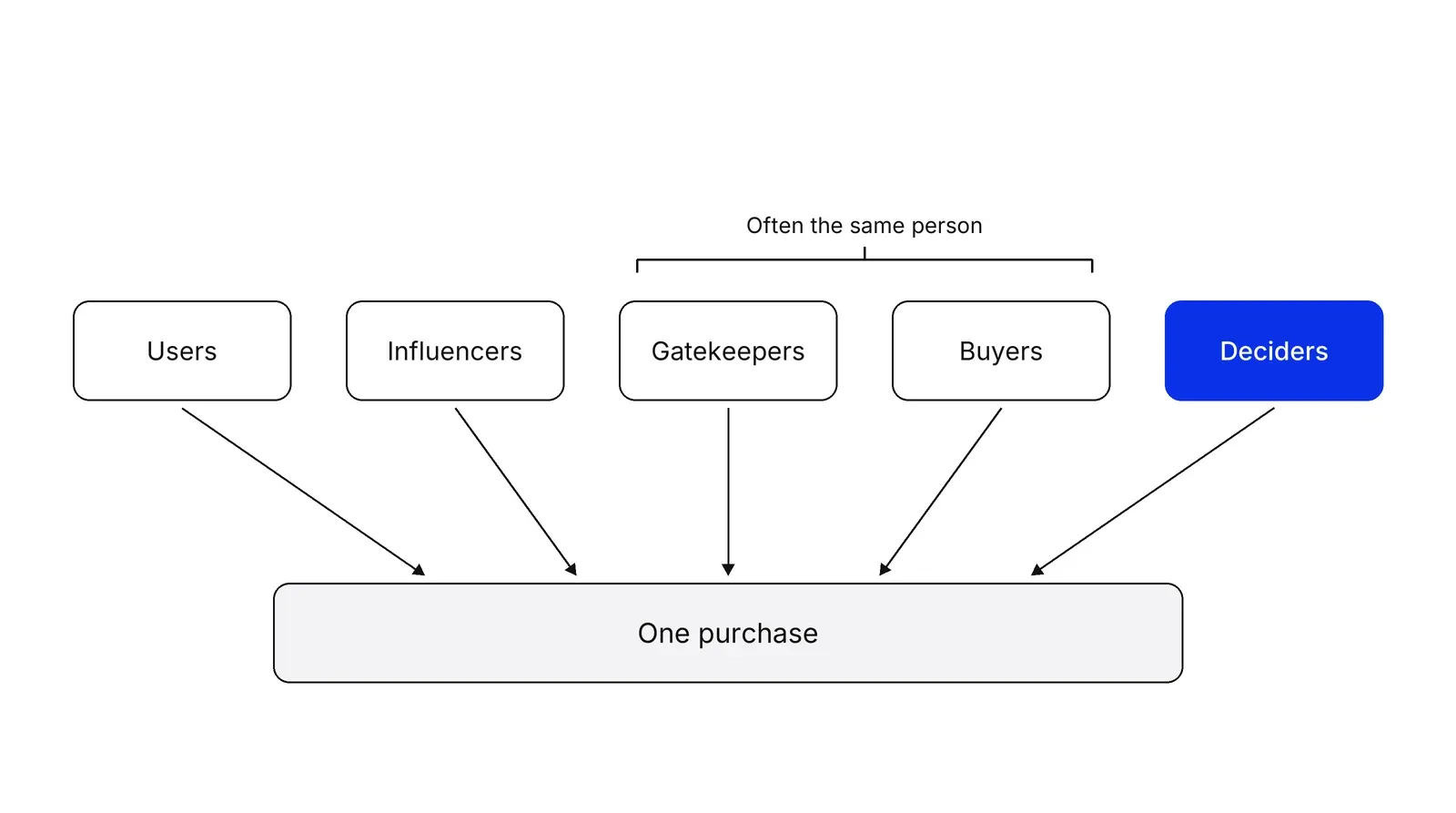
| Role | What they do, per Webster and Wind |
|---|---|
| Users | Use the purchased product or service |
| Buyers | Hold formal authority to contract with suppliers |
| Influencers | Shape the decision by supplying information and evaluation criteria |
| Deciders | Have authority to choose among the options |
| Gatekeepers | Control the flow of information and materials into the group |
Procurement is not a side role. Forrester’s 2026 release says procurement professionals are decision-makers in 53% of business buying cycles. Roles describe what someone does in this purchase, not their job title.
Buy classes: how new the purchase is
How many people join depends partly on how new the purchase is. Robinson, Faris and Wind’s three buy classes are the new task, the modified rebuy and the straight rebuy. A Finnish study of buying centre networks describes the classification as useful for identifying participants and their influence. It also found that the group was widest in the first two phases of the purchases it studied, then narrowed as expertise mattered more.
A straight rebuy is a reorder from the same source and needs little discussion. University lecture notes describe it that way, and describe a modified rebuy as a purchase of something bought before whose requirements have changed. A new task, such as a first payments provider, draws in more departments and takes longer.
The six buying jobs
The Gartner model lists six jobs buyers complete: problem identification, solution exploration, requirements building, supplier selection, validation and consensus creation. The slide copy of Gartner’s deck says 90% of buyers looped back to at least one job, but gives no source for that figure, so treat it as unverified. These are tasks, not a pipeline.
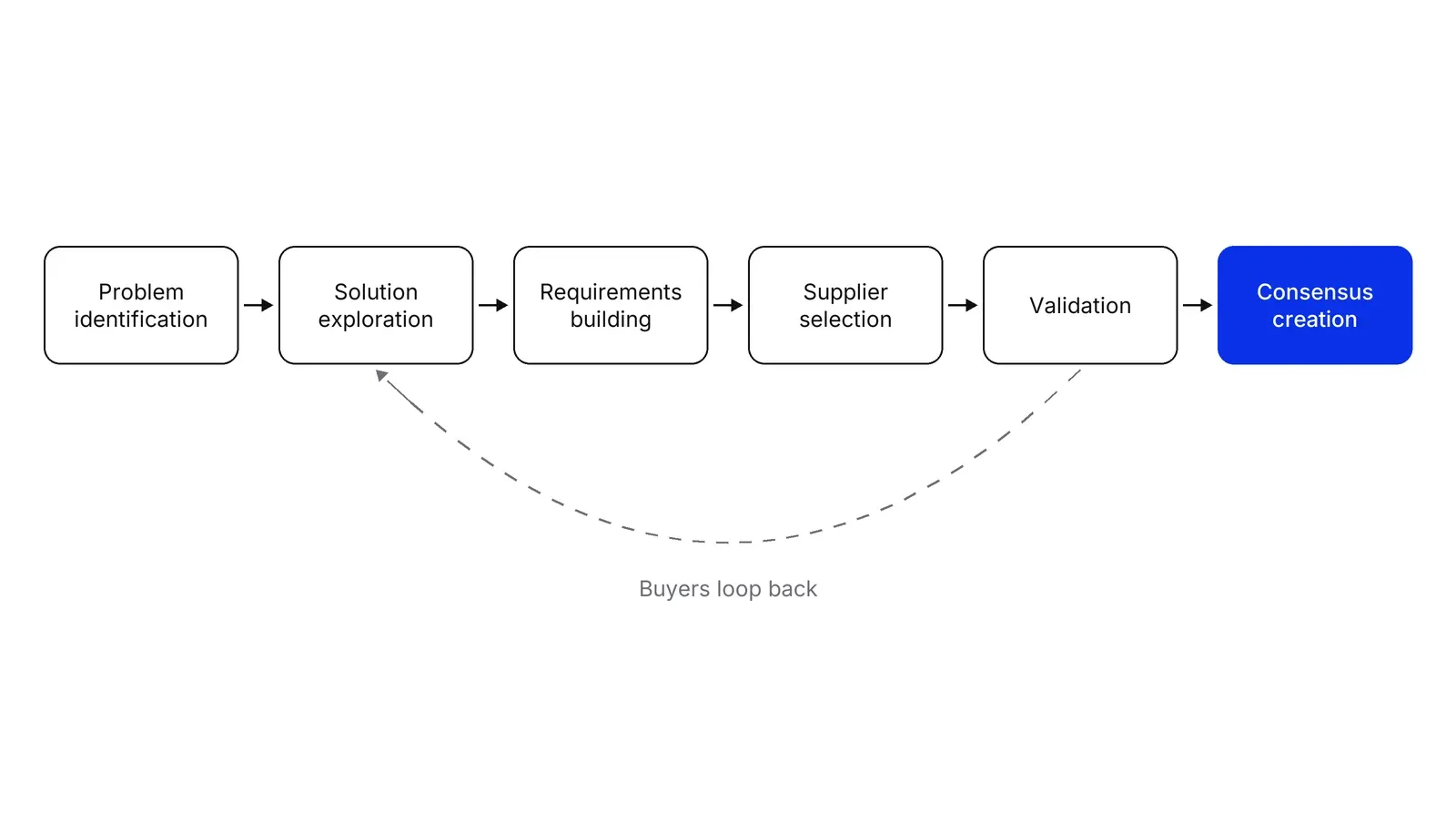
Consensus creation is blue because it is the job sellers see least. Harvard Business Review’s 2015 piece on the consensus sale calls reaching agreement among buyers “an increasingly painful and protracted process”. Adamson argued in a 2022 Harvard Business Review article that most B2B sales and marketing teams work in a serial, linear way and that this model is becoming obsolete. In an interview about The Challenger Customer, he says the seller’s task is to find someone who can drive consensus and change.
How big is the committee?
The number depends on whom you ask and what they count. Read the table as estimates, not a benchmark.
| Source | Figure | Note |
|---|---|---|
| Adamson, in a DestinationCRM interview | 5.4 stakeholders on average | Said of a B2B purchase decision |
| LinkedIn B2B Institute with Bain and NewtonX, 2024 | 6 to 10 stakeholders | 500+ senior buyers of tech products |
| Forrester, 2026 | 13 internal stakeholders plus nine external influencers | Typical decision; sample not stated |
| Australian Marketing Institute on the Bain study | More than 20 people | Reported in the same coverage, which also gives 6 to 10 elsewhere |
A bigger group is not always a worse sign: the same Forrester release says 94% of buyers in groups of six or more report clear benefits. Counting is hard even inside one company. In an MIT working paper, pairs of informants from the same small printing firms often disagreed about who influenced a purchase.
Hidden buyers
Thomas Bonoma’s Harvard Business Review article asks whether the formal buyer is the person who actually decides. Some members of the committee judge the process, not the product. The LinkedIn and Bain study splits the group into target buyers, who are experts in the product, and hidden buyers such as legal, procurement and finance leads. Marketing Week’s report says hidden buyers control nearly half of the decision-making for big purchases, and that they are driven by fear of making a mistake. The same study, fielded in March and April 2024, found 81% of buyers said the product they bought was known to everyone in the group on day one, and only 4% said it was known to just a few decision-makers.
What the evidence does not show
Gong’s analysis of 1.8 million deals closed in 2024 found that won deals had about twice as many buyer contacts as lost ones. Large strategic wins averaged 17 contacts. Gong sells software, the piece does not describe its method, and the pattern is a correlation. Large deals involve more people, and promising deals may attract more of them. It supports reaching beyond one contact, not the idea that adding contacts causes wins. Buying-center research also mixes rational and social factors, as a paper from IIM Lucknow and Johnston and Lewin’s 1996 integrative framework show. The Challenger Customer authors argued in 2012 that sellers should avoid customers who are ready to buy.
How it relates to neighbouring frameworks
| What it answers | |
|---|---|
| Buying committee | Who is involved in the purchase, and what tasks they perform |
| Account-based marketing | Which companies you target, and how you address them as individual markets |
| MEDDIC | A seller’s checklist for one deal, including the economic buyer and the champion |
| Challenger Sale | How a seller teaches and takes control of the conversation |
| Ideal customer profile | Which companies fit your product |
| Buyer persona | The needs and context of one person in the committee |
An ideal customer profile picks the account, and a persona describes one person inside it. The buying committee is the map that connects the persons to the purchase. Ehrenberg-Bass researcher John Dawes’ 95:5 rule says only about 5% of potential buyers are in the market at any time; the page gives it as an approximation with no data, so we cite it as an argument, not a measurement.
A Growth Lab plan for a B2B team starts from mapping the committee for a handful of live accounts before writing any messages.
How to apply Buying committee and the B2B buying journey, step by step
- Pick one deal or account. Choose a purchase that involves several departments and runs for months. Result: one account to map, not a general theory of your market.
- List every person by name and role. Write each person who has appeared, and give each one or more of the five roles: user, influencer, gatekeeper, buyer, decider. One person can hold two roles, and a role can have several people. Result: a roster with empty roles clearly visible.
- Find the hidden buyers. Ask who must still approve the purchase for reasons of process rather than product: finance, legal, procurement, security. Add them to the roster even if you have never met them. Result: a list of people with real influence who have not heard from you.
- Place the group in the six jobs. For each job, problem identification, solution exploration, requirements building, supplier selection, validation and consensus creation, write which one the group is working on now, and whether it has gone back to an earlier one. Result: a view of where the buyers are, which can differ from where your pipeline stage says they are.
- Write what each role needs to say yes. A user needs proof that the work gets easier. A finance lead needs a number. A security reviewer needs evidence of controls. Write one line per person, in their words. Result: a set of needs you can answer with one asset each.
- Hand the group something to agree on. Give your closest contact a short document that the whole group can read and forward: the problem in the buyer's own terms, the criteria, the risks and how they are handled. Result: a shared page that does part of the consensus work for you.
- Update the map every week. Mark each name as met, heard from, or unknown. Result: a short list of people to reach this week.
Examples
A payments provider selling to a marketplace
Illustrative. The head of finance feels the pain of slow payouts and is the most active contact. The engineering lead is a user and an influencer, and wants an API with a test mode. The compliance officer is a gatekeeper who can stop the deal over licensing. Procurement, who nobody at the vendor has met, will run the final contract round. The map shows that three of the five roles are covered and that two people are unmet, so the next two weeks go to a compliance pack and an introduction to procurement.
A software vendor selling a messaging tool to a hospital group
Illustrative. Nurses and front desk staff are the users and have strong opinions. The operations director is the buyer and the person who feels the cost. A data protection officer is a gatekeeper who controls what information reaches the group. The chief financial officer decides. The vendor notices it has spoken only to users, so it prepares a one-page privacy summary for the data protection officer and a cost comparison for the finance side.
When to use it
Use it when a deal needs approval from several departments, takes months, and costs enough that a stalled decision hurts. It suits companies selling to mid-size and large organizations.
When not to use it
Skip it for purchases that one person can make in a call or two, and for very small buyers, where the owner usually decides alone. Do not use it as a form to fill in for a manager, or as a reason to email everyone at the account.
Common mistakes
- Treating the committee as a fixed list. Membership changes through the process, and participation was widest in the first two phases of the purchases a Finnish study of buying centre networks looked at.
- Believing the first number you read. Reported group sizes range from 5.4 to 13 internal stakeholders, depending on the study, the year and who is counted.
- Talking only to users and champions. The hidden buyers in legal, finance, procurement and security can stop the deal late.
- Reading the journey as a funnel. Buyers go back to earlier tasks, so a deal can look late in your pipeline and be early in theirs.
- Asking one informant who influenced the purchase. Pairs of people from the same company disagreed about it in an MIT study.
FAQ
What is a buying committee in B2B?
A buying committee is the group of people in a company who together decide a business purchase, drawn from several departments such as the team using the product, finance, legal and procurement. Academic research calls the same idea the buying center and the decision-making unit, and it describes five roles within it.
How many people are in a B2B buying committee?
It depends on the study. Adamson, a Gartner researcher, has said an average of 5.4 stakeholders is involved. Forrester's 2026 release counts 13 internal stakeholders and nine external influencers. LinkedIn and Bain report 6 to 10. Definitions, deal sizes and years differ, so use the number as a prompt to check your own deals.
What are the stages of the B2B buying journey?
Gartner describes six buying jobs: problem identification, solution exploration, requirements building, supplier selection, validation and consensus creation. Buyers can work on several at once and return to earlier ones, so it is a set of tasks rather than a sequence. Treat the order as a checklist, not a timeline.
What is the difference between a buying committee and a buying center?
Little. Buying center is the academic term from Webster and Wind's 1972 paper, which defines it as all members of the organization involved in the purchase process. Buying committee is the working term sales and marketing teams use, and it often suggests a formal group, while a buying center can be informal.
How should a seller approach a buying committee?
Map the roles before writing messages, reach the hidden buyers early, and give the group material it can share and agree on. Adamson and Dixon's Challenger Customer research recommends finding a mobilizer who can build agreement inside the company. Chasing a single decision maker rarely works once several people hold approval.
Sources
- Webster and Wind, A General Model for Understanding Organizational Buying Behavior, Journal of Marketing, 1972
- EBSCO Research Starters, Consumer and Organizational Buyer Behavior
- Järvi and Munnukka, Extensivity, participation and organizational culture in the buying centre network, IMP Group paper
- Pandey and Mookerjee, Influence of vendor experiences on buying center decisions, IMP Group paper
- Silk and Kalwani, Measuring Influence in Organizational Purchase Decisions, MIT Sloan working paper, 1980
- Johnston and Lewin, Organizational buying behavior: Toward an integrative framework, Journal of Business Research, 1996 (RePEc record)
- Harvard Business Review, Toman, Adamson and Gomez, The New B2B Sales Imperative, 2017
- Harvard Business Review, Schmidt, Adamson and Bird, Making the Consensus Sale, 2015
- Harvard Business Review, Adamson, Traditional B2B Sales and Marketing Are Becoming Obsolete, 2022
- Harvard Business Review, Adamson, Dixon and Toman, Sales Reps Should Avoid Customers Who Are Ready to Buy, 2012
- Harvard Business Review, Bonoma, Major Sales: Who Really Does the Buying? (Best of HBR reprint)
- DestinationCRM, Required Reading: Selling to Influencers (Adamson and Dixon on The Challenger Customer)
- Forrester, The State of Business Buying 2026, press release, January 2026
- Gong Labs, Data shows top reps don't just sell, they orchestrate
- Marketing Week, LinkedIn marketing VP: understanding complexity of B2B buyers is key to growth, June 2024
- LinkedIn News, LinkedIn is the place to B2B at Cannes Lions 2024 (Buyer Group Marketing study with Bain and NewtonX)
- Australian Marketing Institute, coverage of the Bain and LinkedIn B2B Institute study on hidden buyers
- Ehrenberg-Bass Institute, The 95:5 rule, John Dawes (republished from Dreamdata)
- Gartner, Win More B2B Sales Deals: buyer enablement, 2018 presentation (third-party copy on SlideShare)
- Njau, Business-to-business marketing, week 2: business buying process, university lecture notes
Last updated Oct 9, 2026


Marketing agency or growth system: when a company outgrows its agency
An agency is the right call while the founder still runs most of the company. Once the business starts copying itself into new locations or markets, it needs a system that sets goals, tests hypotheses and owns the result.

Why healthcare marketing agencies stall: the short, mid and long wins model we use with clinics
Most agencies own the click and nobody owns the front desk. How we structure clinic work in three horizons, the research behind each one, and one year of results.

Why channel tests stall after month three
Most paid channel tests do not end with a decision. They end when the budget runs out, the attribution model changes, or everyone quietly stops looking at the dashboard.