Quarterly planning
Quarterly planning is a recurring 90-day session in which a team scores the last quarter, picks a few priorities, checks them against real capacity and gives each result an owner and a date.
Quarterly planning is a session held about every 90 days in which a team reviews the last quarter, chooses a few priorities for the next, checks them against the working time it really has, and gives each priority one owner and one date. A weekly check keeps the plan alive. Its purpose is to stop teams from planning more than they can finish.
- Origin
- No single author; EOS (Gino Wickman), Scaling Up (Verne Harnish), SAFe and Scrum each describe a version, No single date
- Level
- 201 · Tool
- Fits
- Startup, Small and mid-size, Scale-up
- Time to apply
- Half a day for the session, plus about two hours of preparation
- What you need
- the priority list from last quarter, with what was finished and what was not · a calendar of leave, holidays and launches for the next 13 weeks · the people who own the results, in one room
Quarterly planning is a session held about every 90 days in which a team looks back at the last quarter, chooses the few results that matter for the next one, checks them against the time people really have, and gives each result one owner and one date. The idea has no single author. Several management systems each describe their own version, and they agree on more than they differ.
Why plan in quarters?
A quarter is long enough to finish something that matters and short enough that the end is visible from the start. EOS Worldwide calls 90 days “the maximum human attention span for a priority.” That is the vendor’s claim, not a research finding, but the practical point holds: most teams lose track of a goal that is a year away. Cycle lengths in the main systems differ, which shows the number is a convention.
| System | Cycle | What the planning produces |
|---|---|---|
| EOS (Gino Wickman’s method) | 90 days | Rocks, three to seven for the company |
| Scaling Up (Verne Harnish) | One quarter | One top priority plus three to five supporting ones |
| SAFe (vendor framework of Scaled Agile, Inc.) | Every 8 to 12 weeks, a 2-day event | Team objectives and a board of dates and dependencies |
| Google’s OKR guide | Quarterly, plus annual | Three to five objectives, about three key results each |
| Scrum | A sprint of one month or less | A sprint goal and a forecast of work |
| Shape Up (Basecamp) | Six weeks plus a two-week cool-down | Bets on which projects get a team |
Sources: EOS, Scaling Up, SAFe, Google re:Work, the Scrum Guide, Shape Up.
Why do quarter plans run late?
Because people plan from the best case. In a 1994 study, Roger Buehler, Dale Griffin and Michael Ross phoned 37 psychology students who were writing honors theses and asked when each would finish. In the analysed group of 33, the average best guess was 33.9 days. The average actual time was 55.5 days, about 64% longer. Fewer than a third (29.7%) finished by their own prediction. Even when asked for the worst case, the average was 48.6 days, and only 48.7% finished within it.
The authors call this the planning fallacy. Their account is that people build a story of how the task will go and do not look at how long similar tasks took them before. Kahneman and Lovallo named the two views: the inside view anchors on plans and scenarios, the outside view starts from the record of comparable cases. Flyvbjerg turned the outside view into a forecasting method, reference class forecasting, and Lovallo and Kahneman argued in Harvard Business Review that executives fall for the same optimism.
For a quarterly plan, the outside view is one number: the share of last quarter’s priorities that were finished. Everything below is built to feed that number into the next plan.
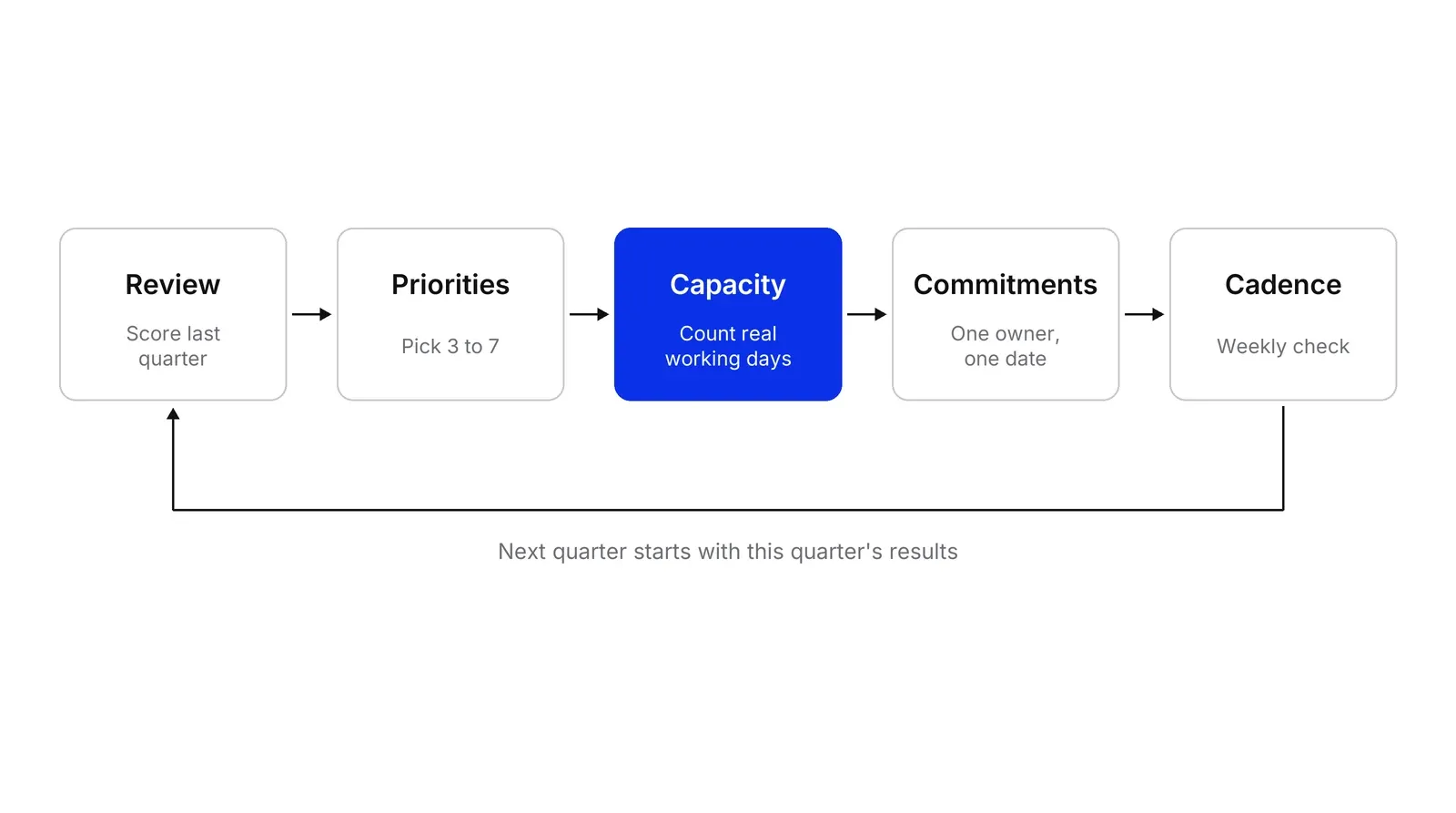
The five parts
Review
Score every priority from last quarter as done or not done. EOS’s quarterly agenda puts this review before any new planning and says that if fewer than 80% of Rocks were completed, the team should discuss why. Keep the completion rate. It is your own reference class.
Priorities
Choose three to seven for the whole company, as EOS advises, or one top priority with three to five supporting ones, as Scaling Up’s Rockefeller Habits put it. Fewer goals do real work. Ordonez and colleagues reviewed research showing that people with several goals tend to concentrate on one, and that goals which are easier to measure get more attention than harder ones.
Capacity
Capacity is the working time left after everything that is not a priority. The Scrum Guide says developers forecast with more confidence when they know their past performance and their upcoming capacity. Subtract leave, holidays and recurring work, then hold back a buffer. SAFe builds the buffer into the calendar: its Innovation and Planning iteration is described as an estimating buffer for meeting objectives.
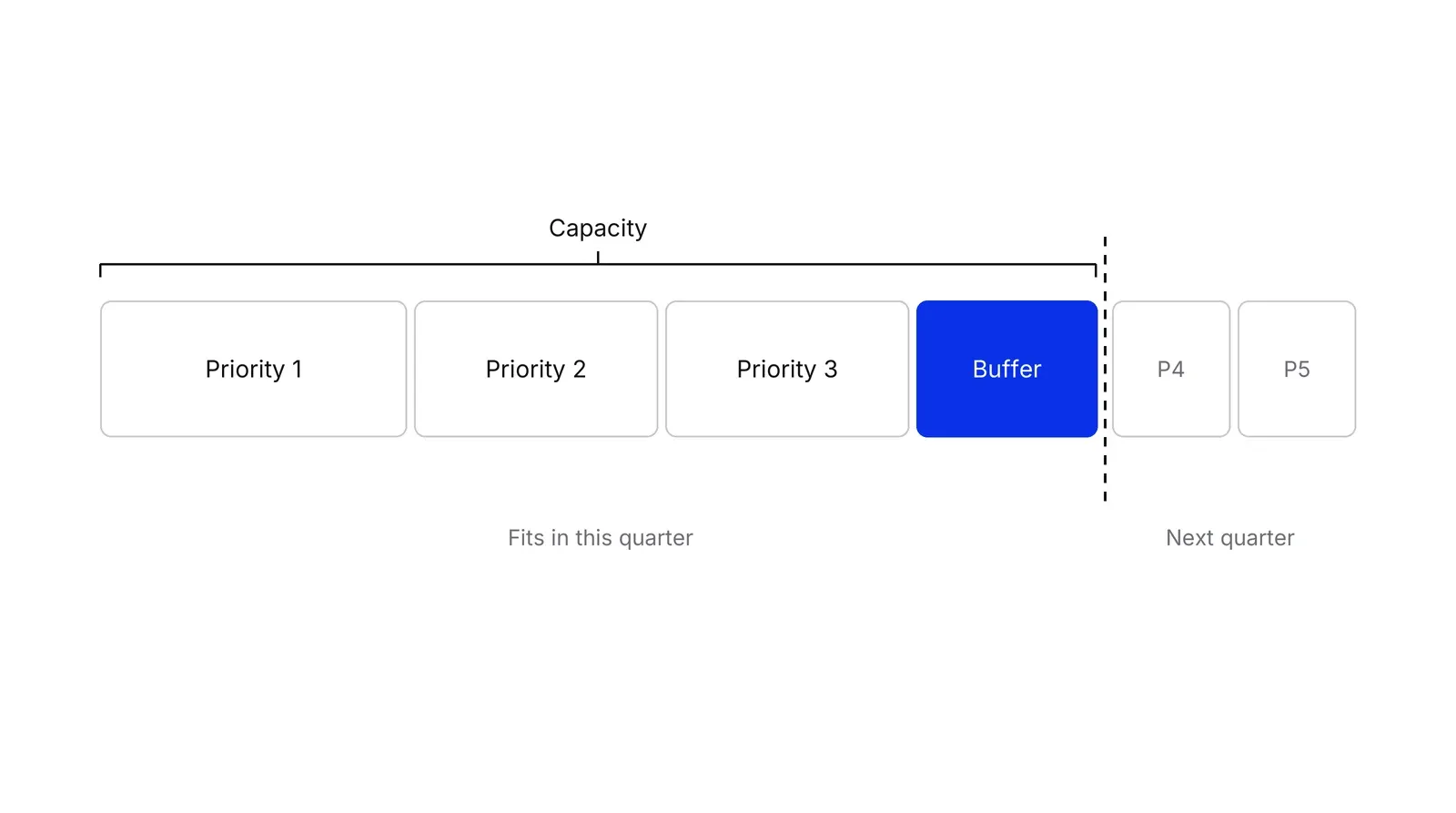
Overloading has a cost beyond lateness. Little’s law, a theorem from queueing theory, says the average amount of work in a system equals the arrival rate times the average time each item spends there. For a team with a fixed throughput, more work in progress means longer waits for every item. If the team sizes the list for sales hiring, sales capacity planning does the same arithmetic with ramp time and attrition.
Commitments
A commitment is a priority with one owner, one due date and an observable finish. SAFe’s PI planning ends with teams committing to objectives, and EOS gives every Rock a single owner. Separate commitments from stretch goals. Google’s OKR guide expects a grade of 0.6 to 0.7 on ambitious goals, so by that logic a 0.7 on a stretch goal is a normal result, while a 0.7 on a commitment is a miss. Where the plan depends on uncertain outside events, a few scenarios with a trigger for each tell the team when to change course.
Cadence
Cadence is the weekly and mid-quarter rhythm that keeps the plan visible. In EOS the weekly leadership meeting has a short Rock review inside it, which EOS puts at five minutes, and Google’s guide recommends mid-quarter and end-of-quarter check-ins. Keep it light: Perlow, Hadley and Eun report that executives average about 23 hours a week in meetings. The operating rhythm page covers how daily, weekly, monthly and quarterly meetings fit together, and the EOS and Scaling Up pages show two complete systems built around a quarterly session.
What does the evidence say?
There is no trial of quarterly planning itself that we could find. The planning fallacy is well documented, and the case for the outside view is strong. The case for 90 days is mostly practitioner experience. Sull, Homkes and Sull report that two-thirds to three-quarters of large organizations struggle with execution, which is the problem the quarter is meant to address. The nearest controlled evidence is indirect: a randomized experiment by Bloom and colleagues found that Indian textile plants given modern management practices raised productivity by 11%, though the practices were not quarterly planning. Goal setting also has side effects, as the Ordonez paper argues: a narrow focus can neglect everything not on the list.
A Growth Lab plan starts from the same cycle: last quarter’s completion rate, three to five priorities and a weekly check.
How to apply Quarterly planning, step by step
- Score last quarter. List last quarter's priorities and mark each done or not done, with no partial credit. Divide the done ones by the total. Result: a completion rate you can plan from, such as 5 of 8.
- List candidates, then cut to 3 to 7. Write down everything people want done, then keep, drop or merge items until three to seven remain for the whole company, as EOS suggests. Result: a short list, with the rest parked for next quarter.
- Count real capacity. Take working days per person, subtract leave and the recurring work that never stops, and hold back a buffer. Result: a number of days or hours the priorities may use.
- Size each priority against that number. Estimate each priority from similar past work, not from the best case, and add them up. If the total exceeds capacity, move the lowest priority to next quarter. Result: a plan that fits.
- Assign one owner and one date. Give every priority a single owner, a due date and a way to see it is done. Mark which ones are commitments and which are stretch. Result: a page where nobody can say it was unclear who was responsible.
- Set the weekly check. Put priority progress on the weekly meeting agenda: on track or off track, nothing more. Add a check-in at mid-quarter. Result: slippage is seen in week 3, not in week 13.
Examples
A six-site dental group
Illustrative. Last quarter the leadership team set 8 priorities and finished 5, a completion rate of 62%. This time they list 9 candidates and cut to 5, because 5 is what the record supports. One of the five is a single online booking flow for all sites, owned by the operations lead, due in week 10. The cut candidates are written on a parked list and reviewed at the next session, so nobody feels the ideas were lost.
A B2B payments team
Illustrative. Four engineers have 13 weeks, which is 260 person-days. Leave takes 20, leaving 240. Support and maintenance take about a quarter of that, 60 days, leaving 180. The team holds back a 20% buffer of 36 days and commits 144 days of work. Priorities that add up to 190 days do not fit, so the lowest-ranked one moves to next quarter, and the team signs the plan knowing it has room for a surprise.
When to use it
Use it when a team has more good ideas than people, when priorities change every few weeks, or when last quarter's list was mostly unfinished. It suits a founder-led team that needs its first shared plan as much as a leadership team of a larger company that needs several teams to move together.
When not to use it
Skip the full ritual for a team of two or three people who already talk every day, where a short weekly list does the same job. It also fits poorly when the work is mostly reactive, such as an on-call or support team, because the quarter's plan is overwritten by incoming requests. There, plan capacity for the reactive load first, then plan only the remainder.
Common mistakes
- Planning from the best case. Buehler, Griffin and Ross found that students predicted 33.9 days for a thesis and took 55.5. Start from last quarter's completion rate, not from hope.
- Setting a dozen priorities. EOS caps company-level Rocks at seven, and Scaling Up asks for one top priority supported by three to five. More than that, people drift to the one they find easiest to measure.
- Counting calendar days instead of working days. Leave, public holidays, recurring work and meetings are all subtracted before anything is promised.
- Treating a stretch goal as a commitment, or the reverse. Mark each priority as one or the other, so a miss on a stretch goal is not read as failure.
- Setting the plan and never opening it again. Without a weekly look the plan is a document, not a control.
FAQ
What is quarterly planning?
Quarterly planning is a recurring session, held about every 90 days, where a team reviews the last quarter, picks the few priorities for the next one, checks them against its real capacity and assigns owners and dates. EOS, Scaling Up, SAFe and Google's OKR guide each run a version of it.
How many priorities should a quarter have?
Three to seven for a whole company, according to EOS, with fewer being better. Scaling Up asks for one top priority with three to five supporting ones. Google's OKR guide recommends three to five objectives. These are conventions from practitioners, not experimental results, so use your last completion rate to set your own limit.
How do quarterly and monthly planning fit together?
The quarterly session sets the few results that matter for 90 days. Monthly sessions, where a team holds them, check progress and decide one or two strategic issues, while weekly meetings track the priorities and solve issues. Quarterly planning is the top of that ladder, which the operating rhythm page describes.
When in the quarter should you plan?
In the last one to two weeks of the quarter, so the review uses real results. SAFe puts planning in the final Innovation and Planning iteration of each cycle for the same reason. Planning mid-quarter works only if you also pause delivery.
What is the difference between quarterly planning and OKRs?
OKRs are one way to write the quarter's goals: objectives with measurable key results. Quarterly planning is the wider cycle around them: review, capacity, commitments and a weekly check. A team can plan quarterly with Rocks, OKRs or sprint goals, and the capacity step is the same either way.
Sources
- Roger Buehler, Dale Griffin, Michael Ross, Exploring the planning fallacy: why people underestimate their task completion times, Journal of Personality and Social Psychology 67(3), 1994
- Daniel Kahneman, Dan Lovallo, Timid choices and bold forecasts: a cognitive perspective on risk taking, Management Science 39(1), 1993
- Bent Flyvbjerg, From Nobel Prize to project management: getting risks right, arXiv preprint
- Dan Lovallo, Daniel Kahneman, Delusions of success: how optimism undermines executives' decisions, Harvard Business Review, July 2003
- EOS Worldwide, Rocks
- EOS Worldwide, Quarterly meeting agenda
- EOS Worldwide implementer blog, How to conduct an EOS quarterly meeting
- EOS Worldwide, Traction by Gino Wickman
- Scaling Up, Mastering the Rockefeller Habits (Verne Harnish)
- Scaling Up, Growth tools: One-Page Strategic Plan
- Scaled Agile, Inc., SAFe: PI Planning
- Scaled Agile, Inc., SAFe: Innovation and Planning iteration
- Google re:Work, Set goals with OKRs
- Ken Schwaber, Jeff Sutherland, The Scrum Guide, 2020
- Basecamp, Shape Up: Principles of shaping, chapter 1
- Donald Sull, Rebecca Homkes, Charles Sull, Why strategy execution unravels, Harvard Business Review, March 2015
- Leslie Perlow, Constance Noonan Hadley, Eunice Eun, Stop the meeting madness, Harvard Business Review, July-August 2017
- Lisa Ordonez, Maurice Schweitzer, Adam Galinsky, Max Bazerman, Goals gone wild, Harvard Business School working paper 09-083, 2009
- John D. C. Little, Little's Law as viewed on its 50th anniversary, Operations Research 59(3), 2011
- Nicholas Bloom, Benn Eifert, Aprajit Mahajan, David McKenzie, John Roberts, Does management matter? Evidence from India, NBER Working Paper 16658, 2011
Last updated Oct 9, 2026


Fractional COO or embedded operations team? How to choose at Series A
The two models solve different problems: how to tell which one your company needs, and what each costs in time and control.

What operational systems successful fintech startups use: lessons from ten companies
Starling, Monzo, Qonto, bunq, Lunar, Pleo, Tide, Ramp, Mercury and Column scaled on four operating systems. Regulators' findings show what breaks when one of them lags behind growth.

What a revenue operations manager actually owns
Pipeline definitions, CRM hygiene, forecasting and the handoffs between marketing, sales and success. What the role covers, and how it differs from sales ops.