OGSM
OGSM is a one-page planning format that links what a business wants to achieve (Objective and Goals) to how it will get there and track progress (Strategies and Measures).
OGSM is a strategic planning format that fits a business plan on one page under four headings: Objective, Goals, Strategies and Measures. The objective states the ambition in words, goals turn it into dated numbers, strategies name the choices that will reach them, and measures show whether each choice is working. Procter & Gamble is its best-known user; its exact origin is undocumented.
- Origin
- Unknown; developed in use at Procter & Gamble, Undocumented; in wide use at P&G by the mid-1980s
- Level
- 301 · Advanced
- Fits
- Scale-up, Enterprise
- Time to apply
- a half-day workshop for a first company page, then a quarterly review
- What you need
- last year's results and this year's budget · the leadership team in one room, with one person who makes the final call · a short list of what you will stop doing
OGSM is a strategic planning format that fits a business plan on one page under four headings: Objective, Goals, Strategies and Measures. The objective says in words what the business wants to achieve. The goals turn that into numbers with a deadline. The strategies are the choices that will get there, and each one gets measures that show whether it is working.
Procter & Gamble is its best-known user. A.G. Lafley, P&G’s former CEO, and Roger Martin, a long-time adviser to the company, wrote in a 2013 Strategy & Leadership article that the OGSM statement for each brand, category or the whole company was where P&G leaders set out where to play and how to win. The format spread through former P&G staff. Marc van Eck and Ellen van Zanten learned it there, according to the Dutch magazine Business Contact, and wrote it up as a book that FT Publishing released in English in 2014 as The One Page Business Strategy, where the co-author is listed as Ellen Leenhouts.
Where did OGSM come from?
Nobody has documented it. The usual story says P&G adopted the method from Japan in the 1950s, and OGSM.com, an Amsterdam consultancy, repeats it. We found no primary source for either the decade or the Japanese route: no P&G document, no dated first-hand account.
The closest thing to testimony comes from Roger Martin. In a 2023 essay he writes that the tool “is believed to have originated” in post-war Japanese business and was later taken up by US companies, as Total Quality was. He calls it a belief. What he saw himself is narrower: OGSM was already well established at P&G when he started consulting there in the mid-1980s. He adds that he had nothing to do with creating it or bringing it to P&G. ArchPoint, a consultancy run partly by former P&G managers, says the origin is unclear.
| Claim | Who makes it | What we found |
|---|---|---|
| Came from Japan, adopted by P&G in the 1950s | OGSM.com and many template sites | No primary source |
| Rooted in post-war Japanese management | Roger Martin, 2023 | Stated as a belief |
| In wide use at P&G by the mid-1980s | Roger Martin, 2023 | First-hand account |
| P&G built the modern version | ArchPoint | Practitioner view |
The Japanese link is plausible because OGSM looks like hoshin kanri, the Japanese method of deploying objectives from the CEO down to the front line, described by the Lean Enterprise Institute. Western firms such as Xerox ran hoshin kanri by the 1990s (Witcher and Butterworth, 1999). Resemblance is not proof of descent, so treat the origin as unknown.
The four boxes
Each box answers one question. The objective and goals say what you want; the strategies and measures say how you will get it and how you will know.
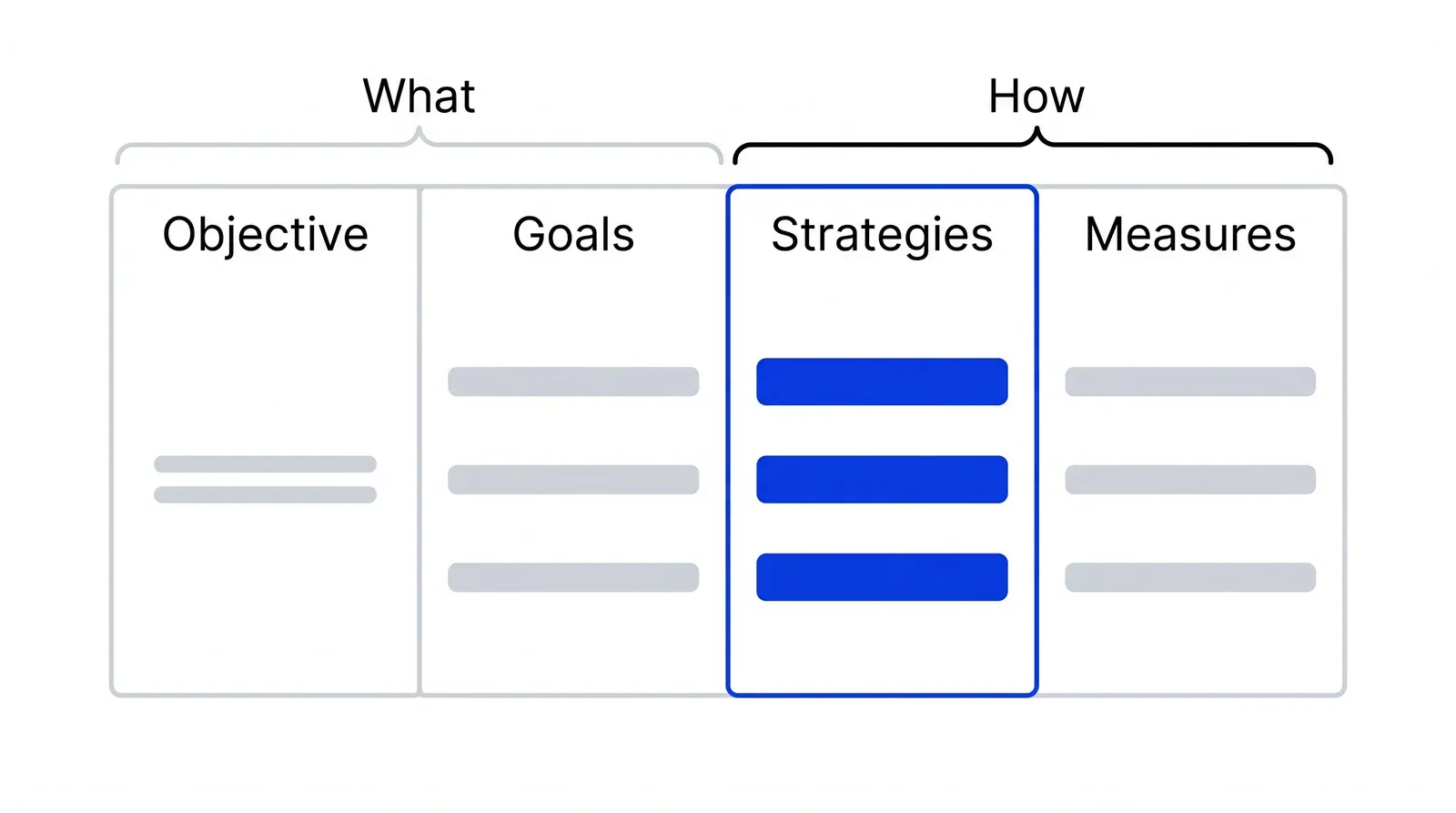
| Box | Question | Form | Illustrative example, payments company |
|---|---|---|---|
| Objective | What do we want to be? | One sentence, no numbers | Become the default way online pharmacies in Spain get paid |
| Goals | How will we know we got there? | Three to five dated numbers | 400 active pharmacy merchants by December 2027 |
| Strategies | Which choices get us there? | Three to five linked choices | Win merchants through the e-commerce platforms pharmacies already use |
| Measures | Is each strategy working? | A metric, target and owner per strategy | Share of new merchants from platform partners, target 60% |
The split between objective and goals confuses people because other traditions swap the words. George Doran, who coined the SMART acronym in a 1981 Management Review article, noted that some companies call long-term aims goals and others call them objectives, and said time should not be wasted on the debate. Pick one convention and hold it across the company.
Measures also get mixed up with goals. A goal tells you whether the whole plan worked. A measure tells you whether one strategy is pulling its weight, early enough to change course. If merchant count is the goal, the measures sit upstream: the share of sign-ups from partners, activation within 30 days, cost per new merchant.
Why the strategies box is where most plans fail
The strategies box usually turns into a to-do list. Roger Martin, who says he finds OGSM a poor tool for strategy, points out that in classic use the S box lists initiatives: build this factory, enter that market, improve quality. Each sounds sensible, but together they do not explain why a customer would pick you over a rival.
His fix at P&G, which he says took about 20 years of work with Lafley and other executives, was to make the S box hold one integrated set of choices about where to play, how to win and which capabilities the business must have. In the same essay he repeats that a plan is not a strategy, the case he made in his 2014 Harvard Business Review article “The Big Lie of Strategic Planning”. A quick test for your own page is to delete one strategy. If the others still make sense on their own, you wrote a list of projects. Strategies that form one plan depend on each other. Good strategy, bad strategy covers the same trap.
How OGSM cascades through a company
OGSM works as a cascade. Each strategy and its measure become the objective and goal of the team one level down, so a regional or functional page is built from one line of the company page.
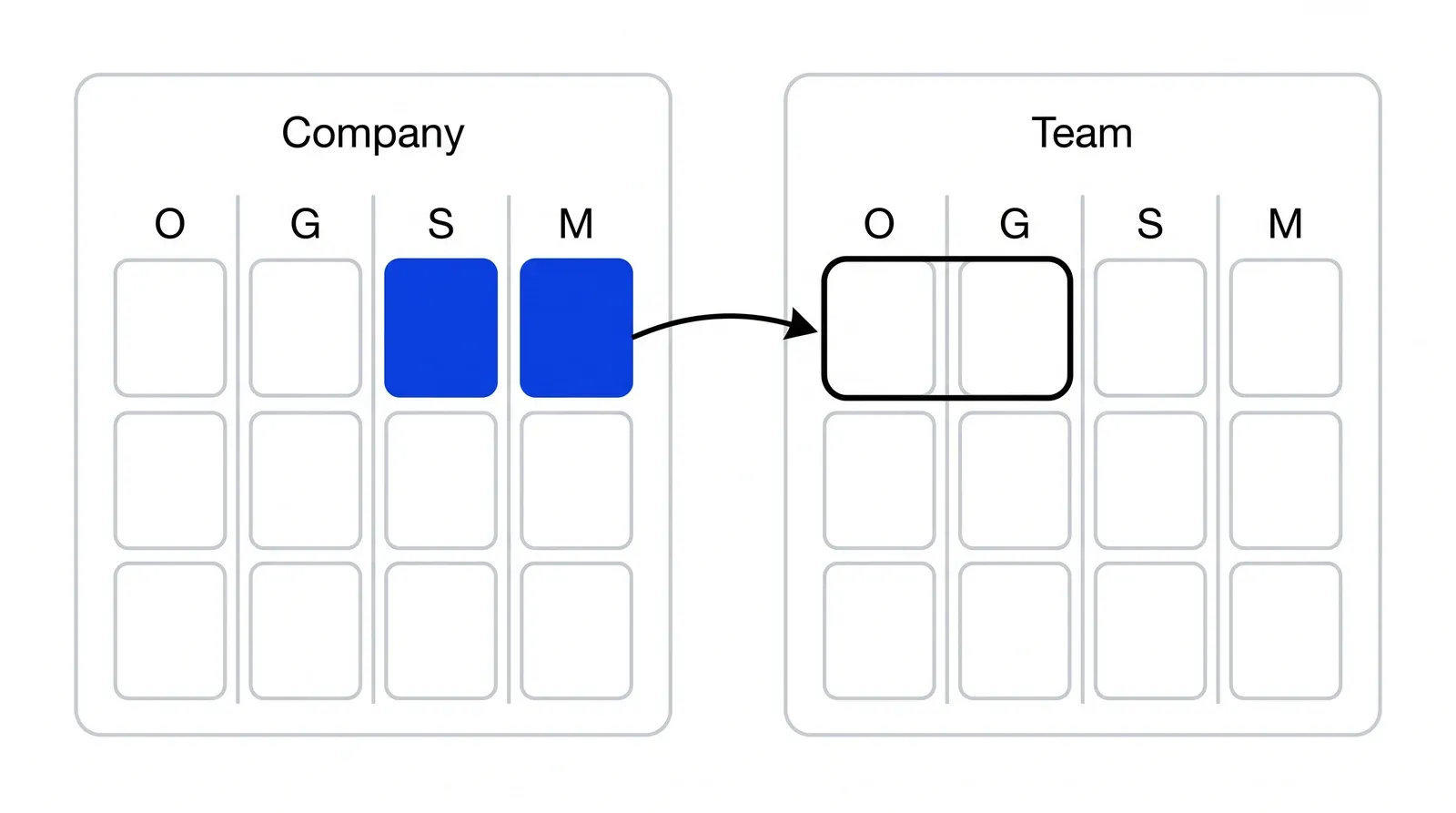
Coastline Academy, a US driving school, published how it runs this. Its CEO writes that each objective and goal pair carries roughly three to five strategy and measure pairs, that the cascade stops at about three levels, and that work below that lives in tools such as Asana or GitHub. Pages are set before the new year, scored monthly and reviewed quarterly. The cascade is also what OGSM shares with hoshin kanri, where managers negotiate targets up and down the hierarchy in a process called catchball (Tennant and Roberts, 2001).
OGSM compared with OKR and the balanced scorecard
Teams often ask whether they need OGSM or OKRs. The difference is mostly horizon and whether the strategy is written down.
| OGSM | OKR | Balanced scorecard | |
|---|---|---|---|
| Origin | Undocumented; long used at P&G | Andy Grove at Intel; brought to Google by John Doerr, 1999 | Kaplan and Norton, Harvard Business Review, 1992 |
| Usual horizon | One to five years, reviewed quarterly | One quarter | A year, measured continuously |
| Strategy written down | Yes, in the S box | No | Implied by the chosen measures |
| Main use | One plan for the whole company | Ambitious short-cycle targets | Balancing financial and non-financial measures |
The scorecard comes from Kaplan and Norton’s 1992 article. Plenty of companies run both, with OGSM for the year and OKRs for the quarter. To break goals into measures that teams can move, a KPI tree helps.
What the evidence says
Direct research on OGSM is thin. The one peer-reviewed study we found, a 2024 paper in Jurnal Manajemen Bisnis, applies it to conflict between employees at Bank Sumut in Indonesia, using interviews with the head of HR. That is a single qualitative case. Most claims that OGSM lifts performance come from firms that sell it.
The argument for a one-page plan rests on research about strategy execution in general. Michael Mankins and Richard Steele wrote in 2005 that most companies’ strategies deliver only 63% of their promised financial value, and their first rule was to keep the strategy simple. A London Business School survey of 11,000 managers in more than 400 companies found only a third could name their firm’s top three priorities, a finding Donald Sull and colleagues set out in Harvard Business Review. The goals box has better support: in their review of 35 years of research, Edwin Locke and Gary Latham report that specific, difficult goals consistently led to higher performance than telling people to do their best. Whether OGSM beats other one-page formats has not been tested.
In Pushers’ Growth Lab work, a page like this is agreed before any channel plan, and its measures feed the KPI tree the team reports against.
How to apply OGSM, step by step
- Write the objective in one sentence. State where the business wants to be in one to five years, in words, without numbers. Test it by asking whether a new hire would know which customers and which market it means. Result: one sentence the leadership team signs off.
- Turn it into three to five goals. Each goal is a number with a date that proves the objective was met: revenue, share, retention, margin. Write them so they are specific and time-bound, and keep the count low. Result: three to five dated targets.
- Choose the strategies as one set of choices. Decide where you will compete and how you will win there, then list the three to five choices that follow from that. Check that they depend on each other; if one can be deleted without affecting the rest, move it to the project list. Result: three to five linked choices.
- Give each strategy a measure and an owner. For every strategy, pick one leading metric with a target and name the person accountable. Add the two or three actions that start this quarter. Result: a measure, an owner and first actions for each strategy.
- Cascade one level down. Hand each strategy and its measure to the team that owns it as that team's objective and goal, and let them write their own page. Stop at about three levels; below that, use a task tool. Result: team pages that trace back to one line of the company page.
- Score monthly, review quarterly. Mark each measure on track or off track every month. Once a quarter, decide what to change: a measure, an action or, rarely, a strategy. Result: a dated record of what changed and why.
Examples
Procter & Gamble
P&G is the company most associated with OGSM. Former CEO A.G. Lafley and Roger Martin wrote in their 2013 Strategy & Leadership article that the OGSM statement for each brand, category or the company was where leaders set out where to play and how to win. Martin says it took about 20 years of work at P&G to make the S box hold an integrated set of choices instead of a list of initiatives.
Coastline Academy, a US driving school
Coastline Academy's CEO Nigel Tunnacliffe described its OGSM process in a 2024 article. One company objective was to be a great place to learn for customers, with the goal of keeping NPS above 80. Each objective and goal pair has roughly three to five strategy and measure pairs, the cascade stops at about three levels, and pages are set before the new year, scored monthly and reviewed quarterly.
A payments company entering online pharmacy
Illustrative, no real company implied. A payments provider writes the objective: become the default way online pharmacies in Spain get paid. Goal: 400 active pharmacy merchants by December 2027. Strategy: win merchants through the e-commerce platforms pharmacies already use instead of direct sales. Measure: share of new merchants arriving through platform partners, target 60%. If the company signs 30 merchants a month and only 9 come through partners (30%), the measure says the strategy is not yet working long before the 400 target is missed.
When to use it
Use it when a company of more than a few dozen people needs everyone working from the same annual plan, when a leadership team's plan lives in a long deck nobody rereads, or when you need team plans that visibly trace back to company goals.
When not to use it
Skip it when you have not yet decided where to compete and how to win; OGSM records those choices but will not make them for you. It also fits poorly in a startup still searching for product-market fit, where the objective may change every quarter and short OKR cycles work better.
Common mistakes
- Filling the Strategies box with a list of projects (launch an app, hire a sales team, improve quality) that do not explain why customers would choose you.
- Writing goals and measures that are the same numbers, so nothing warns you early that a strategy is failing.
- Putting a number in the objective, or no number in the goals.
- Listing ten strategies. The value of the page comes from what you leave off it.
- Cascading five or six levels deep until the bottom pages are task lists dressed up as plans.
FAQ
What does OGSM stand for?
OGSM stands for Objective, Goals, Strategies and Measures. The objective is a qualitative statement of what the business wants to achieve. Goals are numeric, dated targets that prove it. Strategies are the choices that will reach the goals, and measures are the metrics, with owners and actions, that show whether each strategy is working.
Did Procter & Gamble invent OGSM?
Nobody knows. The claim that P&G adopted it from Japan in the 1950s is widely repeated but has no primary source we could find. Roger Martin, a long-time P&G adviser, says it was believed to come from post-war Japan and was already well established at P&G when he arrived in the mid-1980s.
What is the difference between OGSM and OKR?
OGSM is usually an annual or multi-year plan that writes the strategy down in its own box and cascades it through the company. OKRs, developed by Andy Grove at Intel and spread by John Doerr, set ambitious targets for a quarter and do not include a strategy section. Many companies use OGSM for the year and OKRs for the quarter.
How many strategies should an OGSM have?
Three to five is the common guidance from practitioners such as OGSM.com and Coastline Academy. Fewer than three often means the plan is vague; more than five usually means the team has not chosen. Each strategy should have at least one measure and a named owner.
What is the difference between objectives and goals in OGSM?
In OGSM the objective is written in words and describes the ambition, while goals are numbers with a deadline. Other management traditions use the two words the other way round. George Doran, who coined SMART in a 1981 article, advised companies not to waste time on the labels and to agree one convention instead.
Sources
- A.G. Lafley, Roger L. Martin, Instituting a company-wide strategic conversation at Procter & Gamble, Strategy & Leadership 41(4), 2013
- Roger L. Martin, Strategy is Singular: One Entity, One Strategy, January 2023 (Wayback Machine copy)
- Roger L. Martin, Why the How-to-Win Strategy Choice is So Hard (Wayback Machine copy)
- Publishers Weekly, review of A.G. Lafley and Roger L. Martin, Playing to Win: How Strategy Really Works, Harvard Business Review Press, 2013
- Marc van Eck, Ellen Leenhouts, The One Page Business Strategy, FT Publishing International, 2014
- Business Contact, Meesters in management: Marc van Eck and Ellen van Zanten
- OGSM.com, OGSM model: a complete guide
- ArchPoint Consulting, OGSM
- Coastline Academy, Nigel Tunnacliffe, A Startup-Centric Implementation of OGSM, January 2024
- Sy Haura Munawwarah, Azhari Akmal Tarigan, Budi Dharma, HR Management Strategy in Overcoming Conflicts at Bank Sumut Using the OGSM Method, Jurnal Manajemen Bisnis 11(2), 2024
- Michael C. Mankins, Richard Steele, Turning Great Strategy into Great Performance, Harvard Business Review, July 2005 (Bain reprint)
- Donald Sull, Rebecca Homkes, Charles Sull, Why Strategy Execution Unravels and What to Do About It, Harvard Business Review, March 2015
- London Business School, Two thirds of senior managers can't name their firm's top priorities, December 2015
- Roger L. Martin, The Big Lie of Strategic Planning, Harvard Business Review, January-February 2014
- Robert S. Kaplan, David P. Norton, The Balanced Scorecard: Measures That Drive Performance, Harvard Business Review, January-February 1992
- What Matters (John Doerr), OKR meaning, definition and example
- Lean Enterprise Institute, Hoshin kanri
- Barry J. Witcher, Rosie Butterworth, Hoshin Kanri: how Xerox manages, Long Range Planning 32(3), 1999
- Charles Tennant, Paul Roberts, Hoshin Kanri: Implementing the Catchball Process, Long Range Planning 34(3), 2001
- Edwin A. Locke, Gary P. Latham, Building a Practically Useful Theory of Goal Setting and Task Motivation, American Psychologist 57(9), 2002
- George T. Doran, There's a S.M.A.R.T. way to write management's goals and objectives, Management Review, November 1981
Last updated Oct 9, 2026


Fractional COO or embedded operations team? How to choose at Series A
The two models solve different problems: how to tell which one your company needs, and what each costs in time and control.

What operational systems successful fintech startups use: lessons from ten companies
Starling, Monzo, Qonto, bunq, Lunar, Pleo, Tide, Ramp, Mercury and Column scaled on four operating systems. Regulators' findings show what breaks when one of them lags behind growth.

Marketing agency or growth system: when a company outgrows its agency
An agency is the right call while the founder still runs most of the company. Once the business starts copying itself into new locations or markets, it needs a system that sets goals, tests hypotheses and owns the result.