Value proposition
A value proposition states what a specific customer gets from your offer, at roughly what cost, and why that beats their next best option, so the whole team builds and sells the same promise.
A value proposition is a short statement of the specific benefits a defined customer gets from your offer, roughly what it costs them, and why that beats their next best alternative. Teams use it to decide what to build and what to say, then test it with real customers before it goes on a website or into a sales deck.
- Origin
- Michael Lanning and Edward Michaels, McKinsey (term); Alexander Osterwalder and co-authors (Value Proposition Canvas), 1988 (one source says 1983); 2014
- Level
- 101 · Basics
- Fits
- Startup, Small and mid-size, Scale-up, Enterprise
- Time to apply
- Half a day for a first draft; one to three weeks to test it with customers
- What you need
- one named customer segment · notes from customer conversations, reviews, support tickets or sales calls · a clear view of what that customer uses today instead of you · one person who owns the final wording
A value proposition is a short statement of what a specific customer gets from your offer, roughly what it costs them, and why that beats the next best option they have. It answers the question every buyer asks first: why should I pick this over what I do today? Founders, marketers and sales teams use it as the single source for what to build and what to say.
The phrase comes from consulting. Michael Lanning and Edward Michaels used it in a McKinsey staff paper, “A business is a value delivery system”, cited as staff paper no. 41, June 1988. As TechTarget quotes it, their definition was a clear, simple statement of tangible and intangible benefits, plus the approximate price charged to each customer segment. Sources disagree on the year. A 2021 interview with Adrian Payne and Pennie Frow in Technology Innovation Management Review says Lanning introduced the term in 1983 in an internally circulated paper, while most references give 1988. Lanning later expanded the idea in his 1998 book Delivering Profitable Value.
The second wave came from Alexander Osterwalder. His company Strategyzer launched a web app in 2012 and then the Value Proposition Canvas, and the 2014 book Value Proposition Design, written with Yves Pigneur, Gregory Bernarda and Alan Smith, made the canvas the common way to draft one.
Adrian Payne and Pennie Frow, writing in the Journal of Service Management in 2014, cite research that fewer than 10% of companies formally develop value propositions.
What a value proposition is not
Three other short texts get mixed up with it. A slogan is an advertising line built to be remembered. It can carry part of a value proposition, and many carry none. A unique selling proposition, or USP, is older and narrower. Rosser Reeves set it out in Reality in Advertising (1961): each ad offers a specific benefit, one competitors cannot or do not offer, strong enough to pull in new customers. A positioning statement is an internal document. Geoffrey Moore’s two-sentence template from Crossing the Chasm starts “For (target customer) who (need)”, names the product category and its benefit, then adds “Unlike (primary competitive alternative)” and the main difference.
| Value proposition | USP | Positioning statement | |
|---|---|---|---|
| What it states | The benefits one segment gets, at what cost, against its alternative | One benefit that no competitor offers | Where the product sits against competitors |
| Main reader | Customers and the whole team | People seeing an ad | The team and its agencies |
| Must include | Segment, benefits, cost, proof | Benefit, uniqueness, pulling power | Target, need, category, benefit, competitor, difference |
| Origin | Michael Lanning and Edward Michaels, McKinsey, 1988 | Rosser Reeves, Reality in Advertising, 1961 | Geoffrey Moore, Crossing the Chasm |
Most teams need all three, in this order. Agree the value proposition, write the positioning statement from it, and let the ad team find a slogan last. A brand positioning map helps with the middle step, because it shows where customers already place you against competitors.
Three ways to write one
In a 2006 Harvard Business Review article, James Anderson, James Narus and Wouter van Rossum studied how suppliers in business markets use the term and found three versions.
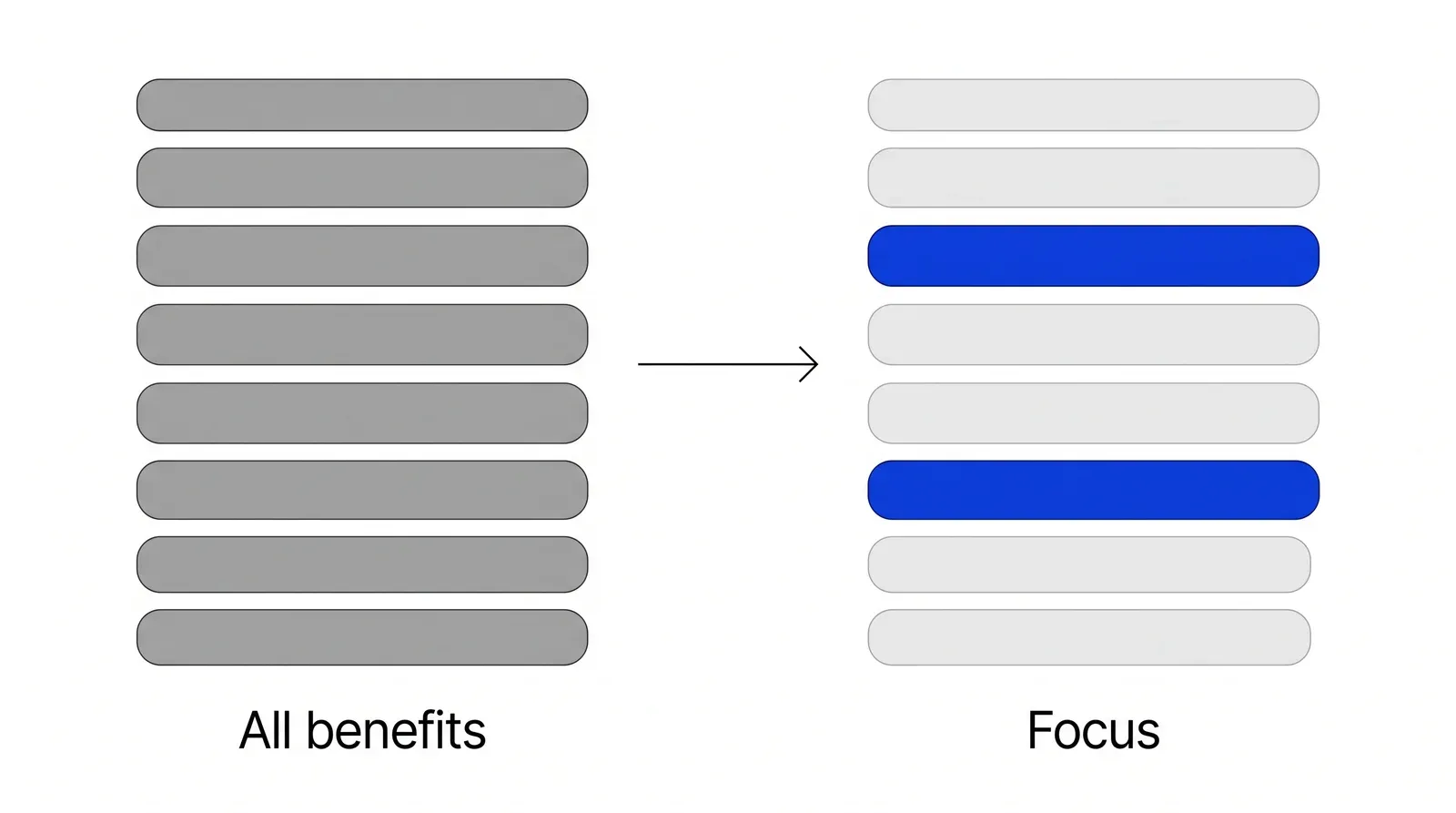
The first is all benefits: list everything good about the offer. The problem is that most of those benefits are points of parity, things the next best alternative also does. The authors describe an engineering firm bidding for a light-rail project that closed its pitch with ten reasons to hire it, most of which the other two finalists could also claim.
The second is favorable points of difference: list everything that beats the alternative. This version falls into what the authors call value presumption, the assumption that any difference must matter to the customer.
The third version, which Anderson, Narus and van Rossum call “resonating focus” and recommend, keeps the one or two points of difference whose improvement would give the customer the most value, plus a point of parity if the customer needs it to consider you at all. Sonoco, a packaging supplier in their study, had six favorable differences for a redesigned package. It chose to lead with two of them and one point of parity: faster filling lines and a better shelf look at the same price as before.
Start from jobs, pains and gains
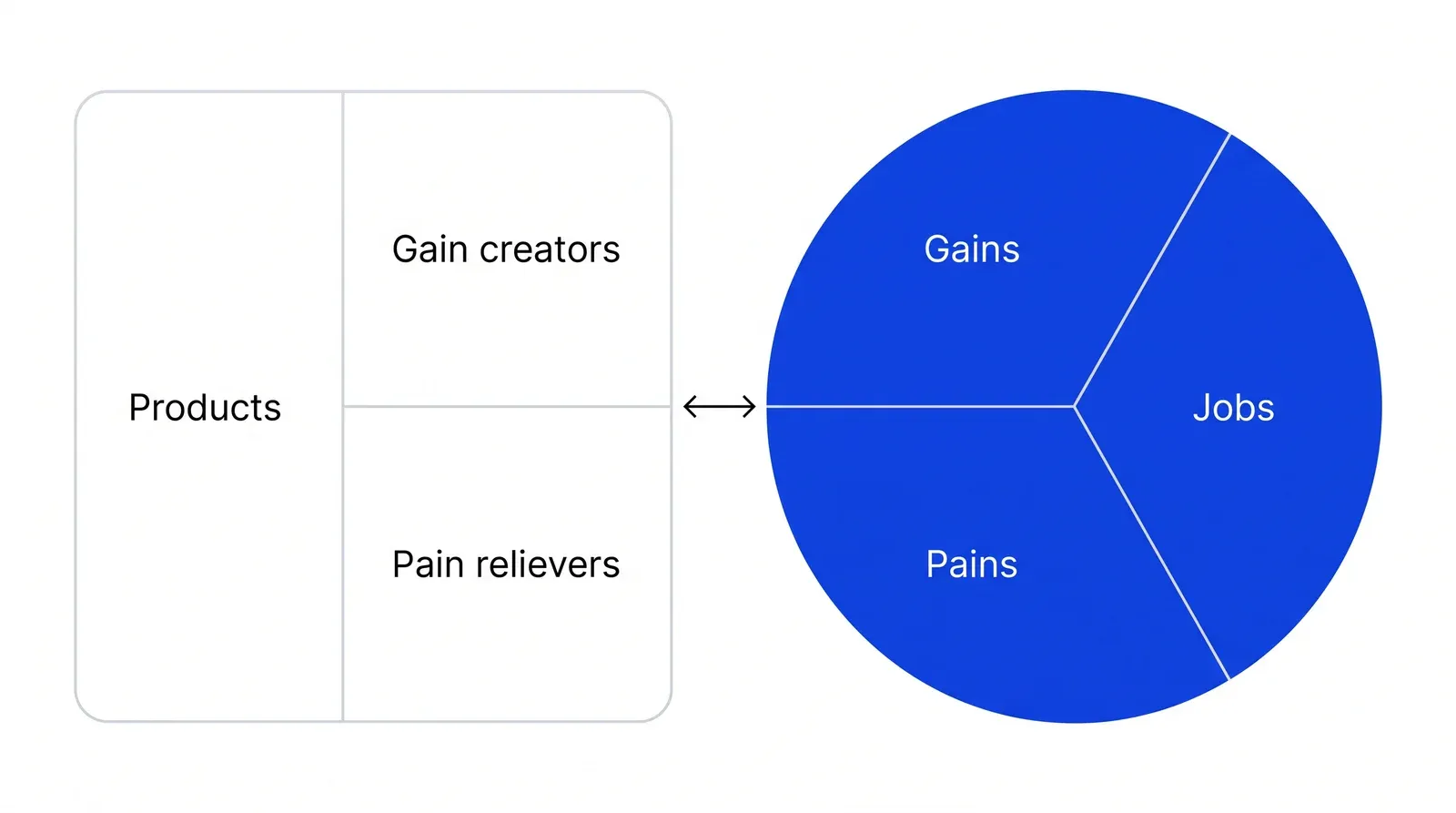
You choose those one or two differences by looking at the customer first. The Value Proposition Canvas from Alexander Osterwalder and Strategyzer splits the work in two. The customer profile lists jobs (what the customer is trying to get done), pains (what gets in the way) and gains (the outcomes they want). The value map lists your products and services, the pain relievers and the gain creators. Fit means the two sides match. Strategyzer’s own page warns that fit is a claim until customers confirm it.
The jobs idea comes from Clayton Christensen and colleagues, who set it out for managers in Harvard Business Review in 2016. The Christensen Institute describes a job as the progress a person is trying to make in a given situation, and says every job has functional, social and emotional sides. A patient with tooth pain wants the pain gone (functional), does not want to miss work in front of colleagues (social) and fears an unknown bill (emotional).
Bain & Company’s Elements of Value research, published in 2016 by Eric Almquist, John Senior and Nicolas Bloch, gives a checklist for the gains side: 30 elements in four groups, functional, emotional, life changing and social impact. A B2B version by Eric Almquist, Jamie Cleghorn and Lori Sherer followed in 2018, with the finding that personal considerations of business buyers matter more as offers become commodities.
Rank jobs, pains and gains by how often and how strongly customers mention them. The proposition should answer the top of each list, not the middle.
Write it, then prove it
A workable draft fits in one or two sentences: who it is for, the main benefit, the cost or effort involved, and why it beats the alternative. Under it, list the evidence for every factual claim.
James Anderson and his co-authors report that buyers hear “We can save you money!” so often that it has become a generic pitch, and one buyer called most such claims fairy tales. Their fix is the value word equation: a formula in the customer’s own terms, such as power cost saved equals kilowatts times hours times price per kilowatt hour, compared with the competitor’s solution. The buyer fills in the numbers and checks the result.
In the United States the Federal Trade Commission has required, under a policy statement dated November 1984, that advertisers have a reasonable basis for objective claims before they make them. In healthcare and financial services, keep to what you can measure and avoid promising outcomes.
How to test it
A value proposition is a hypothesis until customers react to it. Harvard Business School Online, in a 2020 article by Catherine Cote, suggests a first check: give the draft to people who do not know your business and rewrite whatever confuses them. Then show the sentence to people from the segment, take it away, and ask them to say who it is for and what they would get. If they cannot, the wording fails.
Next, run two versions of a landing page, an ad or an outreach email and compare how many people book, sign up or reply. Testing Business Ideas by David Bland and Alexander Osterwalder (2019) catalogues experiments of this kind, in the tradition of the lean start-up method that Steve Blank described in Harvard Business Review in 2013. A lead magnet built around one pain is another cheap test: if nobody downloads it, the pain may rank lower than you thought.
Once a version wins, use it at every point of the customer journey, from the first ad to onboarding. This loop of drafting, testing and rolling out is how Pushers runs growth lab work.
How to apply Value proposition, step by step
- Pick one segment. Write down who the proposition is for in one line: the type of customer, the situation they are in and who signs off on the purchase. A clinic writes 'working adults with tooth pain who cannot take a day off', not 'patients'. The result is a segment narrow enough that one promise can fit all of it.
- List jobs, pains and gains from evidence. From interviews, reviews and sales notes, list what this customer is trying to get done, what gets in the way and what a good outcome looks like. Rank each list by how often customers mention it and how strongly. The result is a short ranked profile built from what customers said, not from what the team assumes.
- Name the next best alternative. Write down what the customer does today if they never meet you: a competitor, a spreadsheet, a bank, doing nothing. Compare your offer with that alternative line by line and mark each benefit as a point of difference or a point of parity. The result is an honest list of where you are better, equal or worse.
- Choose one or two points of difference that matter most. Keep the one or two differences that relieve the top-ranked pains or create the top-ranked gains, plus any point of parity the customer needs before they will consider you at all. Drop the rest from the proposition, even if they are true. The result is a focused claim instead of a feature list.
- Write the sentence and attach the proof. Write one or two sentences: who it is for, the main benefit, the price or effort involved and why it beats the alternative. Under it, list the evidence for every factual claim: a calculation, a measurement, a customer quote. The result is a proposition the sales team can defend when a buyer asks how you know.
- Test it with customers, then roll it out. Show the draft to people from the segment, ask them to explain it back, and run a small market test such as two versions of a landing page or an ad. Keep the version customers understand and act on. The result is a tested proposition that goes into the website, ads, decks and onboarding in the same words.
Examples
A private dental clinic
Illustrative: a clinic sees that most new patients arrive with acute pain and that reviews complain about waiting several days and not knowing the price. Its first draft listed twelve benefits, from modern equipment to free parking. After ranking pains, it keeps two points of difference and one point of parity: 'Tooth pain? We see you today, open until 9 pm, and you see the price of the first visit before you book. Same licensed dentists as any clinic in the city.' To test it, the clinic runs the old and new headline on its booking page for two weeks each. If 1,000 visitors see each version and bookings rise from 30 to 45, that is 3% against 4.5%, and the new version stays. The clinic avoids promising outcomes of treatment, which it cannot guarantee.
A B2B payouts platform
Illustrative: a fintech company sells a payouts API to online marketplaces that pay sellers every week. Interviews with finance leads show the top pain is matching each payout to a bank statement line by hand. The next best alternative is bank wires plus a spreadsheet. The proposition: 'Pay every seller from one API and get each payout matched to your ledger automatically, so month-end close stops depending on manual reconciliation.' The proof is a value word equation the buyer can fill in with their own numbers: hours saved per week equals payouts per week times minutes of manual matching per payout. A marketplace paying 2,000 sellers a week at 3 minutes each spends 6,000 minutes, or 100 hours, a week on matching. The sales team shows the formula, not a promised saving, and asks the buyer to check the inputs.
When to use it
Use it before launching a product, entering a new segment, rewriting a website or building a sales deck, and any time sales, marketing and product describe the offer in different words. It also helps when win rates drop and nobody can say what the customer is choosing instead.
When not to use it
Do not spend days polishing wording before you have talked to customers, since a value proposition written from inside the company is a guess with good grammar. Skip a separate proposition for every small feature release; one per segment is enough. If the company has not yet decided which segment it serves, make that decision first.
Common mistakes
- Listing every benefit the offer has, so the few real differences drown among points every competitor can also claim.
- Assuming any difference from competitors is valuable to the customer, which Anderson, Narus and van Rossum call value presumption.
- Writing a slogan and calling it a value proposition, so the team gets a catchy line but no agreed promise to build and sell.
- Making factual claims such as 'saves 30%' without a calculation or measurement behind them.
- Writing one proposition for 'everyone', which ends up too vague for any single segment to act on.
FAQ
What is a value proposition?
A value proposition is a short statement of what a specific customer gets from your offer, roughly what it costs them and why that beats the option they use today. The term comes from a 1988 McKinsey staff paper by Michael Lanning and Edward Michaels. Teams use it to align product, marketing and sales on one promise.
What is the difference between a value proposition and a USP?
A value proposition states the full promise to one customer segment: benefits, cost and why it beats the alternative. A unique selling proposition, from Rosser Reeves in 1961, is an advertising rule: each ad offers one specific benefit that competitors do not offer. A USP usually expresses one part of a value proposition in an ad.
How do you develop a value proposition?
Start with one customer segment and list their jobs, pains and gains from real interviews and reviews. Compare your offer with what they use today, keep the one or two differences that matter most, write them in one or two sentences with proof, then test the wording with customers before using it everywhere.
What is the Value Proposition Canvas?
The Value Proposition Canvas is a one-page model from Strategyzer, set out in the 2014 book Value Proposition Design by Alexander Osterwalder and co-authors. One side profiles the customer's jobs, pains and gains. The other maps your products, pain relievers and gain creators. Fit means the two sides match, confirmed by customer evidence.
How long should a value proposition be?
Short enough for someone in the segment to repeat it after one reading: usually one or two sentences, with a list of proof points underneath for sales and the website. If it needs a paragraph to explain, the team has probably not chosen which one or two differences matter most.
Sources
- The Open University, OpenLearn, Commercial awareness: references (Lanning and Michaels, 1988, McKinsey Staff Paper no. 41)
- TechTarget, What is a value proposition?
- Open Library, Michael J. Lanning, Delivering Profitable Value, 1998
- Adrian Payne, Pennie Frow and Stoyan Tanev, Interview: Discussing Value Proposition Research, Technology Innovation Management Review 11(4), 2021
- UNSW BusinessThink, Adrian Payne, Three useful things to know about customer value propositions, 2019
- Adrian Payne, Pennie Frow and Andreas Eggert, The customer value proposition: evolution, development, and application in marketing, Journal of the Academy of Marketing Science 45(4), 2017
- Adrian Payne and Pennie Frow, Developing superior value propositions: a strategic marketing imperative, Journal of Service Management 25(2), 2014
- Harvard Business Review, James C. Anderson, James A. Narus and Wouter van Rossum, Customer Value Propositions in Business Markets, 2006
- Strategyzer, The Value Proposition Canvas
- Strategyzer, Who we are (company timeline)
- Strategyzer, Alexander Osterwalder, Mastering value propositions (webinar), 2017
- Wiley, Alexander Osterwalder, Yves Pigneur, Gregory Bernarda and Alan Smith, Value Proposition Design, 2014
- Wiley, Alexander Osterwalder and Yves Pigneur, Business Model Generation, 2010
- Wiley, David J. Bland and Alexander Osterwalder, Testing Business Ideas, 2019
- Harvard Business Review, Clayton M. Christensen, Taddy Hall, Karen Dillon and David S. Duncan, Know Your Customers' Jobs to Be Done, 2016
- Clayton Christensen Institute, Jobs to Be Done
- Harvard Business Review, Eric Almquist, John Senior and Nicolas Bloch, The Elements of Value, 2016
- Bain & Company, The Elements of Value
- Harvard Business Review, Eric Almquist, Jamie Cleghorn and Lori Sherer, The B2B Elements of Value, 2018
- Robert W. Bly, Reality in Advertising (on Rosser Reeves and the USP)
- Stanford University, E145 Entrepreneurial Marketing, Session 4 (Geoffrey Moore's positioning template), 2007
- TechTarget, What is a positioning statement?
- Harvard Business School Online, Catherine Cote, How to Create a Value Proposition
- Harvard Business Review, Steve Blank, Why the Lean Start-Up Changes Everything, 2013
- US Federal Trade Commission, Policy Statement Regarding Advertising Substantiation, 1984
Last updated Oct 9, 2026


Marketing agency or growth system: when a company outgrows its agency
An agency is the right call while the founder still runs most of the company. Once the business starts copying itself into new locations or markets, it needs a system that sets goals, tests hypotheses and owns the result.

Why healthcare marketing agencies stall: the short, mid and long wins model we use with clinics
Most agencies own the click and nobody owns the front desk. How we structure clinic work in three horizons, the research behind each one, and one year of results.

The compliance layer under fintech marketing operations
A fintech marketing agency can build campaigns. It cannot own the compliance review, the KYC drop-off or the multi-market licensing rules that decide whether a lead ever becomes a customer.