Marketing flywheel
The marketing flywheel is a growth model in which satisfied customers, lower costs or wider selection feed the next round of growth, so a company builds momentum by removing friction instead of refilling a funnel.
A marketing flywheel is a growth model in which each part of a business feeds the next, so momentum builds over many turns. Jim Collins introduced the flywheel in Good to Great (2001), Amazon drew its own loop of prices, customers and sellers, and HubSpot's 2018 version recast it as attract, engage and delight, with customers at the centre.
- Origin
- Jim Collins (flywheel effect); Amazon (company flywheel); Brian Halligan, HubSpot (marketing flywheel), 2001; 2001; 2018
- Level
- 401 · Expert
- Fits
- Small and mid-size, Scale-up
- Time to apply
- Half a day to draw a first version; a quarter of data to see whether it turns
- What you need
- a year of customer data: acquisition source, retention, repeat purchase and referrals · the leadership team in one room, including sales, service and finance · agreement on one metric that shows the wheel turning, such as retained revenue or referred customers
A marketing flywheel is a model of growth as a cycle in which each part of the business feeds the next, so effort adds up over many turns instead of starting from zero each month. The idea has three layers. Jim Collins named the flywheel effect in Good to Great in 2001. Amazon turned it into a drawing of its own economics the same year. HubSpot recast it in 2018 as a marketing model with customers at the centre, and that version is what most people mean by flywheel marketing today.
Where the flywheel came from: Collins’ research
Collins’ flywheel is a picture of how companies change, built from a study of company performance. In his 2001 Fast Company article, Collins says his team screened 1,435 companies and kept 11 whose cumulative stock returns ran at least three times the market for 15 years after a turning point. None of the 11 could point to one decisive move. Collins compared the process to pushing a heavy wheel: slow at first, then faster, until momentum carries it. On his concept page he writes that transformations “never happen in one fell swoop.”
The opposite pattern he called the doom loop. Comparison companies launched new programmes, changed direction, hired new leaders and changed direction again, so the wheel never built speed. Warner-Lambert is his example: three restructurings under three chief executives between 1979 and 1998, then acquisition by Pfizer in 2000.
In January 2019 Collins published Turning the Flywheel, a short monograph on how to draw a company’s own flywheel: a few components, each driving the next.
The Amazon flywheel
Amazon’s flywheel is the best-known company version. In an extract from Turning the Flywheel, Collins says Amazon invited him in autumn 2001, during the dot-com bust, and he taught the team the flywheel effect. Brad Stone’s account, quoted there, says Bezos and his lieutenants then sketched their own cycle.
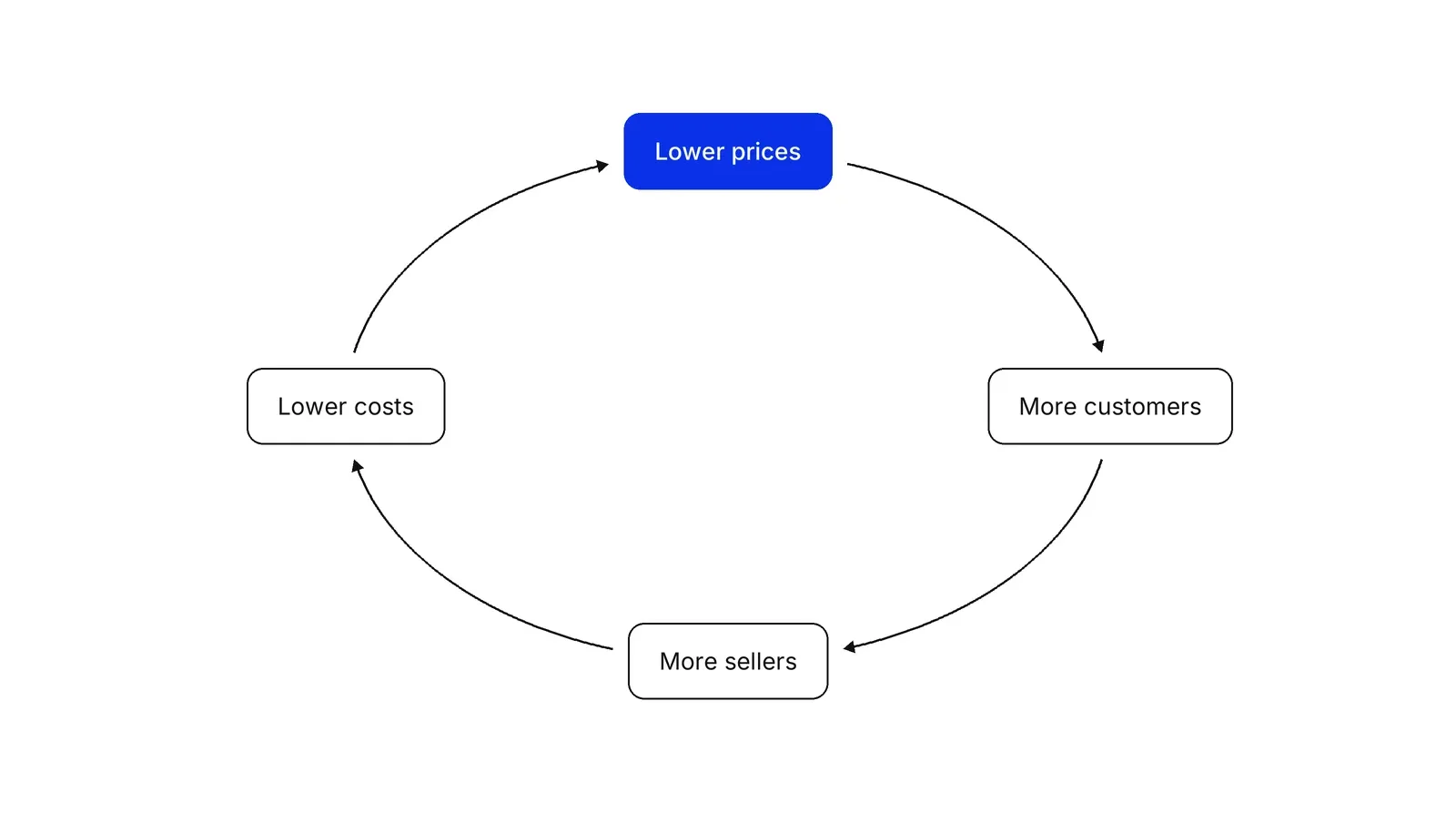
Lower prices bring more customer visits. More customers mean more volume and attract more third-party sellers. Higher volume spreads fixed costs such as warehouses and servers. Lower costs allow lower prices. The often retold detail that Bezos drew it on a napkin does not appear in the accounts we checked, so treat it as legend.
Amazon kept using the term in its own reports. The 2014 shareholder letter said more than 40% of units were sold by over two million third-party sellers, and that this hybrid model “accelerated the Amazon flywheel.” It also described a second loop: “Marketplace pumps energy into Prime, and Prime pumps energy into Marketplace.” The 2015 letter said Prime Video viewers were more likely to convert from a free trial and to renew, which fed “the Prime flywheel.”
HubSpot’s marketing flywheel
HubSpot’s version replaces the sales funnel with a wheel of three stages around the customer. Chief executive Brian Halligan presented it in his keynote at INBOUND 2018, which HubSpot’s own blog records, along with a “flywheel homework” giveaway that ran from 5 to 14 September 2018. A second HubSpot post says plainly: “We introduced it at INBOUND 2018.”
The three stages, per HubSpot’s flywheel page, are attract, engage and delight. Attract means earning attention with useful content. Engage means letting people buy on their own terms. Delight means helping customers succeed so they buy again and refer others. Customers are the energy source here, which is the main break from the marketing funnel, where a customer is the last step.
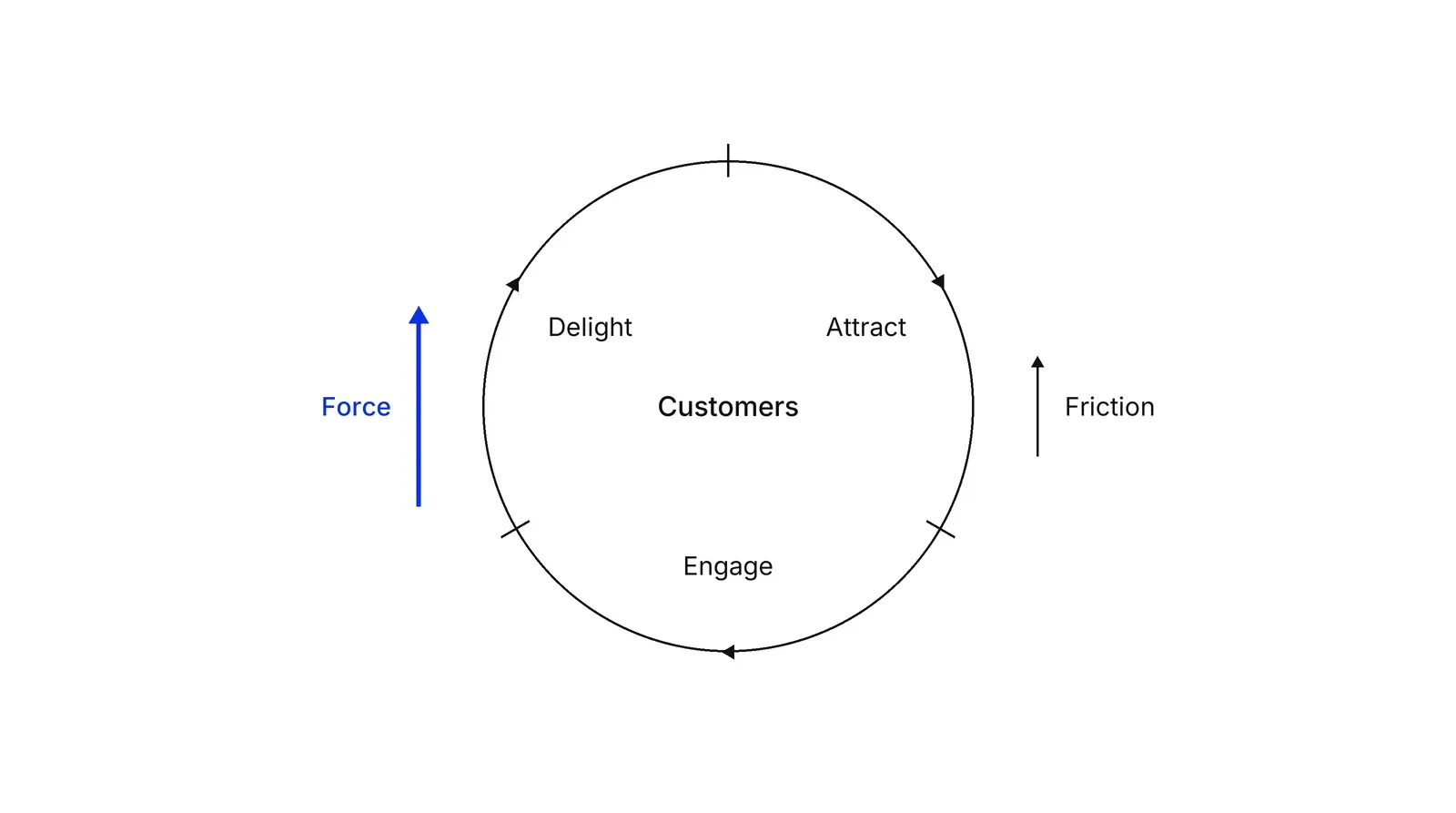
Two more ideas make the model usable. Force is anything that speeds the wheel up: content, a free plan, more investment in service. Friction is anything that slows it: siloed teams, hand-offs, confusing pricing. Jon Dick’s post puts it bluntly: “Friction kills flywheels.” HubSpot’s pages credit James Watt for the physical flywheel and do not mention Collins or Amazon.
How HubSpot measures it
HubSpot’s post gives one metric per stage. Attract is tracked by monthly website traffic. Engage is tracked by free users joining and churning, leads converting to paid, and paying customers churning. Delight is tracked by a quarterly Net Promoter Score survey. Friction shows up as conversion between stages. Those are ordinary metrics; the flywheel only decides which ones the whole company watches together.
Three flywheels compared
The three versions share a name but answer different questions.
| Version | Unit of analysis | What turns the wheel | Main use |
|---|---|---|---|
| Collins (2001, 2019) | The whole company | A few components, each causing the next | Strategy and consistency over years |
| Amazon (2001 onward) | One company’s economics | Price, customers, sellers, unit cost | Deciding where to invest and what to protect |
| HubSpot (2018) | The customer relationship | Attract, engage, delight | Aligning marketing, sales and service |
A flywheel is a strategy picture. If you need conversion rates, cycle times and a forecast, model the cycle as a growth loop instead.
What the evidence supports
The economics behind the HubSpot version hold up: keeping and pleasing customers pays. Gupta, Lehmann and Stuart estimated that a 1% improvement in retention raised firm value by about 5%, against 1% for margin and 0.1% for acquisition cost. Bain’s Fred Reichheld wrote that in financial services a 5% rise in retention produces more than a 25% rise in profit.
Word of mouth also compounds. In a 70-week study of a free web-hosting firm, Villanueva, Yoo and Hanssens found word-of-mouth customers added nearly twice the long-term value of customers won by marketing, as IESE summarised. Kumar, Petersen and Leone add a warning: the customers who buy most are often not the ones who refer most, so delight spend should not go only to top spenders.
Collins’ own research is contested. Niendorf and Beck found the 11 companies’ long-term returns did not differ significantly from the S&P 500 after the book, and Circuit City went bankrupt. Phil Rosenzweig argued the study picked winners first and then read success into their habits, the halo effect, as Knowledge at Wharton reported. The metaphor survives that criticism, but it means a flywheel drawing proves nothing until your own data shows each arrow working.
In Pushers’ Growth Lab work, the flywheel is drawn after the numbers are in, and each arrow carries a metric from the client’s own data.
How to apply Marketing flywheel, step by step
- Write down what actually compounds. List the four to six things that, when they improve, make the next thing easier: lower prices, more repeat buyers, more referrals, more supply, lower unit costs. Keep only items you can show with your own data. Result: a short list of candidate components.
- Put them in a cycle and test every arrow. Arrange the components so each one causes the next, and the last feeds the first. For every arrow, ask what evidence shows that A leads to B in your business. Drop arrows that are hopes. Result: a closed loop of four to six components with a reason under each arrow.
- Pick where to push. Choose the component where extra effort moves the whole wheel most. For Amazon it was price; for a subscription business it is often onboarding or service. Result: one named push point with an owner and a budget.
- Find the friction. Map where customers lose momentum: hand-offs between sales and service, slow onboarding, confusing pricing, unanswered tickets. HubSpot measures friction as conversion between stages. Result: a ranked list of friction points with the stage each one sits in.
- Choose one metric per component. Give each component a number you already track, such as monthly traffic, trial-to-paid conversion, churn, Net Promoter Score or share of new customers who were referred. Result: a one-page scorecard that shows whether the wheel speeds up or slows down.
- Review it quarterly and keep it. Check the scorecard each quarter, remove the worst friction point, and change the drawing only when the business model changes. Collins' point is consistency: many turns in the same direction. Result: a stable flywheel and a quarterly record of what moved it.
Examples
Amazon's retail flywheel
Brad Stone, quoted in Collins' Turning the Flywheel, describes a cycle sketched by Bezos and his lieutenants after Collins visited in autumn 2001: lower prices bring more customer visits, more volume attracts more third-party sellers, scale spreads fixed costs such as fulfilment centres and servers, and lower costs allow lower prices. Amazon's 2014 shareholder letter said more than 40% of units were sold by over two million third-party sellers, and that this hybrid model accelerated the Amazon flywheel.
A dental clinic group's patient flywheel
Illustrative. A group of 4 clinics sees 400 new patients a month. It shortens the wait for a first visit from 10 days to 3, sends treatment plans the same day and asks for a review after each completed plan. If the share of new patients who come by referral rises from 20% to 30%, that is 40 extra referred patients a month at no ad cost, and the money saved funds a fifth hygienist, which shortens waits again.
A payments company's merchant flywheel
Illustrative. A payment provider for online shops cuts onboarding from 5 days to 1 and assigns a support contact to each merchant. Faster onboarding raises sign-up completion; better support lowers churn from 3% to 2% a month, so the average merchant stays 50 months instead of about 33. Longer-lived merchants refer peers in their niche, and the higher volume lowers processing costs, which funds lower fees.
When to use it
Use it when growth depends on customers staying, buying again and recommending you: subscription software, marketplaces, payments, clinics and other repeat-service businesses. It helps a leadership team agree on one causal story of growth, and it is a good frame for moving budget from acquisition to retention and service.
When not to use it
Skip it when you have no repeat purchase and little word of mouth, or before product-market fit, when there is nothing yet to compound. It also does not replace a funnel for diagnosing a specific drop-off, or a growth model with conversion rates when you need to forecast numbers.
Common mistakes
- Drawing a flywheel of wishes. Every arrow needs evidence from your own data that one component drives the next, or the drawing is a slogan.
- Changing the wheel every year. Collins' doom loop is exactly this: new programmes and new directions that never build momentum.
- Copying Amazon's components. Low prices and seller selection fit Amazon's economics; a clinic or a B2B software firm has different drivers.
- Measuring only acquisition. A flywheel slows through churn and poor service long before it shows in lead numbers.
- Leaving friction between teams unowned. HubSpot names silos and hand-offs as main sources of friction, and nobody fixes them unless someone owns the whole cycle.
FAQ
What is a marketing flywheel?
A marketing flywheel is a model of growth as a cycle: you attract people, engage them as customers and delight them so they buy again and recommend you, which attracts more people. HubSpot introduced this version at INBOUND 2018 as an alternative to the sales funnel. The flywheel metaphor itself goes back to Jim Collins' Good to Great.
What is the difference between a flywheel and a funnel?
A funnel ends when a prospect becomes a customer, so each month starts again from the top. A flywheel treats customers as the force that drives the next round of growth through repeat purchases and referrals. HubSpot argued that funnels produce customers but ignore how those customers can help a business grow.
What is the Amazon flywheel?
It is the cycle Bezos and his team sketched after Jim Collins visited Amazon in autumn 2001: lower prices bring more customers, more customers attract more third-party sellers, and the extra volume spreads fixed costs, which allows even lower prices. Amazon's own shareholder letters use the term, for example the letter for 2014.
What are force and friction in the HubSpot flywheel?
Force is any programme that speeds the flywheel up, such as content, a freemium plan or investment in customer service. Friction is anything that slows it down, such as siloed teams, poor hand-offs or confusing pricing. HubSpot measures friction as the conversion rate between stages.
Who created the flywheel concept?
Jim Collins described the flywheel effect in Good to Great (2001) and expanded it in the 2019 monograph Turning the Flywheel. Amazon applied it to its business after Collins met Bezos's team in the autumn the book came out. HubSpot's CEO Brian Halligan turned it into a marketing model at INBOUND 2018.
Sources
- Jim Collins, The Flywheel Effect
- Jim Collins, Good to Great, Fast Company, October 2001
- Jim Collins, Turning the Flywheel (monograph), 2019
- Outlook Business, Escape Velocity (extract from Jim Collins, Turning the Flywheel), 2019
- Amazon.com, 2014 Letter to Shareholders, SEC Exhibit 99.1, 2015
- Amazon.com, 2015 Letter to Shareholders, SEC Exhibit 99.1, 2016
- HubSpot, The Flywheel Model
- Jon Dick, How the Flywheel Killed HubSpot's Funnel, HubSpot, 2018
- Michael Redbord, How to Bend Your Funnel Into a Flywheel, HubSpot
- HubSpot, A Preview of HubSpot's Product Announcements Coming at INBOUND 2018
- Sunil Gupta, Donald R. Lehmann, Jennifer Ames Stuart, Valuing Customers, Journal of Marketing Research 41(1), 2004
- Julian Villanueva, Shijin Yoo, Dominique M. Hanssens, The Impact of Marketing-Induced Versus Word-of-Mouth Customer Acquisition on Customer Equity Growth, Journal of Marketing Research 45(1), 2008
- IESE Insight, Buzz: Better for the Bottom Line, 2008
- Philipp Schmitt, Bernd Skiera, Christophe Van den Bulte, Referral Programs and Customer Value, Journal of Marketing 75(1), 2011
- V. Kumar, J. Andrew Petersen, Robert P. Leone, How Valuable Is Word of Mouth?, Harvard Business Review, 2007
- James L. Heskett et al., Putting the Service-Profit Chain to Work, Harvard Business Review
- Frederick F. Reichheld, The One Number You Need to Grow, Harvard Business Review, 2003
- Fred Reichheld, Prescription for Cutting Costs, Bain & Company, 2001
- Bruce Niendorf, Kristine Beck, Good to Great, or Just Good?, Academy of Management Perspectives 22(4), 2008
- University of Wisconsin Oshkosh, UW Oshkosh professors challenge Good to Great, 2008
- Knowledge at Wharton, The Halo Effect: Debunking Some Hot Business Books with One of His Own, 2007
- Brian Balfour, Casey Winters, Kevin Kwok, Andrew Chen, Growth Loops are the New Funnels, Reforge, 2018
Last updated Oct 9, 2026


Marketing agency or growth system: when a company outgrows its agency
An agency is the right call while the founder still runs most of the company. Once the business starts copying itself into new locations or markets, it needs a system that sets goals, tests hypotheses and owns the result.

Why healthcare marketing agencies stall: the short, mid and long wins model we use with clinics
Most agencies own the click and nobody owns the front desk. How we structure clinic work in three horizons, the research behind each one, and one year of results.

Why channel tests stall after month three
Most paid channel tests do not end with a decision. They end when the budget runs out, the attribution model changes, or everyone quietly stops looking at the dashboard.