Platform strategy and network effects
Platform strategy is a way to grow by connecting groups of users who make each other more valuable, and network effects are the reason it can pay off at scale.
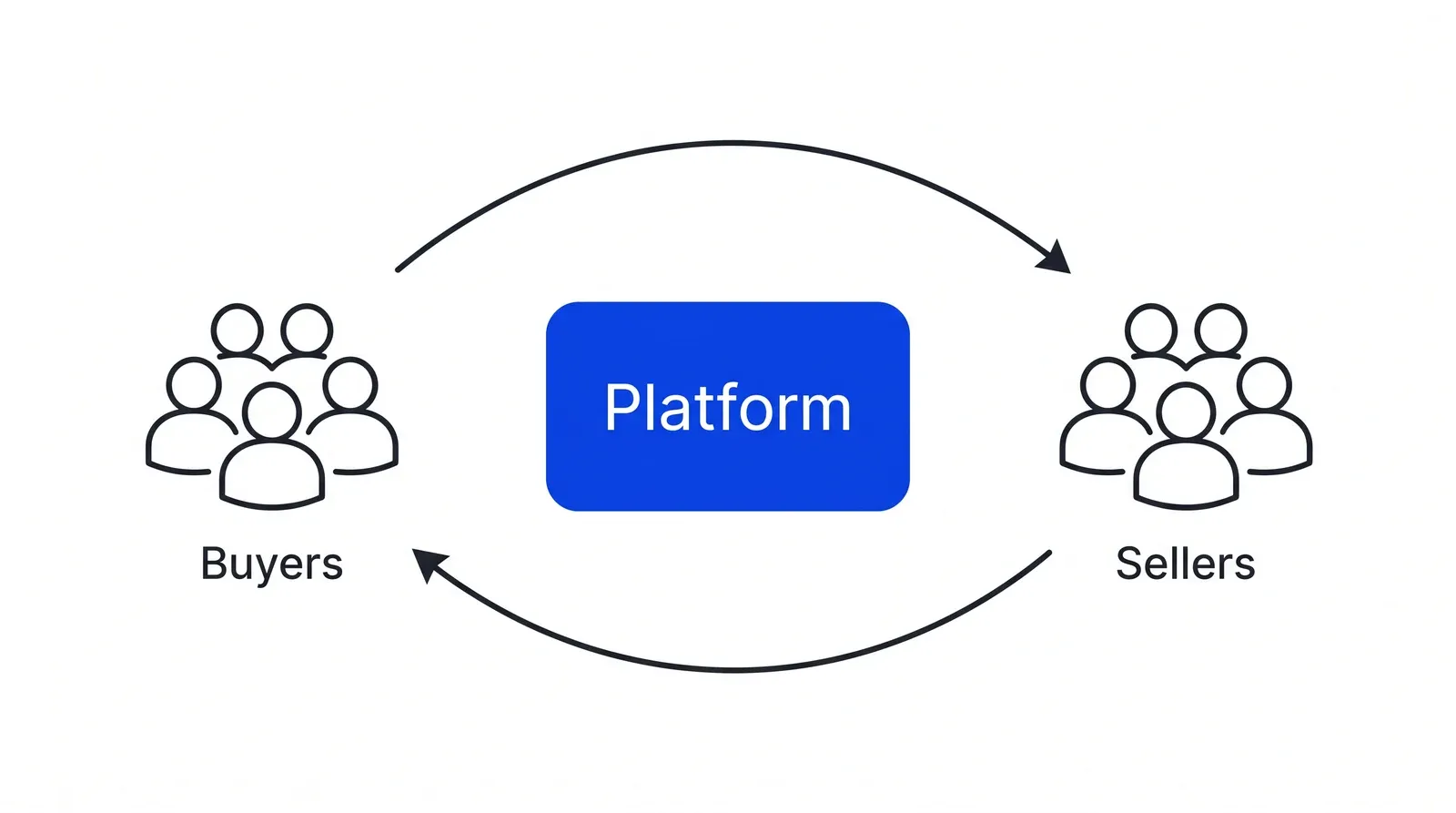
Platform strategy is the practice of building a business that creates value by connecting two or more groups of users, such as buyers and sellers, instead of making and selling a product. It rests on network effects: each user gains more as other users join. The core decisions are which side to subsidize, how to get both sides started and whether one platform will take the whole market.
- Origin
- Jean-Charles Rochet and Jean Tirole (two-sided markets); Thomas Eisenmann, Geoffrey Parker and Marshall Van Alstyne (strategy); Parker, Van Alstyne and Sangeet Paul Choudary (Platform Revolution), 2003; 2006; 2016
- Level
- 301 · Advanced
- Fits
- Startup, Scale-up
- Time to apply
- a half-day workshop for the first map of sides, effects and pricing, then monthly checks on liquidity metrics
- What you need
- a clear list of the user groups your product connects, with who pays today · data on how often a match or transaction happens per user on each side · a rough unit cost of bringing in one more user on each side · one owner who can change prices and rules for both sides
Platform strategy is a way of building a business that makes money by connecting groups of users who need each other, instead of making a product and selling it down a chain. A network effect is what makes it work: the product becomes more valuable to each user as more users join. Card networks link cardholders and merchants, app stores link developers and phone owners, and booking services link patients and clinics.
The ideas come from two lines of work. Economists described network externalities in the 1980s, with Katz and Shapiro’s 1985 paper as a standard reference. In 2003 Rochet and Tirole modelled two-sided markets, where platforms must “get both sides of the market on board.” Tirole won the 2014 Nobel Prize in economics, cited for his analysis of market power and regulation; the citation does not name platforms, though his platform work is part of that body of research. On the strategy side, Eisenmann, Parker and Van Alstyne’s 2006 HBR article turned the economics into management advice, and Parker, Van Alstyne and Choudary expanded it in the 2016 book Platform Revolution.
Pipelines and platforms
A pipeline business creates value in steps and sells the result: costs sit on one side, revenue on the other. A platform has a group of users on each side, and in the words of Eisenmann and colleagues, “cost and revenue are both to the left and the right.” The platform pays to serve both groups and can charge either.
Van Alstyne, Parker and Choudary argued in HBR in 2016 that classic competitive analysis such as Porter’s five forces was written for pipelines. Their opening case: in 2007 five handset makers took about 90% of the industry’s global profits, and then the iPhone arrived with an app store that let outside developers build value for it.
| Pipeline | Platform | |
|---|---|---|
| Creates value by | Making and selling a product | Enabling exchanges between outside producers and consumers |
| Main asset | Owned resources and processes | The users on each side and the rules that connect them |
| Growth limit | Rising cost of each new customer | Value per user rises as both sides grow |
| Key metric | Margin per unit | Share of interactions that end in a match |
The four kinds of network effects
Network effects come in four kinds, set by two questions: does the effect come from the other side or the same side, and does it help or hurt? Eisenmann, Parker and Van Alstyne give an example of each.
| Positive | Negative | |
|---|---|---|
| Cross-side (other group) | Game developers want consoles with many players | TV viewers prefer fewer ads |
| Same-side (own group) | Xbox owners value playing with friends | Sellers prefer fewer rivals on a B2B exchange |
Cross-side effects drive most platforms. Rysman’s 2009 review uses video game consoles and payment cards as the standard cases and notes that in ad-funded media, consumers often dislike the other side.
Negative same-side effects explain failures that look odd at first. Many auto parts makers refused to join Covisint, an exchange set up by carmakers, because more suppliers on one exchange meant more price pressure. The exchange stalled.
Which side should pay?
Most platforms let one side in cheaply and charge the other. Eisenmann and colleagues call them the subsidy side and the money side. Rochet and Tirole make the same point in economic terms: a platform chooses a price structure across sides, not only a price level.
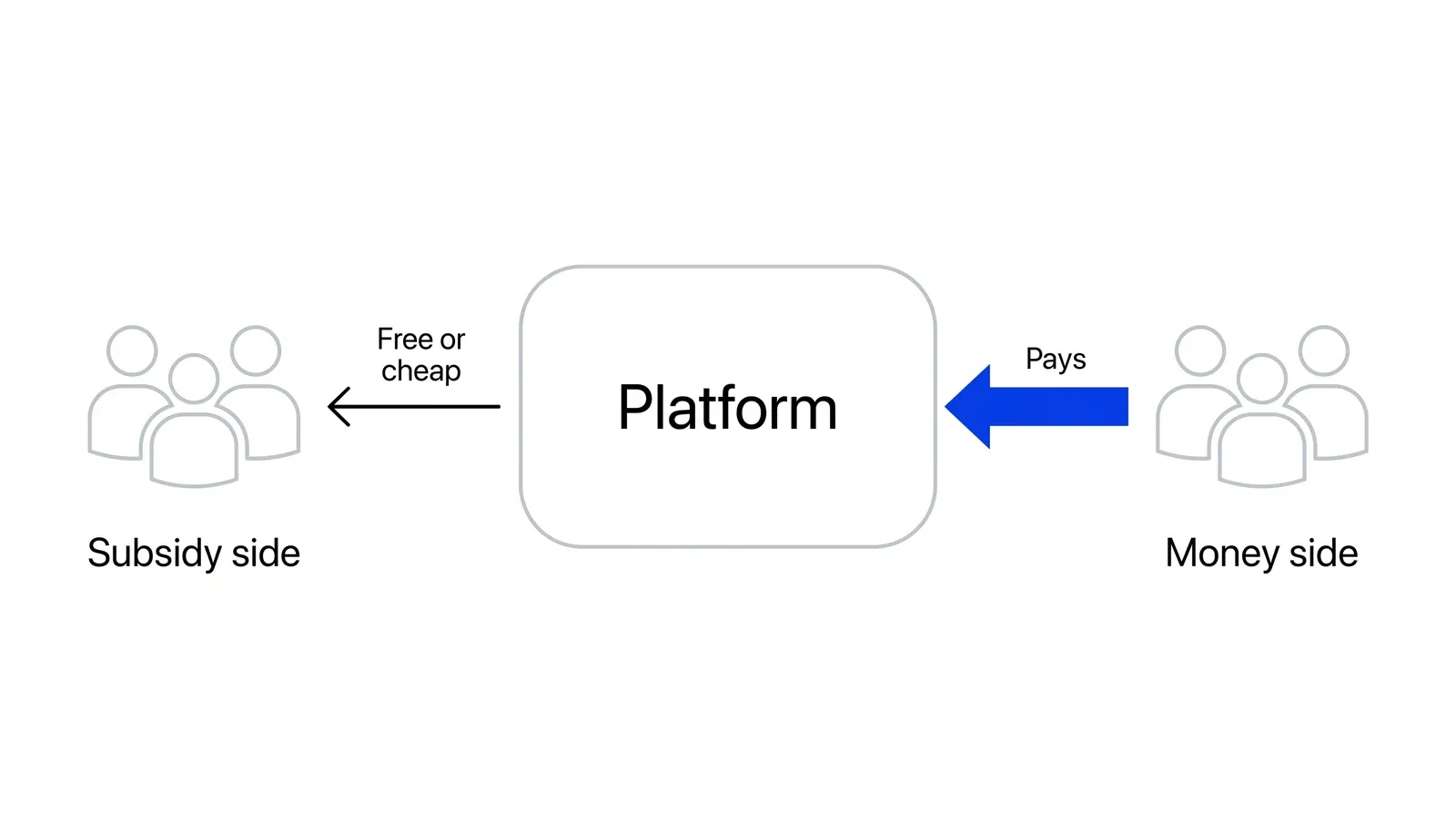
The HBR article gives the rules with cases. Subsidize the more price-sensitive side and charge the side whose demand rises most as the other side grows: Adobe gave Reader to a user base of 500 million and charged the writers who wanted to reach them. Similar-looking markets can flip the model. Console makers price hardware at or below cost and take royalties of up to 20% of a game’s retail price, while PC operating systems charge users and give developers free tools. Apple charged developers $10,000 for Mac development kits while Microsoft gave its kits away, and by the antitrust trial Windows had six times as many applications.
Parker and Van Alstyne’s 2005 paper in Management Science shows that a firm can rationally give one product away permanently, even without a competitor, when the free side raises what the other side will pay. The link to freemium pricing is direct, with one difference: in freemium the free and paying users are usually the same group.
How do you start both sides at once?
Every platform faces the chicken-and-egg problem: buyers will not come without sellers, and sellers will not come without buyers. The term runs through both Rochet and Tirole and Caillaud and Jullien, both published in 2003.
Platform Revolution answers it with design. In an INSEAD summary, the authors start from the core interaction, built from participants, a value unit such as an Airbnb listing, and a filter that shows each user the relevant units. The platform then has three jobs, which the authors name pull, facilitate and match: bring users in, make their exchanges easy with tools and rules, and connect them using data.
Andrew Chen adds a sequencing rule he calls the atomic network: the smallest network that can sustain itself. For Slack it might be fewer than ten people in one company. Uber started with one place and time, a single train station at 5pm, before it covered a city.
When does one platform take the whole market?
A market tends to go to a single platform when three conditions hold, according to Eisenmann, Parker and Van Alstyne: using several platforms is costly for at least one side, network effects are strong and positive, and neither side needs special features. They point to American Express, which earned high margins with only 5% as many cards as Visa because its cards have no preset spending limit, a feature Visa’s lending model cannot match.
Network shape matters too. Zhu and Iansiti separate markets made of local clusters, where buyers care mostly about nearby providers, from interconnected ones. Ride-hailing is local: a rider in one city gains nothing from drivers in another, so a rival can attack city by city. Their 2021 paper adds that stronger network effects tend to lower an entrant’s profit.
How strong is a network effect?
Nobody has settled how fast value grows. Bob Metcalfe’s law says value grows with the square of users. Briscoe, Odlyzko and Tilly argued in 2006 that most possible connections are rarely used, so value grows closer to n log n. Metcalfe answered in 2013 by fitting his law to Facebook’s revenue. For planning, measure your own effect: does match rate or repeat use rise as a market fills up?
Why platforms still fail
Network effects make a platform hard to dislodge once it leads, but they do not make it profitable. Hagiu and Rothman report gross margins of about 70% at eBay and 60% at Etsy, and still argue that network effects alone do not guarantee success. Yoffie, Gawer and Cusumano studied more than 250 platforms and found they fail at an alarming rate.
Leaders also face envelopment: a platform from a nearby market bundles your function into its own offer. Microsoft did this to RealNetworks by shipping a free streaming server with Windows NT. By 2003, 42% of North American internet users named Windows Media Player as their main player, against 19% for Real’s. In Pushers’ Growth Lab work, this map of sides comes before any channel plan, because growth spent on the wrong side buys users who attract nobody.
How to apply Platform strategy and network effects, step by step
- Name the sides and the core interaction. Write down each user group and the one exchange the platform exists for: a ride, a booking, a payment, a listing viewed. Name the value unit (the listing, the trip) and the filter that decides who sees what. Result: one sentence of the form 'producer X gives value unit Y to consumer Z, matched by filter F'.
- Map the network effects. For each side, ask whether more users on the other side make it more or less attractive (cross-side), and whether more users on its own side help or hurt (same-side). Sellers often dislike more rival sellers. Result: a four-cell table with a plus, minus or zero in each cell and one line of evidence for each.
- Choose the subsidy side and the money side. Subsidize the side that is more price sensitive and whose presence the other side values most; charge the side whose demand grows most as the other side grows. Check that the subsidy cannot be captured by a rival's money side, and that each free user does not carry a real unit cost. Result: a price for each side and a written reason for it.
- Build one atomic network first. Pick the smallest market where both sides can find enough of each other to keep coming back: one city district, one clinic network, one corridor of payments. Seed the harder side by hand if needed. Result: a defined launch market with a target ratio of supply to demand and a date to review it.
- Track liquidity, not sign-ups. Measure the share of searches or requests that end in a match, time to match and repeat use on both sides. Sign-ups on one side mean little if the other side cannot find them. Result: a weekly dashboard of three or four liquidity metrics per market.
- Test whether the market tips to one winner. Check the three conditions Eisenmann, Parker and Van Alstyne set out: high multi-homing costs for at least one side, strong positive network effects, and no strong demand for special features. If all three hold, decide whether to fight for the market or share a standard. Result: a written call on fight, share or niche, with the condition that would change it.
Examples
M-PESA and the agent network in Kenya
Safaricom launched M-PESA in March 2007. Customers need agents to turn cash into e-money and back, and agents need enough customers to earn commission, which is a cross-side effect. Jack and Suri's NBER study reports that agent numbers lagged in the first year, so users per agent rose from about 200 to 1,000. Agent growth then sped up, the ratio fell to about 600 by mid-2009, and by late 2009 more than two-thirds of Kenyan households had a member using the service. The authors credit part of that success to the fast-growing agent network.
HMOs: patients on the subsidy side, doctors on the money side
Eisenmann, Parker and Van Alstyne list health maintenance organizations as a two-sided network. Patients are the subsidy side. Doctors accept rates below what they could charge alone in exchange for access to a larger volume of patients. The same logic applies to any clinic network or booking service: the side that brings volume gets the better terms, and the side that wants the volume pays for it in price or fees.
A physiotherapy booking app choosing its first market
Illustrative, no real company implied. A booking app connects physiotherapists and patients across a country. Spread thin, each patient sees two therapists within 5 km and books rarely. The team narrows to one city of about a million people and signs 60 therapists by hand. If each therapist has 20 open slots a week, that is 1200 slots. At a 30% fill rate the city needs about 360 bookings a week to keep therapists listed, so patient marketing targets that one city until it gets there. Only then does the team copy the model to a second city.
When to use it
Use it when your product connects groups that need each other, such as buyers and sellers, patients and providers, merchants and cardholders, or developers and users, and when one group's growth visibly changes how the other behaves. It is also the right lens when a rival gives away one side of the market, or when you are deciding whether to open your product to third parties.
When not to use it
Skip it for a product whose value to each customer does not change with the number of other customers, such as most professional services or a single-seller online store. Calling such a business a platform invites subsidies with no network effect to recover them. It is also a poor first tool before you have one interaction that users repeat on their own.
Common mistakes
- Counting registered users on both sides instead of matches. A marketplace with ten thousand sellers and no buyers in their area has no network effect.
- Subsidizing the side whose presence a rival can use for free, as Netscape did when it gave away browsers and web site operators bought rivals' servers anyway.
- Giving away something with a real unit cost before the money side proves it will pay. FreePC gave consumers free computers in return for watching ads, found few advertisers wanted that audience and dropped the offer after heavy losses.
- Assuming the market will tip to one winner when users can multi-home cheaply, as riders and drivers do across ride-hailing apps.
- Launching everywhere at once, so no single market reaches the density where both sides find each other.
FAQ
What is a network effect in economics?
A network effect exists when a product becomes more valuable to each user as more people use it. Economists also call it a network externality; Katz and Shapiro's 1985 paper in the American Economic Review is a standard starting point. A telephone is the classic case: one phone is useless, and each new subscriber makes every other phone more useful.
What is the network effect of digital platforms?
On a digital platform the main effect usually runs between sides: more sellers attract more buyers, and more buyers attract more sellers. Economists call these cross-side or indirect network effects. Same-side effects also exist, positive for gamers who want friends on the same console and negative for sellers who face more rivals.
What is the difference between direct and indirect network effects?
Direct network effects come from users of the same kind: a messaging app is worth more when more of your friends use it. Indirect, or cross-side, effects come from the other group on the platform: a payment card is worth more to cardholders when more merchants accept it, and to merchants when more people carry it.
Is Metcalfe's law true?
Metcalfe's law says a network's value grows with the square of its users. Briscoe, Odlyzko and Tilly argued in IEEE Spectrum that most connections are rarely used, so value grows closer to n log n. Metcalfe later replied with a fit to Facebook revenue. Treat any formula as a rough guide.
Sources
- Thomas Eisenmann, Geoffrey Parker, Marshall W. Van Alstyne, Strategies for Two-Sided Markets, Harvard Business Review, October 2006
- Marshall W. Van Alstyne, Geoffrey G. Parker, Sangeet Paul Choudary, Pipelines, Platforms, and the New Rules of Strategy, Harvard Business Review, April 2016
- Geoffrey G. Parker, Marshall W. Van Alstyne, Sangeet Paul Choudary, Platform Revolution, W. W. Norton, 2016
- INSEAD Knowledge, Sangeet Paul Choudary, Geoffrey Parker, Marshall Van Alstyne, How to build a successful platform business, 2016
- Geoffrey G. Parker, Marshall W. Van Alstyne, Two-Sided Network Effects: A Theory of Information Product Design, Management Science 51(10), 2005
- Thomas Eisenmann, Geoffrey Parker, Marshall Van Alstyne, Platform envelopment, Strategic Management Journal 32(12), 2011
- Jean-Charles Rochet, Jean Tirole, Platform Competition in Two-Sided Markets, Journal of the European Economic Association 1(4), 2003
- Jean-Charles Rochet, Jean Tirole, Two-sided markets: a progress report, RAND Journal of Economics 37(3), 2006
- Nobel Prize Outreach, The Prize in Economic Sciences 2014, press release
- Econlib, Jean Tirole biography, The Concise Encyclopedia of Economics
- Michael L. Katz, Carl Shapiro, Network Externalities, Competition, and Compatibility, American Economic Review 75(3), 1985
- Marc Rysman, The Economics of Two-Sided Markets, Journal of Economic Perspectives 23(3), 2009
- Mark Armstrong, Competition in two-sided markets, RAND Journal of Economics 37(3), 2006
- Bernard Caillaud, Bruno Jullien, Chicken & Egg: Competition among Intermediation Service Providers, RAND Journal of Economics 34(2), 2003
- Andrei Hagiu, Julian Wright, Multi-sided platforms, International Journal of Industrial Organization 43, 2015
- Annabelle Gawer, Michael A. Cusumano, Industry Platforms and Ecosystem Innovation, Journal of Product Innovation Management 31(3), 2014
- Feng Zhu, Marco Iansiti, Why Some Platforms Thrive and Others Don't, Harvard Business Review, January-February 2019
- Feng Zhu, Xinxin Li, Ehsan Valavi, Marco Iansiti, Network Interconnectivity and Entry into Platform Markets, Information Systems Research 32(3), 2021
- Harvard Kennedy School, M-RCBG, Feng Zhu and Marco Iansiti, Network Structures and Entry into Platform Markets, 2018
- Andrei Hagiu, Simon Rothman, Network Effects Aren't Enough, Harvard Business Review, April 2016
- David B. Yoffie, Annabelle Gawer, Michael A. Cusumano, A Study of More Than 250 Platforms Reveals Why Most Fail, Harvard Business Review, May 2019
- Michael A. Cusumano, David B. Yoffie, Annabelle Gawer, The Future of Platforms, MIT Sloan Management Review, February 2020
- Bob Briscoe, Andrew Odlyzko, Benjamin Tilly, Metcalfe's Law Is Wrong, IEEE Spectrum, July 2006
- Bob Metcalfe, Metcalfe's Law after 40 Years of Ethernet, IEEE Computer 46(12), 2013
- William Jack, Tavneet Suri, Mobile Money: The Economics of M-PESA, NBER Working Paper 16721, 2011
- Andrew Chen, The Atomic Network, excerpt from The Cold Start Problem, Lenny's Newsletter, December 2021
Last updated Oct 9, 2026


Marketing agency or growth system: when a company outgrows its agency
An agency is the right call while the founder still runs most of the company. Once the business starts copying itself into new locations or markets, it needs a system that sets goals, tests hypotheses and owns the result.

Why healthcare marketing agencies stall: the short, mid and long wins model we use with clinics
Most agencies own the click and nobody owns the front desk. How we structure clinic work in three horizons, the research behind each one, and one year of results.

Why channel tests stall after month three
Most paid channel tests do not end with a decision. They end when the budget runs out, the attribution model changes, or everyone quietly stops looking at the dashboard.