MECE
MECE, short for mutually exclusive, collectively exhaustive, is a rule for splitting a problem or a total into parts so that every item falls into exactly one part.
MECE (mutually exclusive, collectively exhaustive) is a rule for breaking a problem or a total into parts so that no item sits in two parts and no item sits in none. It is the logic of a mathematical partition. Teams use it to avoid double counting and blind spots, and it works best when each split uses one clear criterion.
- Origin
- Barbara Minto at McKinsey, who credits Aristotle for the underlying idea, undated by Minto; secondary sources say late 1960s to 1970s
- Level
- 201 · Tool
- Fits
- Small and mid-size, Scale-up, Enterprise
- Time to apply
- 20 minutes for one breakdown, plus a sample check on real data
- What you need
- one total or question to split, such as new patients last month · a sample of 20 to 50 real items to place into the parts
MECE is a rule for splitting a whole into parts so that every item lands in exactly one part. Mutually exclusive means no overlaps. Collectively exhaustive means no gaps. Consultants use it to structure problems, and analysts use it whenever a report has to add up.
Where does MECE come from?
Barbara Minto, a McKinsey consultant, is credited with the term, and the story is less tidy than the credit. In a McKinsey alumni interview titled “I invented it”, she first claims the term and then corrects herself: the idea goes back to Aristotle, and her contribution was to abbreviate it and apply it to groups of ideas. We could not check the Aristotle link beyond her own statement.
Minto presents it as part of her Pyramid Principle, a method for structuring writing and thinking. Her own site describes the pyramid as built by grouping related ideas under one point, and the interview says the structure rests on three logical rules, with MECE covering how ideas are grouped. The earliest edition of her book we can document is from 1981 (Internet Archive record, London, Minto International), and her textbook page lists a 1996 edition that supersedes the earlier ones. Neither the interview nor her site dates the coining. Secondary sources place it in the late 1960s or the 1970s, so treat any exact year with caution.
The mathematics behind it: a partition
A MECE split is what mathematicians call a partition. A partition of a set X is a collection of nonempty, mutually disjoint subsets whose union is all of X, in the definition from W. Edwin Clark’s algebra text; MathWorld gives the same picture of disjoint subsets that make up the whole. Disjoint is the exclusive half. Union equal to X is the exhaustive half.
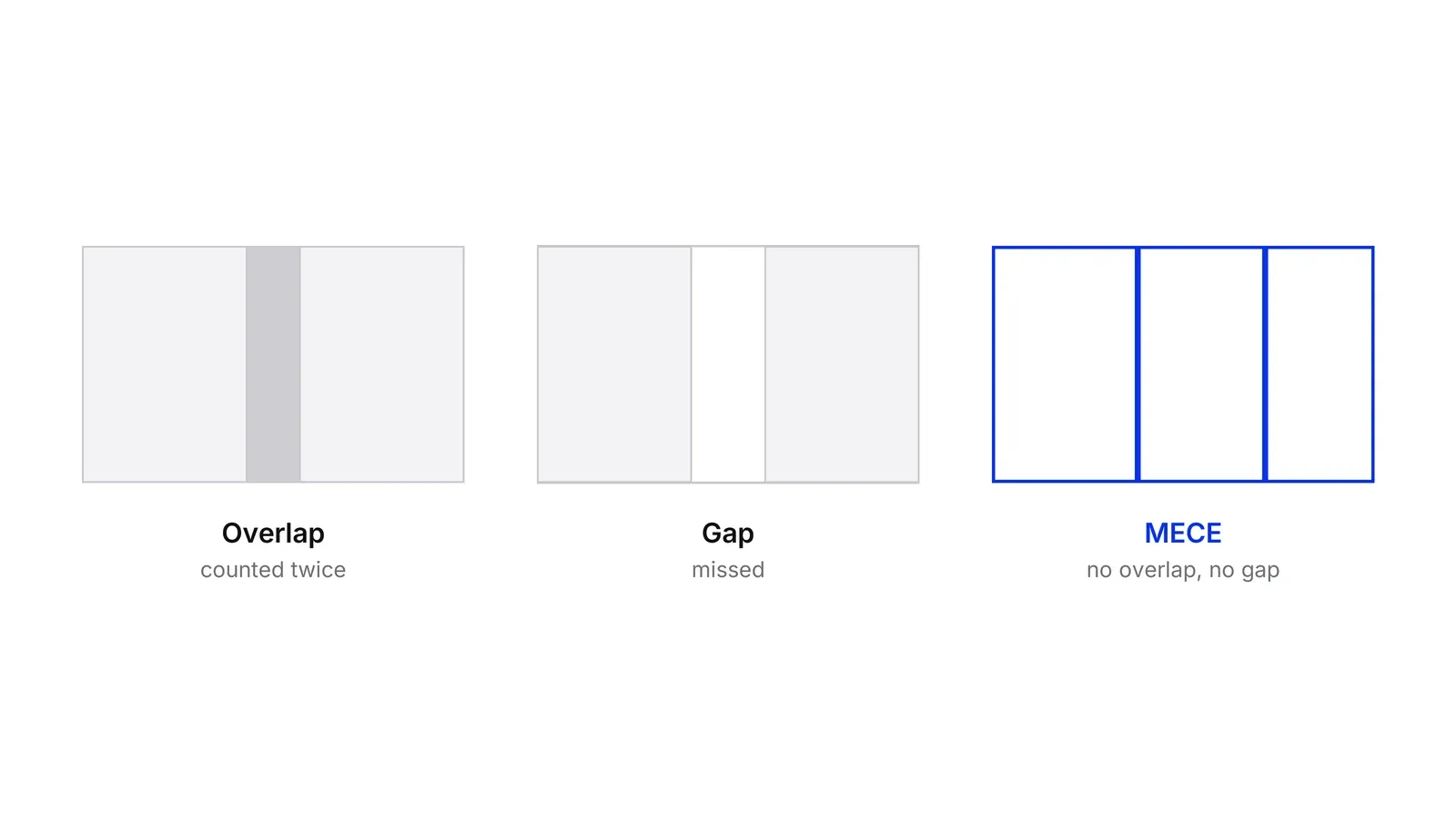
The same text proves a useful link: every partition corresponds to an equivalence relation, where two items are related when they sit in the same part. In plain terms, a clean split is a sort by one attribute. Two items belong together when they have the same value of it. That is why one criterion per level matters.
The maths also explains why overlaps spoil totals. For two sets, the size of the union is the sum of the sizes minus the size of the overlap, so adding the parts gives the total only when the overlap is empty (Joy Morris, Combinatorics). Probability uses the same condition. MIT’s 18.05 notes state the law of total probability for events that are disjoint and cover the whole sample space.
How to test a breakdown
Three tests catch most failures. Run them on real items, not on the labels.
- One criterion. Every part at a level comes from the same attribute. A split of customers into “delivery” and “college students” fails here, because the first part is about how they buy and the second about who they are.
- Overlap. Find an item that fits two parts. Dartmouth’s career centre uses that pizza case: a college student can order delivery, so one person lands in both parts. The fix is a rule or a better criterion.
- Gap. Place the whole sample and check that the counts sum to the total. The same pizza split also misses dine-in high school students, and Dartmouth’s guide notes that dine-in, take-out and delivery place every customer in one category.
A fourth check applies to levers. A Boston University workshop deck warns that “increase retention” and “grow the total number of customers” are not MECE, since retention adds to the total. “Retain existing customers” and “win new ones” are.
Keep each level short. George Miller’s 1956 paper put the limit of absolute judgment at about seven categories, which is a rough guide for how many parts a reader can hold.
MECE splits in marketing
| Split | Criterion | Where it breaks | Fix |
|---|---|---|---|
| Funnel stage | Furthest stage reached | People move back and forth | Assign each person to the furthest stage reached on a date |
| Channel | First or credited source | One sale has several touchpoints | Fix one attribution rule and keep an Unassigned bucket |
| Segment | Behaviour or need | One buyer fits two segments | One criterion, such as new versus returning |
| Revenue | Terms of a formula | Terms influence each other | Treat the terms as an identity, not as independent levers |
Funnel stages overlap in practice. Google’s research on the messy middle (Alistair Rennie and Jonny Protheroe, 2020) states that what happens between trigger and purchase is not linear, with shoppers looping between exploring and evaluating. A funnel report still works if its rule is explicit: each person counts once, at the furthest stage reached by the report date.
Channels need a catch-all and a rule. Google Analytics assigns events that match no rule to Unassigned, which is the gap bucket made visible. A conversion usually has several touchpoints, and GA4 attribution offers a data-driven model that spreads credit across them and last-click models that give all credit to one channel. Choose one model, or the same sale will look different in different reports.
Segments by profile are fragile. Daniel Yankelovich and David Meer argued in Harvard Business Review in February 2006 that psychographic profiling had drifted from the purpose of segmentation, which is to find customers whose behaviour can change or whose needs go unmet. A segment tied to behaviour is easier to keep exclusive.
The revenue formula is the cleanest case. Revenue equals visits times conversion rate times average order value. Conversion rate is orders divided by visits, and order value is revenue divided by orders, so the terms cancel back to revenue.
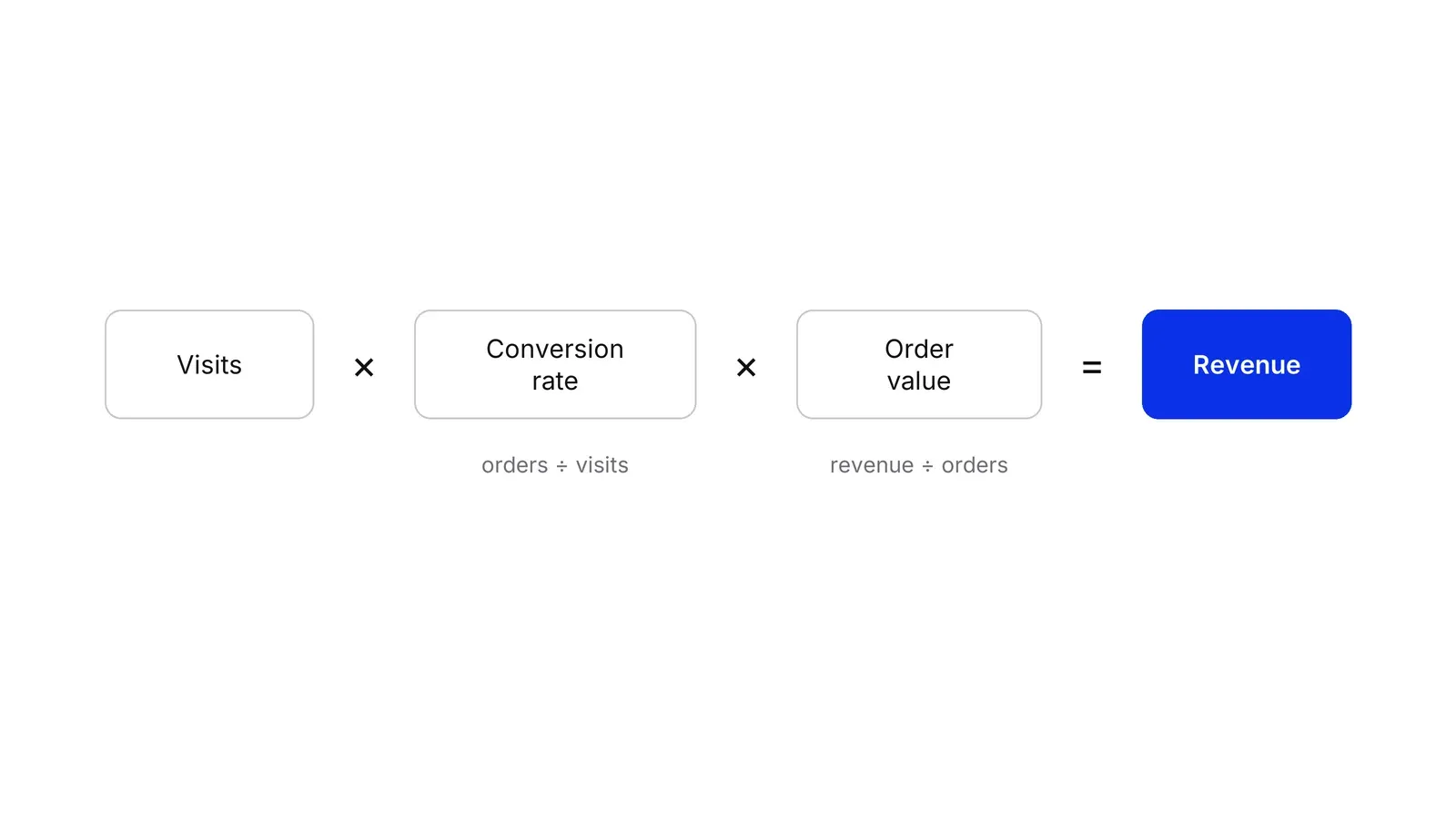
Multiply the three terms for any month and the result is that month’s revenue, to the last cent. The split is exhaustive by construction. It is not a guarantee of independence, because a discount can raise conversion and lower order value at once. A KPI tree extends this identity downward, for example by splitting visits into channels.
Where MECE breaks down
Real categories rarely behave like sets. Bowker and Star list three ideals of a classification system: consistent principles, mutually exclusive categories and completeness. They argue that real systems fall short of all three, and use the International Classification of Diseases as an example, which draws on several principles that are not mutually exclusive. Psychology points the same way. Rosch and Mervis found that members of natural categories resemble each other through overlapping features, with some members more typical than others, and the Stanford Encyclopedia of Philosophy describes membership under this view as graded.
Strict exclusivity can also be the wrong goal. Arnaud Chevallier of IMD argues that collective exhaustiveness matters most, and that forcing options to exclude each other can add artificial branches. In a companion post he prefers independent options, which can be pursued separately, and accepts intentional redundancy.
A neat tree can mislead as well. In a 1978 study, Fischhoff, Slovic and Lichtenstein showed college students and experienced garage mechanics fault trees of four to eight branches for a car that fails to start. Both groups were quite insensitive to what had been left out, including a branch labelled “all other problems”, and a branch’s perceived importance rose when it was shown in two pieces. Splitting changes judgment, so the same total can look different under different trees.
Fixed grids such as a SWOT analysis need the overlap test too, because one item often fits two boxes. For the cause of a single failure, a 5 whys chain or an Ishikawa diagram follows the evidence instead of a structure. A Growth Lab plan can start from a revenue breakdown that passes the three tests above.
How to apply MECE, step by step
- Define the whole. Write the exact total you are splitting: new patients last month, revenue this quarter, reasons customers cancelled. Fix the period and the unit. Result: one line that says what is inside the whole.
- Choose one criterion. Pick a single attribute to split by, such as first source of contact, funnel stage reached, or a term of a formula. Mixing two attributes in one level is the usual cause of overlaps. Result: a named criterion for this level.
- List the parts and add a catch-all. Write the parts, then add an explicit other bucket and measure its size. Result: a first draft in which every item has somewhere to go.
- Test for overlaps. Take real items and try to place each in two parts. Every item that fits twice shows a boundary to redefine, or a rule that assigns it to one part. Result: a short list of tie-break rules.
- Test for gaps. Place the whole sample. Count the items in each part and check that the counts add up to the total. If other is large, split it. Result: parts that sum to the whole.
- Go one level down. Repeat the same steps inside each part, and stop when a branch is something you can measure or act on. Result: a tree whose every level passes the same tests.
Examples
A dental clinic and its new patients
Illustrative. A clinic had 400 new patients last month and asks where they came from. Draft split: web search 120, map listing 90, patient referrals 80, doctor referrals 40, ads 30, other 40. The counts sum to 400, so there is no gap. The overlap test fails at once: a patient who was referred and then found the clinic on the map fits two rows. The fix is a rule, such as recording the first source the patient names, and the split passes.
A payments startup and falling revenue
Illustrative. Monthly fee revenue equals active merchants times payments per merchant times average payment size times fee rate. With 500 merchants, 40 payments each, an average payment of 250 dollars and a 1.5% fee, revenue is 75,000 dollars. The formula is an identity, so it has no gap by construction. If revenue falls 10%, the team checks which of the four terms moved. The one definition to fix first is active merchant, or two reports will disagree.
When to use it
Use it when you structure a problem before analysing it, build a report where parts must add up to a total, or sort causes, options or customers into groups. It helps most when several people will fill in the same structure and need rules for borderline items.
When not to use it
Skip strict exclusivity when the options can be combined: raising retention and cutting costs are both pursued at once. Do not use it to prove that a list is complete, since a tidy tree can still miss a cause nobody thought of. For finding the cause of one failure, a 5 whys or fishbone chain fits better.
Common mistakes
- Mixing criteria in one level, such as splitting customers by size and then by industry in the same list. Each level needs one criterion.
- Hiding gaps in a large other bucket. If other holds more than the smallest named part, split it.
- Mixing levels, with a broad part like paid media beside a narrow one like one campaign. Parts at one level should be the same kind of thing.
- Checking the structure only on paper. Run the sample of real items through it, because overlaps show up when real items arrive.
- Treating a MECE tree as an answer. It organises the search; the evidence still has to say which branch matters.
FAQ
What does MECE stand for?
MECE stands for mutually exclusive, collectively exhaustive. Mutually exclusive means the parts do not overlap, so an item belongs to only one. Collectively exhaustive means the parts together cover the whole, so no item is left out. Minto says it is pronounced with one syllable, rhyming with niece, though many people say mee-see.
Who invented MECE?
Barbara Minto, a McKinsey consultant, is credited with the term. In a McKinsey alumni interview she first said she invented it, then corrected herself and credited Aristotle, adding that she was the first to abbreviate it and apply it to groups of ideas. The interview gives no date, and secondary sources disagree on when.
How do you check that a breakdown is MECE?
Use one criterion per level. Then take 20 to 50 real items and try to place each in two parts, which tests overlaps. Place all of them once and check that the counts sum to the total, which tests gaps. Any item that fits twice or fits nowhere shows what to redefine.
What is a MECE example in marketing?
Revenue equals visits times conversion rate times average order value. Conversion rate is orders divided by visits and order value is revenue divided by orders, so the terms multiply back to revenue with nothing missing. Another is new versus returning customers, which splits every customer into exactly one group for a given period.
Is MECE always necessary?
No. Arnaud Chevallier of IMD argues that collective exhaustiveness matters most and that strict exclusivity is often unnecessary, because options that can be pursued together are not exclusive. Intentional overlap, such as backup systems, can be useful. What matters is that overlaps are chosen and counted once, not hidden.
Sources
- McKinsey Alumni Center, Barbara Minto: MECE, I invented it, so I get to say how to pronounce it
- Barbara Minto, The Minto Pyramid Principle, concept page
- Barbara Minto, The Pyramid Principle: Logic in Writing and Thinking, Minto International, London, 1981, Internet Archive record
- Barbara Minto, The Minto Pyramid Principle, textbook page (1996 edition)
- W. Edwin Clark, Partitions and Equivalence Relations, Elementary Abstract Algebra, Mathematics LibreTexts
- Wolfram MathWorld, Set Partition
- Joy Morris, Inclusion-Exclusion, Combinatorics, Mathematics LibreTexts
- MIT OpenCourseWare 18.05, Conditional Probability, Independence and Bayes' Theorem, Spring 2022
- Geoffrey Bowker and Susan Leigh Star, Sorting Things Out: Classification and Its Consequences, MIT Press, 1999 (author's page)
- Eleanor Rosch and Carolyn Mervis, Family resemblances: studies in the internal structure of categories, Cognitive Psychology 7(4), 1975
- Stanford Encyclopedia of Philosophy, Concepts, section on prototype theory
- Google Analytics Help, Default channel group
- Google Analytics Help, Attribution overview
- Alistair Rennie and Jonny Protheroe, Google, Navigating purchase behavior and decision-making (the messy middle), 2020
- Daniel Yankelovich and David Meer, Rediscovering Market Segmentation, Harvard Business Review, February 2006
- Baruch Fischhoff, Paul Slovic and Sarah Lichtenstein, Fault trees: sensitivity of estimated failure probabilities to problem representation, Journal of Experimental Psychology: Human Perception and Performance 4(2), 1978
- Arnaud Chevallier, IMD, Be more MECE
- Arnaud Chevallier, IMD, Don't overdo that MECE thing
- Dartmouth Career Design Center, Case interview guidelines
- University of Oregon Consulting Group, Case interview preparation
- Boston University School of Public Health, Case interview prep workshop, 2021
- George A. Miller, The magical number seven, plus or minus two, Psychological Review 63, 1956
Last updated Oct 9, 2026


Marketing agency or growth system: when a company outgrows its agency
An agency is the right call while the founder still runs most of the company. Once the business starts copying itself into new locations or markets, it needs a system that sets goals, tests hypotheses and owns the result.

Why healthcare marketing agencies stall: the short, mid and long wins model we use with clinics
Most agencies own the click and nobody owns the front desk. How we structure clinic work in three horizons, the research behind each one, and one year of results.

Why channel tests stall after month three
Most paid channel tests do not end with a decision. They end when the budget runs out, the attribution model changes, or everyone quietly stops looking at the dashboard.