Challenger Sale
The Challenger Sale is a B2B selling approach from Matthew Dixon and Brent Adamson's 2011 book: the rep teaches the buyer something new, tailors it to each stakeholder and takes control of the deal.
The Challenger Sale is a B2B selling approach from Matthew Dixon and Brent Adamson of CEB, set out in their 2011 book. Its research sorted sales reps into five profiles and found that Challengers, who teach buyers a new view of their business, tailor it to each stakeholder and take control of the sale, were the most common profile among high performers.
- Origin
- Matthew Dixon and Brent Adamson (CEB, now Gartner), 2011
- Level
- 301 · Advanced
- Fits
- Scale-up, Enterprise
- Time to apply
- One week to build a first insight and test it on three live deals
- What you need
- one deal type where buyers compare you with rivals mostly on price · a finding about the buyer's business that they probably have not seen, with a number behind it · a way to listen to or read recent calls, to see how your reps open them
The Challenger Sale is a B2B selling approach built on one finding: in complex sales, the reps who teach buyers something new about their own business tend to outperform the reps who focus on being liked. Matthew Dixon and Brent Adamson of the Corporate Executive Board (CEB) published it in the book The Challenger Sale in November 2011, with a foreword by Neil Rackham, who wrote SPIN Selling. CEB is now part of Gartner (Corporate Visions), which is why the research is now associated with Gartner.
What research is behind the Challenger Sale?
The Sales Executive Council at CEB ran a global study of sales rep productivity involving more than 6,000 reps across nearly 100 companies, and the authors say it began about three years before their 2011 article (Harvard Business Review). Top performers were defined in later work as the top 20% on quota attainment.
The numbers move a little between the authors’ own pieces. A 2012 article describes the first study as more than 6,000 reps from 83 companies (Harvard Business Review), and a CEB blog post from the same year says the sample covers more than 20,000 sales professionals (Adamson). The sources do not say how the counts reconcile. Use “more than 6,000 reps” for the original study.
What are the five sales rep profiles?
The study found that every rep falls into one of five profiles, defined by a main way of dealing with customers. Among average reps the five were spread fairly evenly. Among stars they were not.
| Profile | How the authors describe it |
|---|---|
| Relationship Builder | Builds strong personal ties across the customer, generous with time, works to relieve tension |
| Hard Worker | Shows up early, stays late, makes more calls and visits than most |
| Lone Wolf | Self-confident, does things their own way |
| Reactive Problem Solver | Reliable and detail-oriented, strong on post-sale follow-up |
| Challenger | Uses a deep understanding of the customer’s business to push their thinking and take control |
According to the authors (Harvard Business Review), Challengers made up close to 40% of star reps and Relationship Builders only 7%. In complex solution-selling environments the split widened: according to the same article, 54% of stars were Challengers and 4% were Relationship Builders. According to Challenger, Inc., the vendor that now sells Challenger training, Challengers were 27% of all reps in the study, with Hard Workers and Relationship Builders at 21% each, Lone Wolves at 18% and Problem Solvers at 14%. That is vendor-reported, and we did not find those shares in the authors’ own articles.
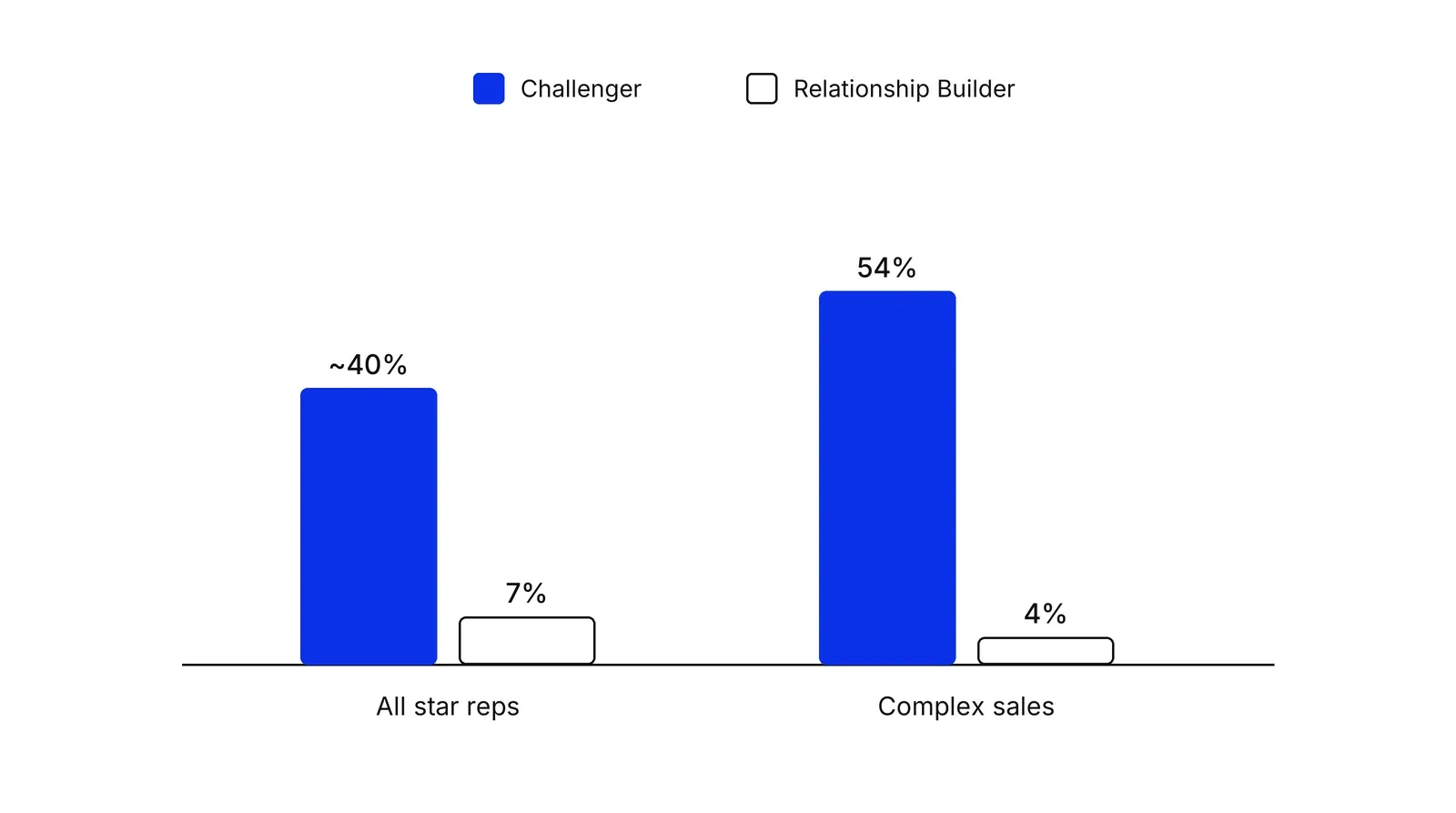
The authors add that this does not mean relationships stopped mattering. In their words, the nature of the relationship matters: Challengers create constructive tension, Relationship Builders try to remove it.
What do Teach, Tailor and Take Control mean?
Challengers are defined by three capabilities. They teach with insight instead of features, tailor the message to each stakeholder’s goals, and take control of the sale by being assertive without being aggressive (Harvard Business Review).
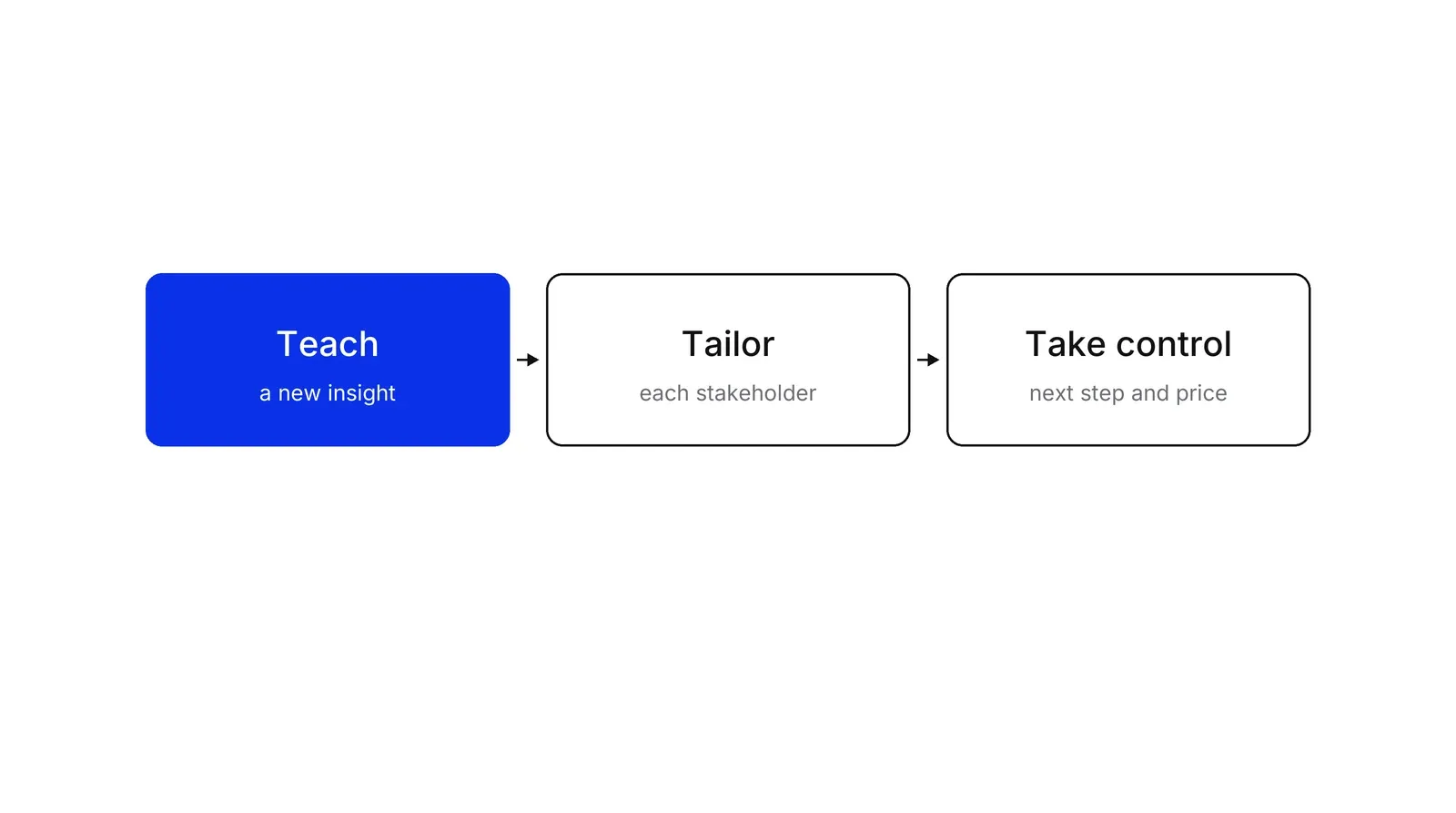
Teaching. The authors reject the opener “What is keeping you up at night?”, arguing that buyers often do not know what they need, so the rep should reveal it (Harvard Business Review). Challenger, Inc. describes a six-step teaching sequence that ends with the rep’s own solution: warmer, reframe, quantifying the cost of inaction, emotional impact, a new way, then the solution. It calls the sequence a flexible framework, not a script.
Tailoring. The same insight is framed for different people in the buying group, because each cares about different outcomes. This matters more as the buying group grows, and the authors’ later work found that average reps lock onto friendly contacts (“Talkers”) who are four to six times less able to build consensus than “Mobilizers” (Harvard Business Review).
Taking control. Challengers guide customers through the purchase, push for the right stakeholders, and answer a discount request by returning to value before conceding (Harvard Business Review). The authors argue most reps err on the passive side.
Marketing has a role too. The authors say reps cannot source and package insights alone, and that marketing collateral that talks about the supplier, not the customer, undermines the approach (Harvard Business Review). Building that supply of insight is a sales enablement job.
Why did the authors say the approach was needed?
They argued buyers had changed. According to a Harvard Business Review article, a CEB study of more than 1,400 B2B customers found that, on average, customers completed nearly 60% of a typical purchasing decision before talking to a supplier. A Harvard Business Review piece reports a survey of more than 5,000 business customers in which the sales experience accounted for 53% of the overall driver of loyalty, ahead of brand, product and price. Those are the authors’ figures from their own surveys.
How does it compare with similar methods?
| Challenger Sale | SPIN Selling | Solution selling | BANT | |
|---|---|---|---|---|
| Core move | Teach an insight, then connect it to the offer | Ask questions until the buyer states the need | Diagnose a problem, then fit a solution | Check budget, authority, need and timeline |
| Assumes the buyer | Does not fully know what they need | Can state the need if led there | Knows the problem, not the fix | Is a fit or is not |
| Best for | Complex deals, informed buyers | Multi-call major sales | Problem-led sales | Early qualification |
The authors say their method is meant to add to questioning, not replace it, and that questioning was too common to separate top performers in their models (Toman and Dixon). They also argue that “The End of Solution Sales” shows traditional solution selling losing ground when buyers define solutions themselves.
What are the main critiques?
The research is large, but it is one programme, owned by CEB. We found no independent replication.
Columbia’s Noel Capon titled his 2015 review of the book “Breakthrough Built on a Flimsy Foundation” (Columbia Business School). A peer-reviewed review and critique appeared in the Journal of Personal Selling and Sales Management in 2014 (Rapp and others). A 2019 paper compares relationship selling with the Challenger approach and summarises criticisms (Inks, Avila and Talbert).
Competing research points elsewhere. RAIN Group studied more than 700 B2B purchases and found “educated me with new ideas” and “collaborated with me” the biggest gaps between winners and runners-up, which partly supports teaching and partly adds collaboration (Trusted Advisor). RAIN also says its findings clash with parts of the book (RAIN Group). RAIN, Corporate Visions and Challenger, Inc. all sell training, so weigh each account accordingly. Corporate Visions argues that challenging messages carry risk with existing customers (Corporate Visions), a claim from its own research.
Some practitioners say the Challenger is an old type of seller with a new name (Kurlan). Brent Adamson himself wrote that the approach is not entirely new and not right for every sale, because highly transactional buying may be better served by a low-cost channel (Adamson). The authors followed the book with The Challenger Customer, on finding buyers who will push for change inside their own company.
A Growth Lab plan for a sales team can start from the deals lost to price and ask what insight, if any, would have changed the buyer’s mind.
How to apply Challenger Sale, step by step
- Find where buyers are stuck in a belief. List the three most common reasons buyers give for not changing, or for choosing the cheaper option. Look for a belief behind each, such as 'planned purchases are where we save money'. Result: two or three beliefs about the buyer's own business that you could challenge.
- Build one insight from your own data. Turn one belief into a finding the buyer has not seen: a cost they do not track, a risk they underrate, a pattern across similar customers. Put a number on it and keep the source. Result: a one-page insight that leads to what you do well, instead of starting with it.
- Write the conversation in the teaching order. Open with the buyer's situation, reframe it with the insight, show the cost of leaving things as they are, and only then bring in your offer. Keep it a flexible outline, not a script. Result: a call outline in which the offer arrives last.
- Tailor the insight to each stakeholder. For every person in the buying group, note what they personally gain or risk: the finance lead cares about cost, the operations lead about disruption. Adjust the same insight for each. Result: a short stakeholder map with one angle per person.
- Practise taking control of the next step and the price. Decide in advance what you will ask for at the end of the call and how you will answer a request for a discount: acknowledge it, move it back to value, and offer a smaller concession if pressed. Result: a planned next step and a prepared answer on price.
- Test on three live deals and review the calls. Run the new opening on three real opportunities. Afterwards, check whether the buyer engaged with the insight, who joined the next meeting, and whether price came up earlier or later than usual. Result: a verdict on whether the insight is worth rolling out.
Examples
W.W. Grainger: from company facts to a cost the buyer had not seen
Documented. According to the authors, Grainger's reps used to open with facts about the company, then ask what kept the customer up at night. They moved to opening with research on how much money buyers waste on unplanned purchases of maintenance supplies, which Grainger's research showed could be a large share of a company's total spend on those supplies. Only after that did they discuss Grainger's capabilities (Harvard Business Review, 2011).
A payments provider selling to an online retailer
Illustrative. The usual opener is a fee comparison. The challenger opener is a finding: retailers that treat all declined cards the same lose sales that a retry would recover. If a merchant sees 400 declined checkouts a week and a retry recovers a quarter of them at an average basket of 80, that is about eight thousand in recovered sales a week. The rep shows the arithmetic, asks how the finance team would react to the number, and only then discusses the provider's retry logic.
A software vendor selling scheduling to a private clinic group
Illustrative. Instead of asking the clinic manager what is hard about booking, the rep brings a pattern: clinics that confirm appointments only by phone tend to lose the late-cancellation slots that cannot be refilled. With 20 such slots a week at an average visit value of 60, the idle time is worth twelve hundred a week. The rep tailors it differently for the owner (revenue), the front desk (workload) and the doctors (waiting patients).
When to use it
Use it in complex B2B sales with several stakeholders, where buyers arrive well informed, vendors look alike and deals are lost to price or to 'no decision'. It fits teams that can produce a real, sourced insight about the buyer's business.
When not to use it
Skip it where the purchase is simple and transactional, where a website or low-touch channel serves the buyer better, or where you have no distinctive insight to offer. Be careful with existing customers: some critics argue that provocation can backfire in renewals and expansion.
Common mistakes
- Challenging without an insight. Pushing back on a buyer is only credible when you bring a finding they can check.
- Treating the five profiles as a hiring test. The profiles came from managers' ratings of reps, and the authors present Challenger behaviours as learnable, so use them for coaching.
- Leading with your own capabilities after one slide of reframing. If the first pages of the pitch are about you, the teaching is gone.
- Mistaking assertiveness for aggression. The authors describe Challengers as assertive, not aggressive, and as comfortable with tension, not seeking it.
- Dropping discovery entirely. The authors say challenging adds to questioning and does not replace it.
FAQ
What is the Challenger Sale?
It is a B2B selling approach from Matthew Dixon and Brent Adamson, published in late 2011. The Challenger rep teaches the buyer a new view of their business, tailors the message to each stakeholder and takes control of the sale, including the conversation about price. It rests on CEB research into thousands of reps.
Who wrote The Challenger Sale and when?
Matthew Dixon and Brent Adamson, then of the Corporate Executive Board (CEB), wrote it. Portfolio published it on 10 November 2011, with a foreword by Neil Rackham, the author of SPIN Selling. Gartner has since acquired CEB, so the research now sits with Gartner.
What are the five sales rep profiles?
The Hard Worker, the Lone Wolf, the Relationship Builder, the Problem Solver (called Reactive Problem Solver in the first HBR article) and the Challenger. The authors say there are five ways to be an average rep but only one way to be a star: Challengers dominated the star group, and Relationship Builders came last.
How is the Challenger Sale different from SPIN Selling?
SPIN Selling is built on questions: the buyer reaches and states the need. The Challenger Sale starts from the idea that buyers often do not know what they need, so the rep brings an insight first. The two are not rivals in practice, and the authors say challenging adds to good questioning.
Is the Challenger Sale research reliable?
It is a large study, but the data belong to CEB and the profiles rest on a single research programme. Columbia's Noel Capon called it a breakthrough on a flimsy foundation, and a peer-reviewed journal has published a critique. We found no independent replication, so treat the profiles as a strong hypothesis.
Sources
- Matthew Dixon, Brent Adamson, Selling Is Not About Relationships, Harvard Business Review, 30 September 2011
- Matthew Dixon, Brent Adamson, The Worst Question a Salesperson Can Ask, Harvard Business Review, 7 October 2011
- Matthew Dixon, Brent Adamson, Why Your Salespeople Are Pushovers, Harvard Business Review, 14 October 2011
- Matthew Dixon, Brent Adamson, How the Rift Between Sales and Marketing Undermines Reps, Harvard Business Review, 7 November 2011
- Brent Adamson, Matthew Dixon, Nick Toman, The End of Solution Sales, Harvard Business Review, July-August 2012
- Brent Adamson, Matthew Dixon, Nick Toman, The Best Sales Reps Avoid Talkers, Harvard Business Review, July 2012
- Brent Adamson, Matthew Dixon, Nick Toman, Dismantling the Sales Machine, Harvard Business Review, November 2013
- Penguin Random House, The Challenger Sale, publisher page
- Matthew Dixon, Brent Adamson, The Challenger Sale, Portfolio, 2011 (Internet Archive record)
- Penguin, The Challenger Customer, publisher page
- Nick Toman, Matthew Dixon, Does Challenger Undermine Questioning Skills?, CEB Sales Executive Council, 2012
- Brent Adamson, The Single Most Important Question for the Challenger Sale, CEB Sales Executive Council, 2012
- Scott Inks, Ramon Avila, George Talbert, The evolution of the sales process: Relationship selling versus the Challenger Sale, Journal of Global Scholars of Marketing Science 29(1), 2019
- Adam Rapp, Daniel Bachrach, Nikolaos Panagopoulos, Jessica Ogilvie, Salespeople as knowledge brokers: a review and critique of the challenger sales model, Journal of Personal Selling and Sales Management 34(4), 2014
- Noel Capon, Revisiting The Challenger Sale: Breakthrough Built on a Flimsy Foundation, Velocity 17, 2015 (Columbia Business School record)
- RAIN Group, Sales research: what sales winners do differently
- Trusted Advisor, What sales winners do differently: Q&A with Mike Schultz
- Corporate Visions, Challenger sales model: what it gets right and where it falls short
- Dave Kurlan, Kurlan and Associates, The Challenge of the Challenger Sales Model
- Challenger, Inc., What is the Challenger sales methodology?
Last updated Oct 9, 2026


Marketing agency or growth system: when a company outgrows its agency
An agency is the right call while the founder still runs most of the company. Once the business starts copying itself into new locations or markets, it needs a system that sets goals, tests hypotheses and owns the result.

Why healthcare marketing agencies stall: the short, mid and long wins model we use with clinics
Most agencies own the click and nobody owns the front desk. How we structure clinic work in three horizons, the research behind each one, and one year of results.

Why channel tests stall after month three
Most paid channel tests do not end with a decision. They end when the budget runs out, the attribution model changes, or everyone quietly stops looking at the dashboard.