Content scoring and decay
A routine for finding the published pages that are losing search traffic, scoring every page on value and trend, and deciding which to update, merge, redirect, keep or remove.
Content decay is the gradual loss of search traffic and rankings on a page that once performed well. Content scoring rates every page on its value and its recent trend, so you can decide which pages to update, merge, redirect, withdraw or remove. It replaces guessing with a short list, checked against the same period a year earlier.
- Origin
- Practitioner practice with no documented originator; HubSpot's 'historical optimization' is an early named version, undated
- Level
- 301 · Advanced
- Fits
- Small and mid-size, Scale-up
- Time to apply
- one to two days for a first audit of a few hundred pages; a quarterly rhythm after that
- What you need
- read access to Google Search Console and to your analytics · a list of every indexable URL with publish date, last edit and an owner · someone who can edit pages and set redirects · a subject expert for pages with medical, legal or financial claims
Content decay is the gradual loss of search traffic, rankings or conversions on a page that once performed well. Content scoring is the routine that finds those pages: you rate every page on its value and its trend, and each page gets one action. No originator is documented. HubSpot’s historical optimization is an early named version, and its page does not show a first publication date. HubSpot reports that old posts produced 92% of its monthly blog leads, and that the old posts it optimized more than doubled their monthly leads and gained 106% more organic search views on average. Pamela Vaughan’s post adds that all 75 posts whose calls to action were matched to the search phrase that brought readers saw their conversion rate rise. Those figures are HubSpot’s own, from one blog.
Why do pages lose traffic over time?
A page loses traffic because demand moved, other pages improved, its facts aged or something broke. Google’s guide to debugging traffic drops names algorithm updates, technical faults, security and spam issues, seasonality and changing interests, and site moves. Its core updates page adds that a page can fall because other pages now serve searchers better, not because it did anything wrong.
Freshness matters for some queries and not for others. Google describes freshness systems that show newer content where users would expect it, such as reviews of a new film. A guide to a stable subject is judged differently. In an Ahrefs study of 1.3 million US keywords, 72.9% of top-10 pages were more than three years old, up from 59% in Ahrefs’ 2017 study, and the average page in first place was 5 years old, against 2 in 2017. Age alone is not decay, so score the trend, not the birthday.
There is no universal rate either. Librarians borrowed the idea of a literature “half-life” from physics, and M. B. Line noted in 1970 that the figures vary widely and hold only for the sample studied. The pages you compete with also keep moving: Fetterly and colleagues re-crawled 150,836,209 HTML pages weekly for 11 weeks and found that the average amount of change varies widely by domain, and Adar and colleagues found that pages people visit often change more than randomly sampled ones.
One cause is new. Google says traffic from its AI features is counted inside the Web search type in Search Console, so a fall in clicks can sit beside stable impressions.
How do you score a page?
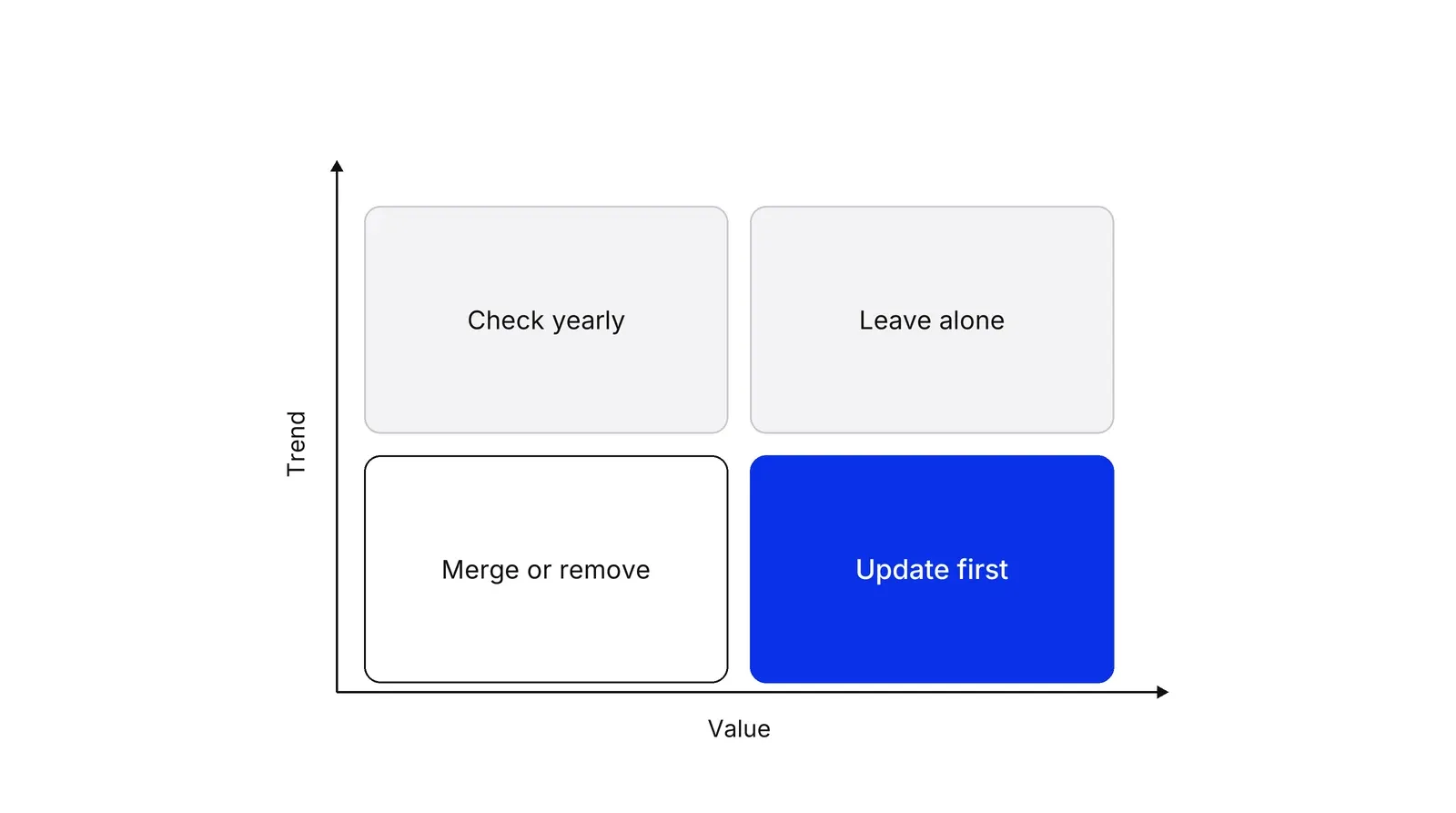
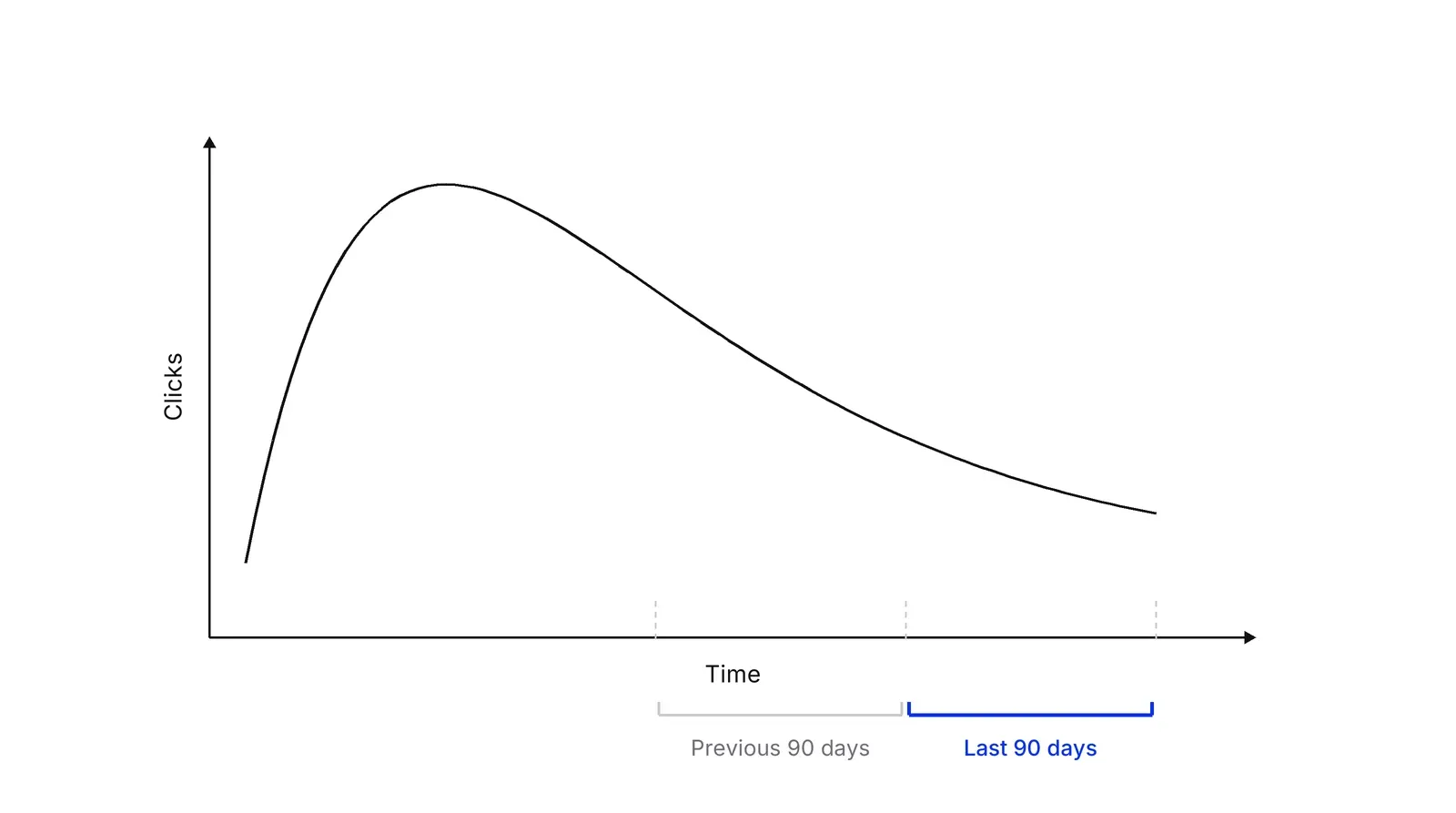
Score each page on two numbers: value and trend. Value is what the page earns now, such as clicks plus conversions. Trend is the change against an earlier period. The Performance report defines clicks, impressions, click-through rate and average position, and Google’s traffic guide suggests the last 16 months with a three-month comparison, plus a year-over-year view to see whether the drop repeats each year.
| Signal | Where it comes from | What it tells you |
|---|---|---|
| Clicks and change | Search Console, Pages table | How much the page earns and whether it is slipping |
| Same quarter last year | Search Console, year-over-year compare | Whether the dip is seasonal |
| Impressions and position | Search Console | Whether you lost rank or only clicks |
| Conversions per landing page | Analytics key events | Whether low traffic still carries business value |
| Last real edit, owner | CMS | Whether anyone is responsible |
Cut-offs such as “a fall of a fifth” are your own starting rules, not findings from a study. Adjust them after the first pass. Google Trends can confirm a demand shift, since it shows relative interest, not raw volume.
What do you do with each page?
Update the pages that are still needed, merge duplicates, redirect retired pages, and delete only what has no use. Google’s starter guide says to check published content and update it, and to delete it if it is no longer relevant. The core updates page calls deleting content a last resort for content that cannot be salvaged, and warns against changing pages that already perform well. After a core update, Google advises waiting at least a week after the rollout ends, then comparing that week with the week before it began.
Evidence for pruning is thin. Ahrefs’ pruning guide cites a consultant who cut a vehicle-valuation site from 4,860,000 pages to 1,500 and saw organic visits rise 160%. The author adds that a prune is hard to isolate from other SEO work, and that pruning mostly suits very large sites. Eugene Zatiychuk of Belkins pruned 400 pages, almost two thirds of his site, and monthly organic visits rose from about 3,000 to almost 10,000, but he changed JavaScript rendering in the same period. Treat these as single cases.
| Action | Use when | Documented handling |
|---|---|---|
| Update | The topic is still needed and the page is slipping | Change the content; Google asks for real dates |
| Merge and redirect | Two pages answer one question | A permanent 301 or 308 redirect shows the target in results; 302, 303 and 307 keep the source |
| Withdraw | Readers still need it but it is no longer current | GOV.UK keeps it online, marked as withdrawn, out of internal search |
| Remove | No traffic, no links, no use | A 404 and a 410 are treated the same |
Deleting text is also less final than it sounds. Patrick Stox of Ahrefs removed the text from two posts between 8 and 20 August, then restored it, and most rankings lost only a few positions and traffic recovered, but he does not recommend repeating it.
Where does this fit in a content plan?
Scoring is the maintenance half of a content plan. New pages come from topic clusters, and a strong source can be reworked through content repurposing. Scoring then tells you which of those pages still earn their place. Most pages never earn traffic in the first place. Ahrefs found that 96.55% of about 14 billion pages in its Content Explorer index had none, and 1.94% had one to ten visits a month, from a sample Ahrefs says leans toward the quality side of the web. New pages are slow to arrive too: 1.74% of 1 million new URLs reached the top 10 within a year, against 5.7% in 2017, and Ahrefs calls 6.11% in a second sample of 2 million English URLs a fairer figure. Rescuing a page that already had traffic is the cheaper bet. Paul Boag, writing in Smashing Magazine in 2015, said microsoft.com once had more than 10 million pages online and more than 3 million of them had never been visited. His advice on ROT, content that is redundant, out of date or trivial, points the same way: judge trivial pages against traffic, user tasks and business goals, and archive outdated ones instead of letting them sit in search.
Make the routine permanent with ownership. GOV.UK’s guidance lets editors find pages overdue for review and ties monitoring to review dates and ends in two outcomes: change the page or retire it. A Growth Lab plan starts from an inventory like this one; see the Growth Lab practice.
How to apply Content scoring and decay, step by step
- List every page. Export the indexable URLs from your CMS or sitemap, with publish date, last real edit and owner. Result: one row per URL, and nothing you cannot name an owner for.
- Pull value and trend. In Search Console, compare the last 90 days with the previous 90 and with the same 90 days a year ago. Add key events per landing page from your analytics. Result: clicks, change and conversions beside each URL.
- Score and sort. Mark each page as high or low value, and rising or falling. Use your own cut-offs, for example the top fifth of pages by clicks plus conversions as high value, and a fall of a fifth or more as falling. Result: every URL in one of four boxes.
- Diagnose before you touch. For each high-value falling page, check seasonality, a technical fault, a recent Google update and a change in the results page. Result: a one-line cause, so you do not fix a page that only had a quiet season.
- Choose the action. Update a page that is still needed, merge two that answer the same question, redirect a retired page to its closest match, withdraw a page that must stay for readers, and remove only pages with no traffic, no links and no use. Result: one action per page.
- Make the change and log it. Change the content, not just the date. Record URL, change and day in a shared log. Result: a record you can measure against.
- Re-measure and set a review date. Wait several weeks, compare again, and give each kept page a review date. Result: a decay list that shrinks, and a calendar that stops it growing back.
Examples
A cross-border payments blog
Illustrative. A guide to settlement times had 1,200 clicks in the previous 90 days and 840 in the last 90, a fall of 30%. The same quarter a year ago had 1,150, so it is not seasonal. Its fee table is out of date. It goes to the top of the update list, with a fresh table and a real edit date.
A dermatology clinic
Illustrative. Two old posts answer the same question about mole checks, and each gets a trickle of clicks. They merge into one page, and the weaker URL redirects to it. A third post quotes a guideline the clinic no longer follows, so it is withdrawn until a doctor reviews it.
When to use it
Use it when the site has more than about a hundred published pages, traffic from older pages has slipped, and nobody has looked at them since publishing. It suits teams that already publish regularly and have a year or more of Search Console data.
When not to use it
Skip it on a young site with a few dozen pages, where there is no history to score. Do not run it as a reaction to one bad week or the first days after a Google update, when the numbers have not settled.
Common mistakes
- Changing the date on a page without substantially changing the content, which Google's guidance lists as a warning sign.
- Deleting pages because they are old, when age alone does not make a page bad.
- Reading one quarter without the same quarter a year ago, and calling a seasonal dip decay.
- Merging two pages and forgetting the redirect, so the links to the old URL go nowhere.
- Updating the pages that are easiest to edit instead of the ones that carry the most value.
FAQ
What is content decay?
Content decay is the slow fall in search traffic, rankings or conversions on a page that used to perform. It has several causes: changed demand, newer competing pages, outdated facts, technical faults or Google updates. Measure it by comparing recent clicks with an earlier period, and with the same period a year ago.
How do you find decaying content in Search Console?
Open the Performance report, set the date filter to the last 16 months and use Compare to set the last 3 months against the previous period, then against the same months a year ago. Sort the Pages table by clicks difference. The pages with the biggest loss are your candidates.
Should I delete old blog posts?
Usually not. Google says removing older content to look fresh will not help, and calls deletion a last resort for content that cannot be saved. Remove a page only when it has no traffic, no links and no use. If another page covers the topic, redirect it.
Does changing the date of an article help it rank?
No. Google asks site owners to show dates that reflect when the page was published or updated, and lists changing dates without a real change as a warning sign. Update the content first, then let the date follow. Google also states that it does not define what counts as significant.
How often should I update old content?
No study sets a schedule. Google's starter guide says to check published content and update it as needed. A practical rhythm is a quarterly check of high-value pages and a yearly review of the rest, with a review date set on each page, as GOV.UK does.
Sources
- Google Search Central, Creating helpful, reliable, people-first content
- Google Search Central, Influence your byline date in Google Search
- Google Search Central, Debugging drops in Google Search traffic
- Google Search Central, Redirects and Google Search
- Google Search Central, How HTTP status codes, and network and DNS errors affect Google Search
- Google Search Console Help, Performance report (Search results)
- Google Search Central, A guide to Google Search ranking systems
- Google Search Central, Core updates and your website
- Google Search Central, AI features and your website
- Google Search Central, SEO starter guide
- Google Trends Help, FAQ about Google Trends data
- Pamela Vaughan, HubSpot, historical blog optimization (page updated 13 June 2025; first publication date not shown)
- Tim Soulo, Ahrefs, 96.55% of content gets no traffic from Google, 1 December 2023
- Ahrefs, How long does it take to rank in Google? (study, 15 May 2025)
- Ryan Law, Ahrefs, Content pruning: why it works, and how to do it
- Patrick Stox, Ahrefs, I deleted the content from two posts to see if they would still rank, 26 October 2023
- Paul Boag, Smashing Magazine, How to deal with redundant, out-of-date and trivial content (ROT), 11 June 2015
- GOV.UK publishing guidance, Retire content
- GOV.UK publishing guidance, Manage existing GOV.UK content
- Dennis Fetterly, Mark Manasse, Marc Najork, Janet Wiener, A large-scale study of the evolution of web pages, WWW 2003
- Eytan Adar, Jaime Teevan, Susan Dumais, Jonathan Elsas, The web changes everything, WSDM 2009
- M. B. Line, The 'half-life' of periodical literature: apparent and real obsolescence, Journal of Documentation 26(1), 1970
Last updated Oct 9, 2026


Marketing agency or growth system: when a company outgrows its agency
An agency is the right call while the founder still runs most of the company. Once the business starts copying itself into new locations or markets, it needs a system that sets goals, tests hypotheses and owns the result.

Why healthcare marketing agencies stall: the short, mid and long wins model we use with clinics
Most agencies own the click and nobody owns the front desk. How we structure clinic work in three horizons, the research behind each one, and one year of results.

The compliance layer under fintech marketing operations
A fintech marketing agency can build campaigns. It cannot own the compliance review, the KYC drop-off or the multi-market licensing rules that decide whether a lead ever becomes a customer.