Mental and physical availability
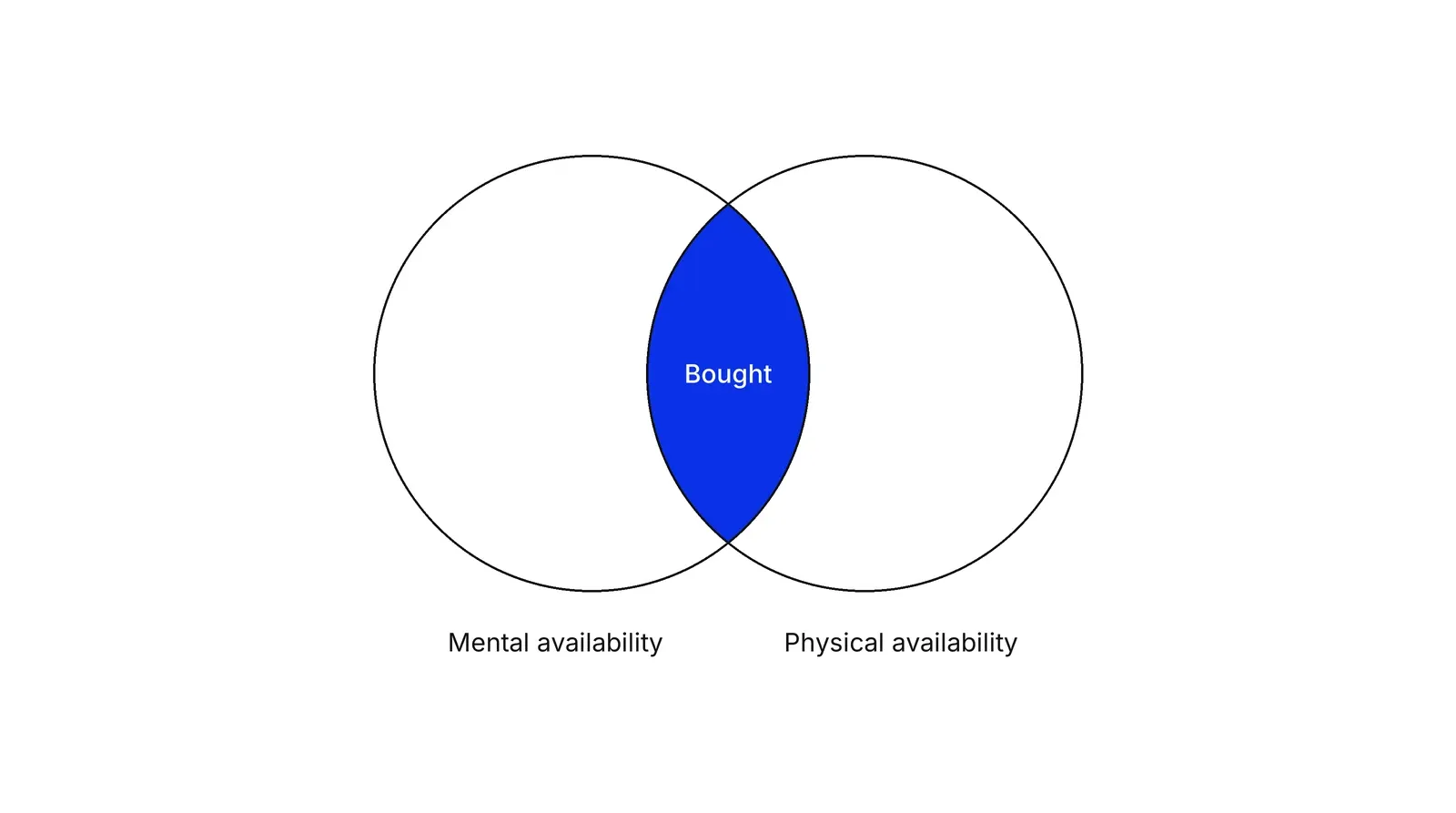
Mental and physical availability is the Ehrenberg-Bass model of brand growth: a brand sells more when more buyers think of it in more buying situations and can find and buy it wherever they shop.
Mental availability is the likelihood that a buyer notices or thinks of a brand in a buying situation. Physical availability is how easy the brand is to find and buy. Both ideas come from Byron Sharp, Jenni Romaniuk and the Ehrenberg-Bass Institute, which argues that brands grow mainly by raising both, so that more category buyers can think of and get the brand.
- Origin
- Jenni Romaniuk and Byron Sharp, Ehrenberg-Bass Institute, 2004 (as brand salience); 2010 (How Brands Grow)
- Level
- 401 · Expert
- Fits
- Scale-up, Enterprise
- Time to apply
- two to four weeks for a first survey of buying situations and a distribution audit, then a yearly re-measure
- What you need
- a list of the situations in which people start buying your category, gathered from buyers, not from the team · a survey panel of category buyers that includes people who never bought your brand · distribution data by channel: where the brand is sold, where it is visible, which products are in stock
Mental availability is the likelihood that a buyer notices or thinks of your brand at the moment they need something from your category. Physical availability is how easy the brand then is to find and buy. The pair comes from the Ehrenberg-Bass Institute at the University of South Australia, and marketers use it to decide where brand and distribution budgets should go and what to track in a brand health survey.
The working claim is simple. Buyers spend little time choosing, so they pick from the brands that come to mind and are in front of them. A brand that is easy to think of in more situations, and easy to get in more places, sells to more people.
Where the idea came from
The idea started as a paper about brand salience. In 2004 Jenni Romaniuk and Byron Sharp argued in Marketing Theory that salience had been treated as “top of mind” for too long, and redefined it as a brand’s “propensity to be noticed or come to mind in buying situations.” They tied it to the number and quality of memory links buyers hold about the brand.
Sharp then made mental and physical availability the pair at the centre of How Brands Grow (Oxford University Press, 2010), next to chapters on why distinctiveness matters more than differentiation. Romaniuk and Sharp extended the work in How Brands Grow Part 2, which a 2016 review singled out for its chapters on building mental availability and distinctive assets. Romaniuk went on to lead the Institute’s measurement methods, set out in her books on distinctive assets (2018) and brand health (2023), according to the Institute.
The label changed for a practical reason. At Cannes Lions in 2026 Sharp said of “brand salience”: “It was a terrible name,” because people heard it as awareness, as Mi3 reported.
The broader growth argument behind the model, including double jeopardy and the case for reaching light buyers, belongs to How Brands Grow and is covered on its own page.
How is mental availability different from awareness?
Awareness asks about one cue, usually the category name (“which banks can you think of?”). Mental availability asks about every situation in which a buyer might start looking, and counts how many buyers the brand comes to mind for. Sharp lists three dimensions: how easily the brand is retrieved, in how many buying situations, and for how many people.
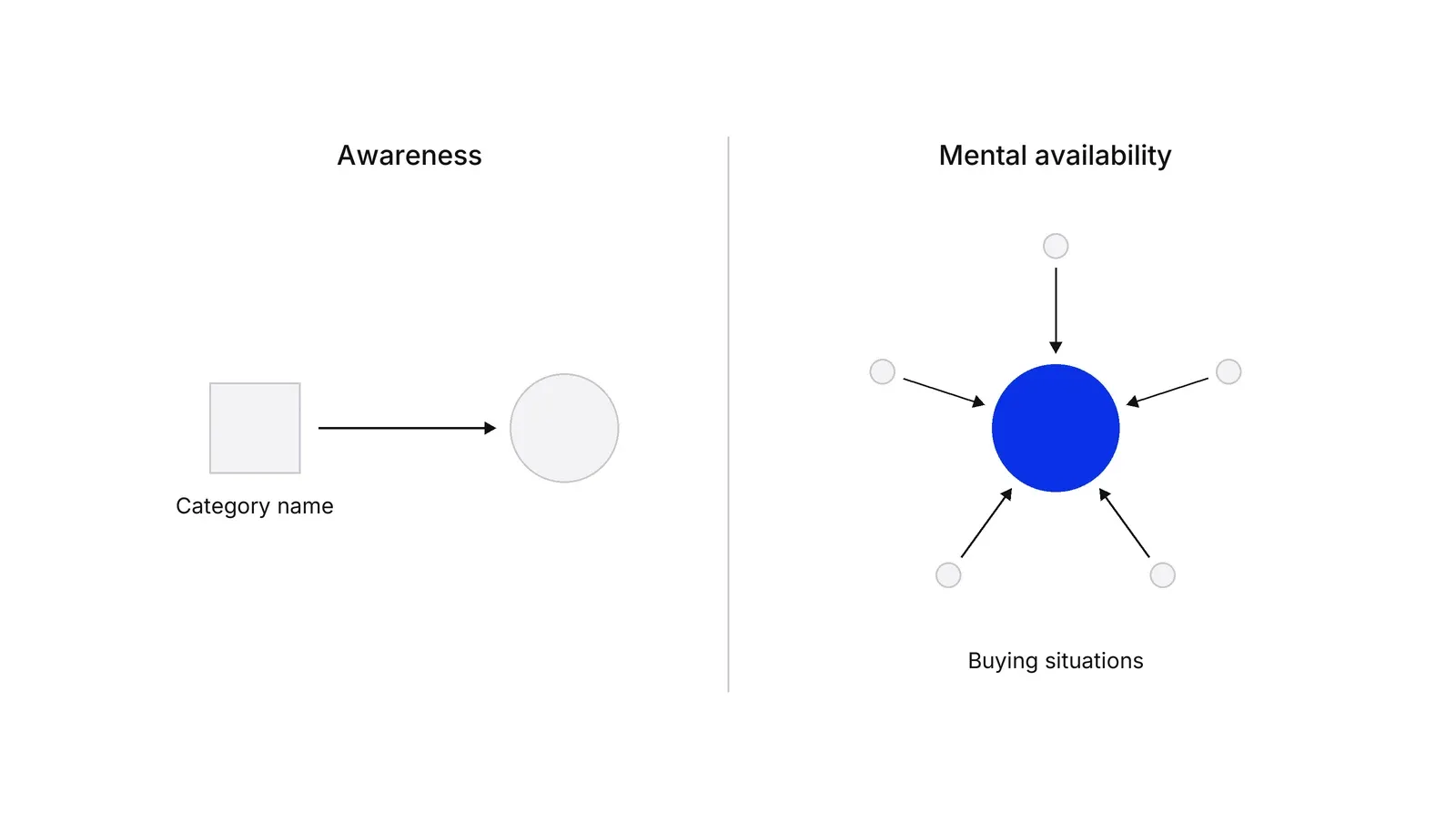
Take a payments app. Almost every adult in its market may have heard of it, which looks like strong awareness. Yet when people think “I need to split a restaurant bill” or “I have to pay a supplier abroad,” a different app may come to mind first. The Institute’s argument is that the second question, which brand comes to mind in the moment, is the one that decides the sale.
The memory effect has support outside the Institute. Prakash Nedungadi showed in the Journal of Consumer Research in 1990 that making a brand easier to recall changed which brands people considered and chose, without changing how they rated the brands. Danny Vieceli and Robin Shaw found in a 2010 study of 270 respondents that brand salience was related to purchase likelihood.
The Institute also separates the idea from liking. Rachel Kennedy writes that the Institute does not argue for “mass awareness” but for building and refreshing memory structures among the buyers a budget can reach.
Category entry points in brief
Category entry points are the cues buyers use to retrieve brands when they enter a buying situation. They can be internal, such as a motive or a mood, or external, such as a place or time of day, as Romaniuk defines them. Each entry point linked to your brand is one more route into the buyer’s shortlist. How to find, rank and build them is a topic of its own; here they matter as the unit in which mental availability is counted.
How mental availability is measured
The Institute’s method surveys category buyers, shows them a list of entry points and records every brand they link to each one. Three metrics come out of that table.
| Metric | What it counts | Barclays, UK business banking | RBS |
|---|---|---|---|
| Mental penetration | share of category buyers who link the brand to at least one entry point | 78% | 53% |
| Mental market share | the brand’s share of all brand-to-entry-point links in the category | 9.8% | 4.4% |
| Network size | average number of entry points linked, among buyers who link the brand at all | 7.9 | 5.2 |
The figures come from Romaniuk’s 2022 B2B report, based on 609 UK business banking decision makers. Mental market share also has a peer-reviewed model, published by Romaniuk in the Journal of Business Research in 2013. In the same report, a study of 17 insurance products found that each extra entry point a customer linked to their insurer lowered the probability of switching by about 5%.
What does physical availability cover?
Physical availability is how easy the brand is to find and buy once someone wants it. The Institute’s 2025 B2B report by Magda Nenycz-Thiel and Romaniuk splits it into presence (sold wherever buying happens), prominence (easy to spot in each sales setting, whether rented through paid placement or owned through distinctive assets) and portfolio (products that fit current and future needs).
The labels have shifted over time. A 2017 WARC summary of the Institute’s work listed presence, relevance and findability. The logic stayed the same while the wording moved.
For a clinic, presence means being on the map apps and booking sites people use. Prominence means a buyer can pick it out among twenty results. Portfolio means there is an evening slot for the person with a toothache at 9 pm.
How the two work together
Each kind of availability makes the other pay. Advertising that builds memory links is wasted if the brand is missing from the shelf, and distribution does little if nobody thinks of the brand. Distinctive brand assets, such as colours, characters and shapes, serve both: they help buyers recall the brand and help them spot it, the Institute says. Romaniuk and Nenycz-Thiel measure an asset by fame (how many buyers link it to the brand) and uniqueness (how few link it to rivals), as tested in 2014.
The link also shows up when advertising stops. Nicole Hartnett described a 20-year study of 57 Australian consumer goods brands in which a year without mass-reach advertising cut sales by 16% on average, and noted that retailers may give fewer placements to brands that stop advertising. That is a mental loss turning into a physical one.
Where the evidence is disputed
The sharpest dispute is about differentiation. Romaniuk, Sharp and Andrew Ehrenberg reported in 2007 that buyers see little difference between competing brands and still buy them, and argued that distinctiveness should sit at the centre of brand strategy. Kantar’s Nigel Hollis analysed 5,334 brands and found that most growing brands also grew salience, but only 25% grew on salience alone; the rest also built meaning or difference. He notes the analysis shows correlation only.
Mark Ritson argues for both: distinctive assets for mental availability and a clear position for relative differentiation. A practical reading is that a positioning statement still decides what the brand says, while mental and physical availability decide how many buyers hear it and can act on it. In Pushers’ Growth Lab, the entry point survey and distribution audit come before any channel plan, because they show where buyers are being lost.
How to apply Mental and physical availability, step by step
- Collect the buying situations. Interview recent category buyers and ask what was happening when they started looking: the time, the place, the problem, who they were with. Group recurring answers into category entry points. Result: a long list of 15 to 30 buying situations in buyers' own words.
- Survey category buyers, not only customers. Show a sample of category buyers each situation and ask which brands they link to it, with no prompt and no limit. Include buyers who have never bought from you, because growth has to come from them. Result: a table of brand-by-situation links for you and your main rivals.
- Calculate the three core metrics. Mental penetration is the share of category buyers who link your brand to at least one situation. Mental market share is your share of all brand-situation links in the category. Network size is the average number of situations linked to your brand among those who link it at all. Result: three numbers per brand that you can compare with competitors.
- Audit physical availability. Check presence (is the brand sold in every channel where category buyers shop), prominence (can a buyer spot it quickly on a shelf, a marketplace page or an app store) and portfolio (is there a product, size and price that fits each common need). Result: a list of gaps, ranked by how many buyers each gap blocks.
- Pick a few situations and gaps to work on. Choose a short list of situations where rivals are weak and your product fits, and the physical gaps that cost the most buyers. Brief advertising to link the brand to those situations with consistent distinctive assets. Result: one plan for mental availability and one for distribution, each with a target metric.
- Re-measure once a year. Repeat the same survey with the same situations and sample design. Mental metrics move slowly, so quarterly tracking mostly shows noise. Result: a yearly comparison showing whether the brand gained links, buyers and distribution against rivals.
Examples
Barclays and RBS in UK business banking
In a July 2022 report, Jenni Romaniuk of the Ehrenberg-Bass Institute published mental availability scores from a survey of 609 UK business banking decision makers. Barclays had a mental market share of 9.8%, mental penetration of 78% and a network size of 7.9. RBS scored 4.4%, 53% and 5.2. Barclays came to mind for more decision makers and was linked to more buying situations by each of them, which is the pattern the Institute associates with a bigger brand.
Brands that stop advertising
Researchers at the Ehrenberg-Bass Institute tracked 41 beer, cider and spirit brands over almost two decades and found that sales fell in the first year without broad-reach advertising and in every dark year after it (Journal of Advertising Research, 2021). A 2023 replication on 365 US brands in 22 categories found steadily falling market share, with small brands losing faster. The Institute reads this as memory structures fading once advertising stops refreshing them.
A dental clinic checking both kinds of availability
Illustrative, no real clinic implied. A dental clinic surveys 300 adults in its city and lists six buying situations, from a sudden toothache at night to a child's first check-up. It is named for routine cleaning by 30% of respondents but for night-time emergencies by 4%, and its booking page shows no evening slots. The clinic adds evening emergency hours (physical availability), lists them on its map listings, and runs local ads tying its name and colour to the toothache-at-night situation (mental availability). The next yearly survey shows whether the 4% moved.
When to use it
Use it when a brand has stopped growing and the team keeps trying to win more from existing customers, when you need to decide where advertising and distribution money should go, or when you are setting up a brand health tracker and want metrics tied to buying behaviour instead of liking. It fits categories with many buyers and repeat purchase best: consumer goods, retail banking, payments, insurance, clinics.
When not to use it
It helps little for a pre-launch product with no distribution and almost no buyers, where the first job is product-market fit. It is a weak guide for enterprise deals with a handful of named accounts, where account work and sales coverage matter more than broad memory. It also does not tell you what to say to win a buyer once they are considering you.
Common mistakes
- Treating mental availability as top-of-mind awareness and tracking it with one unaided recall question about the category name.
- Surveying only current customers, which hides how few non-buyers think of the brand at all.
- Choosing buying situations in a workshop instead of collecting them from buyers, so the list reflects how the team describes the product.
- Building memory links in advertising while the product is missing from the channels where those buyers shop.
- Changing logos, colours and taglines often, so the cues that link the brand to buying situations never settle in memory.
FAQ
What is mental availability?
Mental availability is the probability that a buyer will notice, recognise or think of a brand when they are in a buying situation. Byron Sharp and Jenni Romaniuk of the Ehrenberg-Bass Institute describe it as depending on how many memory links buyers have to the brand and how fresh those links are.
What is the difference between mental availability and brand awareness?
Awareness questions usually test a brand against one cue, the category name. Mental availability covers every buying situation in which the brand could come to mind, and how many buyers it comes to mind for. The Ehrenberg-Bass Institute dropped the older label brand salience because people kept reading it as top-of-mind awareness.
What is physical availability in marketing?
Physical availability is how easy a brand is to find and buy. The Ehrenberg-Bass Institute's 2025 B2B report splits it into presence (sold where buyers shop), prominence (easy to spot in each sales setting) and portfolio (products that fit buyers' needs). A 2017 version listed presence, relevance and findability.
How do you measure mental availability?
Survey category buyers, show them a list of buying situations and ask which brands they link to each. From the answers, calculate mental penetration (share of buyers linking the brand to at least one situation), mental market share (the brand's share of all links) and network size (average links among those who link it). Compare with rivals yearly.
Who came up with mental and physical availability?
The ideas come from the Ehrenberg-Bass Institute at the University of South Australia. Jenni Romaniuk and Byron Sharp defined brand salience in Marketing Theory in 2004, and Sharp set out mental and physical availability as a pair in How Brands Grow, published by Oxford University Press in 2010. Romaniuk later led the measurement work.
Sources
- Byron Sharp, How Brands Grow: What Marketers Don't Know, Oxford University Press, 2010, ESCP library record
- Jenni Romaniuk and Byron Sharp, Conceptualizing and measuring brand salience, Marketing Theory 4(4), 2004
- Byron Sharp, Ehrenberg-Bass Institute, Mental availability is not awareness, brand salience is not awareness
- Rachel Kennedy, Ehrenberg-Bass Institute, Why you won't find Ehrenberg-Bass talking about mass awareness
- Jenni Romaniuk, Ehrenberg-Bass Institute, Category Entry Points in a business-to-business world, B2B report, July 2022
- Magda Nenycz-Thiel and Jenni Romaniuk, Ehrenberg-Bass Institute, Easy to find: being where B2B buying happens, November 2025
- Jenni Romaniuk, Byron Sharp, John Dawes and Sahar Faghidno, How B2B Brands Grow, Ehrenberg-Bass Institute and LinkedIn B2B Institute, November 2023
- Ehrenberg-Bass Institute, Distinctive Asset Measurement
- Ehrenberg-Bass Institute, Professor Jenni Romaniuk profile and books
- Nicole Hartnett, Ehrenberg-Bass Q&A: What happens when brands stop advertising?, Research World
- Nicole Hartnett, Adam Gelzinis, Virginia Beal, Rachel Kennedy and Byron Sharp, When Brands Go Dark, Journal of Advertising Research 61(3), 2021
- Peilin Phua, Nicole Hartnett, Virginia Beal, Giang Trinh and Rachel Kennedy, When Brands Go Dark: A Replication and Extension, Journal of Advertising Research 63(2), 2023
- Jenni Romaniuk, Byron Sharp and Andrew Ehrenberg, Evidence concerning the importance of perceived brand differentiation, Australasian Marketing Journal 15(2), 2007
- Jenni Romaniuk and Magda Nenycz-Thiel, Measuring the strength of color brand-name links, Journal of Advertising Research 54(3), 2014
- Jenni Romaniuk, John Dawes and Magda Nenycz-Thiel, Modeling brand market share change in emerging markets, International Marketing Review 35(5), 2018
- Jenni Romaniuk, Modeling mental market share, Journal of Business Research 66(2), 2013
- Ella Ward, Song Hee Yang, Jenni Romaniuk and Virginia Beal, Building a unique brand identity, Journal of Brand Management 27(4), 2020
- Alan Wilson, review of How Brands Grow Part 2 by Jenni Romaniuk and Byron Sharp, University of Strathclyde, 2016
- Prakash Nedungadi, Recall and consumer consideration sets, Journal of Consumer Research 17(3), 1990
- Danny Vieceli and Robin Shaw, Brand salience for fast-moving consumer goods: an empirically based model, Journal of Marketing Management 26(13-14), 2010
- Mi3, republished by the Ehrenberg-Bass Institute, What Ritson and Sharp did and didn't agree on at Cannes, 2026
- Mark Ritson, In the battle between salience and differentiation, bothism wins, October 2022
- Nigel Hollis, Kantar, Brands need to build more than just salience to grow, August 2020
- Kantar, What is the Meaningful Different and Salient framework?, July 2022
- Brian Carruthers, WARC, Ehrenberg-Bass Institute's three pillars of physical, January 2017
- LinkedIn B2B Institute, Easy to find: being where B2B buying happens
- Denise Turner, WARC, Does mental availability matter in the digital age?, February 2020
Last updated Oct 9, 2026


Marketing agency or growth system: when a company outgrows its agency
An agency is the right call while the founder still runs most of the company. Once the business starts copying itself into new locations or markets, it needs a system that sets goals, tests hypotheses and owns the result.

Why healthcare marketing agencies stall: the short, mid and long wins model we use with clinics
Most agencies own the click and nobody owns the front desk. How we structure clinic work in three horizons, the research behind each one, and one year of results.

Why channel tests stall after month three
Most paid channel tests do not end with a decision. They end when the budget runs out, the attribution model changes, or everyone quietly stops looking at the dashboard.