SWOT analysis
SWOT analysis is a four-box planning tool that lists an organization's internal strengths and weaknesses and its external opportunities and threats, so a team can agree where it stands before choosing a strategy.
SWOT analysis is a planning tool that sorts what a team knows about its situation into four boxes: internal strengths and weaknesses, and external opportunities and threats. Teams use it to agree on a starting position before choosing a strategy. Its known weakness is long, unranked lists, so it works best when followed by a TOWS matrix that turns the boxes into concrete moves.
- Origin
- Robert F. Stewart's planning team at SRI, as the SOFT approach (often credited to Albert Humphrey or to Harvard), 1965 as SOFT; SWOT wording by 1966 to 1967
- Level
- 101 · Basics
- Fits
- Startup, Small and mid-size, Scale-up, Enterprise
- Time to apply
- 90 minutes for a first workshop, plus an hour to turn it into TOWS moves
- What you need
- one decision or goal the analysis has to serve · 4 to 10 people who see different parts of the business · recent evidence: sales and churn figures, customer feedback, a scan of the market
SWOT analysis is a planning tool that sorts what a team knows about its situation into four boxes: strengths and weaknesses inside the organization, opportunities and threats outside it. An ESRC-funded study of UK business school alumni, led by Paula Jarzabkowski in 2009, called it “the most popular by far” of the tools its team encountered. Filling in the grid takes an hour. Making it change a decision takes more work, and most of this page is about that gap.
Who invented SWOT analysis?
Three stories compete. The best-documented one points to the Stanford Research Institute (SRI) in California in the mid-1960s, not to Harvard.
| Claim | Who makes it | What the evidence shows |
|---|---|---|
| Albert Humphrey invented it | Many textbooks and handouts, such as a 2017 Sheffield Hallam University guide | Humphrey worked on the SRI team. In his own 2005 account he said the research was led by Robert Stewart |
| Harvard Business School invented it | Pankaj Ghemawat (Business History Review, 2002) and many strategy texts | The 1965 Harvard textbook Business Policy: Text and Cases uses the separate words but never presents SWOT as a tool. Co-author William Guth denied a Harvard origin in 2017 |
| Robert F. Stewart’s team at SRI created it, first as SOFT | Richard Puyt, Finn Birger Lie and Celeste Wilderom (Long Range Planning, 2023), from SRI archives and interviews | SRI’s Long Range Planning Service published the SOFT approach in 1965. The letters were later relabelled SWOT |
SOFT stood for Satisfactory, Opportunity, Fault and Threat. Humphrey’s 2005 letter in the SRI Alumni Newsletter explains the logic: good in the present is satisfactory, good in the future is an opportunity, bad in the present is a fault, bad in the future is a threat. He added that Harvard and MIT had claimed credit: “not so!” A 2025 follow-up by Puyt, Lie and Dag Øivind Madsen in the Journal of Management History dates the SWOT wording to SRI seminars tested in 1966, and its first printed use to a 1967 SRI report by Igor Ansoff and Stewart.
The original was a process more than a grid. Every manager wrote down 8 to 10 planning issues from their own unit and classified each one with evidence. Groups of managers then worked the pile into proposals for an executive planning committee. Most flaws people find in SWOT today come from dropping that process and keeping only the boxes.
Inside or outside: the line that keeps the grid honest
The four boxes come from two questions. Is the factor inside the organization, something it can change, or outside it? Does it help or hurt the goal? Strengths help and are internal. Weaknesses hurt and are internal. Opportunities help and are external. Threats hurt and are external.
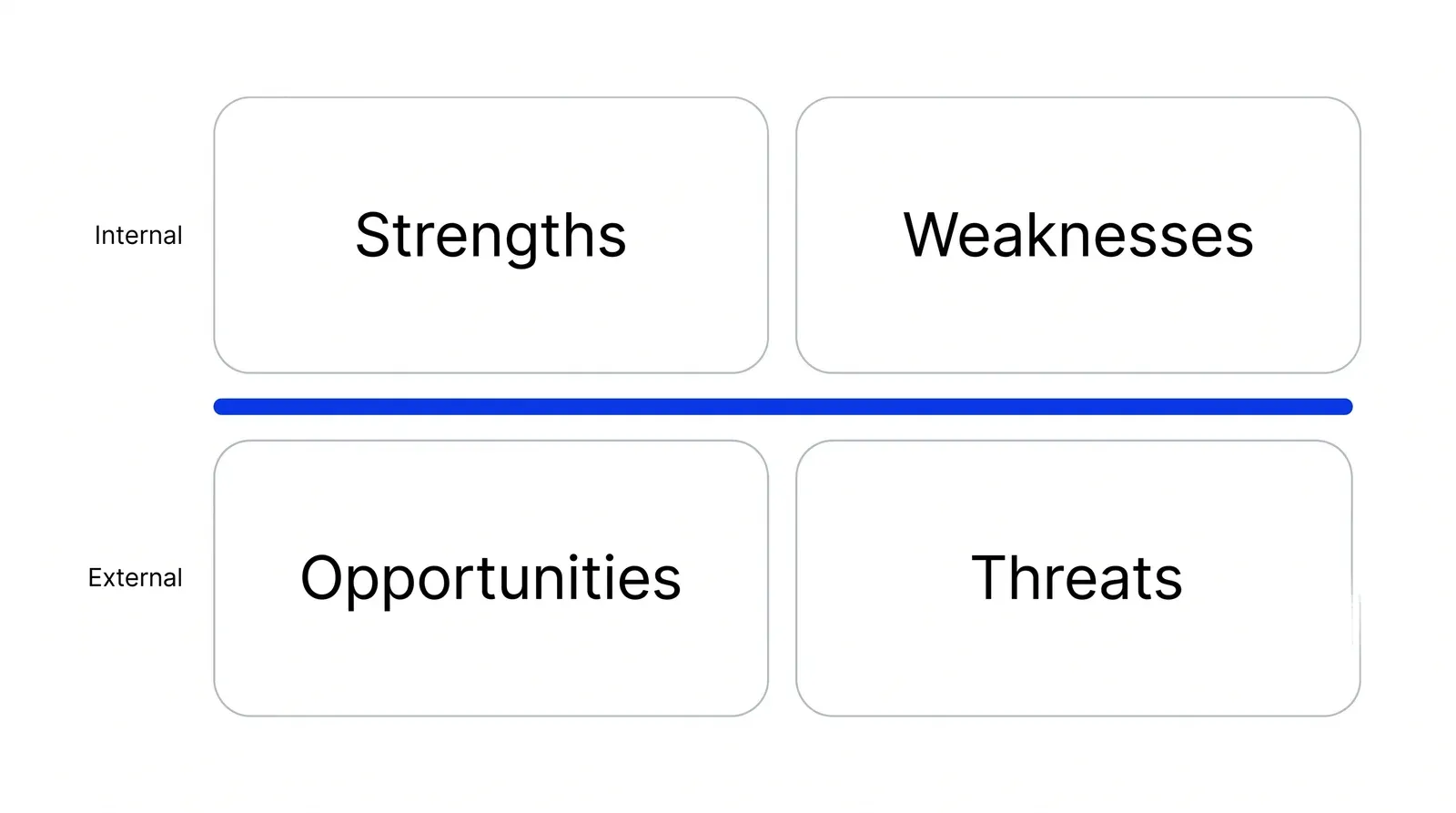
Most grids go wrong at this line. A growing market for online consultations is an opportunity, not a strength, because a clinic did nothing to create it. “We already run a telehealth platform” is the strength that lets the clinic use it. When an item could sit in either row, ask who controls it.
The bottom row is only as good as the market scan behind it. Porter’s five forces gives that scan a structure: rivalry, new entrants, substitutes, and the bargaining power of suppliers and buyers. Score those first, and the opportunities and threats boxes fill with evidence instead of guesses.
Questions to ask for each quadrant
The University of Kansas Community Tool Box suggests probing internal resources, such as people, funding, location, programs and reputation, for the top row, and forces you do not control, such as trends, the economy, demographics and legislation, for the bottom row. Start with these questions.
Strengths
- Why do customers say they chose us over the alternative?
- Which asset would take a competitor a year or more to copy: a license, a dataset, a team, a contract?
- Where are our unit economics better than the market’s, and by how much?
Weaknesses
- Where do we lose deals or customers, and what reason do they give?
- Which process depends on a single person?
- What do customers or staff see as a problem that management does not? The Tool Box raises this blind spot directly.
Opportunities
- Which change in rules, technology or customer behaviour over the next 12 to 24 months favours a company shaped like ours?
- Which customer segment do current players serve badly?
- Which partner could open a channel we cannot open alone?
Threats
- Which competitor move, price cut or new entrant would hurt us most this year?
- Which dependency, such as a supplier, a platform or a bank partner, could change its terms?
- Which rule change would raise our cost to serve?
Answer with evidence. “Strong brand” is an opinion. “Most new patients arrive by referral, according to the booking system” is a strength you can build on.
From four lists to strategy: the TOWS matrix
TOWS is a matrix that turns a SWOT into strategy options by pairing each internal box with each external box. Heinz Weihrich, then a management professor at the University of San Francisco, published it in Long Range Planning in 1982. It forces the step most SWOT sessions skip: deciding what to do about the lists.
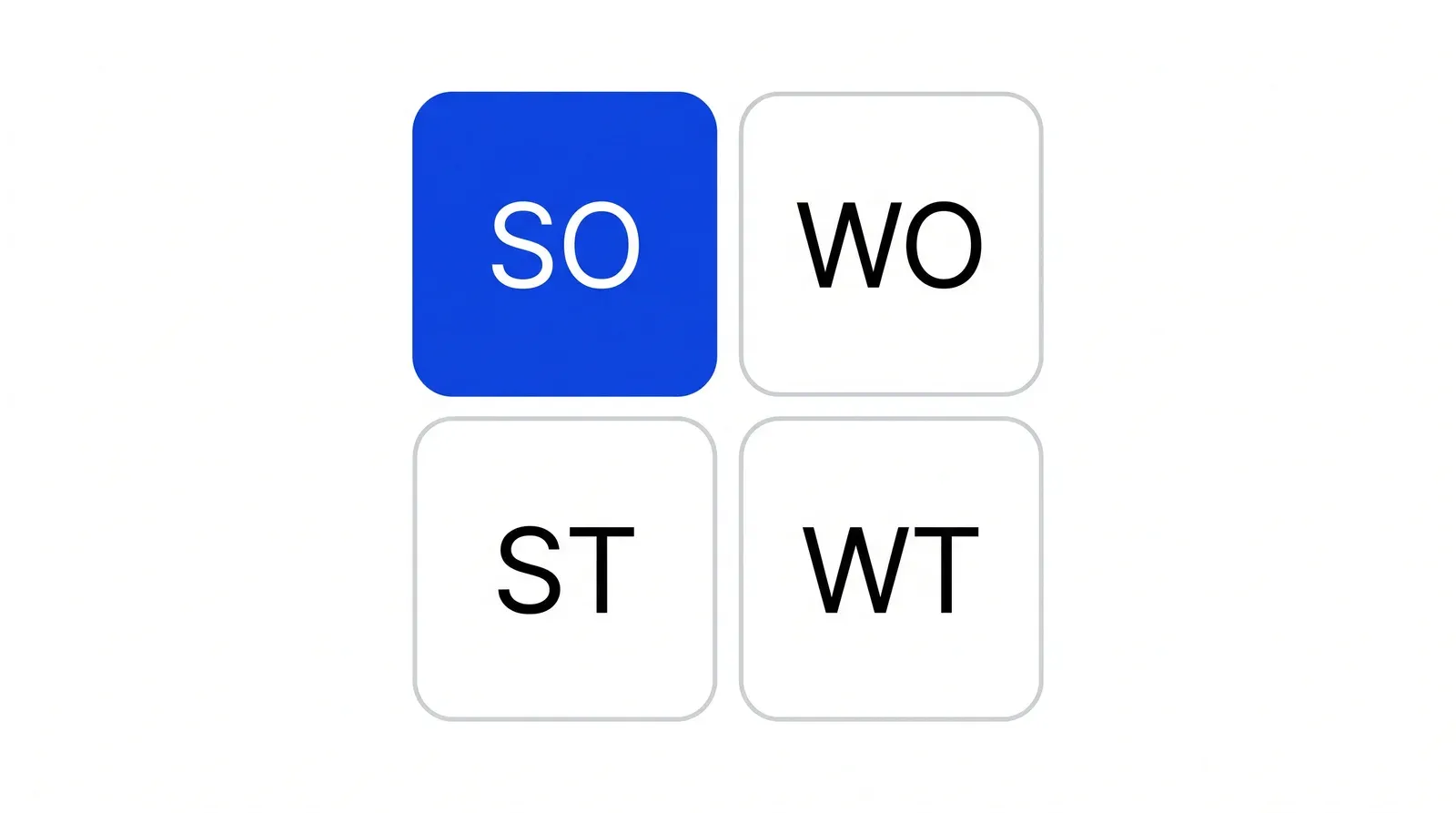
| Pairing | Question it asks | Kind of move |
|---|---|---|
| SO | How do we use a strength to take an opportunity? | Attack where you are already good |
| ST | How do we use a strength to blunt a threat? | Defend with what you have |
| WO | Which opportunity helps us fix a weakness? | Invest, hire or partner to close a gap |
| WT | How do we limit a weakness that a threat would expose? | Cut exposure, retreat or restructure |
Mind Tools’ summary of Weihrich’s matrix calls WT moves defensive and warns against relying on them to create success.
The main criticism: lists without priorities
The best-known critique is empirical. Terry Hill and Roy Westbrook reviewed SWOTs that 14 consulting firms produced for more than 20 of 50 companies in a UK Department of Trade and Industry scheme. Their 1997 Long Range Planning paper was titled “SWOT analysis: it’s time for a product recall.” The grids ran to long lists, over 40 factors on average, used vague wording, showed “a failure to prioritize” and were never checked. Nobody used the outputs in the later stages of strategy work.
Others went further. Erhard Valentin wrote in the Journal of Applied Business Research in 2005 that the SWOT approach “often is ineffective” and proposed a defensive and offensive evaluation in its place. Henry Mintzberg, in a 1990 Strategic Management Journal paper, questioned whether a management team can assess its own strengths and weaknesses accurately before it acts. Ansoff replied in the same journal in 1991, defending formal planning.
The defenders have evidence as well. Marilyn Helms and Judy Nixon’s 2010 review found research “supports SWOT analysis as a tool for planning purposes” and put its spread down to simplicity, while noting that nobody had measured its success with numbers. A 2011 review by Sayed Ghazinoory and colleagues drew on about 557 SWOT papers. Robert Wright, Sotirios Paroutis and Daniela Blettner found in a 2013 Journal of Management Studies study that managers rated SWOT more useful than the BCG matrix or the value chain. The Jarzabkowski project ranked value differently: SWOT was used most, but managers rated Porter’s five forces and PESTLE as more valuable for analysis.
The fixes follow from the critique:
- Cap each box at about ten items, as the Community Tool Box suggests, and agree on the order.
- Weight what is left. Mikko Kurttila, Jyrki Kangas and colleagues combined SWOT with the analytic hierarchy process, a scoring method based on pairwise comparisons, in a hybrid called A’WOT, because plain SWOT “includes no means of analytically determining the importance of factors.”
- End with TOWS moves that have owners and dates.
In our Growth Lab work we run changes through HADI loops, and a TOWS move is a ready-made hypothesis: an action, the result it should produce and a date to check it.
How to apply SWOT analysis, step by step
- Name the decision. Write the goal at the top of the page: enter a new market, plan next year, fix a falling conversion rate. A SWOT with no decision attached turns into a list of everything. Result: one sentence that every item in the grid has to be relevant to.
- Collect items alone, then together. Each person writes their own items before the group meets, the way the original SRI process asked every manager for 8 to 10 planning issues. This stops the most senior or loudest person from setting the list. Result: a raw pile of items from several points of view.
- Sort by control, then by effect. Ask of each item: does the organization control it? If yes, it is a strength or a weakness. If no, it is an opportunity or a threat. Then ask whether it helps or hurts the goal. Result: four boxes with no market trends hiding among the strengths.
- Cut, prove and rank. Narrow each box to about ten items or fewer, as the University of Kansas Community Tool Box suggests, and drop any item nobody can support with a number, a customer quote or a document. Rank what remains. Result: four short, ranked lists.
- Pair the boxes into TOWS moves. Match the top items: strengths with opportunities (SO), strengths with threats (ST), weaknesses with opportunities (WO), weaknesses with threats (WT). Write at least one concrete move for each pairing. Result: a shortlist of strategy options instead of four lists.
- Give each move an owner and a date. Choose the moves you will act on, then give each an owner, a first step and a review date. Re-run the SWOT when the market shifts. Result: a plan someone is accountable for.
Examples
A private dental clinic weighing a second site
Illustrative. Strengths: two senior implant specialists and steady referrals from three nearby general practices. Weaknesses: online booking covers only half the schedule, and one person handles all insurance paperwork. Opportunities: a new residential district 6 km away with no clinic. Threats: a dental chain opening a branch in the same area and rising rent. The TOWS step turns this into moves. SO: open the second site with implant work as the lead service, backed by the existing referral network. WT: automate insurance paperwork before expansion doubles the load on one person. Without the TOWS step the team would have stopped at four lists.
A B2B payments startup
Illustrative. Strengths: an e-money license and live integrations with two accounting platforms. Weaknesses: 70% of revenue comes from five clients. Opportunities: a neighbouring market whose rules now let licensed firms from the region serve local businesses. Threats: a large bank launching a free basic version for small firms. WO: enter the neighbouring market to spread revenue across more clients. ST: sell the accounting integrations, which the bank's product lacks, to the segment the bank is targeting. Each move gets an owner and a quarter.
When to use it
Use it at the start of annual planning, before a market entry or a major launch, or when a new leader needs a shared picture of the business in one session. It works best as the first step of a process that ends in decisions, with a TOWS matrix or a prioritization method straight after it.
When not to use it
Skip it when the question is narrow and measurable: a drop in last month's conversion rate needs a funnel analysis, not four boxes. Skip it when nobody in the room can act on the result. To judge whether an industry can be profitable at all, use Porter's five forces instead. Never let a SWOT be the only analysis behind a large investment.
Common mistakes
- Writing 40 items per box. Hill and Westbrook found consultants' grids averaged over 40 factors and nobody used them afterwards. Keep about ten per box and rank them.
- Putting market trends under strengths. If the organization did not create something and cannot control it, it belongs under opportunities or threats.
- Vague items such as 'good team' or 'strong brand'. Rewrite each one with evidence: a figure, a customer quote, a signed contract.
- Stopping at the grid. Without a TOWS step, owners and dates, the session changes nothing.
- Filling it in alone at the top. The original SRI process gathered issues from every manager, and a SWOT written by one executive misses what the front line sees.
FAQ
What are the four parts of a SWOT analysis?
Strengths and weaknesses, which are internal and within the organization's control, and opportunities and threats, which come from outside it. Strengths and opportunities help the goal; weaknesses and threats hurt it. The quickest test for any item is whether the organization could change it tomorrow. If it could, the item is internal.
What questions should you ask in a SWOT analysis?
For strengths: why do customers choose us, and what would take a competitor a year to copy? For weaknesses: where do we lose deals, and which process depends on one person? For opportunities: which change in rules, technology or demand favours us? For threats: which competitor move or supplier change would hurt most this year?
Who invented SWOT analysis?
It is disputed. Albert Humphrey is often credited, and many textbooks point to Harvard Business School. Archival research by Puyt, Lie and Wilderom (Long Range Planning, 2023) traces it to Robert F. Stewart's planning team at the Stanford Research Institute, which published a SOFT approach in 1965. Humphrey, a member of that team, credited Stewart himself.
What is the difference between SWOT and TOWS?
SWOT lists the factors; TOWS turns them into strategy. Heinz Weihrich's TOWS matrix (Long Range Planning, 1982) pairs each internal box with each external box, giving four kinds of move: SO uses strengths to take opportunities, ST uses strengths against threats, WO uses opportunities to fix weaknesses, and WT limits weaknesses that threats would expose.
Is SWOT analysis still useful?
Yes, if it ends in decisions. Surveys find it is the most used strategy tool, and a 2013 study found managers rated it more useful than several other classic tools. Critics, starting with Hill and Westbrook in 1997, showed most SWOTs are long unranked lists nobody acts on. Ranking items and adding a TOWS step answers most of that criticism.
Sources
- Richard W. Puyt, Finn Birger Lie, Celeste P.M. Wilderom, The origins of SWOT analysis, Long Range Planning 56(3), 2023
- Richard W. Puyt, Finn B. Lie, Frank J. de Graaf, Celeste P.M. Wilderom, Origins of SWOT analysis, Academy of Management Proceedings, 2020
- Richard W. Puyt, Finn Birger Lie, Dag Øivind Madsen, From SOFT approach to SWOT analysis, a historical reconstruction, Journal of Management History 31(2), 2025
- University of Twente, PhD defence of Richard Puyt: The origins and institutionalization of SWOT analysis, March 2025
- Albert S. Humphrey, SWOT Analysis for Management Consulting, SRI Alumni Association Newsletter, December 2005 (Internet Archive copy)
- Edmund P. Learned, C. Roland Christensen, Kenneth R. Andrews, William D. Guth, Business Policy: Text and Cases, Irwin, 1965, Internet Archive record
- Pankaj Ghemawat, Competition and Business Strategy in Historical Perspective, Business History Review 76(1), 2002
- Sheffield Hallam University, SWOT Analysis handout, 2017
- Heinz Weihrich, The TOWS matrix: a tool for situational analysis, Long Range Planning 15(2), 1982
- Mind Tools, The TOWS Matrix
- Terry Hill, Roy Westbrook, SWOT analysis: it's time for a product recall, Long Range Planning 30(1), 1997, Oxford University Research Archive
- Erhard K. Valentin, Away With SWOT Analysis: Use Defensive/Offensive Evaluation Instead, Journal of Applied Business Research 21(2), 2005
- Henry Mintzberg, The design school: reconsidering the basic premises of strategic management, Strategic Management Journal 11(3), 1990
- H. Igor Ansoff, Critique of Henry Mintzberg's 'The design school', Strategic Management Journal 12(6), 1991
- Marilyn M. Helms, Judy Nixon, Exploring SWOT analysis: where are we now?, Journal of Strategy and Management 3(3), 2010
- Sayed Ghazinoory, Mansoureh Abdi, Mandana Azadegan-Mehr, SWOT methodology: a state-of-the-art review for the past, a framework for the future, Journal of Business Economics and Management 12(1), 2011
- Mikko Kurttila, Mauno Pesonen, Jyrki Kangas, Miika Kajanus, Utilizing the analytic hierarchy process (AHP) in SWOT analysis, Forest Policy and Economics 1(1), 2000
- Jyrki Kangas, Mauno Pesonen, Mikko Kurttila, Miika Kajanus, A'WOT: integrating the AHP with SWOT analysis, ISAHP 2001
- Robert P. Wright, Sotirios E. Paroutis, Daniela P. Blettner, How useful are the strategic tools we teach in business schools?, Journal of Management Studies 50(1), 2013
- UKRI Gateway to Research, Applying strategic management education in practice (ESRC project led by Paula Jarzabkowski, Aston University), 2009
- University of Kansas, Community Tool Box, SWOT Analysis
Last updated Oct 9, 2026

Marketing agency or growth system: when a company outgrows its agency
An agency is the right call while the founder still runs most of the company. Once the business starts copying itself into new locations or markets, it needs a system that sets goals, tests hypotheses and owns the result.

Why healthcare marketing agencies stall: the short, mid and long wins model we use with clinics
Most agencies own the click and nobody owns the front desk. How we structure clinic work in three horizons, the research behind each one, and one year of results.

Why channel tests stall after month three
Most paid channel tests do not end with a decision. They end when the budget runs out, the attribution model changes, or everyone quietly stops looking at the dashboard.