Affiliate and partner marketing
Affiliate and partner marketing is a way to sell through other people's audiences and pay them a commission only when their referral turns into a lead, a sale or recurring revenue.
Affiliate marketing is a performance-based channel in which a merchant pays independent partners a commission for customers they refer through a tracked link or code. Partner marketing is the wider version that also covers resellers, agencies and technology partners, usually ranked in tiers. Both shift acquisition cost from upfront spend to payment on results, which makes commission design, attribution, fraud control and disclosure the main jobs.
- Origin
- Industry practice; early referral-tracking patents by William J. Tobin (priority 1996) and Amazon (filed 1997), 1996-1997
- Level
- 201 · Tool
- Fits
- Startup, Small and mid-size, Scale-up
- Time to apply
- two to four weeks to launch a first program, then a monthly review of partners and payouts
- What you need
- contribution margin per order or per customer, so you know the most you can pay a partner · a tracking setup, either an affiliate network or in-house software, that records clicks, conversions and refunds · written program terms covering commission, hold period, banned traffic sources and disclosure · one owner who approves partners and reviews traffic every month
Affiliate marketing is a sales channel in which a merchant pays independent partners a commission for customers they send through a tracked link or code. The partner might be a review site, a creator, a newsletter or a comparison tool. The merchant pays only when the referral turns into the outcome both sides agreed on, usually a sale. Partner marketing uses the same logic with a wider cast: resellers, agencies, consultants and software companies whose products integrate with yours.
Nobody owns the idea, and the sources disagree on who came first. William J. Tobin’s US patent 6,141,666, with a priority date of January 1996, describes tracking which site sent a visitor to PC Flowers & Gifts so that site “can then be paid on a percentage basis of sales.” Amazon filed its own patent for an Internet-based customer referral system in June 1997, naming Jeff Bezos among the inventors; it describes associates whose links carry their ID and earn a percentage commission. Both patents were granted in 2000.
How does affiliate marketing work?
Three parties do the work. The partner publishes a link that carries its ID. The customer clicks and buys. The merchant’s tracking matches the purchase to the partner’s ID and pays the commission, often after a hold period. An affiliate network can sit between them to handle tracking and payouts, but the logic stays the same.
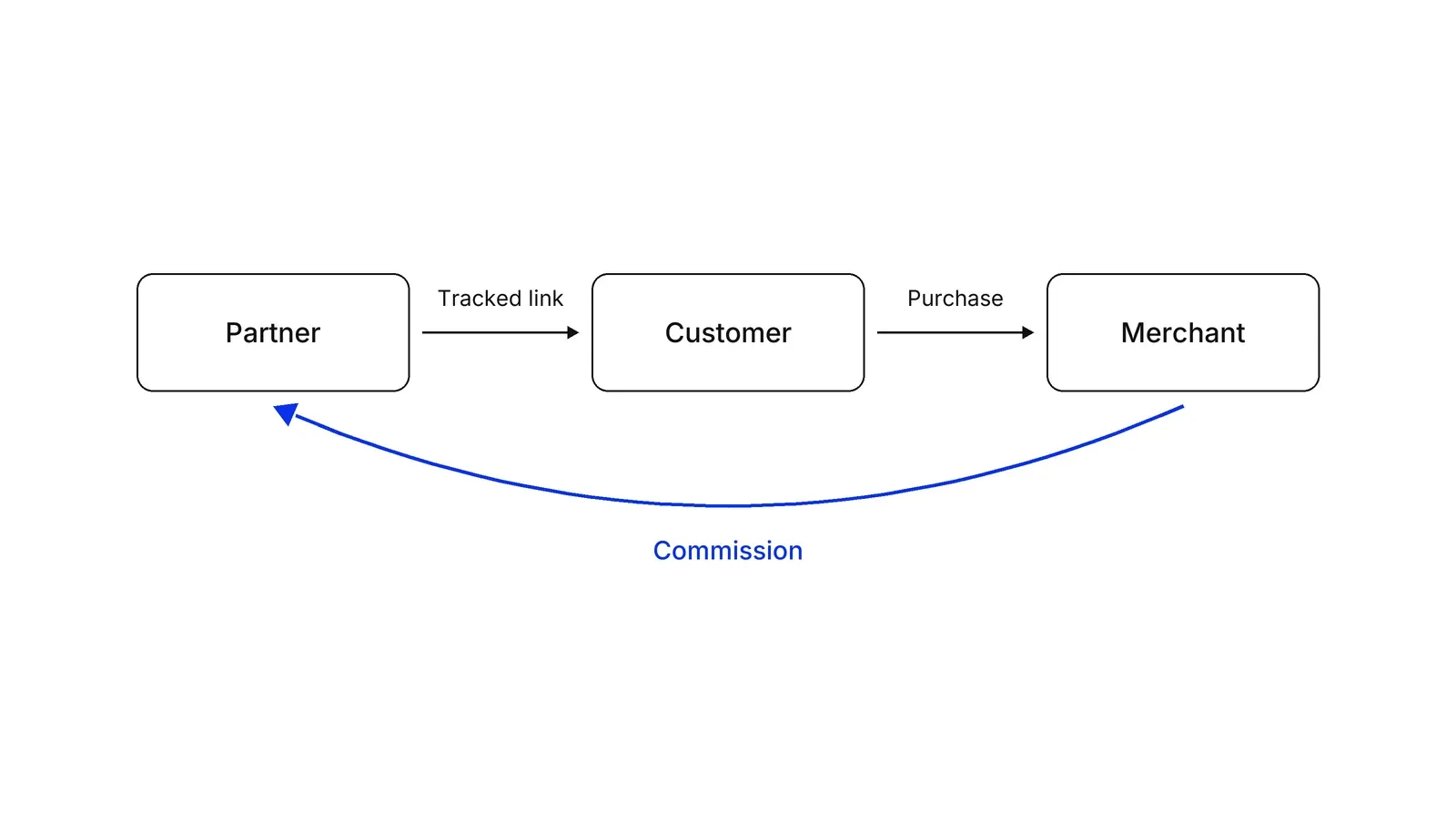
Dennis Duffy’s 2005 review in the Journal of Consumer Marketing put the success condition simply: the arrangement has to work for both the advertiser and the affiliate over the long run. A program that squeezes partners loses the good ones, and one that overpays attracts the wrong ones.
| Partner type | How they are paid | Relationship | Typical example |
|---|---|---|---|
| Affiliate publisher | Commission per sale or lead | Many partners, standard terms | Review or comparison site |
| Referral (customer) | Reward per referred customer | Existing customers | Bank “refer a friend” offer |
| Creator or influencer | Commission, flat fee or both | Individual deals | Creator with a discount code |
| Reseller or agency partner | Share of recurring revenue, margin | Few partners, tiers, co-selling | Agency selling software to clients |
Referred customers can be worth more than average. Schmitt, Skiera and Van den Bulte tracked about 10,000 customers of a German bank for almost three years and found referred customers were at least 16% more valuable than comparable customers, mainly because they stayed longer.
Commission models: what you pay for
The commission model decides who carries the risk that a referral turns out to be worthless. Pay per click puts all of it on the merchant. Pay per lead moves part of it. Pay per sale and revenue share move most of it to the partner, who earns nothing unless the customer buys and, with revenue share, keeps paying.
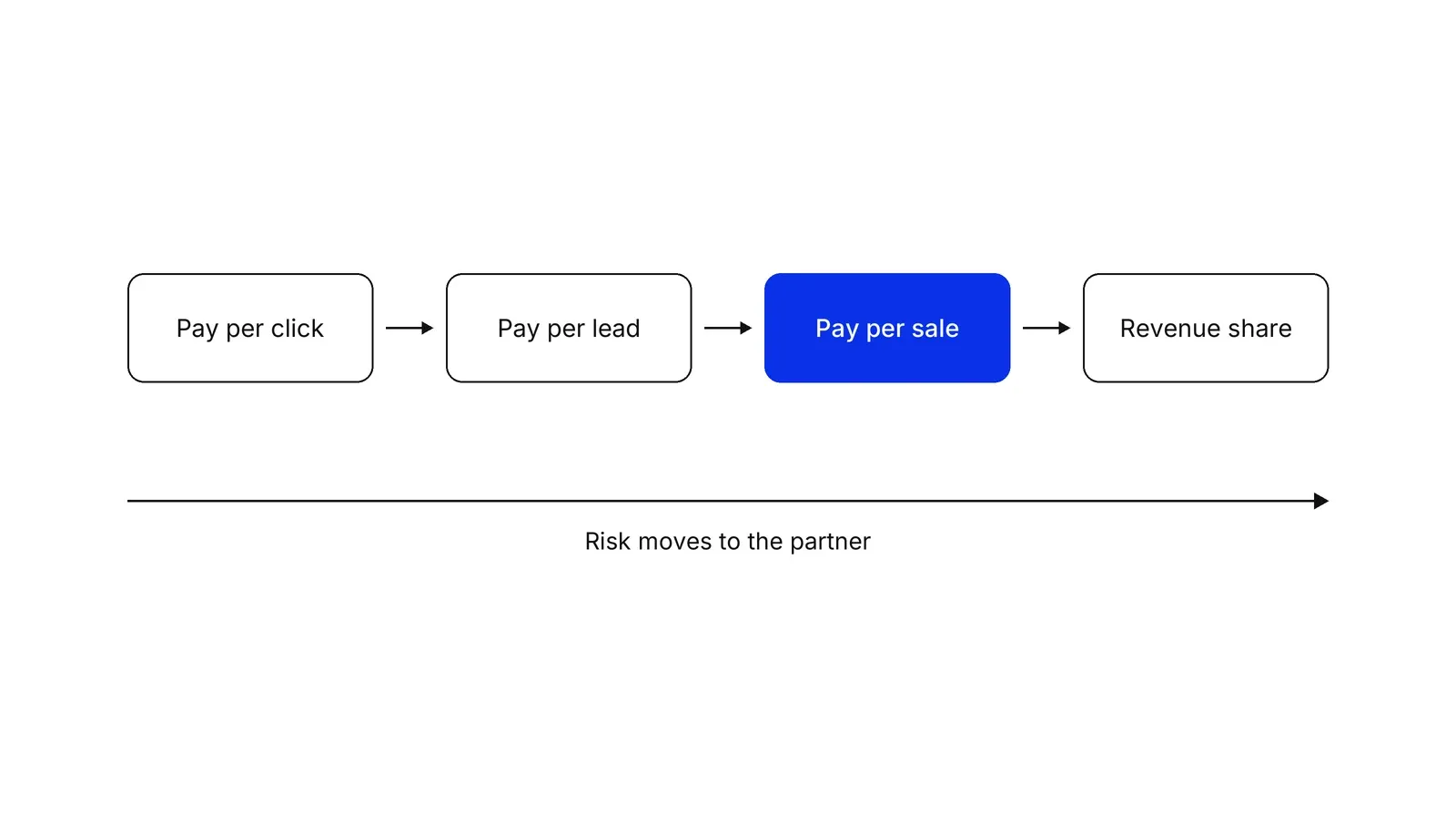
Research supports matching the model to the deal. Libai, Biyalogorsky and Gerstner (2003) found that pay per lead can be more profitable in a one-to-one negotiated deal, while a merchant running many affiliates on the same terms does better paying per conversion, because pay per lead invites bogus referrals.
Rates follow margin. Amazon’s standard commission table pays 1% on grocery, 4.5% on physical books, 4% on most other categories and 10% on luxury beauty. A low-margin category cannot fund a high rate, whatever partners ask for. For the arithmetic, start from contribution margin per order and decide how much of it you are willing to give away.
Attribution: who gets the credit
Most programs still pay the last partner whose link was clicked before the purchase. Amazon’s Commission Income Statement ends a referral session 24 hours after the click, or earlier if the customer buys or clicks another associate’s link.
Last click is simple and easy to audit, and it rewards the wrong partners. Ron Berman’s 2018 paper in Marketing Science shows that last-touch attribution overpays for ad exposures and lowers advertiser profit compared with a Shapley-value split. Coupon and cashback sites are the practical version of the problem: they often catch shoppers who were already at checkout. Google has moved its own ad platform away from simple rules, retiring first click, linear, time decay and position-based models in 2023 and keeping only last click and data-driven attribution. The cleanest test of whether a partner brings new customers is a holdout: stop or pause the partner for a sample of traffic and compare.
Fraud: what goes wrong
Affiliate fraud is any trick that collects commission without sending a real customer. Edelman and Brandi’s study, summarised by Harvard Business School Working Knowledge, describes three main forms: cookie stuffing, where a tracking cookie is planted without a click; adware that reroutes shoppers through an affiliate link; and typosquatting on misspelled domains. Their crawlers ran more than 2 million page loads, and nearly half of the programs they tracked showed no fraud at all.
Who manages the program matters. In the published version of the study, outside specialists were better at removing affiliates who clearly broke the rules, while in-house staff were better at catching borderline practices that still hurt the merchant. Chachra, Savage and Voelker (2015) found cookie stuffing relatively scarce in their crawl, with large networks targeted more than merchant-run programs.
The controls are dull and effective: hold commission until refunds clear, reverse payouts on returns, ban traffic sources you cannot see, and sample partner pages each month.
FTC disclosure rules: 16 CFR Part 255
In the US, the FTC’s Endorsement Guides at 16 CFR Part 255 decide how partners must disclose that they are paid. The revised Guides took effect on 26 July 2023, replacing the 2009 version. Section 255.5 requires a connection that “might materially affect the weight or credibility” of an endorsement to be disclosed clearly and conspicuously, which the Guides define as difficult to miss and easy to understand. Online, the disclosure “should be unavoidable.”
FTC staff guidance in What People Are Asking is specific about affiliates. The words “affiliate link” alone may not be understood. “Paid link” next to the link is adequate. A disclosure buried at the end of a post, in a bio or behind a “more” button is likely to be missed, according to Disclosures 101.
The merchant carries the risk too. Section 255.1(d) says advertisers should guide their endorsers, monitor them and act on non-compliance. The LeadClick case showed that a network can be held liable for its affiliates’ fake news sites. Since 2024 the FTC’s rule on fake reviews also lets it seek civil penalties against knowing violators. Rules differ outside the US, so check local advertising law before launching there.
Partner tiers: how to rank partners
Tiers turn a list of partners into a ladder with better rates, support and visibility at each step. HubSpot’s Solutions Partner tiers are a public model: points per $100 of monthly recurring revenue, weighted toward deals the partner sources, plus a retention requirement for the top two tiers. The retention test is the part worth copying. Ranking partners on volume alone rewards whoever brings the most customers, including the ones who leave in month two. In Pushers’ Growth Lab work, partner programs are measured on the same unit economics as every other channel.
How to apply Affiliate and partner marketing, step by step
- Set the ceiling on what a customer is worth to you. Start from contribution margin, not revenue. If an order leaves $40 after product, delivery and payment costs, and you want half of that to stay with you, the most you can pay any partner is $20 per order. Result: a maximum commission per outcome, written down before anyone negotiates.
- Choose the outcome you pay for. Pick the trigger: a click, a qualified lead, a first sale, or a share of revenue for as long as the customer pays. Pay for the latest outcome partners will accept, because later triggers leave less room for junk traffic. Result: one commission model per partner type, with the definition of a valid conversion in plain words.
- Decide how credit is assigned. Write down the attribution rule: how long the referral window lasts, what happens when two partners touch the same customer, and whether a paid search or coupon click after the partner's click cancels the partner's credit. Result: an attribution policy partners can read before they join.
- Recruit and sort partners. List the publishers, creators, agencies, consultants and software vendors your customers already listen to. Approve them one by one, and start everyone in a base tier with the standard rate. Result: a first cohort of partners, each with a named traffic source.
- Put disclosure and fraud rules into the contract. Require a clear disclosure next to every recommendation, ban brand-term bidding, cookie stuffing and pop-ups if you do not want them, and hold commissions until the refund window closes. Result: terms that let you reverse payouts and remove partners without a dispute.
- Review every month and promote by results. Each month, check new customers, refund rate and retention by partner, sample partner pages for disclosures, and move partners up or down tiers on sourced revenue and customer quality. Result: a short report that says who gets promoted, who gets a warning and who leaves.
Examples
A payments app paying for funded accounts
Illustrative, no real company implied. A payments app earns about $90 of contribution margin from a business customer in its first year. It pays partners $30 only when a referred business passes verification and makes its first transfer, and holds the payout for 60 days. Paying per sign-up would have cost the same $30 for every abandoned application, so a partner sending 100 sign-ups that produce 20 funded accounts earns $600, not $3,000.
LeadClick and the cost of not watching affiliates
In 2016 the US Court of Appeals for the Second Circuit upheld an order that LeadClick Media, an affiliate network, pay $11.9 million over fake news sites its affiliates used to sell LeanSpa weight-loss products. The FTC said the network recruited the affiliates, could accept or reject their sites, paid them, bought ad space for them and commented on their content. The FTC called it the first appeals court decision holding an affiliate network operator liable for deception by third-party marketers.
HubSpot's partner tiers
HubSpot ranks its Solutions Partners as Gold, Platinum, Diamond and Elite. Partners earn points for every $100 of monthly recurring revenue: more for deals they source, fewer for deals they help close or customers they manage. Under thresholds partners must meet by 15 January 2027, Gold needs 115 sourced and 345 total points, Elite needs 2,750 and 11,000, and Diamond and Elite also require average gross revenue retention of at least 75% and 80%.
When to use it
Use affiliate and partner marketing when other people already hold the attention of your buyers, your margin can fund a commission, and you can track a referral from click to paid outcome. It suits e-commerce, subscription software, financial products and services where creators, comparison sites, agencies or consultants shape the purchase decision.
When not to use it
Skip it while unit economics are unknown or negative, because a commission on top of a loss scales the loss. It is also a poor fit when you cannot track conversions reliably, when your category bans or tightly restricts paid endorsements, or when you have nobody to vet partners and audit their traffic.
Common mistakes
- Paying on sign-ups or leads to a large open network, which invites bogus referrals that never convert.
- Accepting the network's last-click report as proof of new customers, when coupon and cashback sites often take credit for buyers who were already checking out.
- Paying commissions before the refund or chargeback window closes, so fraudulent or returned orders are already paid out.
- Treating disclosure as the partner's problem. Under the FTC Guides the advertiser is expected to guide, monitor and act on its endorsers.
- Building tiers on volume alone, so partners who bring customers who churn fast get the best rates.
FAQ
What is the difference between affiliate marketing and partner marketing?
Affiliate marketing usually means many independent publishers paid a commission per tracked click, lead or sale, often through a network. Partner marketing is broader: it also includes resellers, agencies, consultants and software integrations, with closer relationships, co-selling and tiers. Many companies run both, with affiliates as the open entry level and partners as the managed top.
How much commission do affiliate programs pay?
It depends on margin and on what triggers the payout. Amazon's published standard rates, for example, run from 1% for grocery to 10% for luxury beauty, with 4% for most other categories. Subscription software often pays a share of recurring revenue instead. Work back from your contribution margin rather than copying a rate.
Do affiliate links have to be disclosed?
In the US, yes, when the audience would not expect the payment. The FTC's Endorsement Guides, 16 CFR Part 255, require material connections to be disclosed clearly and conspicuously. FTC staff say the words affiliate link alone may not be enough, while paid link placed right next to the link is adequate.
What is cookie stuffing in affiliate marketing?
Cookie stuffing is fraud in which an affiliate plants its tracking cookie in a visitor's browser without a real click, so it collects commission if that person later buys from the merchant. Researchers have also documented adware that reroutes shoppers through affiliate links and typosquatting on misspelled merchant domains.
What are some examples of partner marketing?
Common forms include a software company paying agencies a share of revenue for clients they bring in, a bank rewarding customers for referrals, a retailer paying review sites per sale, and a payments provider listing integration partners in tiers. HubSpot's Solutions Partner Program, with Gold to Elite tiers, is a public example.
Sources
- Federal Trade Commission, Guides Concerning the Use of Endorsements and Testimonials in Advertising, final revised Guides, 88 FR 48092, 26 July 2023
- Cornell Legal Information Institute, 16 CFR Part 255, Guides Concerning the Use of Endorsements and Testimonials in Advertising
- Federal Trade Commission, FTC's Endorsement Guides: What People Are Asking
- Federal Trade Commission, Disclosures 101 for Social Media Influencers
- Federal Trade Commission, FTC Announces Updated Advertising Guides to Combat Deceptive Reviews and Endorsements, 29 June 2023
- Federal Trade Commission, FTC Announces Final Rule Banning Fake Reviews and Testimonials, 14 August 2024
- Federal Trade Commission, U.S. Circuit Court Finds Operator of Affiliate Marketing Network Responsible for Deceptive Third-Party Claims, 4 October 2016
- Federal Trade Commission, Federal court ruling against affiliate marketing network LeadClick and its parent company, 6 April 2015
- Barak Libai, Eyal Biyalogorsky, Eitan Gerstner, Setting Referral Fees in Affiliate Marketing, Journal of Service Research 5(4), 2003
- Benjamin Edelman, Wesley Brandi, Risk, Information, and Incentives in Online Affiliate Marketing, Journal of Marketing Research 52(1), 2015
- Harvard Business School Working Knowledge, The Tricky Business of Managing Web Advertising Affiliates, February 2014
- Neha Chachra, Stefan Savage, Geoffrey M. Voelker, Affiliate Crookies: Characterizing Affiliate Marketing Abuse, ACM Internet Measurement Conference, 2015
- Philipp Schmitt, Bernd Skiera, Christophe Van den Bulte, Referral Programs and Customer Value, Journal of Marketing 75(1), 2011
- Dennis L. Duffy, Affiliate Marketing and Its Impact on E-commerce, Journal of Consumer Marketing 22(3), 2005
- Ron Berman, Beyond the Last Touch: Attribution in Online Advertising, Marketing Science 37(5), 2018
- William J. Tobin, US Patent 6,141,666, Method and system for customizing marketing services on networks communicating with hypertext tagging conventions
- Jeffrey P. Bezos et al., Amazon.com, US Patent 6,029,141, Internet-based customer referral system
- Amazon Associates Central, Standard Commission Income Rates
- Amazon Associates Central, Associates Program Policies and Commission Income Statement
- HubSpot, How Solutions Partner tiers work
- Google Ads Help, About attribution models
- Google Ads Help, First click, linear, time decay and position-based attribution models are going away
Last updated Oct 9, 2026


Marketing agency or growth system: when a company outgrows its agency
An agency is the right call while the founder still runs most of the company. Once the business starts copying itself into new locations or markets, it needs a system that sets goals, tests hypotheses and owns the result.

Why healthcare marketing agencies stall: the short, mid and long wins model we use with clinics
Most agencies own the click and nobody owns the front desk. How we structure clinic work in three horizons, the research behind each one, and one year of results.

DORA for marketing and operations teams
What the EU Digital Operational Resilience Act changes for teams outside IT: vendor registers, incident reporting and who owns compliance without a CISO.