Ethnographic research
Ethnographic research is a way of learning about customers by watching them in their own homes, shops and offices, so a company decides from what people do rather than only from what they say in surveys.
Ethnographic research is a method borrowed from anthropology in which researchers observe and talk with people in their own setting, at home, at work or in a store, to understand what they do and why. In business it is used to find needs customers cannot put into words, to explain behaviour that surveys miss and to inform product, positioning and strategy decisions.
- Origin
- Bronisław Malinowski (anthropological fieldwork); Eric Arnould and Melanie Wallendorf (market-oriented ethnography); Hugh Beyer and Karen Holtzblatt (contextual inquiry), 1922; 1994; 1980s, in book form 1998
- Level
- 301 · Advanced
- Fits
- Scale-up, Enterprise
- Time to apply
- two to six weeks for a focused study: one week to plan and recruit, one to three weeks in the field, one week to interpret
- What you need
- one business question the study must help answer · permission to visit people where the behaviour happens, and a consent and recording policy · two researchers per visit, or one researcher plus one person from product, marketing or operations · time for the team to interpret notes together within a day or two of each visit
Ethnographic research is a way of studying customers by going to where they live, work or shop, watching what they do and talking with them about it in that setting. The method comes from anthropology. In his 1922 book Argonauts of the Western Pacific, Bronisław Malinowski wrote that the fieldworker’s aim is “to grasp the native’s point of view.” Today product teams, consumer brands and strategy groups use it to see the parts of customer behaviour that questionnaires cannot reach.
Three bodies of work shape how companies use it. Eric Arnould and Melanie Wallendorf’s 1994 paper in the Journal of Marketing Research, “Market-Oriented Ethnography”, set out how fieldwork can feed segmentation, targeting, positioning and brand management. Hugh Beyer and Karen Holtzblatt turned it into a short, repeatable method for product teams called contextual inquiry. And Ken Anderson, an anthropologist at Intel, argued in Harvard Business Review in 2009 that ethnography belongs in strategy and long-range planning, beyond its usual home in innovation.
Why watch instead of ask?
Watching matters because what people say about their behaviour is often a poor guide to what they do. Sociologists Colin Jerolmack and Shamus Khan call the habit of reading behaviour off interview answers the “attitudinal fallacy”. In marketing, Richard Elliott and Nick Jankel-Elliott describe the same problem as the “limitations of asking”: people forget, tidy up their stories and leave out what seems too obvious to mention.
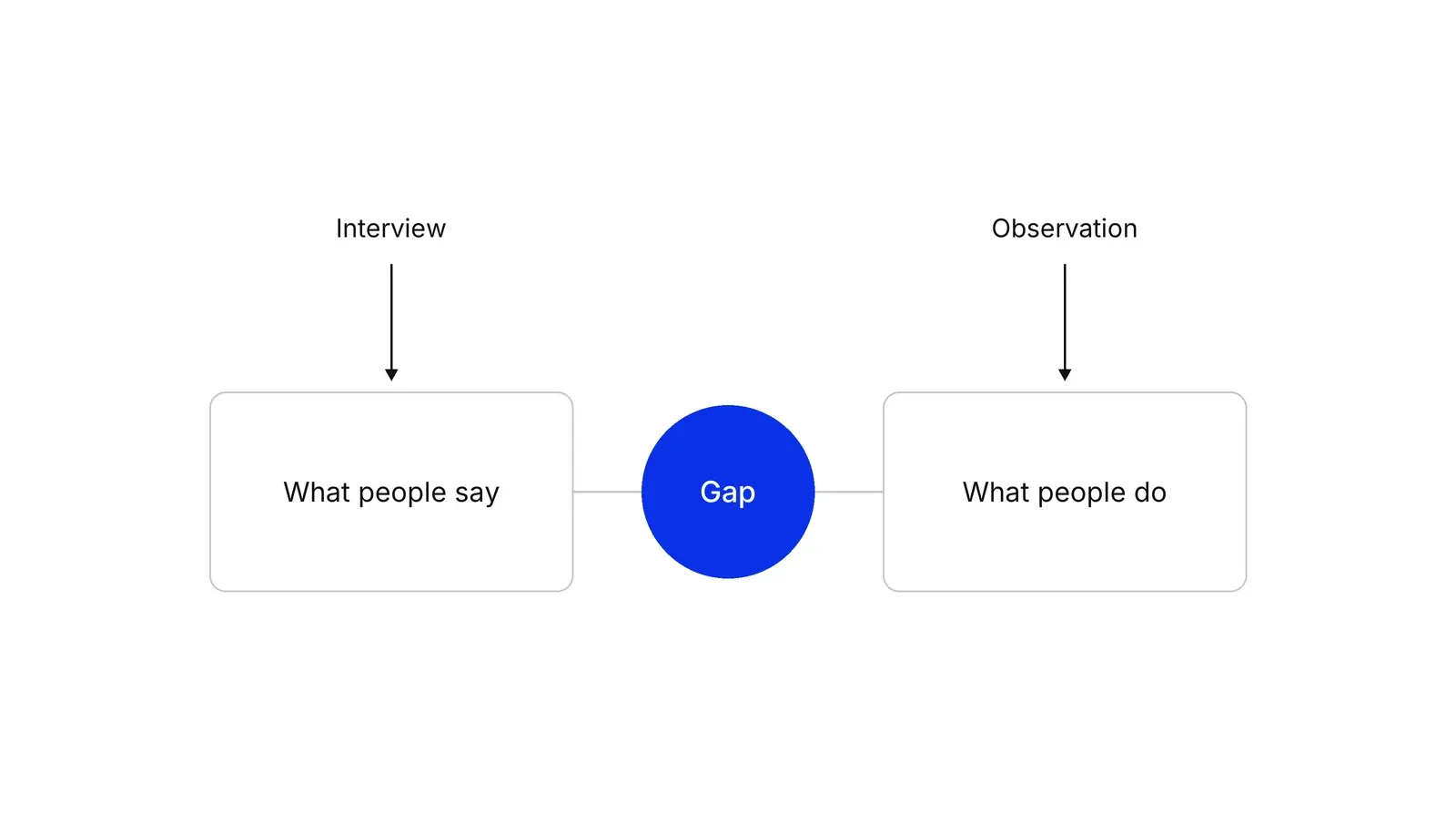
A second reason is needs that customers cannot name. Dorothy Leonard and Jeffrey Rayport made this point in “Spark Innovation Through Empathic Design” in 1997: customers can guide a company only as far as their own experience and imagination reach. A parent will not ask for a diaper that feels like underwear. Watching that parent hesitate before putting plastic against a baby’s skin tells you the same thing, and Procter & Gamble acted on exactly that observation.
What market-oriented ethnography adds
Arnould and Wallendorf’s contribution was to show how a company gets from field notes to strategy. Their abstract describes interpretations built by comparing data that agree and data that conflict, say, what a family tells you about a holiday meal against what a researcher saw at the table. The multilayered picture that results is then tied to marketing decisions through what they call representational strategies.
Their own studies show the scale this can take. Wallendorf and Arnould’s 1991 study of Thanksgiving drew on ten data sets collected over five years. Arnould and Linda Price’s 1993 study of river rafting trips collected data over two years and found that the story of the trip, more than whether it met expectations, drove how customers judged it. That is a challenge to the common view of satisfaction as expectations met.
Later work looked at how the findings travel inside a company. Julien Cayla and Eric Arnould found that ethnographic stories help executives grasp how complicated their customers’ lives are, which tables of numbers rarely do.
Contextual inquiry: ethnography for product teams
Contextual inquiry is a short form of ethnography in which a researcher watches one person do real work in their own setting and asks questions as the work happens. Holtzblatt and Beyer developed it at Digital Equipment Corporation and published it in Contextual Design in 1998. Sources differ on the start date: the authors’ encyclopedia chapter says the early 1980s, while the publisher of the 2016 second edition says the approach was first developed in 1988.
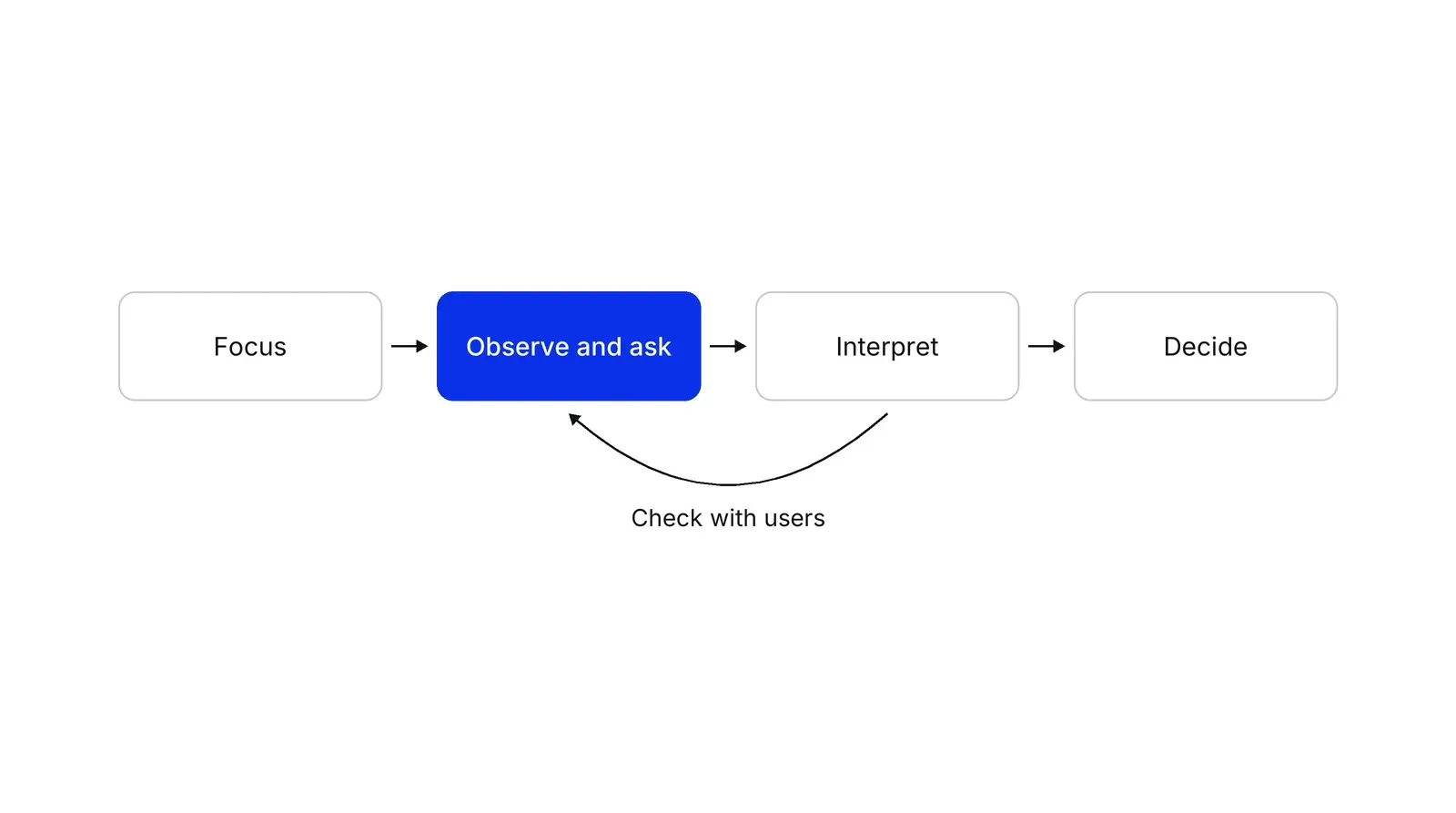
The researcher takes the role of an apprentice learning from a master. Nielsen Norman Group’s summary lists four principles: context (watch the work where it happens), partnership (the user shares control of the conversation), interpretation (check your reading of events with the user) and focus (know what you are there to learn). A session moves from a short primer to a transition into normal work, then cycles of watching and asking, and ends with a wrap-up in which the researcher reads back their interpretations so the user can correct them.
Ethnography, contextual inquiry, interviews and surveys
These methods are often confused. Nielsen Norman Group’s guide to field studies places them on a spectrum from pure observation to customer site visits, with full ethnography as the most immersive.
| Method | Where | Time per person | Best for |
|---|---|---|---|
| Ethnography | The person’s world | Days to months | Culture, routines, unspoken needs |
| Contextual inquiry | Where the task happens | A few hours | How work is really done, workarounds |
| Interview | Anywhere, often remote | About an hour | Opinions, history, reasons people give |
| Survey | Online | Minutes | How many people think or report something |
Teams often run them together. Interviews and fieldwork find the pattern, and a survey or product analytics measure how common it is. Our voice of customer and jobs to be done pages cover the interview side.
How companies use it
The best-known corporate programmes run for years. Intuit’s Follow Me Home visits add up to 10,000 hours a year, according to its chief executive in a 2014 Fortune interview. At Intel, Genevieve Bell spent three years observing family life in hundreds of homes across Asia, InfoWorld reported in 2005; one of her observations was six people in a two-room Beijing flat sharing one television, a poor fit for the idea of streaming video to screens in every room.
Consultancies sell the method for strategy work too. Christian Madsbjerg and Mikkel Rasmussen of ReD Associates described a European brewer whose pub sales were falling for reasons its market research could not explain, which is the kind of question fieldwork is good at.
The cost question is real, since field time is expensive. Stephen Rosenthal and Mark Capper’s review of fourteen projects in the Journal of Product Innovation Management treats how much ethnography to buy as a cost-benefit decision made at the front end of product development. In Pushers’ Growth Lab work, a few customer visits come before a new segment or offer goes into a test, so the hypothesis is built on observed behaviour.
How to apply Ethnographic research, step by step
- Write the focus. State the decision the study feeds and the behaviour you need to see, for example how small merchants reconcile card payouts at month end. Contextual inquiry calls this focus: it tells the researcher what to watch and what to ignore. Result: one paragraph with the decision, the behaviour and the places where it happens.
- Choose the people and the places. Recruit a small set of people who do the behaviour for real, chosen to differ on what matters to the decision, such as size, experience or channel. Plan to visit them where the work happens, not in a meeting room. Result: a visit schedule with the reason each person is on it.
- Observe first, then ask. Follow the contextual inquiry pattern: explain the visit, ask the person to do their normal work, watch, and pause to ask about anything you do not understand. Note what people do, the tools and workarounds they use, and the words they use for things. Result: field notes, photos and short recordings from each visit.
- Interpret as a team within 48 hours. Hold an interpretation session after each visit, while memory is fresh, with people from more than one function. Read the notes aloud, record observations, breakdowns and questions, and mark where what people said differs from what they did. Result: a set of interpreted notes per visit.
- Build patterns across visits. Group the notes from all visits into patterns, and look hardest at cases that do not fit, since Arnould and Wallendorf argue that discrepant data is where richer interpretations come from. Result: three to seven findings, each backed by notes from several visits.
- Turn findings into decisions. For each finding, write what it changes: a segment definition, a positioning line, a product requirement or a process fix. Share one or two field stories with each finding so executives remember it. Result: a short decision memo with owners and a date to review what happened.
Examples
P&G and Pampers
Newsweek reported in 2005 that Procter & Gamble's design team, led by Claudia Kotchka and working with firms such as IDEO, stopped relying on interviews and went home with consumers. Watching parents showed they were uneasy about putting plastic against a baby's skin, and Pampers moved to softer, cloth-like materials and rounder tapes. Watching toddlers being potty trained showed they wanted to do things themselves, which led to a wipes box a child can open with one hand.
Intuit's Follow Me Home
Intuit staff visit customers to watch them use its software at home or at work, a practice the company calls Follow Me Home. In a 2014 Fortune interview, chief executive Brad Smith said the company runs 10,000 hours of these visits a year and that he did 60 hours himself. Watching software in use shows workarounds that customers would not think to mention in a survey.
A payments company and month-end reconciliation
Illustrative, no real company implied. A payments provider sees that 30% of its small merchants export transaction data every month and assumes they want better reports. Visits to eight merchants show that most of them export only to match payouts against bank statements in a spreadsheet, because payouts batch several days of sales together. The team drops the reporting project and ships one payout line per sales day, a change no survey had asked for.
When to use it
Use it when the numbers show a problem nobody can explain, when customers say one thing and do another, before entering a new market or segment you do not know first hand, and early in product development when you need to find needs people cannot describe. It fits growing and large companies that can fund field time and act on what they learn.
When not to use it
Skip it when you need to measure how many people do or want something, which is a job for surveys and analytics, or when the question is narrow and testable, such as which of two prices converts better. It also helps little when nobody on the team can visit customers, or when the decision is already made and the study would only decorate it.
Common mistakes
- Calling a one-hour interview in a meeting room ethnography. If you did not watch the behaviour where it happens, you collected what people say about it.
- Sending researchers alone and handing over a report weeks later. Insight sticks when product and marketing people sit in the visits and the interpretation sessions.
- Recruiting only happy, articulate customers, which hides the workarounds and failures that carry the most insight.
- Treating a handful of visits as a measurement. Ethnography explains why and how; size the pattern afterwards with data or a survey.
- Keeping only the observations that fit the team's hypothesis and dropping the ones that contradict it.
FAQ
What are examples of ethnographic research in business?
Documented cases include Procter & Gamble watching parents change diapers at home, which led to a softer Pampers design, Intuit's Follow Me Home visits, which run to 10,000 hours a year, and Intel's anthropologist Genevieve Bell spending three years in hundreds of Asian homes to see how families used technology.
What are the main ethnographic research methods?
The core methods are participant observation, where the researcher takes part in daily life, direct observation without interruption, in-context interviews such as contextual inquiry, and collecting artefacts like photos, receipts and spreadsheets. Nielsen Norman Group lists direct observation, contextual inquiry, customer site visits and full ethnography as types of field study.
What is the difference between ethnography and contextual inquiry?
Ethnography means long immersion in a group's life, sometimes for weeks or months. Contextual inquiry, developed by Hugh Beyer and Karen Holtzblatt, is a shorter version for product teams: a session of a few hours in which the researcher watches someone work and asks questions as an apprentice would ask a master.
How many participants does an ethnographic study need?
There is no fixed number. Nielsen Norman Group recommends a small sample of well-chosen participants for contextual inquiry. In practice teams stop visiting when new visits stop changing the patterns, and they pick people who differ on whatever matters to the decision, rather than aiming for a statistical sample.
Is ethnographic research qualitative or quantitative?
It is mainly qualitative: it explains how and why people behave as they do. Studies can include counts and measures, and Arnould and Price's 1993 river rafting study built quantitative measures from qualitative fieldwork. Businesses usually pair it with surveys or analytics to size what the fieldwork found.
Sources
- Bronisław Malinowski, Argonauts of the Western Pacific, 1922, Project Gutenberg
- Eric J. Arnould, Melanie Wallendorf, Market-Oriented Ethnography: Interpretation Building and Marketing Strategy Formulation, Journal of Marketing Research 31(4), 1994
- Melanie Wallendorf, Eric J. Arnould, We Gather Together: Consumption Rituals of Thanksgiving Day, Journal of Consumer Research 18(1), 1991
- Eric J. Arnould, Linda L. Price, River Magic: Extraordinary Experience and the Extended Service Encounter, Journal of Consumer Research 20(1), 1993
- Richard Elliott, Nick Jankel-Elliott, Using Ethnography in Strategic Consumer Research, Qualitative Market Research 6(4), 2003
- Colin Jerolmack, Shamus Khan, Talk Is Cheap: Ethnography and the Attitudinal Fallacy, Sociological Methods & Research 43(2), 2014
- Julien Cayla, Eric Arnould, Ethnographic Stories for Market Learning, Journal of Marketing 77(4), 2013
- Stephen R. Rosenthal, Mark Capper, Ethnographies in the Front End: Designing for Enhanced Customer Experiences, Journal of Product Innovation Management 23(3), 2006
- Forum Qualitative Sozialforschung, interview with Lucy Suchman, 20(2), 2019
- Hugh Beyer, Karen Holtzblatt, Contextual Design: Defining Customer-Centered Systems, Morgan Kaufmann, 1998, Internet Archive record
- Karen Holtzblatt, Hugh Beyer, Contextual Design: Design for Life, 2nd edition, Elsevier, 2016
- Karen Holtzblatt, Hugh R. Beyer, Contextual Design, The Encyclopedia of Human-Computer Interaction, 2nd edition, Interaction Design Foundation
- John Whiteside, John Bennett, Karen Holtzblatt, Usability Engineering: Our Experience and Evolution, Handbook of Human-Computer Interaction, 1988
- Karen Holtzblatt, Sandra Jones, Contextual Inquiry: A Participatory Technique for System Design, in Participatory Design, eds. Schuler and Namioka
- Nielsen Norman Group, Kim Flaherty, Contextual Inquiry: Inspire Design by Observing and Interviewing Users in Their Context, 2020
- Nielsen Norman Group, Susan Farrell, Therese Fessenden, Field Studies, 2024
- Ken Anderson, Ethnographic Research: A Key to Strategy, Harvard Business Review, March 2009
- Dorothy Leonard, Jeffrey F. Rayport, Spark Innovation Through Empathic Design, Harvard Business Review, November-December 1997
- Christian Madsbjerg, Mikkel B. Rasmussen, An Anthropologist Walks into a Bar, Harvard Business Review, March 2014
- Fortune, Geoff Colvin, Tom Ziegler, interview with Intuit CEO Brad Smith, July 2014
- Newsweek, Dorothy Kalins, Going Home With the Customers, May 2005
- InfoWorld, James Niccolai, Anthropologist goes from iguanas to Intel, September 2005
Last updated Oct 9, 2026


Marketing agency or growth system: when a company outgrows its agency
An agency is the right call while the founder still runs most of the company. Once the business starts copying itself into new locations or markets, it needs a system that sets goals, tests hypotheses and owns the result.

Why healthcare marketing agencies stall: the short, mid and long wins model we use with clinics
Most agencies own the click and nobody owns the front desk. How we structure clinic work in three horizons, the research behind each one, and one year of results.

Why channel tests stall after month three
Most paid channel tests do not end with a decision. They end when the budget runs out, the attribution model changes, or everyone quietly stops looking at the dashboard.