Land and expand
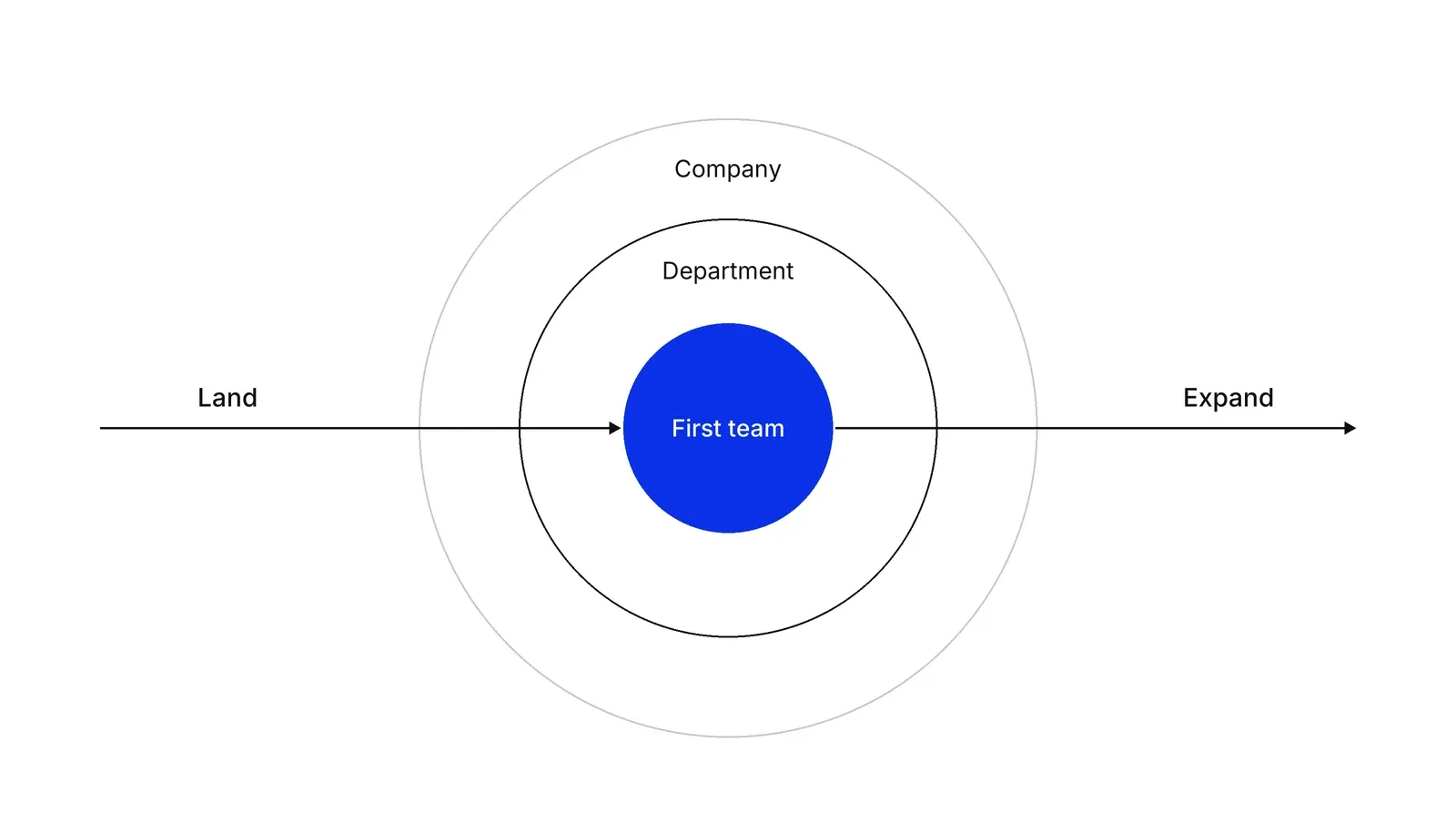
Land and expand is a sales model in which a vendor wins a small first deal in one team and then grows revenue inside the same customer through more users, more teams and more products.
Land and expand is a B2B sales strategy in which a vendor wins a small, easy-to-approve first deal, usually with one team, proves value there, and then grows revenue inside the same company through more seats, more departments and more products. It suits subscription software, where each new purchase is cheap to make and the customer can see the result.
- Origin
- SaaS industry practice; no single originator found, In public filings since at least 2016
- Level
- 401 · Expert
- Fits
- Scale-up
- Time to apply
- Two weeks to define the land offer and the expansion map; one to two quarters to see the first expansion
- What you need
- a first product or plan that one team can buy and use without a long approval · usage data per account (seats, teams, activity) in one place · one named owner for expansion in each account, not only for the first sale
Land and expand is a sales model in which a vendor wins a small first deal inside a company, proves the product there, and then sells more to the same company over time. The first deal is the land. Everything after it is the expansion. We found no single originator. In the sources we opened, the phrase appears in public company filings from at least 2016, when Atlassian’s annual report said its model focuses on a land-and-expand strategy. Zoom, Datadog and MongoDB use it too.
How does land and expand work?
It works in four moves: a small first purchase, a visible result, spread to neighbouring teams, and a larger deal once use justifies it. Datadog’s 10-K describes the model as products that are easy to adopt, with a short time to value, so customers can expand on a self-service basis. Zoom’s S-1 describes a platform that may begin in one line of business and then spread across departments.
Take an illustrative case: a vendor of case-management software for payment companies. It lands the fraud-review team with 10 seats at $50 per seat per month, which is $6,000 a year. Three neighbouring teams ask for the same tool, so the account grows to 40 seats and $24,000. A year later the vendor sells an add-on module at $20 more per seat, and the same 40 seats pay $33,600. No new customer was signed, yet the account is now more than five times the size of the first deal.
Why do vendors choose it?
A small first purchase lowers the buyer’s risk, and expansion is cheaper to sell than a new customer. Gartner’s 2025 survey puts buying groups at five to 16 people across up to four functions. A pilot for one team avoids that group. Adamson, Dixon and Toman argued in Harvard Business Review that business customers now need sales reps less than they used to, which helps a vendor reach one team without a long pitch.
The cost side shows in survey data. In Benchmarkit’s 2025 report, with 2024 data, median expansion made up 40% of new ARR, and the median cost was $1.00 of spend per $1.00 of expansion ARR against $2.00 per $1.00 of new-customer ARR. The sample size is not stated, so read it as a signal.
Filings show how far it can go. Atlassian’s fiscal 2025 10-K says over 90% of revenue came from customer accounts that existed before the year began. Datadog’s 2024 10-K counts about 3,610 customers with ARR of $100,000 or more, representing 88% of ARR. Snowflake’s 10-K reports 745 Forbes Global 2000 customers that contributed about 42% of revenue.
Which ways in does it have?
There are two common entries, and they need different teams. In the self-service route, users find and buy the product themselves, and sales joins later. In the sales-led route, a salesperson sells a small paid pilot to one team and then builds the next purchases.
| Self-service landing | Sales-led pilot | |
|---|---|---|
| Who buys first | A user or team, by card or small contract | A team lead, after a short sale |
| Who expands | Growth in use, then sales on large accounts | The seller or customer success owner |
| Signal to act on | Seats, teams and activity in product data | Pilot results and the stakeholder map |
| Example from filings | Dropbox: over 90% of revenue from self-serve channels | Atlassian: sales force on large existing customers |
The routes mix. Atlassian lands through self-service and uses its sales force to expand strategic relationships with large customers. Account-based marketing works the other way round, by choosing target companies first. Our account-based marketing page covers it.
How do you measure expansion?
Use net revenue retention for the cohort you landed, and read it with gross revenue retention. Our net revenue retention page gives the formula. Skok’s SaaS metrics model shows why it matters: with $6,000 of new monthly bookings, 3% monthly churn levels revenue near $140,000 after 40 months, and 3% negative churn reaches $450,000. Tunguz calculates that a company at 160% net dollar retention is about 4.2 times the size of one at 120% after five years.
The bow-tie model places expansion on the right side of the sale, after onboarding and impact, and Winning by Design describes the expansion stage as customers growing through more usage and products. Customer success usually carries that half.
Where does land and expand stall?
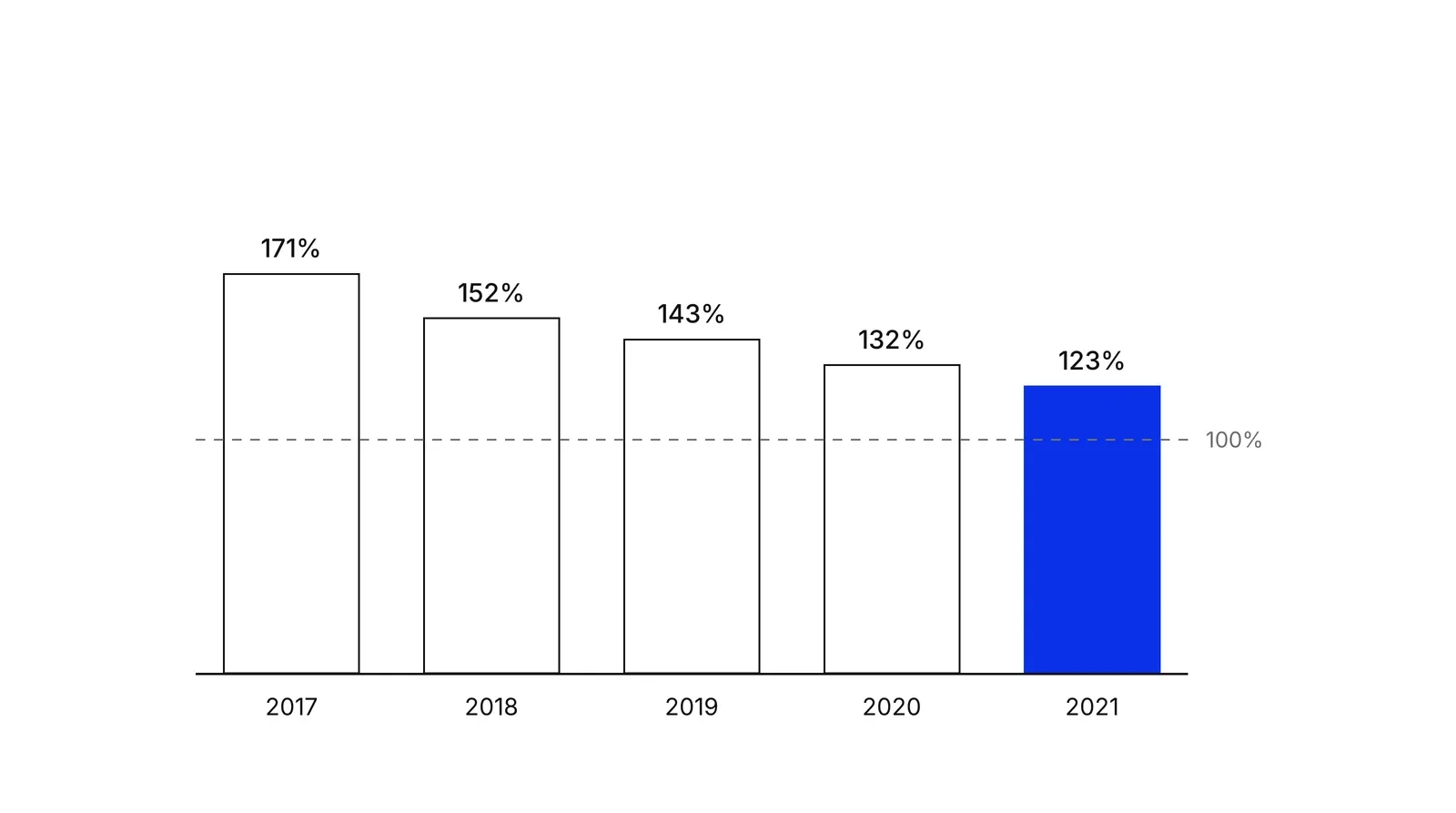
Expansion slows as the base matures, and the first deal can be built so that it cannot grow. Slack’s S-1 reported net dollar retention of 171%, 152% and 143% at the end of January 2017, 2018 and 2019. Its fiscal 2021 10-K added 132% and 123%, and tied the fall to a larger revenue base and deeper penetration of long-term customers. Zoom’s fiscal 2025 10-K says the rate for Enterprise customers had dropped below 100%.
Typical private companies sit lower. SaaS Capital’s 2025 survey found a median net retention of 101% and gross retention of 91%, and expansion more consistent as contract value rises. Design matters too. TSIA asks whether the product has a path for easy add-ons and whether contracts allow extra purchases without renegotiation. If not, expansion will not be cheaper than the land sale.
People matter as well. Gartner found that 74% of buyer teams show unhealthy conflict, and that buying groups reaching consensus were 2.5 times more likely to call their deal high quality. The pilot sponsor is one voice in that group. A 2025 literature review of 147 papers found an overall positive link between cross-selling, upselling and add-on selling and performance, with add-on selling paying more when aimed at loyal customers. Our customer health score page shows how to find those accounts. A Growth Lab plan starts from the expansion map: which account, which next buyer, which trigger.
How to apply Land and expand, step by step
- Define the land offer. Pick the smallest purchase that gives one team a real result and falls below the budget level that triggers a committee. Write down the first result the team should see and by when. Result: a land offer with a price, a scope and a first-value date.
- Choose the landing team. Pick the team that feels the problem daily and has a budget it can spend alone. Check that its work touches other teams, because that contact is what later spreads the product. Result: one target team and a list of the neighbours it works with.
- Instrument first value. Track the action that shows the team got its result, such as a first report sent or a first case closed. Result: a usage signal that tells you when an account is ready to expand.
- Map the account and name the next buyer. For each landed account, list the departments, the likely owners of the next purchase and the product or plan each would need. Result: an expansion map with a named next buyer and a next offer per account.
- Plan the expansion triggers. Decide which signals start an expansion conversation: seat limits reached, a second team using the product, a feature request that belongs to a higher plan. Result: a short list of triggers that route an account to the person who owns expansion.
- Review expansion monthly. Report net revenue retention and gross revenue retention for the landed cohort, plus the share of accounts that have grown beyond their first team. Result: a monthly number that shows whether expansion is happening or only the first sale.
Examples
Atlassian: self-service landing, sales team on the largest accounts
Atlassian's annual reports for fiscal 2016 and 2019 say its model focuses on a land-and-expand strategy with low-touch service, and that it does not rely mainly on a commissioned direct sales force. The fiscal 2025 10-K says over 90% of revenue came from customer accounts that existed before the year began, and that its sales force focuses on expanding strategic relationships with large existing customers.
Slack: expansion that slows as the base grows
Slack's net dollar retention rate was 171% at January 31, 2017, 143% at January 31, 2019 and 123% at January 31, 2021, according to its S-1 and fiscal 2021 10-K. Over the same period the number of paid customers above $100,000 grew from 135 to 1,183. The company links the decline to a larger revenue base and deeper penetration of long-term customers.
Zoom: expansion that can reverse
Zoom's 2019 S-1 says its land-and-expand model led to some of its largest deployments, and reported a net dollar expansion rate of 140% at January 31, 2019. Its fiscal 2025 10-K says the rate for Enterprise customers fell below 100%, so existing customers were spending less in total than a year earlier.
When to use it
Use it when the product gives value to one team alone, the first purchase is small enough to approve quickly, and more teams in the same company have the same need. Subscription and usage pricing fit well, because each added seat or workload is a separate small decision.
When not to use it
Avoid it when the product only works company-wide, when one purchase covers the whole need, or when the first small deal costs more to sell and support than it brings in. It also fails where no one owns the second sale.
Common mistakes
- Treating the first sale as the finish. Without a named owner for expansion, accounts stay at their landing size.
- Landing with a team that has no contact with other teams, so the product has no route to spread.
- Giving the land deal terms that block expansion, such as a price per seat that doubles at the next tier or a contract with no add-on path.
- Counting seats instead of use. Seats that no one uses show up as contraction at renewal.
- Selling the expansion to the same champion. A larger purchase involves a wider buying group, and the sponsor of the pilot may not carry it.
FAQ
What is land and expand in sales?
Land and expand is a strategy of winning a small first customer deal, then growing revenue inside the same company through more users, teams and products. The first deal is the land and the later purchases are the expansion. Public software firms such as Atlassian, Zoom and Datadog describe their own models this way.
Is land and expand the same as upselling?
Upselling is one way to expand: selling a higher plan or more seats to the same buyer. Land and expand is the wider plan. It also covers spreading to new teams and buying groups inside the company, and cross-selling other products. The first sale is designed to make those later steps easy.
How do you measure land and expand?
Measure net revenue retention and gross revenue retention for the cohort of landed accounts, and track the share of accounts with more than one team using the product. Net retention above 100% shows existing customers pay more over time. Gross retention shows how much leaks away.
What is the difference between land and expand and account-based marketing?
Account-based marketing picks target companies in advance and works them with coordinated outreach, often for a large first deal. Land and expand enters through a small first purchase and grows from use. The two combine when a vendor targets a named account and lands one team first.
Does land and expand work without a free product or self-service?
Yes. MongoDB's annual report uses the term for renewals and growing subscriptions, and Atlassian's sales force works expansion in large accounts. A paid pilot sold by a salesperson can serve as the land. What matters is that the first purchase is small and that the product can spread by use.
Sources
- Slack Technologies, Inc., Form S-1 registration statement, April 26, 2019 (SEC)
- Slack Technologies, Inc., Form 10-K for fiscal year ended January 31, 2021 (SEC)
- Atlassian Corporation Plc, Form 20-F for fiscal year ended June 30, 2016 (SEC)
- Atlassian Corporation Plc, Form 20-F for fiscal year ended June 30, 2019 (SEC)
- Atlassian Corporation, Form 10-K for fiscal year ended June 30, 2025 (SEC)
- Datadog, Inc., Form 10-K for fiscal year ended December 31, 2019 (SEC)
- Datadog, Inc., Form 10-K for fiscal year ended December 31, 2024 (SEC)
- Zoom Video Communications, Inc., Form S-1 registration statement, 2019 (SEC)
- Zoom Communications, Inc., Form 10-K for fiscal year ended January 31, 2025 (SEC)
- Dropbox, Inc., Form S-1 registration statement, February 2018 (SEC)
- MongoDB, Inc., Form 10-K for fiscal year ended January 31, 2025 (SEC)
- Snowflake Inc., Form 10-K for fiscal year ended January 31, 2025 (SEC)
- Gartner, Sales Survey Finds 74% of B2B Buyer Teams Demonstrate Unhealthy Conflict, press release, May 7, 2025
- Brent Adamson, Matthew Dixon and Nick Toman, The End of Solution Sales, Harvard Business Review, July-August 2012
- Lily (Xuehui) Gao, Yuxin Jia and Daniyal Aqeela Aizar Yulzardi, Do Sales Mechanisms Pay Off? A Systematic Literature Review, Stockholm School of Economics working paper 2025:1
- Benchmarkit, 2025 SaaS Performance Metrics
- SaaS Capital, Research Brief 32: 2025 B2B SaaS Retention Benchmarks
- TSIA, LAER: the roadmap for revenue growth
- Winning by Design, The Bowtie model
- David Skok, SaaS Metrics 2.0, For Entrepreneurs
- Tomasz Tunguz, How much is 20% more NDR worth to your SaaS startup?
Last updated Oct 9, 2026


Marketing agency or growth system: when a company outgrows its agency
An agency is the right call while the founder still runs most of the company. Once the business starts copying itself into new locations or markets, it needs a system that sets goals, tests hypotheses and owns the result.

Why healthcare marketing agencies stall: the short, mid and long wins model we use with clinics
Most agencies own the click and nobody owns the front desk. How we structure clinic work in three horizons, the research behind each one, and one year of results.

Why channel tests stall after month three
Most paid channel tests do not end with a decision. They end when the budget runs out, the attribution model changes, or everyone quietly stops looking at the dashboard.