Price anchoring and the decoy effect
Price anchoring and the decoy effect are two ways the prices and options placed next to an offer change which one a buyer picks, and how much they will pay.
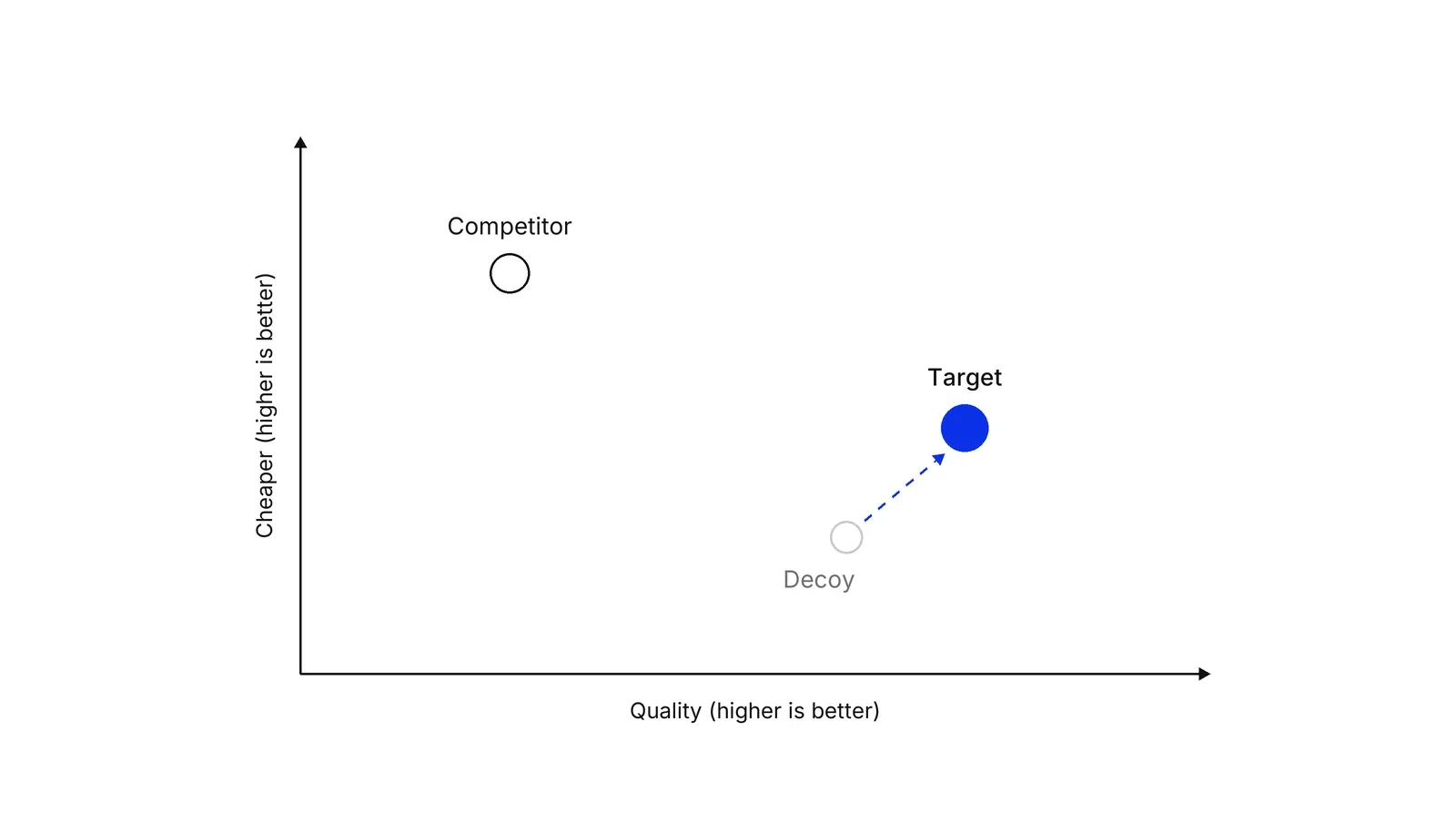
Price anchoring is the pull a first number exerts on later price judgments. The decoy effect, also called the attraction effect, is the rise in share for one option when a clearly worse, similar option is added beside it. Both are well documented in labs, but the decoy effect is weaker with realistic products, so test it before relying on it.
- Origin
- Joel Huber, John Payne and Christopher Puto (decoy effect); Amos Tversky and Daniel Kahneman (anchoring); Dan Ariely (popularised it in a book), 1982; 1974; 2008
- Level
- 201 · Tool
- Fits
- Startup, Small and mid-size
- Time to apply
- one pricing review, then a four-week A/B test
- What you need
- an offers page with two or more plans, packages or price points · revenue per visitor and plan mix, measured before any change · traffic enough to run an A/B test, or a willingness to run it for longer
Price anchoring is the tendency for a first number to pull later price judgments toward it. The decoy effect, also called the attraction effect, is the rise in one option’s choice share when a worse option is added next to it. Both belong to the family of context effects: the choice depends on what else is on the page, not only on the option itself. Our overview in behavioral economics in funnels covers anchoring briefly. This page goes deeper, and checks how well each effect survives outside a lab.
Price anchoring: the first number pulls the next one
An anchor is a number that a person sees before making an estimate, and that drags the estimate toward it even when it is irrelevant. Tversky and Kahneman showed this in a 1974 paper in Science. A wheel of fortune gave each group a random number, and the median estimate of the share of African countries in the United Nations was 25 for the group that saw 10 and 45 for the group that saw 65. Prizes for accuracy did not remove the effect.
Prices work the same way. In Ariely, Loewenstein and Prelec’s experiments, students wrote down the last two digits of their social security number, then bid on products. Those with above-median numbers bid 57 to 107 percent more, and in the top fifth the average bid for a cordless keyboard was $56 against $16 in the bottom fifth. Chapman and Johnson reviewed the causes and found little support for the idea that people adjust too little. Their favoured account is that an anchor makes anchor-consistent information easier to recall. Epley and Gilovich found that adjustment from a self-generated anchor stops once a plausible value is reached.
Anchoring itself replicates well. Many Labs 1 repeated four anchoring tasks across labs and counted them among the largest effects it found. Real payments are harder. Jung, Perfecto and Nelson ran 16 field studies with 21,997 people on pay-what-you-want prices and found that low anchors moved payments more than high ones, and that several factors known to strengthen anchoring in the lab did nothing in the field. In hypothetical settings the effect was as large as the literature suggests.
The decoy effect: a worse option that sells another
The decoy effect is a shift of choice share toward an option because a similar, clearly inferior option sits beside it. Huber, Payne and Puto set out to test a rule of rational choice: adding an option cannot raise another option’s share. In 1982 they reported that adding an asymmetrically dominated alternative could do exactly that. “Asymmetrically dominated” means the decoy is worse than the target on every attribute, but not worse than the competitor.
The famous pricing version is in Dan Ariely’s 2008 book. He saw a subscription page with web only at $59, print only at $125 and print plus web at $125, and he wrote that humans rarely choose things in absolute terms. Print only is the decoy: the bundle costs the same and adds the web. In his test, 100 students at MIT’s Sloan School chose web only 16 times, print only 0 times and the bundle 84 times. Without the decoy, 68 chose web only and 32 the bundle.
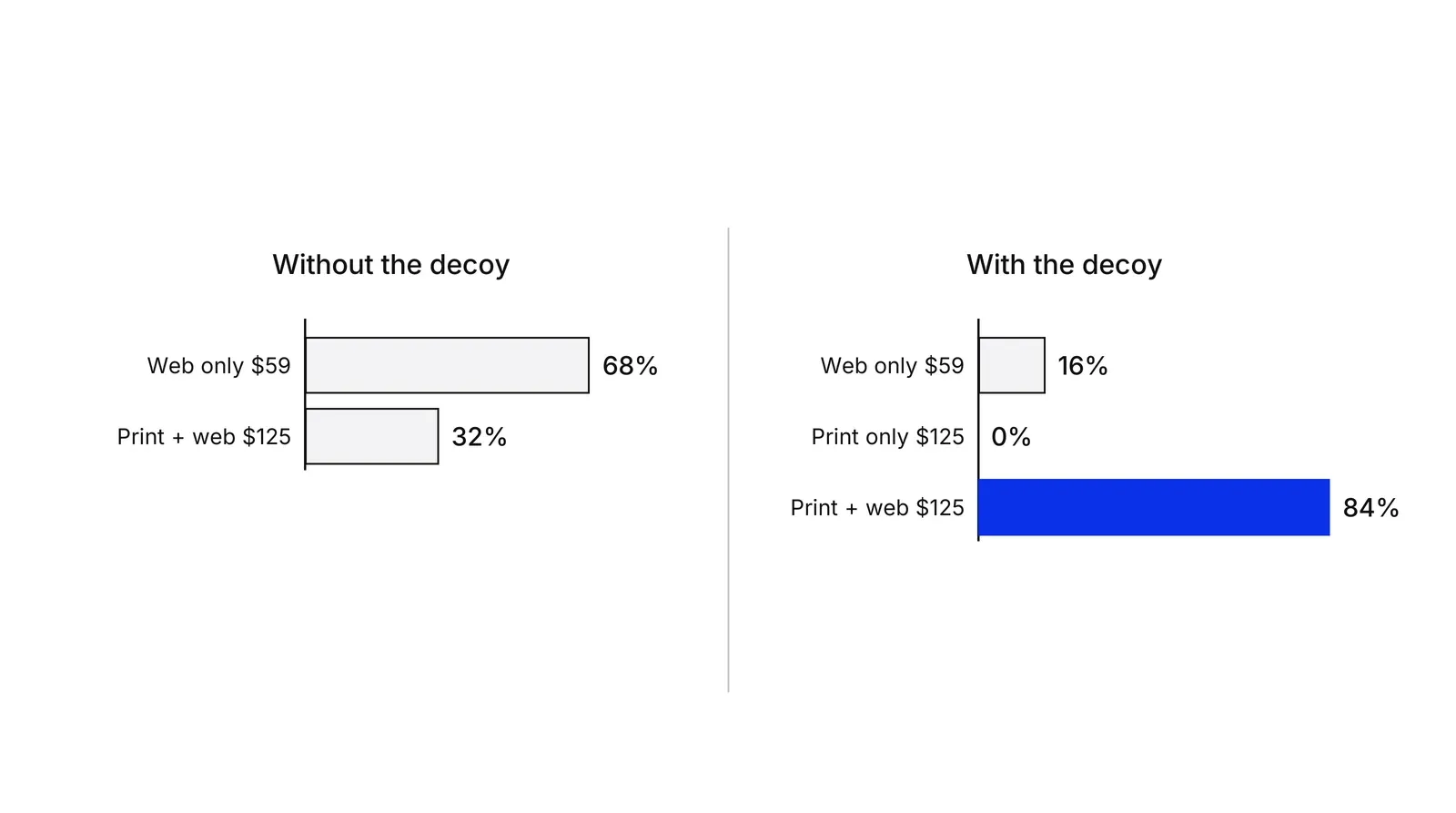
This is one classroom result, and it was not reproduced. Frederick, Lee and Baskin said they failed to replicate this example. Treat it as a clear illustration, not as an expected lift.
Related effects, side by side
| Effect | What changes the choice | Typical pricing use |
|---|---|---|
| Anchoring | A number seen first, relevant or not | A high list price or premium plan shown before the target |
| Decoy (attraction) | A worse option close to the target | A plan priced near the target with fewer features |
| Compromise | An extreme option that makes the middle one look safe | A premium tier above the one you want to sell |
Simonson named the compromise effect in 1989, and found it stronger when buyers expect to justify their choice. Simonson and Tversky grouped it with the decoy effect under context-dependent choice. Chernev later showed that how balanced an option’s own attributes are also shapes these effects. Our offer architecture page covers how to build the whole offer around these effects, and Van Westendorp price sensitivity covers finding the price range first.
Does the decoy effect replicate?
The decoy effect is real under narrow conditions and weak under many realistic ones. In 2014 two papers in the Journal of Marketing Research challenged it. Frederick, Lee and Baskin ran 38 studies. They found the effect in four of five purely numeric displays, and none in the 27 studies where an attribute could be experienced directly, such as tasting a drink or seeing a photo. Yang and Lynn made 91 attempts across 23 product classes and 73 choice sets, and only 11 produced reliable effects.
Huber, Payne and Puto replied that the effect holds when the original conditions are repeated, and listed what weakens it. The effect fades when buyers already have strong preferences, when the dominance is hard to see, or when the two main options are not about equally popular. In the same reply Huber says he could not detect it in about 4,000 conjoint choice sets from 586 respondents. Lichters, Sarstedt and Vogt argued that most studies ignore background factors that limit how far results generalise.
Field evidence points both ways. Doyle and colleagues reported the effect in real in-store purchases. Lichters and colleagues found it much stronger when choices were binding than when they were hypothetical. The diamond study by Wu and Cosguner found large effects but only when shoppers noticed the dominating pair, which happened 11% to 25% of the time. Heath and Chatterjee’s meta-analysis found that decoys raise the share of higher-quality brands but rarely lower-quality ones. Our reading: the effect exists, its size depends heavily on the setting, and your own test matters more than any lab figure.
Using anchors and decoys without crossing the line
Reference prices are the one place where the law bites. In the US, the FTC’s guide says a former price must be a genuine price offered openly for a reasonably substantial period. In the EU, Directive 2019/2161 inserted a rule that the prior price is the lowest price applied in the previous 30 days at least. In the UK, the regulator closed its 2012 to 2014 inquiry into six furniture and carpet retailers after they committed to genuine reference prices.
A decoy has no such rule, but treat it the same way: show only plans you will sell at the stated price, and judge success by revenue and refunds. A Growth Lab plan, described in our practices, starts from this kind of test.
How to apply Price anchoring and the decoy effect, step by step
- Choose the target. Decide which plan or package you want more buyers to pick, usually the one with the best margin or the best fit for customers. Result: one named target option.
- Check that buyers are unsure. Huber, Payne and Puto say the effect fades when buyers already have a firm preference. Ask five or six recent buyers how they compared your plans, and look at whether the plan mix swings between cohorts. Result: evidence that choices are being constructed on the page, not decided beforehand.
- Design a decoy that is clearly worse than the target. Make the decoy resemble the target and cost about the same or a little less, but give less, so the target beats it on every attribute. Do not make it beat your other plan. Result: a draft decoy that a buyer can reject in seconds.
- Place anchors honestly. Show the full price or the premium plan where buyers see it first, and only use a was-price that you really charged. Result: a page whose reference prices pass the legal checks below.
- Test with and without the decoy. Split traffic between the page with the decoy and the page without it. Measure revenue per visitor, plan mix and refunds or downgrades over at least one full buying cycle. Result: a measured effect, which may be zero.
- Keep, change or drop. Keep the decoy only if revenue per visitor rises and refunds do not. Record the legal basis for any reference price. Result: a decision that rests on your own data, not on a lab study.
Examples
The Economist subscription
In Predictably Irrational, Dan Ariely describes a subscription page with web only at $59, print only at $125 and print plus web at $125. He reports that 100 students at MIT's Sloan School chose 16, 0 and 84 across the three. With print only removed, 68 chose web only and 32 chose the bundle. Frederick, Lee and Baskin later failed to replicate this result.
An online diamond retailer
Chunhua Wu and Koray Cosguner studied sales at a large online jewelry retailer in Marketing Science. When a diamond clearly dominated a similar one, its sales rate rose by 1.8 to 3.2 times, but shoppers spotted such a pair in only 11% to 25% of cases. They estimated a 14.3% gain in gross profit.
A payments startup's plan page
Illustrative, no real company implied. A platform sells Starter at $49 and Pro at $149. It adds Pro Lite at $139 with fewer features than Pro. For every 100 buyers, each percentage point of share that moves to Pro adds $100 (the $100 price gap), so a 10-point shift is worth $1,000. Whether Pro Lite causes that shift is what the test decides.
When to use it
Use it when buyers compare several plans on a page and are unsure how to weigh them, when you have a plan you want to promote and traffic to test with, and when the options differ on two attributes such as price and features. It suits subscription, SaaS and service packages.
When not to use it
Skip the decoy when buyers know what they want, when they can try or taste the product, or when the options are shown with photos and real descriptions, where the evidence is weakest. Do not use a decoy that is not truly on sale, and do not use a was-price you never charged.
Common mistakes
- Making the decoy worse than both plans. The effect relies on asymmetric dominance: the decoy loses clearly to the target and only trades off against the other plan.
- Believing the Economist numbers apply to your page. They come from one classroom, and Frederick and colleagues could not reproduce the result.
- Using a crossed-out price that was never charged. US and EU rules require a genuine prior price.
- Judging the decoy by clicks or plan mix alone, without revenue per visitor and refunds.
- Stacking an anchor, a decoy and new copy in one release, so no one can tell which change worked.
FAQ
What is the decoy effect in pricing?
It is a rise in the share of one option when a worse, similar option is added to the choice set. Huber, Payne and Puto first reported it. In a pricing table, the decoy is a plan that costs close to the target but gives less, so the target looks like a good deal.
What is price anchoring, with an example?
Price anchoring is the pull of an earlier number on a later price judgment. In Ariely, Loewenstein and Prelec's experiments, buyers whose social security numbers were in the top fifth bid on average $56 for a cordless keyboard, against $16 for the bottom fifth, after being primed with those digits.
Does the decoy effect really work in marketing?
It works in some settings and not others. Frederick, Lee and Baskin found it mostly with numbers-only choices, and Yang and Lynn found reliable effects in 11 of 91 attempts. A field study of diamond sales and a binding-choice experiment found real effects, so test it in your own funnel.
Is it legal to show a crossed-out was-price?
Only if it is genuine. The US Federal Trade Commission's guide requires a former price to have been actually offered for a reasonably substantial period. EU rules set the prior price as the lowest price over a period of at least 30 days, and UK regulators closed a 2012 to 2014 inquiry after retailers promised genuine reference prices.
Sources
- Joel Huber, John W. Payne, Christopher Puto, Adding Asymmetrically Dominated Alternatives: Violations of Regularity and the Similarity Hypothesis, Journal of Consumer Research 9(1), 1982
- Amos Tversky, Daniel Kahneman, Judgment under Uncertainty: Heuristics and Biases, Science 185, 1974
- Dan Ariely, Predictably Irrational: The Hidden Forces That Shape Our Decisions, HarperCollins, 2008 (chapter 1, The Truth About Relativity)
- Shane Frederick, Leonard Lee, Ernest Baskin, The Limits of Attraction, Journal of Marketing Research 51(4), 2014
- Sybil Yang, Michael Lynn, More Evidence Challenging the Robustness and Usefulness of the Attraction Effect, Journal of Marketing Research 51(4), 2014
- Joel Huber, John W. Payne, Christopher Puto, Let's Be Honest About the Attraction Effect, Journal of Marketing Research 51(4), 2014
- Marcel Lichters, Marko Sarstedt, Bodo Vogt, On the practical relevance of the attraction effect: A cautionary note and guidelines for context effect experiments, AMS Review 5, 2015
- Marcel Lichters, Paul Bengart, Marko Sarstedt, Bodo Vogt, What really matters in attraction effect research: when choices have economic consequences, Marketing Letters 28, 2017
- Chunhua Wu, Koray Cosguner, Profiting from the Decoy Effect: A Case Study of an Online Diamond Retailer, Marketing Science 39(5), 2020
- Doyle, O'Connor, Reynolds, Bottomley, The robustness of the asymmetrically dominated effect: buying frames, phantom alternatives, and in-store purchases, Psychology & Marketing 16(3), 1999
- Timothy B. Heath, Subimal Chatterjee, Asymmetric Decoy Effects on Lower-Quality versus Higher-Quality Brands: Meta-analytic and Experimental Evidence, Journal of Consumer Research 22(3), 1995
- Itamar Simonson, Choice Based on Reasons: The Case of Attraction and Compromise Effects, Journal of Consumer Research 16(2), 1989
- Itamar Simonson, Amos Tversky, Choice in Context: Tradeoff Contrast and Extremeness Aversion, Journal of Marketing Research 29(3), 1992
- Dan Ariely, George Loewenstein, Drazen Prelec, Coherent Arbitrariness: Stable Demand Curves Without Stable Preferences, Quarterly Journal of Economics 118(1), 2003
- Nicholas Epley, Thomas Gilovich, The Anchoring-and-Adjustment Heuristic: Why the Adjustments Are Insufficient, Psychological Science 17(4), 2006
- Gretchen B. Chapman, Eric J. Johnson, Incorporating the Irrelevant: Anchors in Judgments of Belief and Value, in Heuristics and Biases, Cambridge University Press, 2002
- Minah H. Jung, Hannah Perfecto, Leif D. Nelson, Anchoring in Payment: Evaluating a Judgmental Heuristic in Field Experimental Settings, Journal of Marketing Research, 2016
- Richard A. Klein and others, Investigating Variation in Replicability: A Many Labs Replication Project, Social Psychology 45(3), 2014
- Alexander Chernev, Context Effects without a Context: Attribute Balance as a Reason for Choice, Journal of Consumer Research, 2005
- US Federal Trade Commission, Guides Against Deceptive Pricing, 16 CFR 233.1, former price comparisons
- European Union, Directive (EU) 2019/2161, Article 2 inserting Article 6a into Directive 98/6/EC on price reductions
- UK Competition and Markets Authority, Investigations into the use of misleading reference pricing by certain furniture and carpet businesses, case closed 2014
Last updated Oct 9, 2026


Marketing agency or growth system: when a company outgrows its agency
An agency is the right call while the founder still runs most of the company. Once the business starts copying itself into new locations or markets, it needs a system that sets goals, tests hypotheses and owns the result.

Why healthcare marketing agencies stall: the short, mid and long wins model we use with clinics
Most agencies own the click and nobody owns the front desk. How we structure clinic work in three horizons, the research behind each one, and one year of results.

Why channel tests stall after month three
Most paid channel tests do not end with a decision. They end when the budget runs out, the attribution model changes, or everyone quietly stops looking at the dashboard.