Pyramid Principle
The Pyramid Principle is a method for structuring a memo, report or presentation so that the main point comes first and each group of supporting ideas sums up the ideas beneath it.
The Pyramid Principle is a method from Barbara Minto, a former McKinsey consultant, for structuring memos, reports and slides. The main point comes first, and each group of ideas beneath it supports and sums up the level above. The introduction recalls what the reader already knows, the complication and the question it raises, and the answer follows.
- Origin
- Barbara Minto, at McKinsey & Company, 1963 to 1973 at McKinsey; book editions from 1981
- Level
- 201 · Tool
- Fits
- Startup, Small and mid-size, Scale-up, Enterprise
- Time to apply
- 30 to 60 minutes for a one-page memo
- What you need
- one reader and the decision or question that reader has · your raw notes, facts and findings in any order · a person who can read the draft and tell you what they took from the first paragraph
The Pyramid Principle is a method for organising a memo, report or presentation as a pyramid: one main point on top, a small group of supporting points under it, and the evidence at the base. The reader sees the answer first and can go down only as far as they need. Consulting firms such as McKinsey made it a standard way to write, and Barbara Minto’s own site calls it the de facto standard for major consulting firms.
Where it came from
Barbara Minto developed the method while working at McKinsey. According to the firm’s alumni profile of her, she graduated from Harvard Business School in 1963, was the first woman MBA the firm hired as a professional, and worked in its Cleveland and then London offices until 1973. She kept editing other consultants’ reports and noticed she was always reorganising their ideas into a pyramid. She turned that into a course and a manual, “Skillful Writing through Structured Thinking”, and left in 1973 after the London office shrank. The same profile says she then set up her own teaching business.
The date of the book is less settled than most summaries suggest. The McKinsey profile says she published The Pyramid Principle: Logic in Writing and Thinking in 1985 and that Pearson took it over in 1987. Minto’s own site says the book was written in 1987 and reissued unchanged in 2002, and a Stanford catalogue record lists a 2002 third edition after a 1995 one. Neither date is the first: the Internet Archive holds a 1981 edition published in London by Minto International, ISBN 096019102X. A 1996 textbook, The Minto Pyramid Principle: Logic in Writing, Thinking and Problem Solving, replaced it on her site. The year 1973 that often appears next to her name is the year she left McKinsey.
Answer first, with the support grouped beneath
The core rule is answer first. Minto’s site puts it as presenting ideas organised as a pyramid under a single point, so the reader meets the conclusion before the detail. McKinsey’s profile lists the logic behind it: the point above must summarise the points below, and ideas grouped together must be logically the same and in a logical order. The group of three below is the whole structure, repeated at every level.
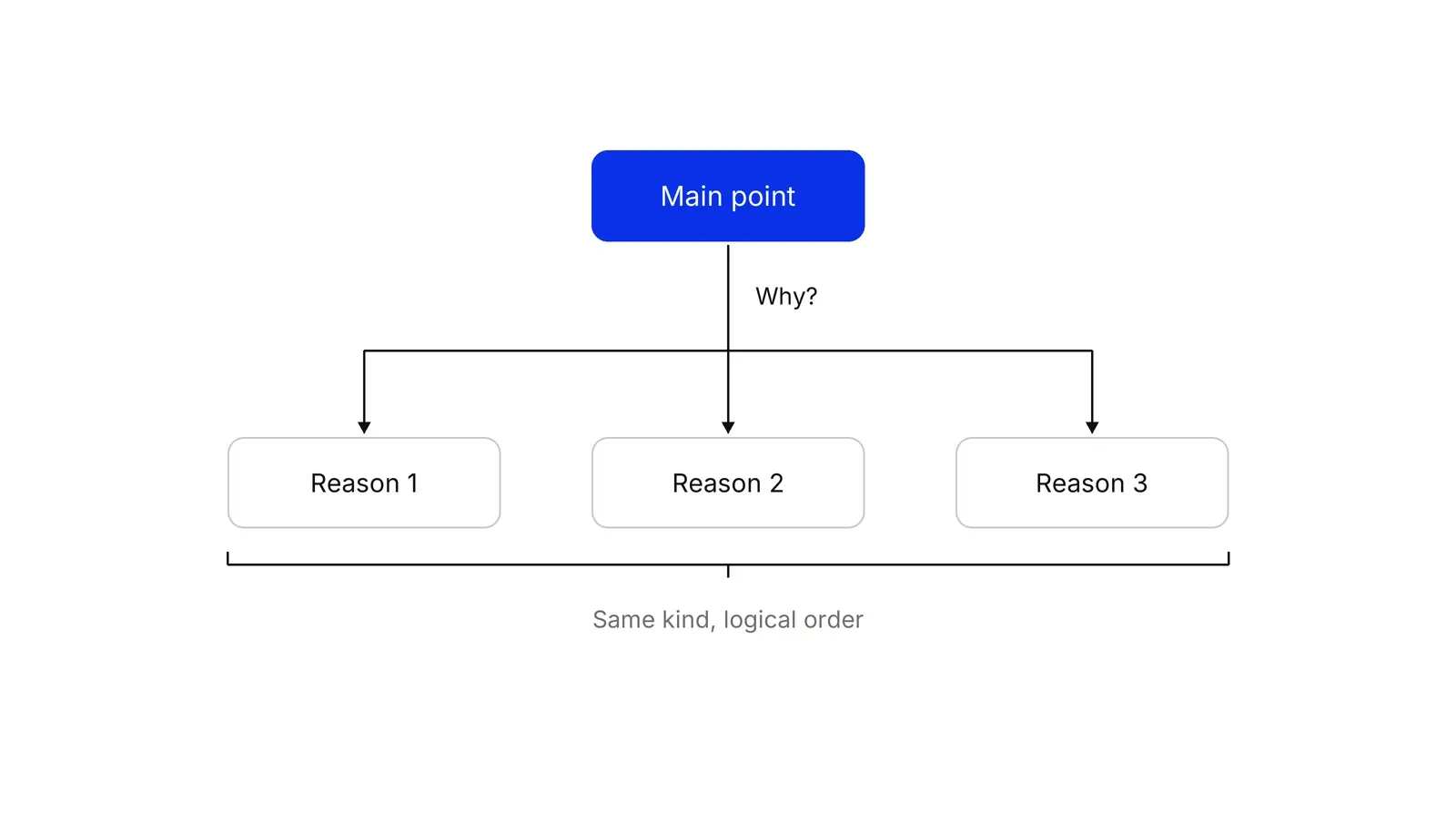
The same profile says the grouping rule came from asking whether the pieces were mutually exclusive and collectively exhaustive, a test now known as MECE, which Minto credits to Aristotle.
Vertical and horizontal logic
Vertical logic is the relationship between a point and what sits under it. A point should raise a question in the reader’s mind, such as “why?” or “how?”, and the line beneath should answer it. Horizontal logic is the relationship among ideas in one group. They have to be the same kind of thing and appear in an order the reader can follow.
Read down one column: if the top idea does not summarise what is under it, the structure is wrong, however good each sentence is. Then read across one row: if one item is a reason and the next a recommendation, the group is mixed.
Deductive and inductive groups
Minto’s book gives the difference between deduction and induction its own chapter, according to the Library of Congress contents listing. The practical difference is in how a group holds together.
| Deductive group | Inductive group | |
|---|---|---|
| How points relate | A chain: each follows from the one before | Parallel: each is the same kind of thing |
| Ends with | A conclusion (“so we should…”) | A summary of what the points share |
| Example | Card payments depend on one processor; it failed; so we need a second | Three reasons search outperforms display |
| Check | Does each step follow? | Is every item the same kind, and is nothing missing? |
Use induction when the points are independent reasons or steps. Use deduction when the argument is a sequence and the reader may dispute the conclusion unless they accept each step.
The SCQ introduction
Minto’s site names an SCQ framework: situation, complication, question. Minto’s course page says it identifies the question in the reader’s mind. In the usual teaching, the situation and the complication are statements the reader already accepts, so the question that follows feels like theirs and the answer arrives where they expect it.
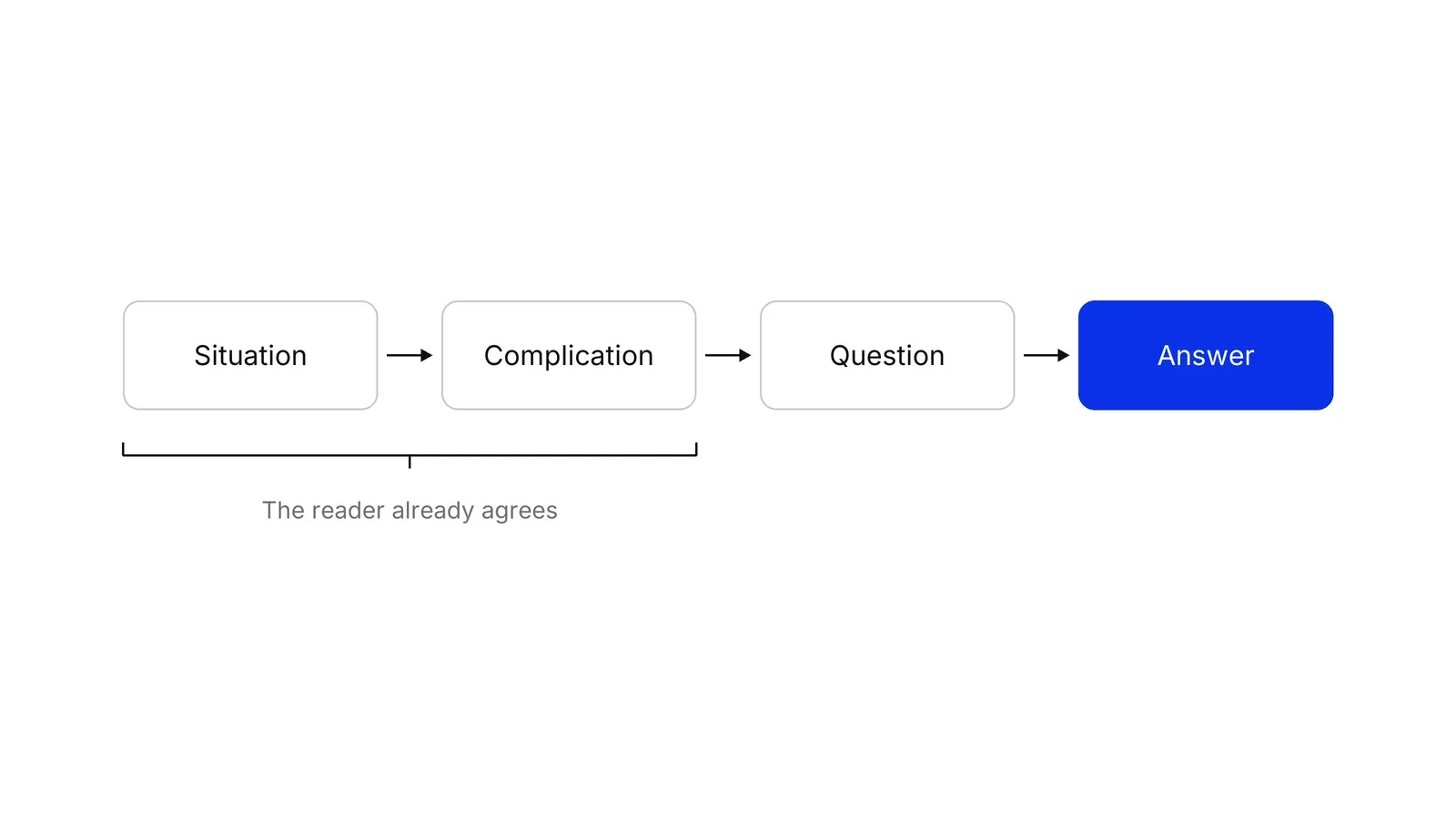
For example, a finance lead writes: “Our card payments run through one processor (situation). It was down for two hours on payroll day (complication). Should we add a second one (question)?” Then the answer: “Yes, within this quarter.”
What the evidence says
We found no controlled study that tests Minto’s pyramid as a whole against another structure. What exists is indirect, and some points the other way.
Organisations already write the rule down. The US Army’s correspondence regulation, AR 25-50, requires writing that is understood in a single rapid reading, and names two essential requirements: the main point at the start, “bottom line up front”, and active voice. The Plain Writing Act of 2010 defines plain writing for US federal agencies as writing that is “clear, concise, well-organized”. These are rules, not proof that they work.
Readers do skim. Jakob Nielsen reported in 1997 that 79 percent of his test users scanned new pages and 16 percent read word by word, and recommended starting with the conclusion. In a 51-person measurement study, Morkes and Nielsen found a concise version of a sample site scored 58 percent better on usability, a scannable one 47 percent better and all changes combined 124 percent better. Those results are about length and scannability, not about order.
Order itself has thin support. Journalism uses the same order, which Purdue’s writing lab explains as essential facts first, so an editor can cut from the bottom. In a 2008 University of Missouri dissertation, chronological news stories slowed readers’ reaction times on a secondary task, a sign of heavier mental load, compared with inverted-pyramid versions. Memory showed no difference, and comprehension favoured the inverted pyramid only marginally. These were news stories, not business papers.
A psychological model fits the idea. Kintsch and van Dijk proposed in 1978 that readers build a gist, a macrostructure, while they read. A document that opens with its gist matches what the reader is trying to build. Cowan’s 2001 review argues that people hold about four chunks in short-term memory, which is a reason to keep each group small. The step from those studies to business memos is our inference.
The strongest counter-evidence concerns bad news. Jansen and Janssen (2013) found that readers rated bad-news e-mails more highly when the explanation came before the verdict, though not for voice mails. Treat answer-first as a default and check the setting before you apply it.
Plain language has the clearest numbers. In a survey of 376 people, Christopher Trudeau found respondents chose the plain-language version about 80 percent of the time. Rogers and Lasky-Fink emailed 7,002 school leaders either 127 or 49 words and saw 4.8 percent of readers respond to the short one against 2.7 percent to the long one.
Where it sits next to other tools
The working backwards process uses a related idea: Amazon replaced slides with prose narratives that the group reads at the start of a decision meeting. An OKR set is a small pyramid, with one objective on top and a few key results beneath it. A weekly business review page that opens with a verdict, on track or off, and then shows the metrics behind it applies the same order. To build the groups themselves, see MECE and issue trees below.
A marketing operational system build starts from the question each report has to answer for its reader.
How to apply Pyramid Principle, step by step
- Name the reader and their question. Write down who will read this and what they are asking: Should we switch supplier? Why did conversion fall? Result: one question in the reader's words.
- Write the answer in one sentence. Answer the question with your conclusion or recommendation, before you organise anything else. If you cannot, you need more thinking, not more writing. Result: a single top sentence.
- Frame it with situation, complication, question. Write the situation the reader already accepts, the change that disturbed it, and the question that change raises. Check that the reader would nod at both statements. Result: a short introduction that ends in the question your answer solves.
- Group the support. Sort your notes into three to five groups of the same kind of idea, such as reasons, steps or causes. Give each group a headline sentence that sums it up. Result: the middle layer of the pyramid.
- Test each level. Ask 'why?' or 'how?' of every point and see whether the line beneath answers it. Check that each group is of one kind and in a logical order. Result: a pyramid where nothing hangs loose.
- Write top-down. Put the answer first, then the key points as headings or lead sentences, then the evidence under each. Read only the headings aloud to someone and ask what they understood. Result: a document that can be skimmed at any depth.
Examples
A dental clinic's marketing update
Illustrative. The owner asks where next month's budget should go. Answer: move budget from display ads to search ads. Situation: the clinic spends on both. Complication: new-patient bookings have been flat for two months. Question: where should the money go? Support, as one group of reasons: search visitors book at a higher rate than display visitors, search spend can be matched to booked visits, and display has had two months to show a result and has not. The owner reads the first line and can decide.
A fintech's payment processor memo
Illustrative. Situation: all card payments run through one processor. Complication: it was down for two hours on a payroll day. Question: should the company add a second processor? Answer: yes, within the quarter. The support is a deductive chain, because each step follows from the last: an outage stops all card revenue, a second processor removes the single point of failure, and the integration fits within one sprint, so the cost is lower than another outage.
When to use it
Use it whenever a reader has to decide or act on what you write: management memos, client reports, proposals, status updates and slide decks. It helps most when the material is complex, the reader is senior and short of time, or you are not yet sure what you think and need the structure to find out.
When not to use it
Skip it for narrative writing meant to be enjoyed, for exploratory notes where you have no conclusion yet, and for bad news that readers may take badly. One experiment found e-mail readers rated bad news more highly when the explanation came first, so check the setting before you lead with the verdict.
Common mistakes
- Starting with background. A reader who has to wait three paragraphs for the point will skim or stop, so put the answer first and the history after it.
- Grouping things that are not the same kind. 'Cost', 'launch in March' and 'competitor risk' are a list of unrelated items. A group works when one noun covers every member, such as three reasons.
- A top sentence that only names a topic. 'Update on suppliers' is a label. 'Switch to supplier B before June' is an answer.
- Mixing deduction and induction in one group. A chain of 'therefore' steps and a set of parallel reasons need different checks, so keep each group to one mode.
- Building the pyramid from the outline only. The structure is meant to expose gaps in your thinking, so if a level will not hold, change the thinking and not the wording.
FAQ
What is the Pyramid Principle?
It is Barbara Minto's method for presenting ideas as a pyramid under a single point. The conclusion goes first, key supporting points sit beneath it, and the evidence sits at the base. Each level answers the question the level above raises, so the reader meets the answer before the detail.
What are the rules of the Minto pyramid?
Three rules: an idea at any level must sum up the ideas grouped beneath it, the ideas in one group must be the same kind of idea, and they must follow a logical order. McKinsey's own alumni profile of Minto describes the rules this way. The profile links the grouping rule to the mutually exclusive, collectively exhaustive (MECE) test.
What is the SCQ framework?
SCQ stands for situation, complication, question. It is the introduction to a pyramid: a fact the reader accepts, a change that disturbs it, and the question that change creates. The document's main point then answers that question. Many summaries add an A for answer, which is the pyramid's top.
What is the difference between deductive and inductive grouping?
Deductive grouping is a chain: each point follows from the one before and ends in a conclusion, like 'A is true, B follows, so C'. Inductive grouping is a set of parallel points of the same kind, such as three reasons. Minto's book gives the difference its own chapter.
Did Barbara Minto invent the Pyramid Principle at McKinsey?
She developed it there. Minto worked at McKinsey from 1963 to 1973, in Cleveland and then London, and taught it as an internal course. She left the firm in 1973 and published the book afterwards: the Internet Archive holds a 1981 edition from her own firm, Minto International.
Sources
- McKinsey & Company, Barbara Minto: 'MECE: I invented it, so I get to say how to pronounce it', alumni news
- Internet Archive, Barbara Minto, The Pyramid Principle: Logic in Writing and Thinking, Minto International, London, 1981
- Minto Books International, The Minto Pyramid Principle, home page
- Minto Books International, Concept
- Minto Books International, Course
- Minto Books International, Textbook
- Library of Congress, table of contents of Barbara Minto, The Pyramid Principle: Logic in Writing and Thinking
- Stanford Libraries SearchWorks, catalogue record for The Pyramid Principle, 3rd edition, 2002
- US Department of the Army, AR 25-50, Preparing and Managing Correspondence, 10 October 2020 (administrative revision 4 October 2024)
- Army Publishing Directorate, record details for AR 25-50
- US Congress, Plain Writing Act of 2010, Public Law 111-274
- Federal Plain Language Guidelines, Have a topic sentence (2011 edition, UNT Web Archive)
- Federal Plain Language Guidelines, Organize to meet your readers' needs (2011 edition, UNT Web Archive)
- Nielsen Norman Group, John Morkes and Jakob Nielsen, Concise, SCANNABLE, and Objective: How to Write for the Web, 1997
- Nielsen Norman Group, Jakob Nielsen, How Users Read on the Web, 1997
- Nielsen Norman Group, Jakob Nielsen, Inverted Pyramids in Cyberspace, 1996
- Todd Rogers and Jessica Lasky-Fink, Write shorter messages, Harvard Kennedy School, 2020
- Walter Kintsch, Teun A. van Dijk, Toward a model of text comprehension and production, Psychological Review 85(5), 1978
- Nelson Cowan, The magical number 4 in short-term memory, Behavioral and Brain Sciences 24(1), 2001
- Miglena Sternadori, Cognitive processing of news as a function of structure: a comparison between inverted pyramid and chronology, University of Missouri dissertation, 2008
- F. Jansen, D. Janssen, Effects of Directness in Bad-News E-Mails and Voice Mails, Journal of Business Communication, 2013
- Christopher R. Trudeau, The Public Speaks: An Empirical Study of Legal Communication, The Scribes Journal of Legal Writing 14, 2011-2012
- Working Backwards (Colin Bryar, Bill Carr), Narratives for decision making
- Purdue Online Writing Lab, The Inverted Pyramid
Last updated Oct 9, 2026


Marketing agency or growth system: when a company outgrows its agency
An agency is the right call while the founder still runs most of the company. Once the business starts copying itself into new locations or markets, it needs a system that sets goals, tests hypotheses and owns the result.

Why healthcare marketing agencies stall: the short, mid and long wins model we use with clinics
Most agencies own the click and nobody owns the front desk. How we structure clinic work in three horizons, the research behind each one, and one year of results.

Why channel tests stall after month three
Most paid channel tests do not end with a decision. They end when the budget runs out, the attribution model changes, or everyone quietly stops looking at the dashboard.