StoryBrand framework (SB7)
StoryBrand is a messaging framework that casts the customer as the hero of a short story and the company as the guide who helps them win, so every page and pitch says the same clear thing.
The StoryBrand framework, or SB7, is a messaging method from Donald Miller's 2017 book Building a StoryBrand. It writes a company's message as a seven-part story: a character with a problem meets a guide, who gives them a plan and calls them to action, which helps them avoid failure and ends in success. The customer is the hero; the company is the guide.
- Origin
- Donald Miller, 2017; revised edition 2025
- Level
- 201 · Tool
- Fits
- Startup, Small and mid-size
- Time to apply
- an afternoon for a first BrandScript, then a week to rewrite the home page from it
- What you need
- ten to twenty customer quotes about why they bought, from calls, reviews or support tickets · your current home page or sales deck to rewrite · one person who can cut copy without asking a committee
The StoryBrand framework is a method for writing a company’s message as a short story in which the customer is the hero and the company is the guide. Donald Miller set it out in his 2017 book Building a StoryBrand, published by HarperCollins Leadership, and calls it the StoryBrand 7-part framework, or SB7. A revised edition, Building a StoryBrand 2.0, followed in January 2025.
Miller runs StoryBrand and Business Made Simple, which sell workshops, courses and certified coaches built on the method. The company’s book page claims more than a million copies sold. Those figures come from the company, not from an independent count.
The problem the book attacks is confusion. Miller’s argument is that companies lose customers because their message is unclear, and that customers ignore what they cannot understand quickly. Web usage data points the same way. Jakob Nielsen’s 2011 analysis found that visitors often leave a page within 10 to 20 seconds, and that a page has about 10 seconds to make its value proposition clear. Psychology adds a reason clarity pays: Alter and Oppenheimer’s 2009 review of processing fluency found that information people process easily tends to be judged as more true.
The seven parts of SB7
SB7 is one sentence with seven slots. A character who wants something has a problem, meets a guide who gives them a plan and calls them to action, and that action helps them avoid failure and end in success. Each slot becomes a block of copy on a website or a line in a pitch.
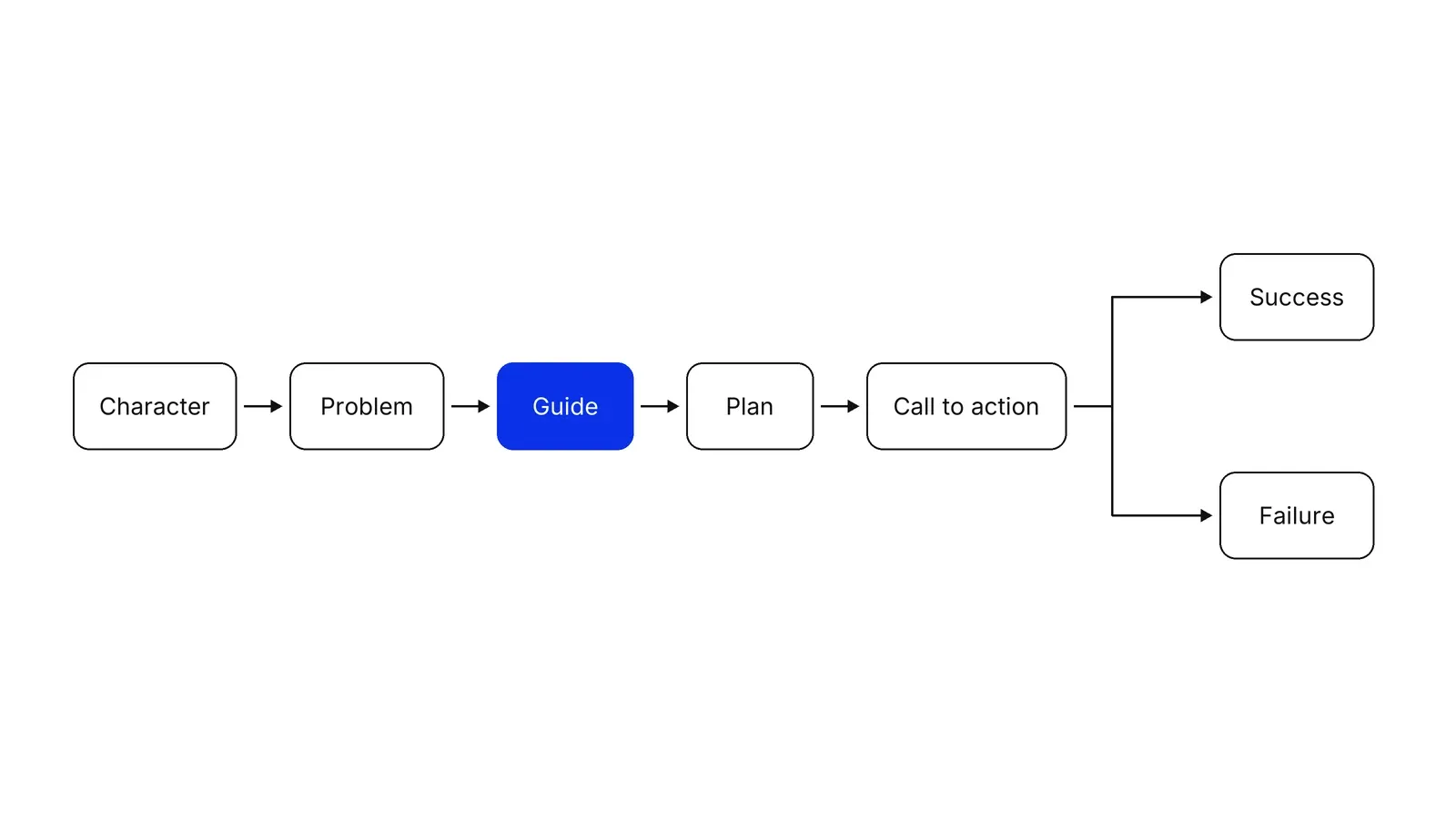
| Part | Question it answers | What it looks like on a page |
|---|---|---|
| Character | What does the customer want? | A headline about their desire, not your product |
| Problem | What stands in the way? | External, internal and philosophical problems, plus a villain |
| Guide | Why should they trust you? | One line of empathy, one piece of proof |
| Plan | What do they do next? | Three steps, or a promise that removes a fear |
| Call to action | What button do they press? | A direct call (buy, book) and a transitional one (a free guide) |
| Failure | What happens if they do nothing? | Short, concrete stakes |
| Success | What does life look like after? | The result, in the customer’s terms |
Miller splits the problem into three layers. The external problem is the visible thing that is broken, such as a late payout. The internal problem is how it makes the customer feel, such as anxious about payroll. The philosophical problem is why it is wrong, such as “a merchant should not wait three days for their own money”. His claim is that companies sell to the external problem while customers buy to fix the internal one.
The failure slot rests on an idea with strong evidence behind it. Kahneman and Tversky’s prospect theory showed that losses weigh more than equal gains in people’s choices. SB7 asks you to name what the customer loses by waiting, briefly, so the decision has a cost on both sides.
Why the customer is the hero and the company the guide
The central rule of StoryBrand is role assignment. Most company websites tell the company’s story: founding year, awards, features. SB7 moves the company into the guide role, the character who has already solved the problem and helps the hero solve it.
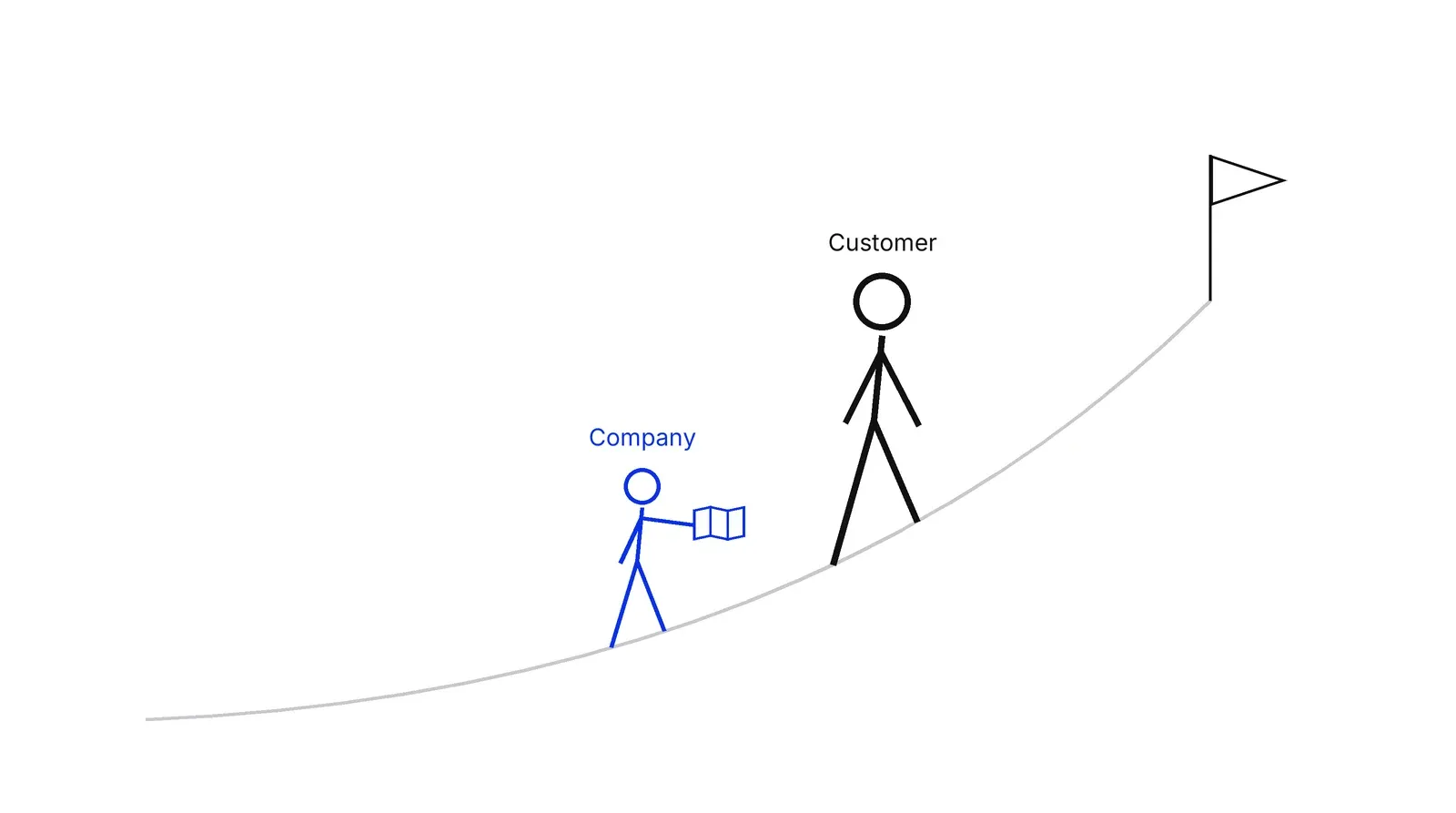
The guide needs two things, in Miller’s terms: empathy and authority. Empathy is a line that shows you understand the problem. Authority is proof that you can fix it, such as reviews, client counts, licences or logos. A guide with only empathy sounds kind but unproven; a guide with only authority sounds like every other vendor.
Consumer research gives this rule some support. Woodside, Sood and Miller argued in Psychology & Marketing in 2008 that consumers tell stories about themselves in which brands appear as props or supporting actors. Jennifer Escalas found in a 2004 study that processing an ad as a story was linked to stronger self-brand connections, which in turn went with better brand attitudes and intentions.
Where SB7 comes from
SB7 is a compressed version of the hero’s journey. Joseph Campbell described that pattern in The Hero with a Thousand Faces in 1949, in three stages of separation, initiation and return, with helpers who give the hero aid along the way, according to the Joseph Campbell Foundation. George Lucas used the book to shape Star Wars, and the foundation’s account of that influence describes Obi-Wan Kenobi as a mentor who starts Luke’s journey but cannot finish it for him. That is the role SB7 gives a company.
Miller’s contribution was to cut Campbell’s long cycle down to seven parts a marketing team can fill in, and to assign the roles: customer as hero, company as mentor.
What research says about stories that persuade
The research behind StoryBrand is research on stories in general; no published study has tested SB7 itself. That research is real but more modest than marketing books suggest.
Melanie Green and Timothy Brock’s 2000 paper introduced narrative transportation, defined as absorption into a story. Across four experiments, readers who were more transported held more story-consistent beliefs, and they found fewer false notes in the story. A 2014 meta-analysis by van Laer and colleagues pooled 132 effect sizes from 76 articles on transportation in consumer settings. Kim, Ratneshwar and Thorson compared 25 narrative and 25 non-narrative TV ads with 484 adults and found the story ads produced better attitudes toward the ad and the brand. Escalas showed in 2007 that when ad viewers are transported, weak ad arguments do less damage to persuasion.
The size of the effect matters. Braddock and Dillard’s 2016 meta-analysis found correlations between exposure to a narrative and beliefs, attitudes, intentions and behaviours of about 0.17 to 0.23. That is a real effect and a small one. A clear story will not rescue a weak offer.
Two cautions apply. First, popular storytelling advice often leans on brain chemistry; Paul Zak’s 2014 HBR article describes stories changing brain activity, but a 2015 review by Nave, Camerer and McCullough found the link between oxytocin and trust has not replicated well. Second, the brand can sometimes be the hero. Paharia and colleagues showed in the Journal of Consumer Research that underdog brand biographies, stories of a company’s humble start and struggle, raised purchase intentions and loyalty, because customers saw their own lives in them.
How StoryBrand differs from neighbouring tools
StoryBrand is often mixed up with positioning and with brand archetypes. The difference is the question each one answers.
| Tool | Question | Output |
|---|---|---|
| StoryBrand (SB7) | How do we say it so customers listen? | A BrandScript and page copy |
| Positioning statement | Who are we for and why do we win? | One internal sentence |
| Brand archetypes | What character does the brand play? | A voice and tone rule |
| Value proposition | What value do we create for which job? | A fit between offer and need |
Run positioning first, then StoryBrand. A BrandScript built on a vague position produces clear sentences about the wrong thing. In our marketing operational system work, the BrandScript sits after the positioning and before any ad copy, so sales, site and ads draw from one page.
How to apply StoryBrand framework (SB7), step by step
- Name what the customer wants. Write one sentence about what your customer wants that your product delivers, in their words: fewer missed appointments, payouts on the same day, a straighter smile. Pick one desire. Result: a headline candidate that a stranger could read in five seconds.
- List the problem on three levels. Write the external problem (the thing that is broken), the internal problem (how it makes the customer feel) and, if there is one, the philosophical problem (why it is simply wrong). Name the villain causing it. Result: three short lines and one villain, all taken from customer quotes.
- Write the guide lines: empathy and authority. Add one sentence that shows you understand the frustration and one piece of proof that you can fix it, such as a number of clients served, a licence, a review score or a logo. Result: two lines that make you the guide instead of a second hero.
- Draw a three-step plan and two calls to action. Turn buying into three steps a customer can picture, such as book a call, get a plan, start. Then write one direct call to action (buy, book, apply) and one transitional one (a free guide, a checklist, a demo video) for people not ready yet. Result: a plan and two buttons.
- Spell out the stakes and the success. List what the customer loses if nothing changes and what life looks like once the problem is solved. Keep the failure side short and concrete. Result: two short lists that every page can draw from.
- Fill in the BrandScript and rewrite one page. Put all seven parts on one page, then rewrite the home page top to bottom from it: desire in the header, problem, guide, plan, calls to action, stakes, success. Result: one live page you can compare against the old version on conversion rate.
Examples
A dental clinic home page
Illustrative, no real clinic implied. A clinic header reads 'Modern dentistry for families'. A BrandScript rewrite starts from what patients want: 'A dentist your kids are not afraid of.' Problem: appointments that run late and children who panic in the chair. Guide: 'We are parents too' plus the clinic's review score. Plan: book online, a ten-minute first visit for the child to see the room, then the check-up. Calls to action: 'Book a visit' and a free one-page guide to preparing a child for the dentist. Stakes: a child who skips check-ups for years. Success: a family that comes twice a year without a fight.
A payment gateway for online pharmacies
Illustrative. A gateway's site opens with its API and a list of 140 payment methods, which makes the company the hero. The rewrite starts with the merchant's desire: 'Get paid on the day you ship.' Problem: settlement that takes three days and a risk team that freezes accounts without warning, which leaves the owner unable to pay suppliers. Guide: one line on knowing the pharmacy rules in each market, plus the licence number. Plan: apply, pass a two-day review, go live. Stakes: frozen funds during peak season. Success: cash flow the owner can plan around.
When to use it
Use it when customers keep asking what exactly you do after reading your site, when sales, ads and the website describe the company in different words, or before a redesign or a new pitch deck. It suits small and mid-sized companies with one main offer and one main buyer, because the method forces a single desire and a single plan.
When not to use it
Skip it as a substitute for positioning: SB7 shapes how you say something once you know who you serve and why you win, and it will not tell you either. It fits poorly when one site must serve several buyers with different problems, such as a platform selling to both patients and hospitals, unless you write a separate BrandScript per buyer.
Common mistakes
- Making the company the hero anyway, with an origin story, awards and a feature list in the first screen, and the customer appearing only at the contact form.
- Listing five desires and four problems because nobody will cut any of them, which brings back the confusion the method is meant to remove.
- Inflating the stakes into fear, so a clinic page reads like a warning leaflet. Short, concrete stakes work; scare copy damages trust.
- Writing the BrandScript from the team's opinions instead of customer quotes, so the problem is the one the company finds interesting.
- Filling in the template and stopping there, without rewriting a live page and measuring whether more visitors book, call or buy.
FAQ
What are the 7 elements of the StoryBrand framework?
The seven elements are a character, a problem, a guide, a plan, a call to action, failure and success. In Miller's formula, a character who wants something has a problem, meets a guide who gives them a plan and calls them to action, and that helps them avoid failure and end in success.
What is a StoryBrand BrandScript?
A BrandScript is the one-page worksheet where you fill in all seven SB7 parts for your business: the customer's desire, the problems and villain, your empathy and authority, the plan, the calls to action, the stakes and the success. Teams then write websites, emails and sales scripts from that single page.
Is the StoryBrand method based on the hero's journey?
Yes, in spirit. SB7 compresses the pattern Joseph Campbell described in The Hero with a Thousand Faces (1949), in which a hero gets help from a mentor figure on the way. Miller assigns the hero role to the customer and the mentor role to the company.
Does the StoryBrand framework actually work?
No independent study has tested SB7 itself; the evidence is the company's own claims and customer stories. Research on narratives in general is supportive but modest: a 2016 meta-analysis found stories shift beliefs, attitudes and intentions with correlations around 0.17 to 0.23. Test a rewritten page against the old one.
What is the difference between Building a StoryBrand and Building a StoryBrand 2.0?
Building a StoryBrand 2.0, published by HarperCollins Leadership in January 2025, is a revised edition of the 2017 book. StoryBrand says it adds more step-by-step help, updated examples, a guide to running a marketing campaign and an introduction to its StoryBrand.ai tool. The seven elements stay the same.
Sources
- Donald Miller, Building a StoryBrand: Clarify Your Message So Customers Will Listen, HarperCollins Leadership, 2017, Google Books record
- Donald Miller, Building a StoryBrand 2.0, HarperCollins Leadership, January 2025, Google Play Books listing
- StoryBrand, Building a StoryBrand 2.0 book page
- StoryBrand, StoryBrand Soundbite Strategy (home page)
- Business Made Simple, StoryBrand Messaging Framework course
- Donald Miller, official site and biography
- Joseph Campbell Foundation, Joseph Campbell and the Hero's Journey
- Joseph Campbell Foundation, Joseph Campbell's Mythic Influence on Star Wars
- Melanie C. Green, Timothy C. Brock, The Role of Transportation in the Persuasiveness of Public Narratives, Journal of Personality and Social Psychology 79(5), 2000
- Tom van Laer, Ko de Ruyter, Luca M. Visconti, Martin Wetzels, The Extended Transportation-Imagery Model: A Meta-Analysis of the Antecedents and Consequences of Consumers' Narrative Transportation, Journal of Consumer Research 40(5), 2014
- Kurt H. Braddock, James Price Dillard, Meta-Analytic Evidence for the Persuasive Effect of Narratives on Beliefs, Attitudes, Intentions, and Behaviors, Communication Monographs 83(4), 2016
- Jennifer Edson Escalas, Imagine Yourself in the Product: Mental Simulation, Narrative Transportation, and Persuasion, Journal of Advertising 33(2), 2004
- Jennifer Edson Escalas, Narrative Processing: Building Consumer Connections to Brands, Journal of Consumer Psychology 14(1-2), 2004
- Jennifer Edson Escalas, Self-Referencing and Persuasion: Narrative Transportation versus Analytical Elaboration, Journal of Consumer Research 33(4), 2007
- Jennifer Edson Escalas, Barbara B. Stern, Sympathy and Empathy: Emotional Responses to Advertising Dramas, Journal of Consumer Research 29(4), 2003
- Arch G. Woodside, Suresh Sood, Kenneth E. Miller, When Consumers and Brands Talk: Storytelling Theory and Research in Psychology and Marketing, Psychology & Marketing 25(2), 2008
- Eunjin Anna Kim, Srinivasan Ratneshwar, Esther Thorson, Why Narrative Ads Work: An Integrated Process Explanation, Journal of Advertising 46(2), 2017
- Neeru Paharia, Anat Keinan, Jill Avery, Juliet B. Schor, The Underdog Effect: The Marketing of Disadvantage and Determination through Brand Biography, Journal of Consumer Research 37(5), 2011
- Michael F. Dahlstrom, Using Narratives and Storytelling to Communicate Science with Nonexpert Audiences, PNAS 111(Suppl. 4), 2014
- Daniel Kahneman, Amos Tversky, Prospect Theory: An Analysis of Decision under Risk, Econometrica 47(2), 1979
- Adam L. Alter, Daniel M. Oppenheimer, Uniting the Tribes of Fluency to Form a Metacognitive Nation, Personality and Social Psychology Review 13(3), 2009
- Jakob Nielsen, Nielsen Norman Group, How Long Do Users Stay on Web Pages?, 2011
- Paul J. Zak, Why Your Brain Loves Good Storytelling, Harvard Business Review, October 2014
- Gideon Nave, Colin Camerer, Michael McCullough, Does Oxytocin Increase Trust in Humans? A Critical Review of Research, Perspectives on Psychological Science 10(6), 2015
- Stephen Herskovitz, Malcolm Crystal, The Essential Brand Persona: Storytelling and Branding, Journal of Business Strategy 31(3), 2010
Last updated Oct 9, 2026


Marketing agency or growth system: when a company outgrows its agency
An agency is the right call while the founder still runs most of the company. Once the business starts copying itself into new locations or markets, it needs a system that sets goals, tests hypotheses and owns the result.

Why healthcare marketing agencies stall: the short, mid and long wins model we use with clinics
Most agencies own the click and nobody owns the front desk. How we structure clinic work in three horizons, the research behind each one, and one year of results.

The compliance layer under fintech marketing operations
A fintech marketing agency can build campaigns. It cannot own the compliance review, the KYC drop-off or the multi-market licensing rules that decide whether a lead ever becomes a customer.