Operating rhythm
An operating rhythm is the fixed schedule of daily, weekly, monthly and quarterly meetings and reports that tells a company what to decide, and when.
An operating rhythm, also called a meeting cadence or regular management, is a fixed schedule of meetings and reports, each with one job. A short daily check removes blockers, a weekly meeting runs priorities and issues, a monthly session handles strategic questions, and a quarterly session sets priorities. It works because every decision has a known place and time.
- Origin
- No single author; Andy Grove, Verne Harnish, Patrick Lencioni and Scrum each describe a version, 1980s onward
- Level
- 301 · Advanced
- Fits
- Small and mid-size, Scale-up, Enterprise
- Time to apply
- a week to design the calendar, then one quarter to see whether it holds
- What you need
- the three to seven priorities for this quarter, written down · a short list of numbers the team reviews every week · one owner for each meeting, with a named person who keeps the agenda
An operating rhythm is a fixed schedule of meetings and reports in which each level has one job, one length and one owner. It has no single inventor. Andy Grove described a version in High Output Management, Verne Harnish packaged one as the Rockefeller Habits, Patrick Lencioni sold another in Death by Meeting, and Scrum builds a smaller one for software teams. They share a premise: a company moves when its recurring decisions have a known time and place, and stalls when they happen by accident.
Why a rhythm beats ad hoc meetings
Without a rhythm, every question becomes its own meeting, and the calendar fills with them. Perlow, Hadley and Eun reported in HBR that executives spend nearly 23 hours a week in meetings, up from under 10 hours in the 1960s. Mroz and colleagues give about 6 hours a week for the average employee. Meetings are not the problem in themselves. Steven Rogelberg, who studies them, calls abolishing meetings a false solution, in an interview with strategy+business.
The cost shows up in people. Luong and Rogelberg found that attending many meetings, especially bad ones, raises stress, fatigue and perceived workload. A rhythm trades many unplanned meetings for a few planned ones, so the load is lower and each meeting is easier to prepare for. It also answers a common execution failure: Sull and colleagues report that two-thirds to three-quarters of large organizations struggle with execution.
The four levels and what each decides
Each level answers a different question, and mixing them is what makes meetings long. The figure below shows the usual ladder; lengths vary between systems, so treat them as ranges.
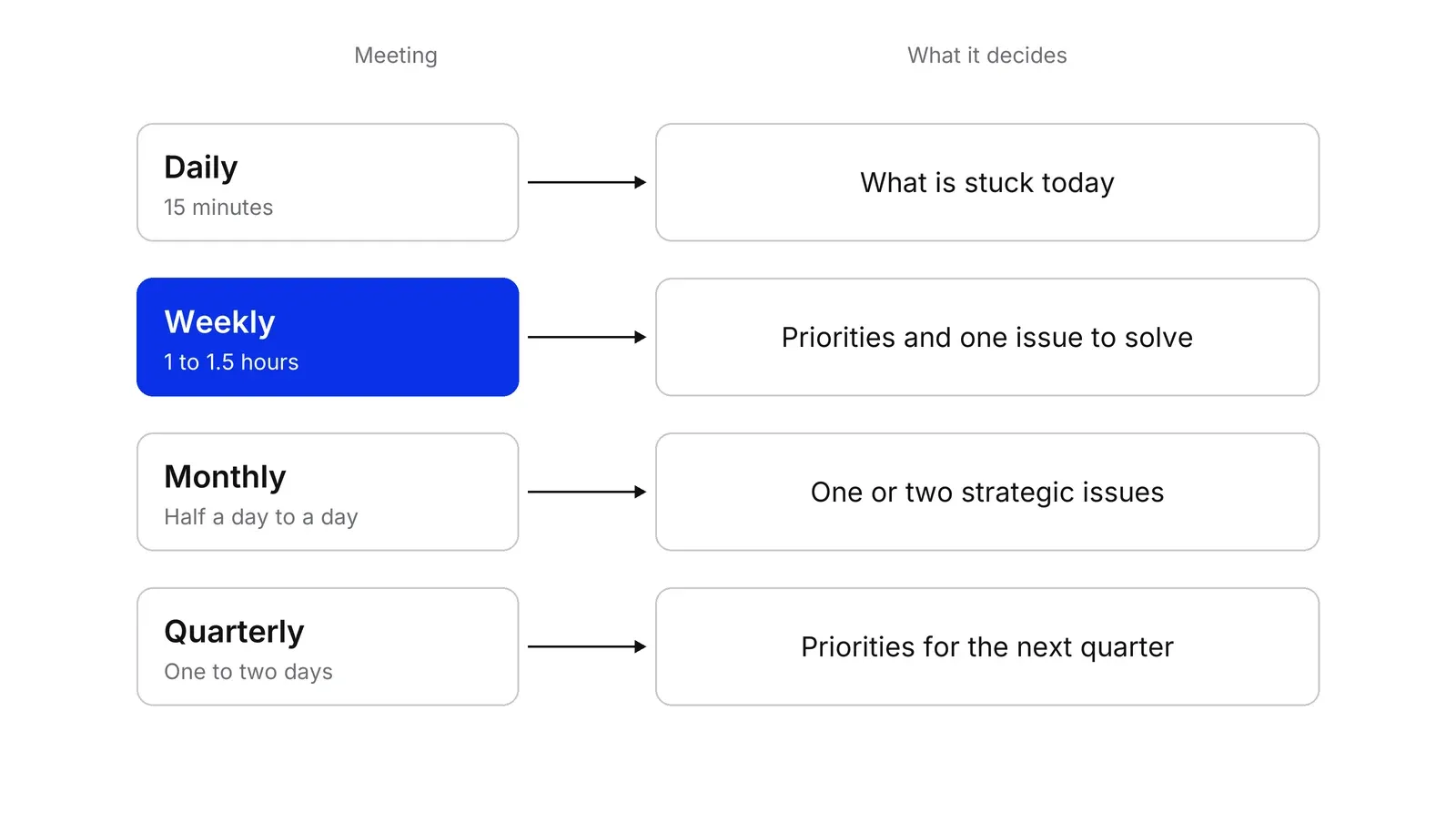
Daily, what is stuck today: Harnish’s daily huddle runs 5 to 15 minutes and covers one or two numbers, the day’s top priority and roadblocks, per Scaling Up coaches. Anything longer moves to a separate meeting. The Scrum Guide sets the same 15 minutes for the Daily Scrum.
Weekly, this week’s priorities and one issue: Scaling Up gives 45 to 90 minutes. The Entrepreneurial Operating System, or EOS, fixes the Level 10 meeting at 90 minutes for the leadership team and 30 to 60 for departments. It spends 5 minutes each on the scorecard, quarterly goals, headlines and to-dos, and 60 minutes on identifying, discussing and solving issues. The 4 Disciplines of Execution uses a weekly session of no more than 20 minutes, centred on commitments for one goal.
Monthly, one or two strategic issues: Scaling Up coaches tell teams to leave long-term strategy to the monthly meeting, and Monkhouse and Company describes it as executives meeting the middle-management layer to share strategy. Lencioni’s monthly strategic meeting likewise takes a small number of critical questions.
Quarterly, priorities for the next 90 days: EOS uses a one-day off-site every 90 days to review the quarter and set three to seven priorities, which it calls Rocks. OKRs follow the same quarterly cycle, according to What Matters. Many systems add an annual planning session above this.
What goes into each meeting
Grove sorted meetings by purpose, not by frequency. In High Output Management, as the book is usually summarised, recurring process meetings share information (the one-on-one, the staff meeting and the operation review), while ad hoc mission meetings exist to make a decision. The distinction is useful: a rhythm covers the recurring kind, and a decision that needs a fresh group does not belong on a standing agenda.
Feed each level with the right numbers. Early signals go to the daily and weekly meetings, and results go to the monthly and quarterly ones. A KPI tree shows which numbers belong where, and the difference between leading and lagging indicators tells you which meeting can still change them. When an action comes out of a meeting, attach one name to it. A RACI matrix settles who is accountable when the answer is unclear.
How the levels connect
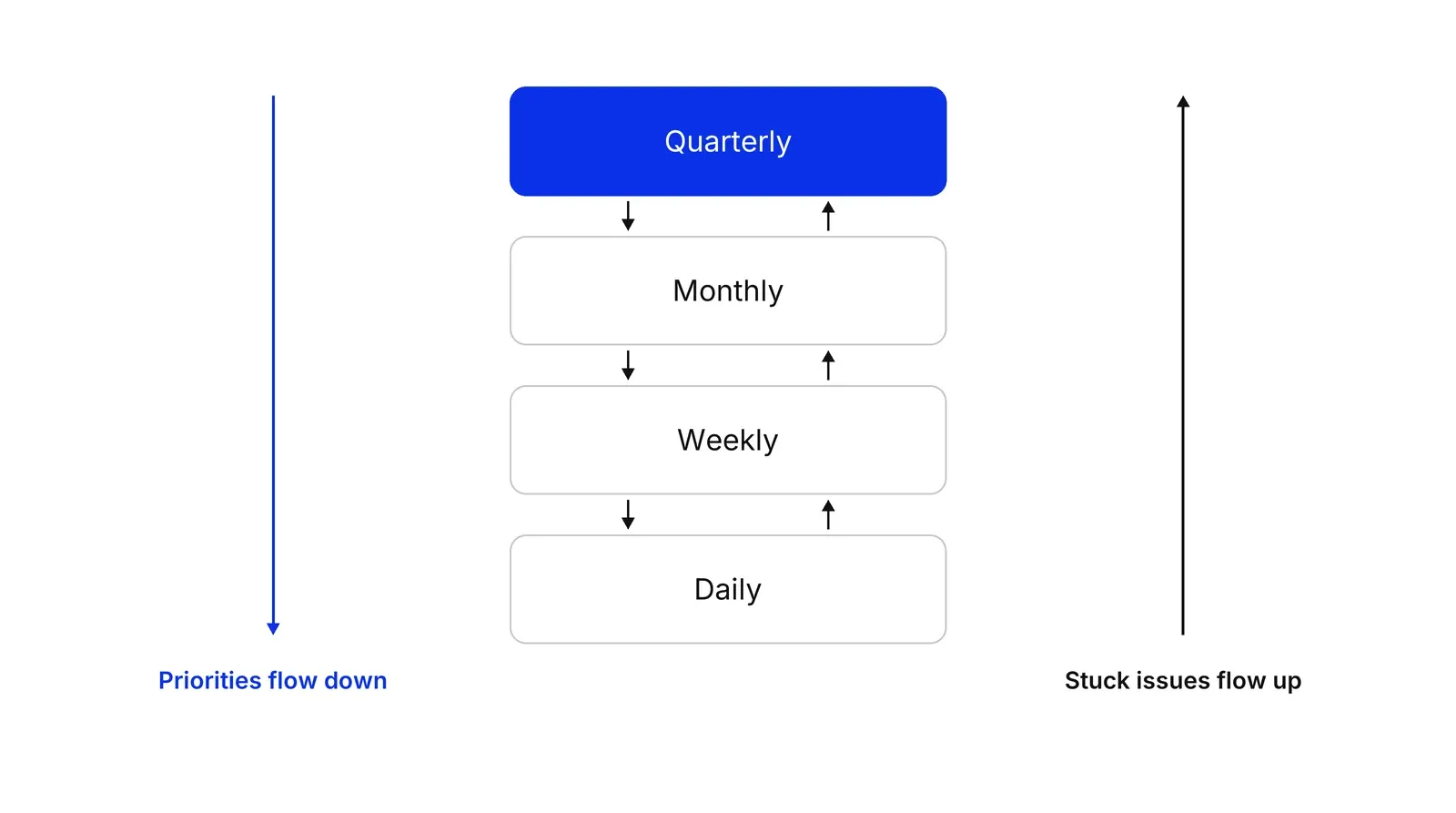
The levels only work together if information moves between them. Quarterly priorities become the weekly agenda, and the weekly meeting checks progress against them. When a weekly meeting meets an issue it cannot solve, it goes to the monthly session instead of eating three weeks of agendas. Scrum shows the same logic in a smaller loop: a daily event, a sprint of one month or less, then a review of up to four hours and a retrospective of up to three. See Scrum for the full set.
What research says about good meetings
The evidence is about how meetings are run. Leach and colleagues found that a written agenda, a verbal agenda at the start, and starting and ending on time raise how effective attendees judge a meeting. Cohen and colleagues found that attendees who come prepared improve meeting quality. Allen and Rogelberg surveyed 319 working adults and found that managers who make meetings relevant, give people a voice and manage time raise engagement.
Frequency matters too. In a study of 980 employees, Rogelberg and colleagues found that for people high in accomplishment striving, many short meetings hurt well-being more than a few long ones of the same total time. Kauffeld and Lehmann-Willenbrock videotaped 92 team meetings and found that constructive interaction, such as problem solving and action planning, was linked to team productivity and to organizational success 2.5 years later.
Mroz and colleagues add a practical checklist: call a meeting only when necessary, keep it small, send minutes and actions at once, and rate the meeting afterwards. EOS builds that last step in by having every participant rate the meeting from 1 to 10.
A plan built with Pushers’ Marketing-Operational System starts from a calendar like this one.
How to apply Operating rhythm, step by step
- List every recurring meeting you run today. Write down each standing meeting, who attends and how long it takes. The result is a map of where leadership time goes, and usually a few meetings with no clear purpose.
- Give every meeting one job. State in one line what the meeting decides: today's blockers, this week's issues, one strategic question, the next quarter's priorities. Merge or cancel any meeting whose job another meeting already does.
- Fix the length, day and agenda. Pick a duration and a printed agenda for each level, such as 15 minutes daily and 60 to 90 minutes weekly, and put them in calendars as fixed slots. The result is a calendar nobody has to renegotiate.
- Choose the numbers that feed each meeting. Pick the few indicators reviewed at each level and say who updates them before the meeting. Early signals go to the weekly meeting, outcome figures to the monthly one.
- Connect the levels. Decide how quarterly priorities reach the weekly agenda, and how an issue the weekly meeting cannot solve moves up to the monthly one. Write both routes down.
- Review the rhythm itself each quarter. At the quarterly session, ask which meetings earned their time and which did not. Rate each meeting, cut one, and keep the rest fixed for the next 90 days.
Examples
A clinic group with six locations
Illustrative. A group's operations lead replaces a daily call that ran 40 minutes with a 15-minute check on today's staffing gaps and equipment failures. Location managers meet weekly for 60 minutes on one question, such as booking gaps, and the owners meet monthly for half a day on one strategic issue, like opening a seventh site. Each quarter they set three priorities, for example cutting no-shows from 12% to 8%. Arithmetic only: 25 minutes saved on each of 20 working days is more than eight hours a month per manager.
A payments company's compliance team
Illustrative. A compliance team runs a 15-minute morning check on the review queue and the oldest open case. A weekly 60-minute meeting reviews average review time and the share of files returned for missing documents, then solves one issue. A monthly session handles one regulatory change, such as a new reporting rule. The quarterly session sets the next three targets and checks whether last quarter's targets were reached.
When to use it
Use it when decisions stall, the same topics return in every meeting, or priorities set in January are forgotten by March. It suits companies from about ten people up, where one founder can no longer hold every decision in their head.
When not to use it
Skip a heavy cadence in a team of three to five people who sit together and talk all day, where a weekly 30-minute check is enough. Also hold off when the company has no agreed priorities, because a rhythm only repeats whatever is put into it.
Common mistakes
- Adding meetings without removing any, so the new rhythm sits on top of the old calendar instead of replacing it.
- Letting the daily check turn into a status round or a problem-solving session, until it runs 40 minutes.
- Using the weekly meeting to report what people did instead of deciding what to do about the gap in the numbers.
- Skipping the monthly and quarterly levels, so strategic questions are squeezed into weekly agendas and never get a full hearing.
- Never checking whether a meeting works. A rhythm that is not reviewed drifts back to ad hoc calls within a quarter.
FAQ
What is an operating rhythm?
An operating rhythm is the recurring set of meetings and reports a company uses to run itself, each level with its own job and length. Daily checks clear blockers, weekly meetings handle priorities and issues, monthly sessions take strategic questions, and quarterly sessions set the next priorities. The term overlaps with meeting cadence and regular management.
How often should a leadership team meet?
Most published systems settle on a weekly leadership meeting of 60 to 90 minutes. The Entrepreneurial Operating System sets 90 minutes for leadership and 30 to 60 minutes for departments, while Scaling Up gives 45 to 90 minutes. Monthly and quarterly sessions sit on top of that for longer questions.
What is regular management?
Regular management is the Russian-language name for the same idea: a fixed calendar of management meetings and reports, with a standard agenda, owner and length for each. It replaces ad hoc calls with a schedule where every recurring decision, from daily blockers to quarterly priorities, has an agreed place.
How long should each meeting be?
Published practice gives a range. Scaling Up puts the daily huddle at 5 to 15 minutes and the weekly at 45 to 90. Scrum caps its daily event at 15 minutes. The Entrepreneurial Operating System allots a full day to the quarterly session. Match length to the number of decisions, not to the calendar slot.
Sources
- Penguin Random House, High Output Management, Andrew S. Grove
- Harvard Business Review, Stop the Meeting Madness, Perlow, Hadley, Eun, 2017
- Harvard Business Review, Why Strategy Execution Unravels, Sull, Homkes, Sull, 2015
- Monkhouse and Company, What are the Rockefeller Habits and why use them
- Scaling Up Coaches, No More Boring Meetings
- Scaling Up Coaches, Rockefeller Habits Checklist
- EOS Worldwide, The EOS Meeting Pulse
- EOS Worldwide, The Level 10 Meeting
- The Table Group, Death by Meeting, Patrick Lencioni
- Ken Schwaber, Jeff Sutherland, The Scrum Guide
- FranklinCovey, Discipline 4: Create a Cadence of Accountability
- What Matters, OKR meaning, definition and example
- Steven Rogelberg, Desmond Leach, Peter Warr, Jennifer Burnfield, Not Another Meeting, Journal of Applied Psychology, 2006
- ScienceDaily, Meeting time and employee well-being, UNC Charlotte study, 2006
- Desmond Leach, Steven Rogelberg, Peter Warr, Jennifer Burnfield, Perceived Meeting Effectiveness, Journal of Business and Psychology, 2009
- Hoang Luong, Steven Rogelberg, Meetings and More Meetings, Group Dynamics, 2005
- Cohen, Rogelberg, Allen, Luong, Meeting design characteristics and attendee perceptions of meeting quality, Group Dynamics, 2011
- Joseph Allen, Steven Rogelberg, Manager-Led Group Meetings, Group and Organization Management, 2013
- Simone Kauffeld, Nale Lehmann-Willenbrock, Meetings Matter, Small Group Research, 2012
- Mroz, Allen, Verhoeven, Shuffler, Do We Really Need Another Meeting, Current Directions in Psychological Science, 2018
- Cambridge University Press, The Cambridge Handbook of Meeting Science, introduction
- strategy+business, Bad meetings no more, on Steven Rogelberg's research
Last updated Oct 9, 2026


Fractional COO or embedded operations team? How to choose at Series A
The two models solve different problems: how to tell which one your company needs, and what each costs in time and control.

What operational systems successful fintech startups use: lessons from ten companies
Starling, Monzo, Qonto, bunq, Lunar, Pleo, Tide, Ramp, Mercury and Column scaled on four operating systems. Regulators' findings show what breaks when one of them lags behind growth.

What a revenue operations manager actually owns
Pipeline definitions, CRM hygiene, forecasting and the handoffs between marketing, sales and success. What the role covers, and how it differs from sales ops.