Hoshin kanri
Hoshin kanri is a way to run strategy as a yearly management cycle: leadership picks a few breakthrough objectives, each level agrees its own targets and means through catchball, and progress is reviewed every month.
Hoshin kanri, also called policy deployment or strategy deployment, is a Japanese management method that turns a few long-term breakthrough objectives into yearly targets and team plans. Each level agrees its share through a back-and-forth called catchball, and progress is checked monthly with the plan-do-check-act cycle. It grew out of total quality control in Japanese companies in the 1960s.
- Origin
- Japanese TQC companies, with Bridgestone Tire credited for the name; codified in a book edited by Yoji Akao, 1960s; Akao's book 1988 in Japanese, 1991 in English
- Level
- 401 · Expert
- Fits
- Enterprise
- Time to apply
- two to three months to agree the first annual plan, then a monthly review for the rest of the year
- What you need
- a three-to-five-year view of where the company must be, written as a few measurable objectives · the leadership team and the head of every function, with time for two or three planning rounds · a monthly review slot that stays on the calendar for the whole year
Hoshin kanri is a management method for carrying a company’s strategy from the board to daily work and back. Leadership chooses a few objectives that need a real change, each level of the company works out with the level above what it will do about them, and everyone checks progress every month. In English it goes by policy deployment, strategy deployment or hoshin planning. Bob King, whose 1989 book introduced it to many Western managers, translated hoshin as policy or target and means, and kanri as planning or management, according to Barry Witcher’s 2014 review.
Its users include Toyota, Nissan, Canon, Xerox, Hewlett-Packard and Danaher. Japan’s national standards body publishes a standard for it, JIS Q 9023, first issued in 2003 and revised in 2018, which notes that no matching international standard exists.
Where did hoshin kanri come from?
Hoshin kanri grew inside Japanese companies practising total quality control (TQC) in the 1960s, and no single inventor can be named. The widely repeated story credits Bridgestone in 1965 or Komatsu. Checked against the sources, it holds in part.
| Claim | What the sources show |
|---|---|
| Bridgestone named it | Supported. Yoshio Kondo wrote in 1998 that Bridgestone Tire, a 1968 Deming Prize winner, “termed this approach hoshin kanri”. |
| Bridgestone started it, 1965 | Disputed. Accounts of Akao’s 1991 book give an internal Bridgestone document of 1962 (Witcher) or a 1965 internal manual (Butterworth). |
| Komatsu invented it | Not supported. Komatsu won the Deming Prize in 1964 and built its own version at about the same time, according to a 2001 Durham thesis. |
| Toyota was early | Disputed. Toyota’s chronology records a corporate policy in January 1963; one later account dates its adoption of hoshin kanri to 1979. |
The Deming Prize years come from the official JUSE list: Komatsu 1964, Toyota 1965, Bridgestone 1968. Rosemary Butterworth’s 2001 thesis, the source for the Komatsu line, is open on Durham’s repository.
Yoji Akao’s role was to codify it. He edited a Japanese book on applying hoshin kanri, published by the Japanese Standards Association in 1988, with chapters by several academics. Its English translation, Hoshin Kanri: Policy Deployment for Successful TQM, followed in 1991 and is still the most cited text. Akao, who died in 2016, is remembered in his TQM Journal obituary as a co-founder of quality function deployment.
How the yearly cycle works
Hoshin kanri is the plan-do-check-act cycle applied to strategy. A 1998 literature review by Lee and Dale in the International Journal of Quality & Reliability Management reached exactly that conclusion and added that success depends on senior leaders running it.
A year has four parts. Leaders set a medium-term plan and the year’s policy. The policy is deployed level by level. Each function runs its part and reports monthly. At year end, senior managers review results and the process, then carry the lessons into next year. The JIS Q 9023 standard follows the same order and adds a “top management diagnosis”, in which senior leaders visit units to check progress in person. Kondo describes the same audit at Bridgestone.
The method also sets a limit on how much goes into the plan. Hoshin covers only the few changes that matter this year. Routine targets stay in daily management, a separate system. One contributor to Akao’s book compared daily control to eating and sleeping well, and hoshin to treating an illness or joining a gym, as Witcher summarises. JIS Q 9023 says it should be used together with the daily management standard, JIS Q 9026.
What is catchball?
Catchball is the negotiation in which a plan passes between two levels until both accept it. Kondo explains the name: the policy “ball” is thrown back and forth between top and middle managers before a final decision. Its purpose is to turn targets set from above into targets people set for themselves. Charles Tennant and Paul Roberts devoted a 2001 Long Range Planning paper to how companies implement it.
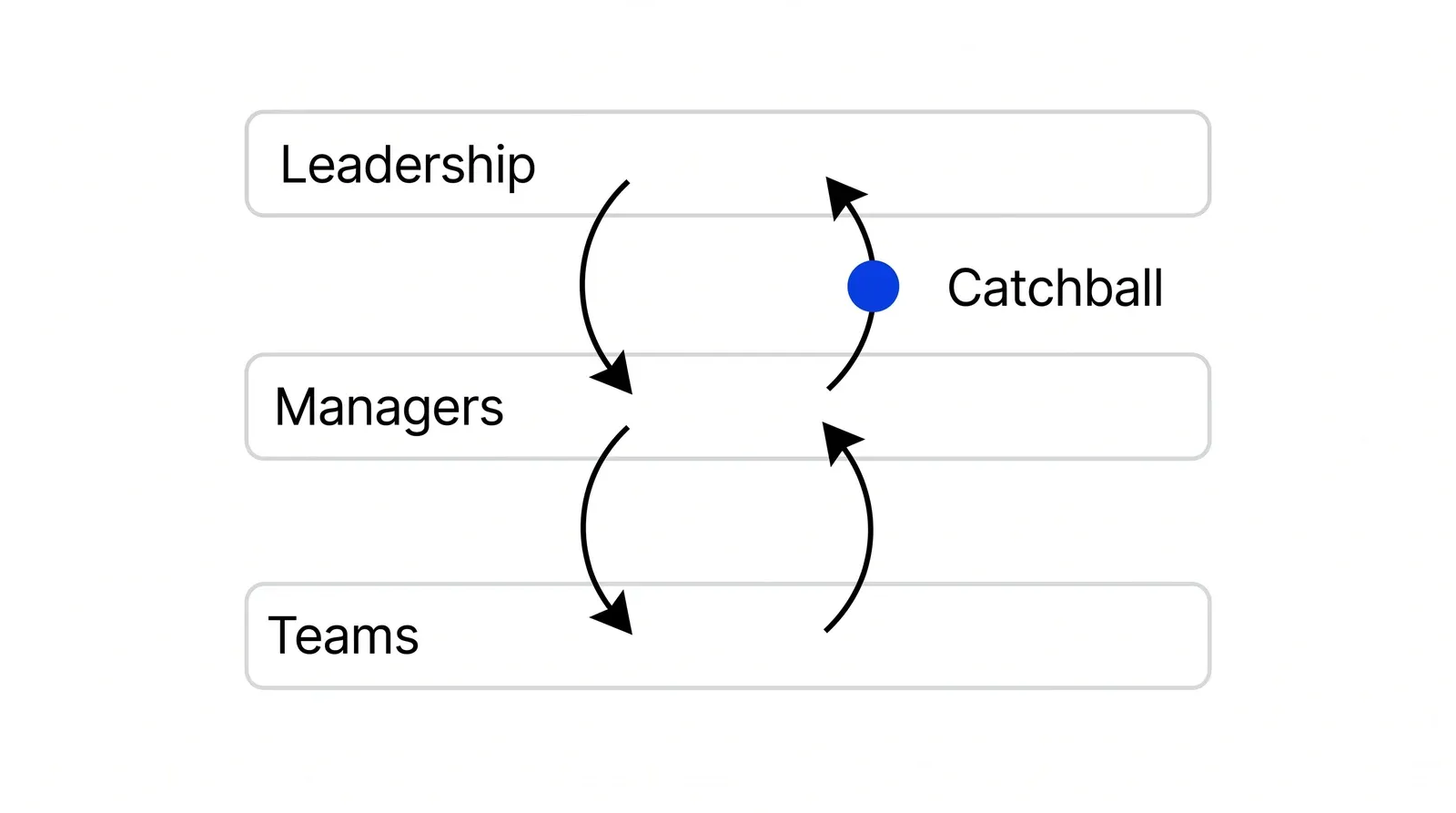
Take an illustrative payments company with 600 staff. Leadership proposes cutting merchant onboarding from 10 days to 4 this year. The operations head replies that 4 days needs automated document checks, which engineering cannot ship before the third quarter, and offers 6 days by June and 4 by December. Leadership accepts the staged target and moves budget to the document checks. The target changed, the means are now named, and the operations head owns a number they helped set.
The X-matrix
The X-matrix is a one-page form for recording a hoshin plan. Four lists sit around a central X: long-term breakthrough objectives at the bottom, annual objectives on the left, improvement priorities on top and numeric targets on the right, with owners in a column beyond. Dots in the corner grids show which item supports which. Christoph Roser, a professor who writes All About Lean, describes filling it from the bottom, clockwise.
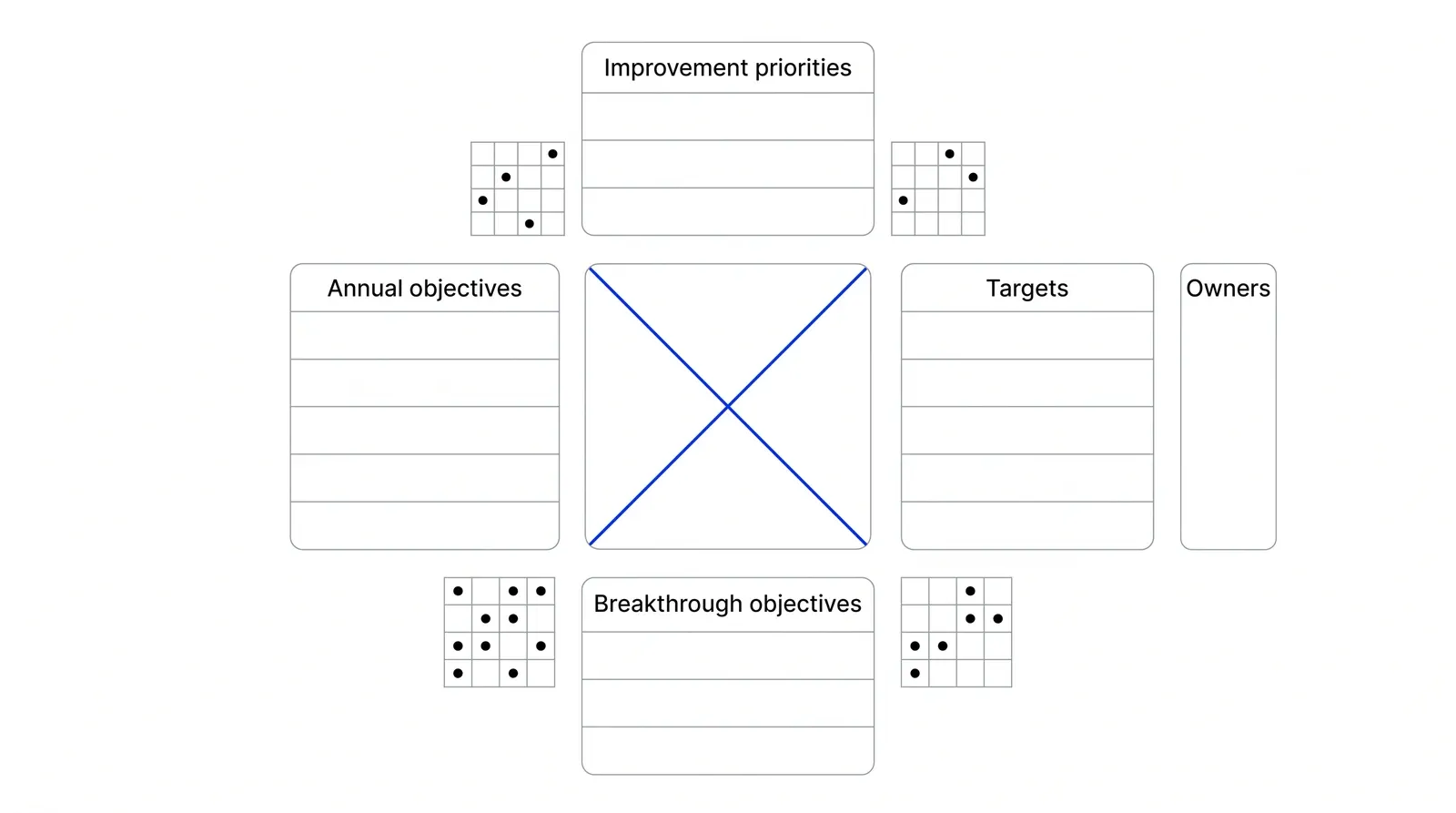
The X-matrix is a later Western tool. Thomas Jackson’s 2006 book, Hoshin Kanri for the Lean Enterprise, made it standard in lean circles. Roser calls its origins fuzzy and argues it hides the check and act steps. Liker and Shook, writing for the Lean Enterprise Institute, make a similar point: filling in a form is not the method.
Hoshin kanri, OGSM, OKR and the balanced scorecard
These tools are often mixed up because each links company goals to team work. The differences are in what they negotiate and how often they check.
| Hoshin kanri | OGSM | OKR | Balanced scorecard | |
|---|---|---|---|---|
| Main question | Which few changes this year, and who does what | What we want and how we will get there | What ambitious outcome this quarter | Which measures show strategy working |
| Cycle | Year, reviewed monthly | Year, reviewed quarterly | Quarter | Year |
| Passed between levels | Targets and means, through catchball | Strategies become the next level’s objectives | Objectives and key results | Measures |
The tools can be combined. Witcher and Chau argued in Management Decision in 2007 that the balanced scorecard and hoshin kanri complement each other, with examples from Canon, Toyota and Nissan.
Why companies still use it
The problem hoshin kanri addresses is common. A London Business School survey of more than 11,000 managers in over 400 companies found that only a third could list their firm’s top three priorities. Catchball and monthly reviews are a direct fix: people who negotiated the priorities can name them.
Research on it is thin. Lee and Dale found fewer than 20 English-language papers in 1998, and John Nicholas wrote in 2016 that Western academics had largely ignored the method. Most evidence is case studies of companies such as Xerox, Hewlett-Packard and Nissan’s UK operations. In Pushers’ marketing operational system work, a KPI tree does a similar job, tracing each yearly objective down to a team metric.
How to apply Hoshin kanri, step by step
- Set two or three breakthrough objectives. Write where the company must be in three to five years, as two or three objectives with a number attached. They should need a change in how the company works, not more of the same effort. Result: a short list of long-term objectives the leadership team signs.
- Choose this year's vital few. From the breakthrough objectives, derive three to five annual objectives that must be met this year to stay on course. Write down the projects you are deliberately not doing this year, so people stop asking. Result: annual objectives plus a visible list of what was set aside.
- Draft the plan on one page. For each annual objective, list the improvement priorities that will move it, a numeric target for each, and one owner. An X-matrix or a simple table both work. Result: a draft page that shows which priority supports which objective.
- Run catchball one level down. Hand the draft to the managers who will own each priority. They come back with their own means, targets and objections, and leadership changes the plan where they are right. Repeat until both sides agree, then do the same with the next level. Result: team plans that each trace back to a line on the company page.
- Keep routine work out of the plan. Run ordinary KPIs such as on-time delivery or monthly close in daily management. The hoshin plan carries only the few changes this year depends on. Result: a short plan that does not drown in business-as-usual metrics.
- Review monthly, diagnose at year end. Each month, owners report actuals against target and, where they miss, the cause and the countermeasure. At year end, senior leaders review what worked and what the process itself got wrong, and feed both into next year's plan. Result: a dated record of misses, fixes and lessons.
Examples
Toyota
Toyota introduced total quality control in June 1961 and its official chronology records a corporate policy announced in January 1963. In a 2025 article for the Lean Enterprise Institute, Jeffrey Liker and John Shook say this is when Toyota first put its hoshin on paper. After its 1965 Deming Prize, Toyota set new policies from the judges' comments, including simple management systems with an emphasis on checks and actions. Christoph Roser dates Toyota's adoption of hoshin kanri proper to 1979, so accounts differ.
Danaher
Danaher, the US science and technology group, calls its version Policy Deployment and lists it as a tool of the Danaher Business System. Its 2022 sustainability report says Policy Deployment helps each operating company determine its critical few improvement priorities. From 2021, every operating company added an annual Policy Deployment initiative on diversity and inclusion, which shows the method carrying a goal that is not a production metric.
An NHS hospital trust
Sandwell and West Birmingham NHS Trust published a board paper in March 2023 on strategy deployment, adapted from ThedaCare and University Hospitals Sussex. It sets three-to-five-year True North metrics, then at most seven breakthrough objectives, each an annual metric found through A3 problem solving. After three one-hour executive sessions between July and December 2022, the paper concluded the work needed more rigour and deferred the breakthrough objectives. The trust's experience shows how long the first cycle takes.
When to use it
Use it in a company of several hundred people or more, where strategy fails between the board and the front line: the plan exists, but managers cannot say which three things matter this year, and every function chases its own list. It fits best where a monthly management rhythm already exists and leaders are willing to hear objections from below.
When not to use it
Skip it in an early-stage company whose direction may change within the year, since the annual cycle and several planning rounds are too slow; quarterly OKRs fit better. It also fails where leadership will not change the plan during catchball, because the process then becomes a long way of issuing orders.
Common mistakes
- Putting every KPI in the plan. Hoshin covers the few breakthroughs; routine performance belongs in daily management.
- Treating catchball as a sign-off. If no target or means ever changes after managers respond, the process is top-down with extra meetings.
- Filling in an X-matrix and calling it hoshin kanri. The form records the plan; the monthly check and act steps are what make it work.
- Choosing ten annual objectives. A plan with that many priorities has not chosen, and monthly reviews turn into status reports.
- Skipping the year-end review of the process itself, so the same planning errors repeat every year.
FAQ
What is hoshin kanri in lean?
In lean management, hoshin kanri is the way strategy reaches daily work. The Lean Enterprise Institute calls it a framework for sustained high performance and links it to PDCA. Thomas Jackson's 2006 book, Hoshin Kanri for the Lean Enterprise, presents it as the operating system behind lean, using the X-matrix and catchball.
What is the X-matrix in hoshin kanri?
The X-matrix is a one-page planning form with an X in the middle and four lists around it: breakthrough objectives at the bottom, annual objectives on the left, improvement priorities on top and targets on the right, with owners beside the targets. Corner dots show which items support which. Thomas Jackson's 2006 book popularised it.
What does catchball mean in hoshin kanri?
Catchball is the back-and-forth in which a plan is passed between levels until both agree. Yoshio Kondo's 1998 paper describes it as the policy ball thrown between top and middle managers before a final decision. The aim is to turn targets set from above into targets people have set for themselves.
Who invented hoshin kanri?
No single person. It grew in Japanese companies practising total quality control in the 1960s. Bridgestone Tire is credited with the name, and Komatsu and Toyota built similar systems at about the same time. Yoji Akao edited the book that codified it, with a Japanese edition in 1988 and an English one in 1991.
What is the difference between hoshin kanri and OKR?
OKRs set ambitious objectives and key results, usually for a quarter, and leave the method open. Hoshin kanri runs on a yearly cycle tied to three-to-five-year objectives, negotiates means as well as targets level by level, and reviews progress monthly with PDCA. Many companies use hoshin for the year and OKRs inside it.
Sources
- Yoji Akao (ed.), Hoshin Kanri: Policy Deployment for Successful TQM, Productivity Press, 1991, Internet Archive record
- National Diet Library, record for Akao et al. (eds.), Hoshin kanri katsuyo no jissai, Japanese Standards Association, 1988
- Yoshio Kondo, Hoshin kanri: a participative way of quality management in Japan, The TQM Magazine 10(6), 1998
- Rosemary Butterworth, Hoshin Kanri: an exploratory study at Nissan Yamato Engineering, PhD thesis, Durham University, 2001
- Barry J. Witcher, Hoshin Kanri, Perspectives on Performance 11(1), 2014, University of East Anglia repository
- JUSE, The Deming Prize winners 1951-2025
- Toyota Motor Corporation, 75-year history, Total Quality Management chronology
- Toyota Motor Corporation, 75-year history, Construction of Motomachi Plant and introduction of TQC
- Jeffrey Liker, John Shook, Hoshin Kanri as a Foundational Piece of a Lean Management System, Lean Enterprise Institute, March 2025
- Lean Enterprise Institute, Lexicon: hoshin kanri
- Thomas L. Jackson, Hoshin Kanri for the Lean Enterprise, Productivity Press, 2006, Routledge page
- Charles Tennant, Paul Roberts, Hoshin Kanri: Implementing the Catchball Process, Long Range Planning 34(3), 2001
- Barry J. Witcher, Rosemary Butterworth, Hoshin Kanri: how Xerox manages, Long Range Planning 32(3), 1999
- Barry J. Witcher, Rosemary Butterworth, Hoshin Kanri at Hewlett-Packard, Journal of General Management 25(4), 2000
- Barry J. Witcher, Policy management of strategy (hoshin kanri), Strategic Change 12(2), 2003
- Barry J. Witcher, Vinh Sum Chau, Balanced scorecard and hoshin kanri: dynamic capabilities for managing strategic fit, Management Decision 45(3), 2007
- R. G. Lee, B. G. Dale, Policy deployment: an examination of the theory, International Journal of Quality & Reliability Management 15(5), 1998
- J. K. Jolayemi, Hoshin kanri and hoshin process: a review and literature survey, Total Quality Management & Business Excellence 19(3), 2008
- John Nicholas, Hoshin kanri and critical success factors in quality management and lean production, Total Quality Management & Business Excellence 27(3-4), 2016
- Japanese Standards Association, JIS Q 9023:2018, Performance improvement of management systems, Guidelines for Policy Management (preview)
- London Business School, Two-thirds of senior managers can't name their firm's top priorities, December 2015
- Danaher Corporation, 2022 Sustainability Report
- Sandwell and West Birmingham NHS Trust, Getting to True North, Public Trust Board paper, March 2023
- Christoph Roser, All About Lean, Hoshin Kanri: the X-Matrix
- Christoph Roser, All About Lean, The evolution of strategic management: Hoshin Kanri
- Alex Douglas, Stanislav Karapetrovic, Obituary: Yoji Akao 1928-2016, The TQM Journal 29(1), 2017
Last updated Oct 9, 2026


Fractional COO or embedded operations team? How to choose at Series A
The two models solve different problems: how to tell which one your company needs, and what each costs in time and control.

What operational systems successful fintech startups use: lessons from ten companies
Starling, Monzo, Qonto, bunq, Lunar, Pleo, Tide, Ramp, Mercury and Column scaled on four operating systems. Regulators' findings show what breaks when one of them lags behind growth.

Marketing agency or growth system: when a company outgrows its agency
An agency is the right call while the founder still runs most of the company. Once the business starts copying itself into new locations or markets, it needs a system that sets goals, tests hypotheses and owns the result.