Hiring scorecard
A hiring scorecard is a one-page definition of a role in terms of its mission, the outcomes the person must deliver and the competencies they need, written before anyone is interviewed.
A hiring scorecard is a one-page document that defines a role by its mission, a short list of measurable outcomes and the competencies needed to reach them, instead of a list of duties. Geoff Smart and Randy Street introduced it in Who (2008). Teams write it before sourcing and then rate every candidate against it.
- Origin
- Geoff Smart and Randy Street, Who: The A Method for Hiring (Ballantine Books), 2008
- Level
- 201 · Tool
- Fits
- Startup, Small and mid-size, Scale-up
- Time to apply
- 2 hours to draft and agree one scorecard, before the role is advertised
- What you need
- the person the new hire will report to · one or two people who work next to the role · the numbers the role is meant to move
A hiring scorecard is a one-page definition of a role that says why the job exists, what the person must achieve and how they need to work, written before you meet any candidate. Geoff Smart and Randy Street set it out in Who: The A Method for Hiring, published by Ballantine Books in 2008. It is the first of four steps in their method: Scorecard, Source, Select and Sell. The other three steps depend on it, because you cannot source or select for a role nobody has defined.
The three parts of a scorecard
A scorecard has a mission, outcomes and competencies, and you write them in that order. Each one narrows the one before it.
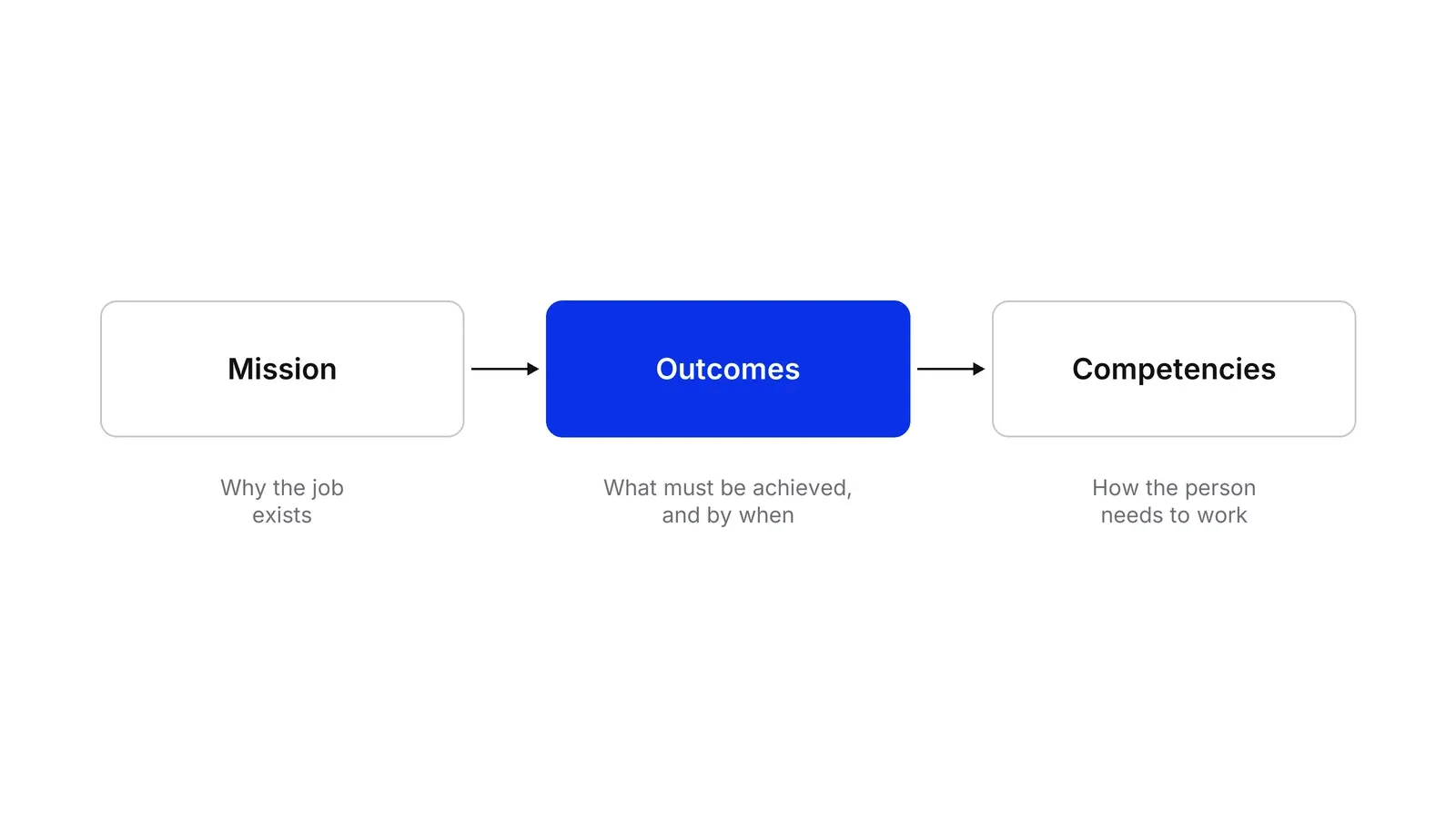
The mission is a plain statement of why the role exists. ghSMART, the firm Smart founded, says a scorecard is not a job description and defines success for the role. Outcomes carry most of the weight. They are the “what”: results the person must deliver, with measures and deadlines. ghSMART asks for outcomes that are specific, measurable, achievable, relevant and time-bound, and also “necessary and sufficient”, so the team has to separate must-haves from nice-to-haves.
Competencies are the “how”: the behaviours and working style that make those outcomes likely in your company. ghSMART’s guidance on cultural fit puts culture here too, as written behaviours on the card, so fit is judged against stated criteria and not against a feeling. If you want more on defining proficiency levels, see the competency model page.
| Job description | Scorecard | |
|---|---|---|
| Describes | Duties and requirements | Results and how to get them |
| Typical line | “Manages paid advertising channels” | “Brings paid payback under 9 months within a year” |
| Used for | Posting the vacancy | Sourcing, interviewing, onboarding, reviews |
| Tested by | Years of experience | Evidence the candidate has done something similar |
What the evidence supports, and what it does not
The scorecard itself has little independent research behind it. We found no peer-reviewed test of the A Method as a whole. The strongest number attached to it is the authors’ own: the book’s publisher listing says the method has a 90 percent success rate, against about 50 percent for the typical manager, and ghSMART repeats it. We found no published study design behind either figure, so read them as a vendor claim.
The parts around it are better studied. The case for starting from the job is old: US federal rules on selection procedures expect a job analysis that identifies the important work behaviours, and the US Office of Personnel Management says structured-interview questions should rest on competencies shown by job analysis to be critical to success. A scorecard is a lightweight version of that step.
The case for what you do next is stronger. In a 2022 re-estimate, Sackett and colleagues found that structured interviews had the highest mean validity of the selection methods they reviewed. SIOP’s summary lists .42 for structured interviews, .40 for job knowledge tests, .33 for work samples and .31 for cognitive ability.
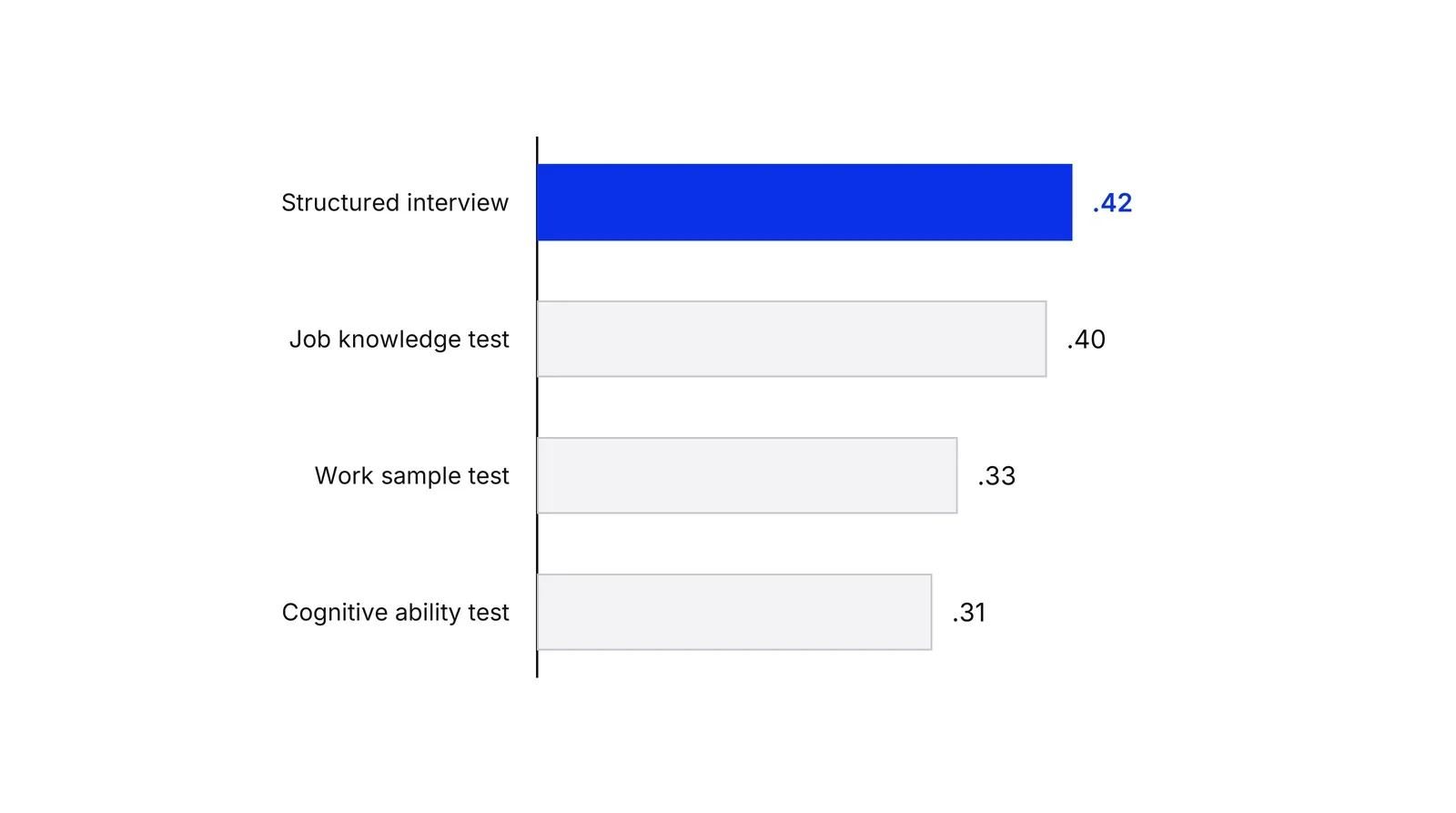
A validity of .42 is a useful edge, not a guarantee. The authors’ 2023 follow-up puts it as .42 with an 80% credibility interval from roughly .18 to .66, so results vary a lot by setting. Earlier meta-analyses by McDaniel and colleagues (1994) and by Wiesner and Cronshaw (1988) had also found that structured interviews beat unstructured ones. Older, higher figures such as those in Schmidt and Hunter’s 1998 review should not be quoted as current: the 2022 paper lowered most older estimates by .10 to .20 points.
From scorecard to structured interview
A structured interview is one where every candidate gets the same planned questions, scored on the same scale. The scorecard is what makes it easy to write one. Each outcome and competency becomes a question, and the outcome’s number becomes the benchmark for a strong answer.
Levashina and colleagues reviewed two decades of research on structure in 2014, covering how to define it, rating scales, follow-up probes and situational versus past-behaviour questions. Campion, Palmer and Campion had earlier catalogued the elements of structure, among them questions based on a job analysis, the same questions for every candidate, anchored rating scales and several interviewers, and the situational interview of Latham and colleagues (1980) already built its questions from incidents identified by job analysis. Google’s guidance describes four parts: vetted role-relevant questions, recorded answers, a rubric with examples at each level (outstanding, solid, borderline, poor) and interviewer calibration. OPM adds that panel members score individually first and then discuss big gaps.
Why bother? Because unstructured conversation misleads in a particular way. In an experiment by Dana, Dawes and Peterson, people predicting students’ grades did worse after an interview than from records alone, and were just as confident when the interviewee answered at random. Kausel and colleagues found hiring decision-makers who saw unstructured interview information were more overconfident. Highhouse argued that belief in intuition is why decision aids are adopted slowly.
Scorecard, competency model and OKR
A scorecard covers one role, a competency model covers a family of roles, and an OKR covers a team’s quarter. They fit together: the outcomes on a scorecard should roll up to the team’s OKRs, and the competencies can be taken from your competency model. When a new hire’s outcomes depend on other people, use a RACI matrix to say who decides and who is consulted, and check the role against your growth team structure before you advertise it.
ghSMART says scorecards also work after hiring: shared with a new hire as a 90-day plan, then used in reviews. A CEO’s scorecard can cascade, with other leaders’ scorecards rolling up to its outcomes.
Limits to keep in mind
A scorecard cannot fix what the interview does not test. Rivera’s study of hiring at elite professional firms found evaluators favoured candidates who were similar to themselves in leisure pursuits and self-presentation, and often gave this more weight than productivity. Competencies that read as “culture fit” can smuggle that in, so write each as an observable behaviour with a question that tests it.
Outcomes can also be set too high or depend on things the hire does not control. Check each one for whether the person could reasonably affect it, and revisit the card when the business changes. A Growth Lab plan starts from the same step, by naming the outcomes each growth role must deliver.
How to apply Hiring scorecard, step by step
- Write the mission. Describe why the job exists in one or two plain sentences, specific enough that a stranger could tell it apart from the job next door. Result: a mission that settles what the role is for.
- List the outcomes. Write what the person must have achieved, each with a number and a date, and rank them. If you have twelve, you are describing two jobs. Result: a short, ranked list of results, not duties.
- Derive the competencies. Ask what a person would have to do day to day to reach each outcome, and write those behaviours down. Add the working-style traits that matter in your company. Result: competencies that trace back to an outcome.
- Test it with the people who know the job. Ask the manager and a close colleague whether hitting every outcome would make the hire a success, and whether anything on the page is a nice-to-have. Result: a scorecard everyone involved reads the same way.
- Turn it into interview questions and a rubric. Write the same questions for every candidate, one set per outcome or competency, and describe what a strong, a middling and a weak answer looks like. Result: a structured interview kit.
- Rate each candidate against the card. After the interviews, each interviewer rates the candidate on every outcome and competency before the group compares notes. Result: ratings you can compare line by line.
- Reuse it after the offer. Share the scorecard with the hire as the first-90-days plan and review progress against it. Result: onboarding and later reviews that use the same yardstick as the hiring decision.
Examples
Head of growth at a 30-person SaaS company
Illustrative. Mission: build a repeatable acquisition engine for self-serve sign-ups. Outcomes: grow monthly trial sign-ups from 800 to 2,000 within 12 months; reach a payback period under 9 months on paid channels; run at least 4 documented experiments per month by the end of month 3. Competencies: forms a hypothesis before spending, reads a cohort table without help, hires and manages two specialists, writes a one-page weekly report. The outcome numbers become interview material: a candidate who has moved sign-ups by a similar factor can say what they changed, what failed and what it cost.
Patient coordinator at a private clinic
Illustrative. Mission: make sure every patient who calls or messages is booked and arrives prepared. Outcomes: answer 95% of calls within 20 seconds; cut no-shows from 15% to 8% within 6 months using confirmation calls; keep the next-day schedule at least 90% full. Competencies: stays calm with an anxious caller, follows a written script and flags where it fails, handles personal data under the clinic's privacy rules. The same card works as the first-month checklist.
When to use it
Use it for any role you will hire more than once or where a miss is expensive: a first marketer, a head of sales, a compliance lead, a clinic manager. It also helps when the hiring team disagrees about what the role is, because the disagreement shows up on the page instead of in the debrief.
When not to use it
Skip the full version for short-term or low-stakes roles where a checklist of duties is enough. Do not use a scorecard as proof that a method works: it organizes your decision, and it does not make the candidate pool better. For a role that is still shapeless, define the team first, with a competency model or a team structure.
Common mistakes
- Writing duties and calling them outcomes. 'Manage the paid channels' is a duty; 'bring paid payback under 9 months' is an outcome with a test.
- Filling the card with a dozen outcomes. Rank them and cut until a reviewer could remember them.
- Keeping the scorecard private to the recruiter. The hiring manager, the interviewers and the candidate all need to read the same version.
- Adding competencies that no outcome needs. Each competency should trace back to an outcome, or it becomes a stand-in for 'someone like us'.
- Writing the scorecard and then interviewing from the usual open conversation. The scorecard only pays off when every interviewer asks planned questions and scores against it.
FAQ
What is a hiring scorecard?
A hiring scorecard is a written definition of a role built from three parts: a mission, a short list of measurable outcomes and the competencies needed to reach them. Smart and Street describe it in Who (2008) as the first step of their A Method. Interviewers rate candidates against it instead of against an impression.
What is the difference between a scorecard and a job description?
A job description lists duties and requirements. A scorecard states what the person must achieve and by when, then the behaviours that get them there. ghSMART says a scorecard is not a job description or spec. The practical difference is that outcomes can be checked in an interview and at the 90-day review.
How many outcomes should a scorecard have?
A handful, ranked by importance. We found no research that fixes a number, and the books and articles we read give ranges that vary. The test is whether the hiring team can recite them from memory and whether all of them together would count as a successful hire.
Does the 90% hiring success rate hold up?
It is the authors' claim. The book and ghSMART's pages say the A Method reaches 90%, against a baseline of about 50% for typical managers. We found no independent study or published method behind the figure, so treat it as a vendor claim. The better evidence is for structured interviews, which the method includes.
Where does the scorecard fit with structured interviews?
The scorecard supplies the content, and the structured interview supplies the method. Questions are written from the outcomes and competencies, asked to every candidate and scored on a shared scale. Google and the US Office of Personnel Management both describe this pairing: job-related questions, a rubric and trained raters.
Sources
- Geoff Smart, Randy Street, Who: The A Method for Hiring, Ballantine Books, 2008, publisher listing at Miami University campus store
- ghSMART, Who: The A Method for Hiring
- ghSMART, Scorecards: They're Not Just for Hiring Anymore
- ghSMART, Hiring for Cultural Fit: A Simple 3-Step Formula
- Paul R. Sackett, Charlene Zhang, Christopher M. Berry, Filip Lievens, Revisiting meta-analytic estimates of validity in personnel selection, Journal of Applied Psychology 107(11), 2022
- SIOP, Is cognitive ability the best predictor of job performance?
- Paul R. Sackett and colleagues, Revisiting the design of selection systems in light of new findings regarding the validity of widely used predictors, Industrial and Organizational Psychology 16(3), 2023
- Julia Levashina, Christopher J. Hartwell, Frederick P. Morgeson, Michael A. Campion, The structured employment interview: narrative and quantitative review of the research literature, Personnel Psychology 67(1), 2014
- Frank L. Schmidt, John E. Hunter, The validity and utility of selection methods in personnel psychology, Psychological Bulletin 124(2), 1998
- Michael A. McDaniel, Deborah L. Whetzel, Frank L. Schmidt, Steven D. Maurer, The validity of employment interviews: a comprehensive review and meta-analysis, Journal of Applied Psychology 79(4), 1994
- Willi H. Wiesner, Steven F. Cronshaw, A meta-analytic investigation of the impact of interview format and degree of structure on the validity of the employment interview, Journal of Occupational Psychology 61(4), 1988
- Michael A. Campion, David K. Palmer, James E. Campion, A review of structure in the selection interview, Personnel Psychology 50(3), 1997
- Gary P. Latham, Lise M. Saari, Elliott D. Pursell, Michael A. Campion, The situational interview, Journal of Applied Psychology 65(4), 1980
- US Office of Personnel Management, Structured interviews
- Google re:Work, Use structured interviewing
- Jason Dana, Robyn Dawes, Nathanial Peterson, Belief in the unstructured interview: the persistence of an illusion, Judgment and Decision Making 8(5), 2013
- Edgar E. Kausel, Satoris S. Culbertson, Hector P. Madrid, Overconfidence in personnel selection: when and why unstructured interview information can hurt hiring decisions, Organizational Behavior and Human Decision Processes 137, 2016
- Scott Highhouse, Stubborn reliance on intuition and subjectivity in employee selection, Industrial and Organizational Psychology 1(3), 2008
- Lauren A. Rivera, Hiring as cultural matching: the case of elite professional service firms, American Sociological Review 77(6), 2012
- US Equal Employment Opportunity Commission and others, Uniform Guidelines on Employee Selection Procedures, 29 CFR 1607.14 (technical standards for content validity)
Last updated Oct 9, 2026


Fractional COO or embedded operations team? How to choose at Series A
The two models solve different problems: how to tell which one your company needs, and what each costs in time and control.

What operational systems successful fintech startups use: lessons from ten companies
Starling, Monzo, Qonto, bunq, Lunar, Pleo, Tide, Ramp, Mercury and Column scaled on four operating systems. Regulators' findings show what breaks when one of them lags behind growth.

What a revenue operations manager actually owns
Pipeline definitions, CRM hygiene, forecasting and the handoffs between marketing, sales and success. What the role covers, and how it differs from sales ops.