Sandler Selling System
The Sandler Selling System is a seven-step, low-pressure sales method from Sandler Training: agree the rules of the call up front, find the pain, budget and decision process before you present, and end every call with a yes, a no or a dated next step.
The Sandler Selling System is a sales method created by David Sandler and taught by Sandler Training. It runs seven steps, pictured as the compartments of a submarine: bonding and rapport, up-front contract, pain, budget, decision, fulfillment and post-sell. The seller qualifies the buyer on pain, money and decision process before presenting anything, and aims to end each call without a think-it-over.
- Origin
- David Sandler, Sandler Training, 1967 (the company's date)
- Level
- 301 · Advanced
- Fits
- Small and mid-size, Scale-up
- Time to apply
- one hour to write an up-front contract and pain questions for a live deal, then a handful of real calls
- What you need
- one open deal where you have not yet asked what the problem costs or how the buyer will decide · a call recording or notes, to check whether you presented before you had qualified · permission from yourself, and ideally your manager, to lose weak deals earlier
The Sandler Selling System is a sales method taught by Sandler Training, a franchised training company founded around David Sandler’s ideas. Its core rule is to qualify before you present: a seller learns what the problem costs, whether money exists and how the buyer will decide before showing a product. Sandler describes the approach as low-pressure and consultative, with the seller in control of the conversation.
Where it comes from, and how to read the claims
Sandler Training is a vendor, and nearly everything published about the system comes from Sandler or its franchisees. The company’s own pages put the start at 1967, and the publisher Nightingale-Conant agrees on 1967 and gives David Sandler’s death as 1995. Sandler’s site separately tells a story set in 1966, the 87 calls and 87 noes. We found no register or independent biography that fixes the year, so read 1967 as the company’s date.
The book most tied to the method is “You Can’t Teach a Kid to Ride a Bike at a Seminar”. We could not confirm its first-print year from a source we could open. A bookseller listing shows an edition by Bay Head Publishing dated 2003.
What are the seven steps of the Sandler Submarine?
The seven steps are bonding and rapport, up-front contract, pain, budget, decision, fulfillment and post-sell. Sandler’s site says David Sandler took the image from World War II films: the crew closes the door behind it, and the seller seals each compartment so the prospect cannot go backwards. The same page says a prospect can be disqualified at any compartment and that a call should never end in a think-it-over.
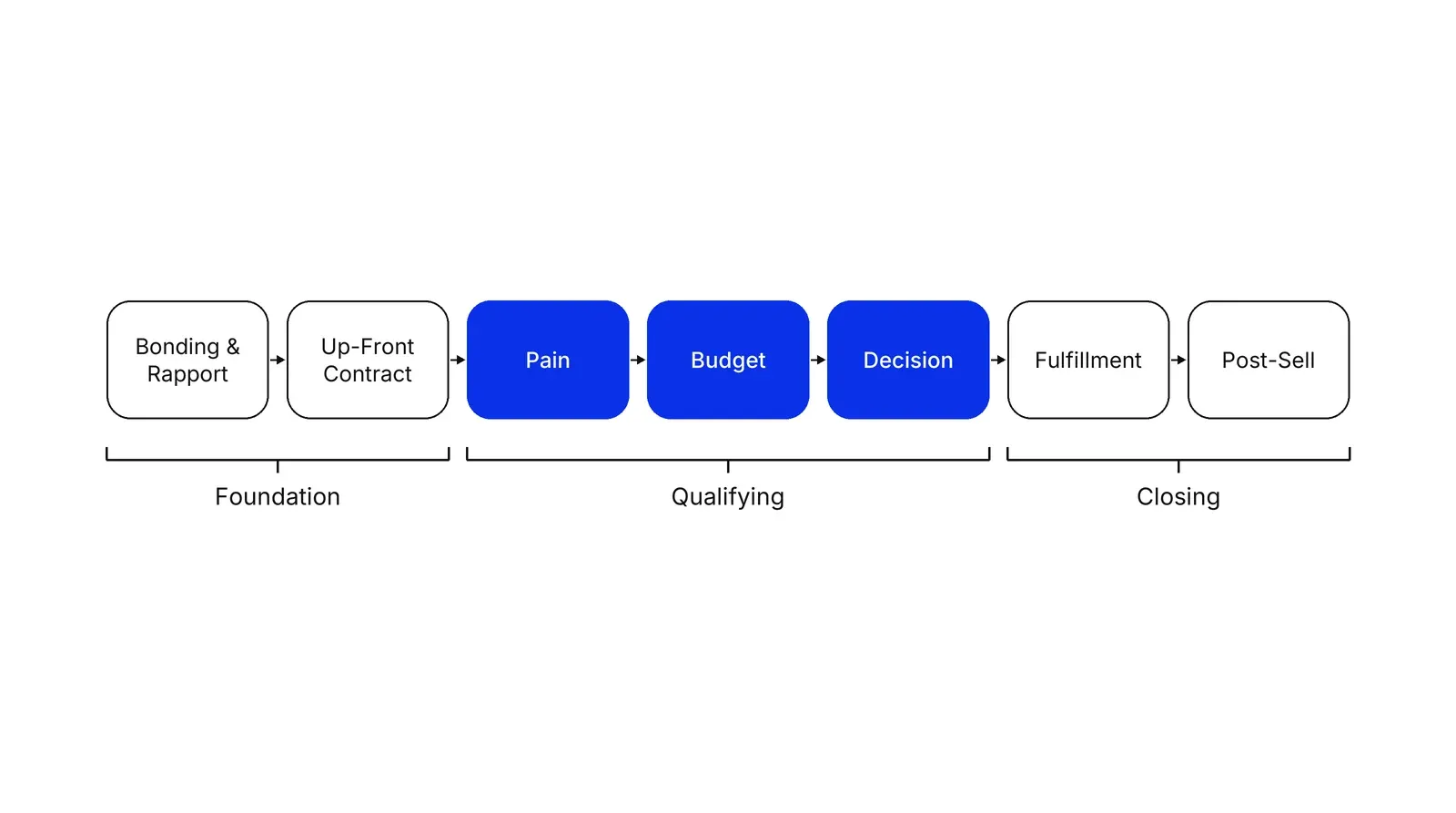
| Compartment | Job, in Sandler’s words |
|---|---|
| Bonding and rapport | Equal footing and open, honest communication |
| Up-front contract | Roles and ground rules both sides accept |
| Pain | Problems and their business impact |
| Budget | Whether the prospect can and will invest time, money and resources |
| Decision | Who is involved, when and how the choice is made |
| Fulfillment | A solution that fits the problem, budget and decision process |
| Post-sell | Next steps, and preventing buyer’s remorse |
The descriptions come from Sandler’s system page, and the three phases from its submarine article.
What is an up-front contract?
An up-front contract is a spoken agreement at the start of a call about what will happen in it. Sandler franchisees publish versions with four or five parts. One lists confirmation, acknowledgment, questioning, clarifying expectations and outcome agreement, and says a call should end in a yes, a no or a scheduled next step.
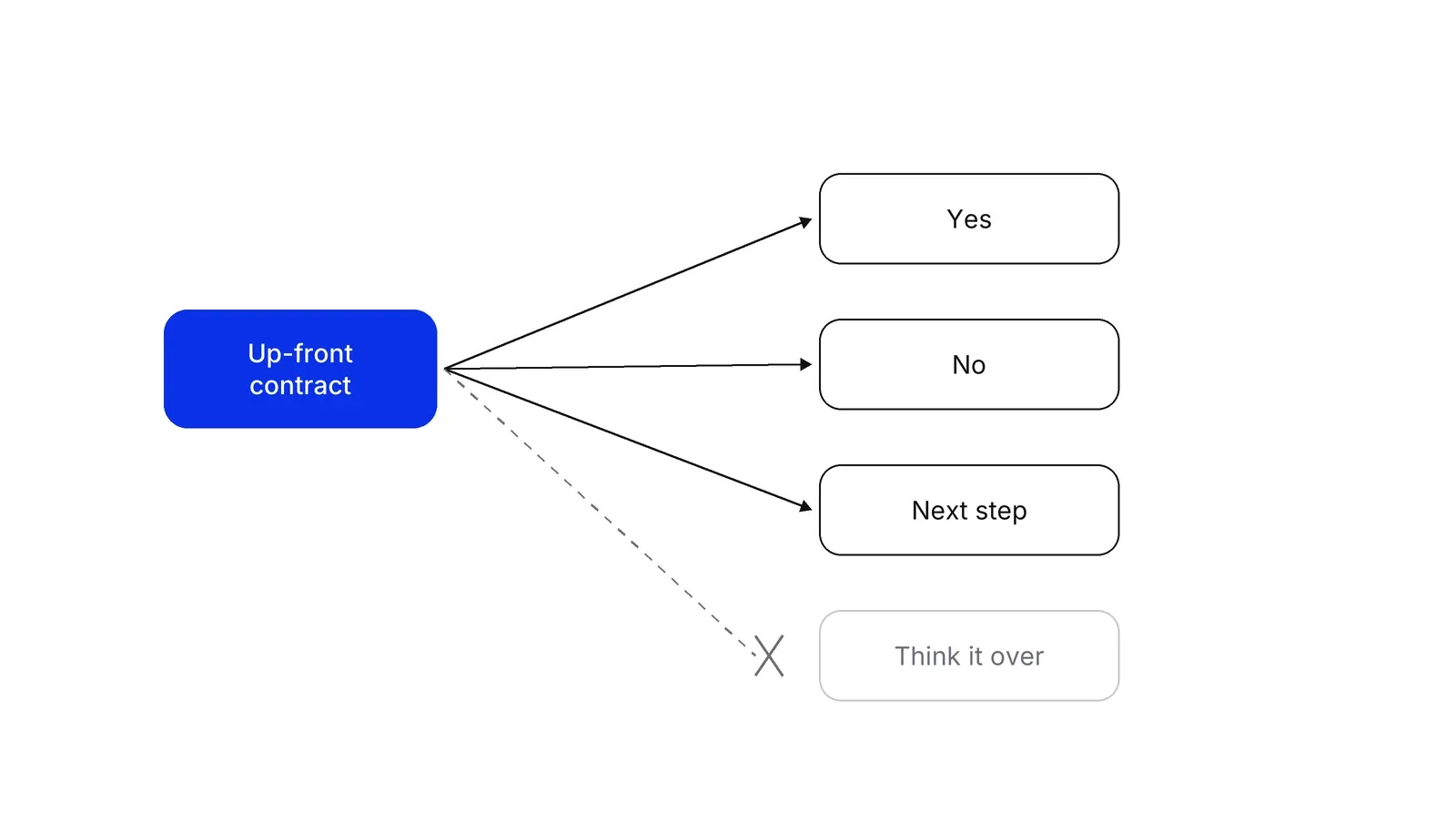
The contract does two jobs. It lets the buyer say no without friction, and it removes the vague ending that fills a pipeline with deals that never move.
Why does pain come before budget and the pitch?
Sandler’s argument is that buyers act to solve problems, not to acquire features, so presenting before you understand the problem wastes the demo. Sandler’s partners describe this as qualification ahead of the proposal, and they recommend raising money early because sellers tend to avoid it.
This is close in spirit to SPIN Selling, where questions make the buyer state a need. It differs in sequence: Sandler adds budget and decision checks before any presentation, much like the BANT screen, and leaves the buyer free to say no early. For how these steps fit a pipeline, see sales process stages.
What is negative reverse selling?
Negative reverse selling is a questioning move where the seller leans slightly away from the sale so the buyer argues the case. Sandler’s example lines include “I’m not sure we’re the right fit”, and the article rests on psychological reactance, the urge to restore a freedom that feels threatened.
Reactance is real research. Steindl and colleagues’ review says forceful wording produces more reactance than softer wording, and that people are then less convinced. That supports asking over telling. It does not test Sandler’s specific lines, and Sandler’s own article warns against sarcasm and overuse.
What does the evidence say?
We found no independent evaluation of the Sandler method. Sandler’s about page claims 50% more salespeople hit quota, and says 88% report an improved sales strategy, with no method attached. The Sandler partner guide offers no statistics at all, and Gong’s Sandler article repeats Sandler’s figures while noting that Gong is a certified Sandler partner.
Evidence for the underlying habits is better. A 2015 review of sales training research found most studies report positive effects, but only two experiments, so the base is weak. In live conversations, people who asked more questions were better liked. Gong’s 2025 call analysis of 326,000 calls found closed-won deals averaged 57% seller talk time against 62% in lost deals, and calls it correlation. Gong’s earlier study of 519,000 discovery calls found 11 to 14 targeted questions did best, with the same caution.
Where it falls short
The method assumes a buyer you can question and a decision you can map. Forrester’s 2026 press release says the typical purchase involves 13 internal stakeholders and nine outside voices. One pain conversation and one named decision maker will not cover that, so teams in complex deals pair Sandler’s habits with a framework such as MEDDIC and the Challenger approach, whose authors argued in Harvard Business Review that buyers no longer need sellers the way they once did.
| Sandler | SPIN | BANT | MEDDIC | |
|---|---|---|---|---|
| Main job | Run each call in a fixed order and end it with a decision | Make the buyer state a need | Screen a lead | Qualify a complex deal |
| Strength | Early disqualification | Question design | Speed | Buying committee view |
A Growth Lab plan starts from the deal stages you already run, and tests one Sandler habit, usually the up-front contract, before changing the rest.
How to apply Sandler Selling System, step by step
- Write the up-front contract. Before the call, write one opening that states the purpose, the time, what the buyer wants, what you want and what happens at the end, including that a no is fine. Result: a three-sentence opening you can say aloud.
- Ask pain questions until a cost appears. Start from a problem the buyer mentions, then follow with questions such as asking them to say more, to be specific, and how long it has been a problem. Stop only when the buyer states what it costs them. Result: one problem with a cost in the buyer's words.
- Raise budget before you present. Ask whether the buyer can and will invest money, time and people to fix this. Sandler's own description frames it as a question of both ability and willingness. Result: a yes, a no or a range, before any proposal exists.
- Map how the decision will be made. Ask who else is involved, what they will look for, and by when a choice has to be made. Result: a list of people and steps, and a note of who you have not yet met.
- Present only what was confirmed. Build the proposal from the pain, budget and decision process you recorded, then ask for the decision. Result: a proposal that answers the buyer's own stated problem, with a clear request.
- Agree the post-sell. Settle next steps, ask what could make the buyer back out, and discuss future business or referrals. Result: a written list of what happens in the first weeks and what the buyer might doubt.
Examples
Selling scheduling software to a dental clinic group
Illustrative, no real clinic implied. A seller opens with an up-front contract: 30 minutes, the clinic manager's questions first, then the seller's, and either side may say no at the end. The manager mentions missed appointments. The seller asks how many a week, what a missed slot costs in chair time and what has been tried. Only after the manager says the number out loud does the seller ask about budget and about who else signs. The demo is built around missed slots only.
A payments provider qualifying a merchant
Illustrative. A merchant asks for a price list on the first call. The seller replies with a question, using Sandler's reverse technique: what would pricing need to look like for a switch to make sense, and what is wrong with the current provider? The merchant describes slow settlement and a recent chargeback dispute. The seller now knows the pain and can decide whether the fit is real before spending a demo.
David Sandler's own origin story
Sandler Training's site tells it this way: in the 1960s David Sandler had made 87 calls and received 87 consecutive noes, which pushed him to build a method around verbal agreements with the prospect. The account comes from the company, and we found no independent biography to confirm the number. It is the story the method rests on, not evidence that it works.
When to use it
Use it when deals take several conversations, when reps spend demos on buyers who never had budget or authority, or when forecasts fill up with think-it-overs. It suits a team that can invest in coaching and role-play, because the method is a set of spoken habits.
When not to use it
Skip it for very short transactional sales where a price list is enough, and be careful in deals with large buying committees, where one pain conversation and one named decision maker are not a map of the real buying process. It also cannot replace product-market fit or a clear ideal customer.
Common mistakes
- Treating the submarine as a script. Sandler's own materials call it a path to move through compartment by compartment, so skipping pain to reach the demo defeats the point.
- Using the negative reverse as a trick, with sarcasm or fake disinterest. Sandler's own posts warn against that, and buyers notice.
- Qualifying out of a deal on one person's answer. A named decision maker may still need a committee, and large buying groups are the norm in many B2B purchases.
- Asking pain questions as an interrogation. A buyer who feels examined stops talking, so keep the up-front contract and rapport alive across the whole call.
- Quoting Sandler's own results as proof. The most-cited numbers come from the vendor's marketing pages.
FAQ
What are the 7 steps of the Sandler Selling System?
Bonding and rapport, up-front contract, pain, budget, decision, fulfillment and post-sell. Sandler groups them into three phases: foundation (the first two), qualifying (pain, budget, decision) and closing (fulfillment, post-sell). Sandler Training calls the whole map the Sandler Submarine.
What is the Sandler Submarine?
It is Sandler's diagram of the seven steps as submarine compartments. According to Sandler's site, David Sandler took the image from World War II films, in which crews seal each compartment behind them. In a sale, each step is closed before the next, and a prospect can be disqualified at any compartment.
What is an up-front contract in Sandler selling?
It is a short verbal agreement at the start of a call about its purpose, time, each side's agenda and the outcome, including that a no is acceptable. Sandler partners publish versions with four or five elements. The aim is a call that ends in a decision, not a think-it-over.
What is negative reverse selling?
It is a Sandler questioning technique where the seller leans slightly away from the sale, for example saying they are not sure there is a fit, so the buyer argues the case themselves. Sandler's posts link it to psychological reactance, a response to threatened freedom described by Jack Brehm in 1966.
Does the Sandler method work?
There is no independent evaluation we could find. Sandler's site claims 50% more salespeople hit quota, but gives no method. Academic reviews of sales training in general report mostly positive effects with weak designs, and Sandler's own results rest on vendor-reported data.
Sources
- Sandler Training, The Sandler Selling System
- Sandler Training, Introducing the new Sandler Submarine
- Sandler Training, David H. Sandler, founder
- Sandler Training, About Sandler Training
- Sandler UK, The Sandler Methodology
- Nightingale-Conant, David Sandler
- Selling Power, How David Sandler created his magnificent obsession, part 2, 2010
- Sandler NYC, The UFC strategy: 5 elements of an up-front contract, David Fischer
- Sandler France, Motivating buyers with negative reverse selling
- Sandler MP Solutions, What is the Sandler Selling System
- Gong, Sandler selling method
- Gong, Mastering the talk-to-listen ratio in sales calls
- Gong, Nailing your sales discovery calls
- Forrester, The State of Business Buying 2026, press release
- Brent Adamson, Matthew Dixon, Nick Toman, The End of Solution Sales, Harvard Business Review, 2012
- Matthew Dixon, Brent Adamson, Selling Is Not About Relationships, Harvard Business Review, 2011
- Alison Wood Brooks, Leslie K. John, The Surprising Power of Questions, Harvard Business Review, 2018
- Karen Huang and others, It Doesn't Hurt to Ask: Question-Asking Increases Liking, JPSP 113(3), 2017
- Christiane Steindl and others, Understanding Psychological Reactance, Zeitschrift fur Psychologie 223(4), 2015
- Vishal Singh, Ashok Manrai, Lalita Manrai, Sales training: a state of the art and contemporary review, 2015
- Raymond Thomas, Geoffrey Soutar, Maria Ryan, The Selling Orientation-Customer Orientation (SOCO) scale, JPSSM 21(1), 2001
- Antikvarium, You Can't Teach a Kid to Ride a Bike at a Seminar, listing
Last updated Oct 9, 2026


Marketing agency or growth system: when a company outgrows its agency
An agency is the right call while the founder still runs most of the company. Once the business starts copying itself into new locations or markets, it needs a system that sets goals, tests hypotheses and owns the result.

Why healthcare marketing agencies stall: the short, mid and long wins model we use with clinics
Most agencies own the click and nobody owns the front desk. How we structure clinic work in three horizons, the research behind each one, and one year of results.

Why channel tests stall after month three
Most paid channel tests do not end with a decision. They end when the budget runs out, the attribution model changes, or everyone quietly stops looking at the dashboard.