JTBD switch interview
The switch interview is the jobs-to-be-done research method from Bob Moesta and Chris Spiek: you rebuild one recent purchase as a timeline, from the first thought to first use, to learn what pushed, pulled, worried and held the buyer.
A JTBD switch interview is a 45 to 90 minute conversation with someone who recently changed what they use, in which the interviewer rebuilds the purchase as a timeline: first thought, passive looking, active looking, deciding and consuming. Developed by Bob Moesta and Chris Spiek, it shows what pushed the buyer to change, what pulled them, what worried them and what held them back.
- Origin
- Bob Moesta and Chris Spiek (The Re-Wired Group); applied to sales in Moesta and Greg Engle, Demand-Side Sales 101, work from the 1990s on; book 2020
- Level
- 301 · Advanced
- Fits
- Startup, Small and mid-size, Scale-up
- Time to apply
- two to three weeks: a week to recruit, a week of interviews at an hour each, two or three days to code and cluster
- What you need
- one switch you want to explain, such as signing up, upgrading, cancelling or choosing a competitor · 8 to 15 people who made that switch in the last three months, plus a few who almost did · two interviewers per call: one leads, one listens and marks the timeline · a recording tool, consent to record and a budget for participant incentives
A JTBD switch interview is a research conversation with someone who recently changed what they use, in which you rebuild that one decision as a timeline, from the first thought that something had to change to the first weeks of using the new thing. Bob Moesta and Chris Spiek of The Re-Wired Group developed it as the working method behind jobs to be done, and their site describes it as a documentary reconstruction of a purchase. Moesta and Greg Engle later turned the same timeline into a sales method in Demand-Side Sales 101 (2020).
The interview has one goal: to find the forces behind a switch. Push from the old situation and pull toward the new one move a buyer; anxiety about the new and habits of the old hold them back. The theory and the forces diagram are on the jobs to be done page. This page is about the interview itself: who to talk to, what the timeline looks like and what to ask.
What does the buying timeline look like?
The timeline has five stages: first thought, passive looking, active looking, deciding and consuming. Two events usually separate them. On jobstobedone.org, a first event turns “I should look into this” into “I need to do something,” and a second event, often a deadline, tips looking into deciding.
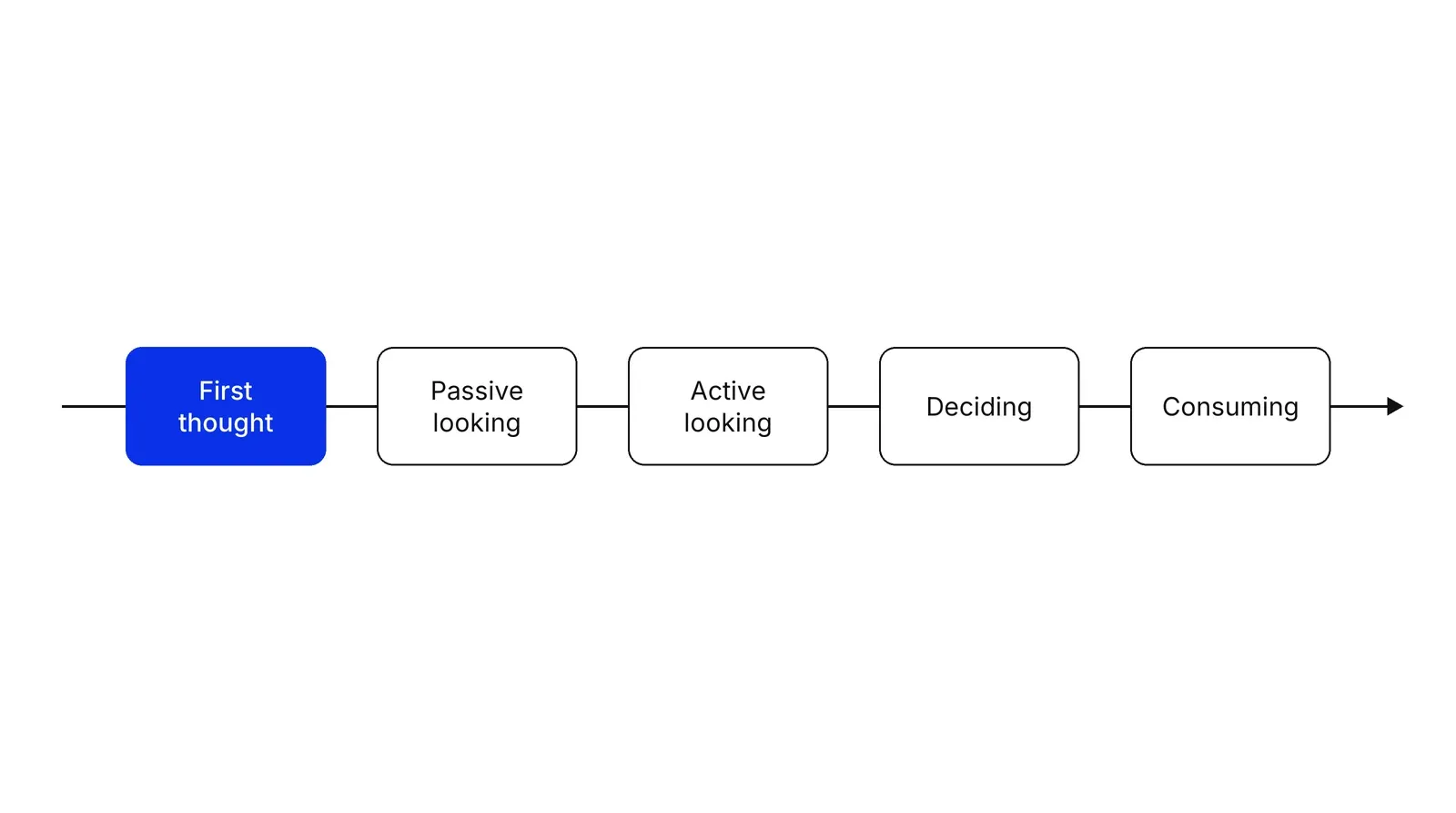
First thought is the moment the current way stops being good enough. It can be one event or a slow build-up. Moesta and Spiek warn that it is almost always earlier than people report, so the interviewer keeps asking what was going on before that.
Passive looking is low-energy noticing. The buyer is not shopping but starts to see ads, overhear colleagues and register options they ignored before. In his 2024 Business of Software talk, Moesta describes it as the stage where people decide whether the problem is worth acting on.
Active looking is shopping: comparing, visiting, asking for demos. This is the first stage where a seller usually sees the buyer. Moesta and Spiek say buyers shape what the job means to them here, which is why asking customers what features they want before they shop gives poor answers.
Deciding is a set of trade-offs, since no option fits perfectly. Consuming starts at purchase. Moesta and Spiek separate “consumption in the mind”, the expectations a buyer locks in when paying, from real use, and say satisfaction depends on the gap between them.
Sources name the last stages differently. Demand-Side Sales 101 runs the timeline “through to ongoing use” and splits consuming into onboarding and ongoing use, so some summaries count six stages. Moesta’s 2023 Lenny’s Podcast episode also refers to six phases. The order is the same in every version we read.
How do you run a switch interview?
You run it the way a detective rebuilds a day. The interviewer anchors on the purchase and moves backwards and forwards through events, asking for physical detail until the story is specific enough to date.
Recruit people who switched in roughly the last 30 to 90 days, the window jobstobedone.org gives before details fade. Include people who chose a competitor and people who nearly switched. Moesta told Intercom it is often easier to run the interview on a competitor’s product.
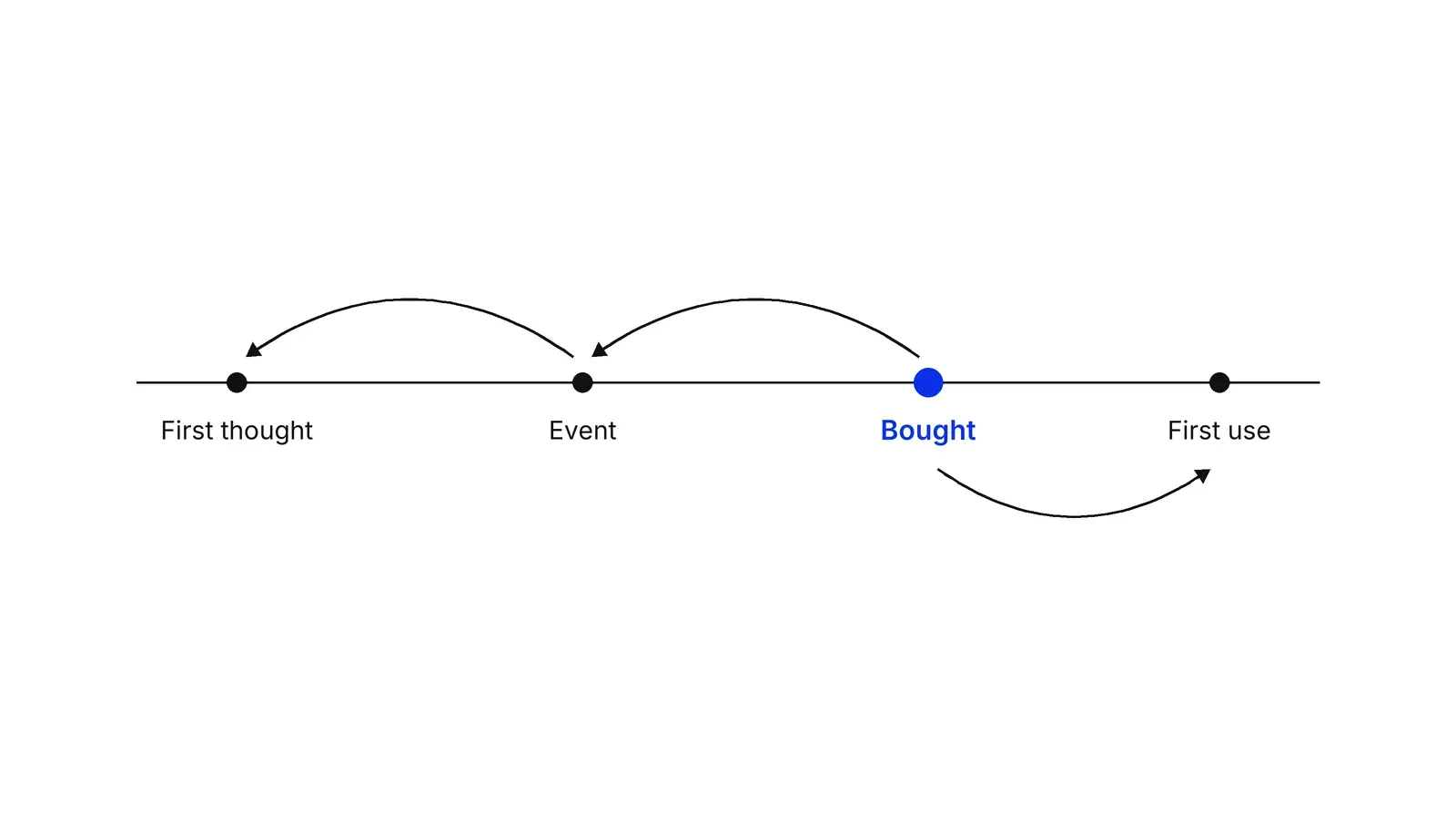
Open with the frame thoughtbot’s playbook borrows: pretend you are making a documentary about the purchase. Then mark “bought” first and place each event as the person mentions it. The Timeline page advises bouncing between points rather than walking the stages in order, because memory does not work in order.
Ask for the scene. In his 2023 talk, Moesta asks where people were when the idea came up and even what they were wearing, to bring the memory back. He unpacks vague words such as “comfortable” or “easy” until they become events, and watches for pauses and changes in energy, which often mark an anxiety. Ask what held the buyer back right before they paid: small hesitations there often point to the largest fears.
Moesta argues against a fixed discussion guide; the Lenny’s episode has a chapter titled “Why you should not have a discussion guide.” Keep a checklist of the stages and the four forces instead, and follow the story.
How many interviews, and who is in the room?
Sources agree the number is small and disagree on the exact figure.
| Source | Interviews suggested | Notes |
|---|---|---|
| jobstobedone.org | 5 to 8 per job | 45 to 90 minutes each, interviewers in pairs |
| Moesta, Business of Software 2024 | patterns after 7 to 12 | 45 to 60 minutes, cross-functional debrief, participants paid about $200 to $300 an hour |
| Re-Wired Group guide | as few as 10; 15 to 20 for a first project | “not 100”; never interview alone |
| Moesta to Intercom, 2016 | 10 | compares ten interviews to a thousand surveys |
Two people per call is the common advice. One leads; the other listens for forces and gaps in the timeline. Both debrief the same day, while they still remember tone and pauses that a transcript loses.
From transcripts to jobs
Each interview produces a timeline and a forces sheet in the participant’s words. Moesta’s guide then groups people who share a circumstance and a desired outcome, a step it calls clustering, and aims for three to five jobs. In the 2024 talk he describes a “contrast” method that groups similar stories by their starting point and the outcome the buyer wanted.
A finished job names the struggling moment, the pushes and pulls, the anxieties and habits, the hiring and firing criteria and the trade-offs buyers accept. If you cannot say what the buyer fired to hire you, the interviews are not done.
How it compares to other interview methods
| Switch interview | Critical incident technique | The Mom Test | ODI job-map interview | |
|---|---|---|---|---|
| Unit of study | One recent purchase | One memorable incident | The customer’s life and past behaviour | A functional job and its steps |
| Question style | Timeline, dates, scene | What happened and why it mattered | Specifics in the past, no pitching | Steps and success measures |
| Output | Forces and jobs | Critical requirements | Facts and commitments | Desired outcome statements for a survey |
The closest ancestor is John Flanagan’s critical incident technique from 1954, which also asks for specific past events rather than opinions. Nielsen Norman Group notes its weak spot: it relies on recall, so details get lost or distorted. The switch interview manages this with recency and physical anchors. Rob Fitzpatrick’s Mom Test shares the rule of asking about the past, and Strategyn’s ODI uses interviews to collect 50 to 150 outcome statements that a survey then scores.
What the evidence says
The switch interview is a practitioner method. We found no peer-reviewed test of its accuracy. Academic uses of JTBD interviews are small case studies: a rural food pantry study with 12 patrons, an Extension needs assessment built on “a small number” of interviews, and a requirements engineering case with four interviews. Treat the findings as hypotheses. In our Growth Lab work, a job from switch interviews becomes the input to a test with a metric and a date.
How to apply JTBD switch interview, step by step
- Name the switch and recruit recent switchers. Pick one decision and find people who made it in roughly the last 30 to 90 days, the window jobstobedone.org recommends before details fade. Include people who chose a competitor or nearly switched and stopped. Result: a recruit list of 8 to 15 people with the date of their purchase.
- Set the documentary frame. Open by saying you are making a documentary of how they came to buy, and that small details matter more than opinions. Tell them there are no right answers and you will interrupt to ask about specifics. Result: a participant who tells a story instead of giving a review.
- Anchor on the purchase, then work backwards. Start at the moment they paid or signed, where and when it happened, and who was there. Then ask what was going on before that, and before that, until you reach the first thought. Expect it to be earlier than the first answer. Result: a dated first thought and the events that moved the buyer from passive to active looking.
- Walk forward through deciding and first use. Ask what they compared, what nearly stopped them, what deadline forced the choice and what happened the first time they used it. Unpack vague words such as 'easy' or 'better' until they turn into events. Result: the trade-offs, the hesitations and the gap between what they expected and what they got.
- Debrief the same day and code the forces. Right after the call, both interviewers mark the pushes, pulls, anxieties and habits they heard, in the participant's own words, and note the timeline on one page. Result: one forces sheet and one timeline per interview.
- Cluster stories into jobs. Group interviews that share a starting situation and a desired outcome, ignoring demographics. Moesta's guide aims for three to five jobs. Result: a short list of jobs, each with its triggers, criteria, anxieties and real competitors, ready to turn into product, sales or messaging changes.
Examples
Detroit-area condominiums: the timeline that found the table
Documented in Harvard Business Review, 2016. A builder of condos for downsizers had many visits and few sales. Moesta asked buyers to draw a timeline of how they got from first thinking about moving to buying. The stories stalled at the same point: what to do with the dining room table. The builder added moving services, two years of storage and room for the table, and HBR reports the business grew 25% in a year when industry sales fell 49%.
A payments platform losing deals to bank transfers
Illustrative. A B2B payouts company interviews 10 finance leads who signed in the last two months and 4 who stopped after a demo. The first thought usually came months before the demo, when a contractor complained about a late payment. Active looking began after a second event: an audit question about manual spreadsheets. The four who stopped had the same anxiety, moving bank details for 200 contractors. The team builds an import service and tests it on the next 20 deals.
A dental clinic studying patients who left
Illustrative. A clinic interviews 8 patients who moved to another clinic in the last quarter. Price comes up less than expected. In 6 of the 8 timelines, the first thought followed a wait of more than three weeks for a follow-up, and passive looking started when a colleague mentioned online booking at another clinic. The clinic tests opening follow-up slots online and tracks how many patients book a second visit within a month.
When to use it
Use it when you need to know why people start, switch or leave: a launch that is not converting, rising churn with no agreed cause, a sales team that loses deals to 'no decision', or messaging that sounds right but does not move people. It works when the purchase is recent and the buyer remembers it, for consumer and B2B products alike.
When not to use it
Skip it when the question is narrow and testable, such as which price page converts better; an experiment answers faster. It is weak for habitual repurchases with no real struggle, for purchases older than a few months, and when you need to rank dozens of needs across a market, where an Outcome-Driven Innovation survey fits better.
Common mistakes
- Interviewing prospects about what they would do. The method only works on people who already made the switch, so their story contains real events.
- Marching through the stages in order. People remember out of sequence; jobstobedone.org advises marking the purchase first and placing events as they come up.
- Accepting the first answer to 'when did you start thinking about this?'. The real first thought is almost always earlier; keep asking what happened before that.
- Stopping at the purchase. The first use shows whether the job got done and where expectations broke, which drives churn and referrals.
- Interviewing alone and summarising from memory. A second listener and a same-day debrief catch forces the lead missed.
FAQ
What is a switch interview in jobs to be done?
It is an interview with someone who recently switched products, in which you rebuild the decision as a timeline from first thought to first use. Moesta and Spiek developed it to find the forces behind a purchase: the push of the old situation, the pull of the new one, anxiety and habit.
How many JTBD interviews do you need?
Fewer than most teams expect. jobstobedone.org says patterns often appear within 5 to 8 interviews per job, Moesta's 2024 talk puts it at 7 to 12, and the Re-Wired Group's guide suggests 15 to 20 for a first project. The aim is repeated patterns, not statistical significance.
What questions do you ask in a switch interview?
Questions about events, not opinions: when did you first think about this, where were you, what was going on before that, what did you look at, what nearly stopped you, why that day. Moesta asks for concrete details, such as where they were or what they were wearing, to bring the memory back.
What are the stages of the JTBD timeline?
First thought, passive looking, active looking, deciding and consuming. Two events usually separate the looking stages: one turns passive into active looking, another forces the decision. Demand-Side Sales 101 splits consuming into onboarding and ongoing use, so some sources count six stages.
How is a switch interview different from a usual customer interview?
A usual interview asks what people like, need or would use. A switch interview reconstructs one past decision step by step, with dates and places, and treats the participant's feelings at each step as data. It studies the purchase rather than the product, so you can run it on a competitor's customers too.
Sources
- Bob Moesta with Greg Engle, Demand-Side Sales 101: Stop Selling and Help Your Customers Make Progress, Lioncrest Publishing, 2020
- Melanie B. Brewer, review of Demand-Side Sales 101, QRCA Views, July 2021
- Bob Moesta and Chris Spiek, jobstobedone.org, Switch Interviews
- Bob Moesta and Chris Spiek, jobstobedone.org, The Timeline
- Bob Moesta and Chris Spiek, jobstobedone.org, The Four Forces
- Bob Moesta and Chris Spiek, jobstobedone.org, The Struggling Moment
- Bob Moesta and Chris Spiek, jobstobedone.org, Learn
- The Re-Wired Group (Bob Moesta), The Complete Guide to Jobs to Be Done, 2022
- Business of Software Europe 2024, Bob Moesta, Live Jobs to be Done Case Studies and Problem Shooting
- Business of Software Europe 2023, Bob Moesta, Understanding Your Customer Jobs-to-be-Done
- Intercom, Des Traynor, Bob Moesta on Jobs-to-be-Done (podcast), May 2016
- Lenny's Podcast, The ultimate guide to JTBD with Bob Moesta, August 2023
- Clayton M. Christensen, Taddy Hall, Karen Dillon, David S. Duncan, Know Your Customers' Jobs to Be Done, Harvard Business Review, September 2016
- Clayton Christensen Institute, Jobs to Be Done
- Clayton Christensen Institute, Competing Against Luck (Christensen, Hall, Dillon, Duncan, 2016)
- Strategyn, Jobs-to-be-Done Theory and Methodology
- John C. Flanagan, The Critical Incident Technique, Psychological Bulletin 51(4), 1954
- Nielsen Norman Group, Maria Rosala, The Critical Incident Technique in UX, 2020
- Product Talk, Teresa Torres, Story-Based Customer Interviews course
- Rob Fitzpatrick, The Mom Test, official book site
- thoughtbot, Playbook: Jobs to be Done
- Lucassen, van de Keuken, Dalpiaz, Brinkkemper et al., Jobs-to-be-Done Oriented Requirements Engineering: A Method for Defining Job Stories, REFSQ 2018
- Vaterlaus, Cottle, Patten, Gibbons, Understanding Customers: The Jobs to Be Done Theory Applied in the Context of a Rural Food Pantry, Journal of the Academy of Nutrition and Dietetics, 2018
- Holly Jarvis Whitaker, Jobs to Be Done: An Innovative Needs Assessment Method, Journal of Extension, 2018
Last updated Oct 9, 2026


Marketing agency or growth system: when a company outgrows its agency
An agency is the right call while the founder still runs most of the company. Once the business starts copying itself into new locations or markets, it needs a system that sets goals, tests hypotheses and owns the result.

Why healthcare marketing agencies stall: the short, mid and long wins model we use with clinics
Most agencies own the click and nobody owns the front desk. How we structure clinic work in three horizons, the research behind each one, and one year of results.

Why channel tests stall after month three
Most paid channel tests do not end with a decision. They end when the budget runs out, the attribution model changes, or everyone quietly stops looking at the dashboard.