Economic value added (EVA)
Economic value added is operating profit after tax minus a charge for all the capital a business uses, so a team can see whether it earns more than its capital costs.
Economic value added (EVA) is a measure of corporate performance equal to net operating profit after tax minus a charge for the capital employed, debt and equity both. A positive EVA means a business earns more than its investors could expect elsewhere. Stern Stewart & Co. trademarked and promoted it, and G. Bennett Stewart set it out in his 1991 book The Quest for Value.
- Origin
- Stern Stewart & Co.; G. Bennett Stewart III (The Quest for Value), 1991 (book)
- Level
- 401 · Expert
- Fits
- Enterprise
- Time to apply
- two to three weeks for a first EVA by business unit; a full incentive scheme takes a budget cycle or more
- What you need
- operating profit by business unit, with the tax rate you will apply · invested capital by unit, taken from the balance sheet at the start of the period · a cost of capital estimate agreed with the finance lead · a list of accounting items you will adjust, such as capitalised R&D
Economic value added (EVA) is a performance measure equal to net operating profit after tax (NOPAT) minus a charge for all the capital a business uses. A company with EVA above zero earns more than its capital costs. One with EVA below zero has made an accounting profit that its debt and equity holders would not accept if they could invest elsewhere.
The consultancy Stern Stewart & Co. promoted EVA as its own measure. G. Bennett Stewart III set out the method in his 1991 book The Quest for Value. Stern Stewart’s annual Performance 1000 ranking brought it wide attention; in the 1997 edition Coca-Cola and General Electric still ranked first and second, according to the Journal of Applied Corporate Finance. The idea behind it is older. Balachandran traces management accounting textbook arguments for charging profit for capital to 1965, and it goes by the names residual income and economic profit. EVA is the trademarked version with its own adjustments.
How is EVA calculated?
EVA equals NOPAT minus the cost of capital multiplied by invested capital. Damodaran’s lecture notes give the equivalent form: the spread between return on capital and cost of capital, times the capital invested.
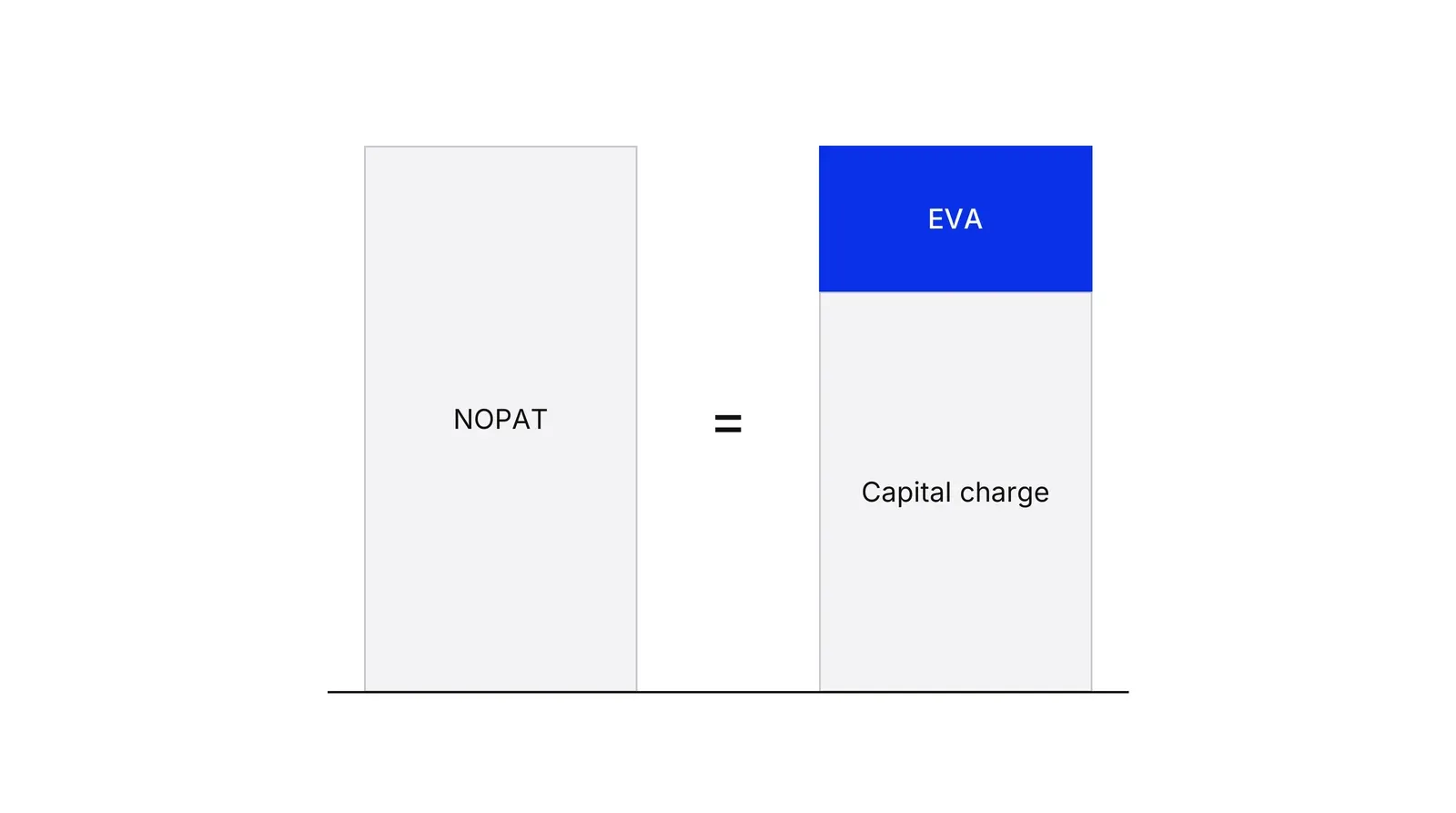
The cost of capital is the weighted average of what debt and equity cost. Modigliani and Miller’s 1958 paper is the classic account of why equity belongs in that average: owners also give up the return they could earn elsewhere. Damodaran adds that the rate used for EVA should come from market values, not book values.
A worked example: profit up, EVA down
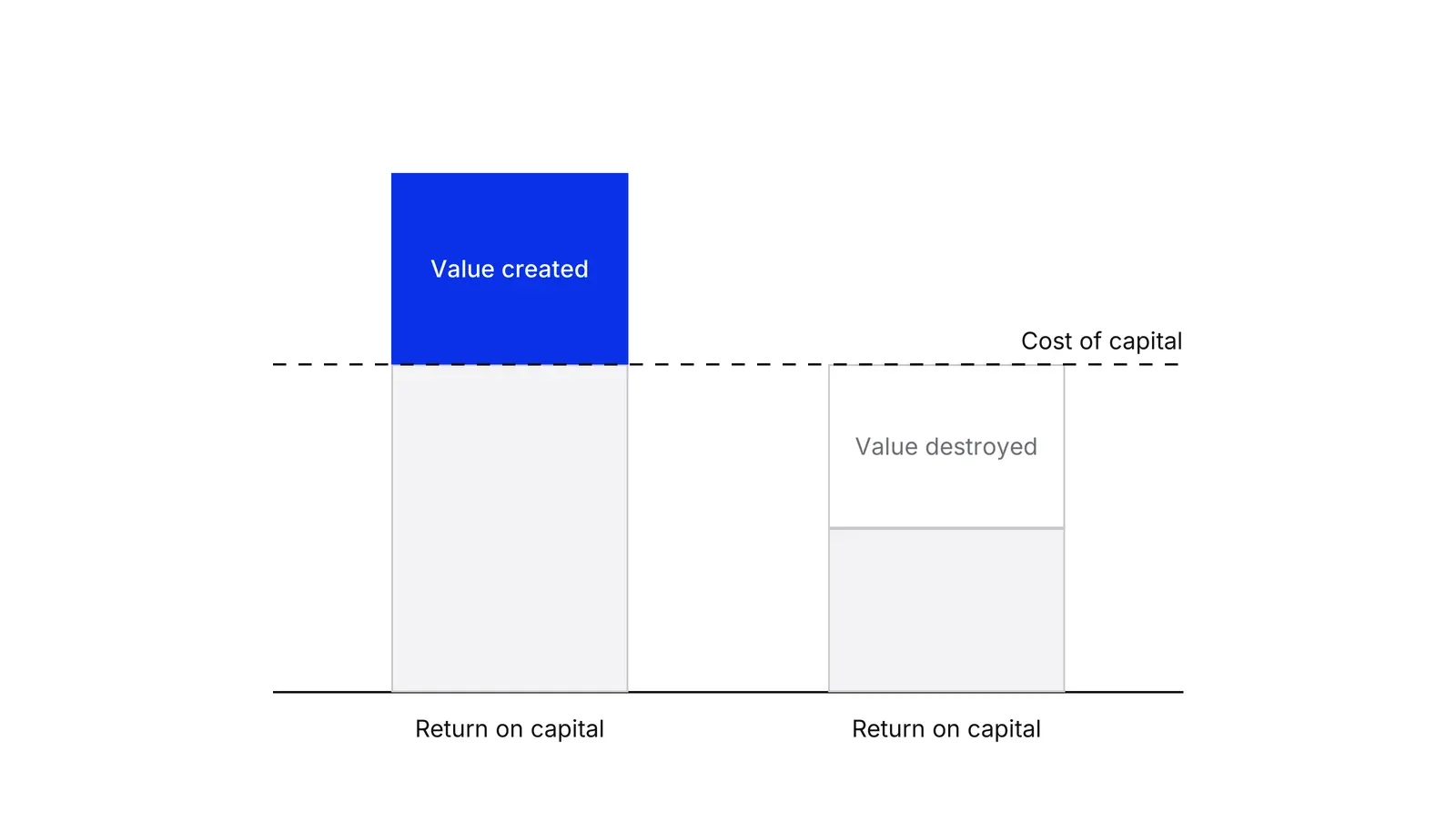
Illustrative, no real company implied, using the spread form from Damodaran’s notes. A group of dental clinics earns 600,000 in NOPAT on 4,000,000 of invested capital, with an 11% cost of capital. The capital charge is 440,000, so EVA is 160,000. Return on capital is 15%, four points above the cost of capital.
Now test a new clinic with the same spread logic: it adds 120,000 of NOPAT and uses 1,500,000 of capital. Profit rises 20%, to 720,000. The capital charge rises to 605,000 and EVA falls to 115,000. The new clinic returns 8% on capital that costs 11%, so it lowers value while it raises profit. A profit-and-loss view alone would approve it. This is the gap between EVA and the lines in a P&L. The cost of capital here is an assumption of the example, not a benchmark.
What did Stern Stewart add to residual income?
Stern Stewart added accounting adjustments, so that reported profit and capital better reflect economic reality. A typical example is treating research spending as capital instead of expense. David Young’s 1997 primer for European managers shows how the calculation works on Rhône-Poulenc’s accounts. Stewart himself wrote in 2019, as an adviser at ISS, that ISS applies more than a dozen rules to recast earnings. The number of adjustments is not fixed, and we found no primary source that settles it. Each adjustment buys accuracy and costs transparency, and managers who cannot reproduce the figure tend to distrust it. That is why many firms keep only a handful of adjustments, the ones that change the answer for their business.
Does EVA beat earnings?
The evidence is split. Biddle, Bowen and Wallace’s 1997 paper in the Journal of Accounting and Economics found earnings more closely associated with stock returns and firm value than EVA, residual income or operating cash flow. Stephen O’Byrne, writing for the Journal of Applied Corporate Finance, argued that their test turned the earnings model into an EVA model in disguise.
| Study | Setting | Finding |
|---|---|---|
| Biddle, Bowen, Wallace, 1997 | US firms | Earnings more associated with returns and value than EVA |
| Feltham et al., 2004 | Canadian firms, 1995 to 1999 | EVA had greater power than earnings in explaining returns |
| Forker and Powell, 2008 | US and UK firms | EVA and residual income gave lower valuation errors |
Even the original authors, in a 1999 follow-up, drew a practical conclusion: a measure like EVA can work as an internal incentive tool even if it tells outsiders little about firm value.
Does paying managers on EVA work?
Results vary by firm. Kleiman (1999) reported that US adopters between 1987 and 1996 beat same-industry medians by 28.8% over the adoption year and three years after, and that capital spending rose after adoption, unlike in Wallace’s earlier study. Hogan and Lewis (2005) found that adopters improved, but matched non-adopters improved by about as much, and the benefits concentrated in firms that were expected to adopt. Riceman, Cahan and Lal (2002) found that managers who understood EVA did better, and suggested that the gain came from pay matching how managers are assessed, not from EVA being superior. In three New Zealand companies, McLaren and colleagues (2016) saw EVA systems introduced, adjusted heavily and later abandoned.
When does EVA mislead?
EVA misleads where capital is mismeasured or where investment is young. Damodaran notes that book capital reflects past accounting choices and may miss intangible assets. For companies with long gestation periods, current EVA is a poor guide to investment quality. De Villiers examined distortions that inflation introduces into EVA. Gibbons and Murphy’s study of accounting-based bonuses is a reminder that any single measure used for pay shapes behavior.
How EVA differs from profit, ROIC and residual income
| Measure | What it shows | What it ignores |
|---|---|---|
| Net profit | Earnings after interest and tax | Any charge for equity capital |
| Return on capital | A percentage return on capital used | Scale: a small high-return unit looks better than a large good one |
| Residual income | Profit less a charge for capital | Stern Stewart’s specific adjustments |
| EVA | Currency amount of value created above the capital charge | Growth not yet visible in current profit |
The table shows why EVA is usually reported in currency and by unit: it ranks a large surplus above a small one whatever the percentage return.
How EVA fits with other tools
EVA turns a P&L into a capital question. Pair it with operating leverage to see how fixed costs and capital intensity move together, and with unit economics to see whether a customer or order earns its capital. Capital allocation is where the spread is used to rank projects. A Growth Lab plan starts from the projects that earn above their cost of capital.
How to apply Economic value added (EVA), step by step
- Compute NOPAT. Take operating profit before interest and tax, then apply the tax rate to get net operating profit after tax. Leave out financing costs, because the capital charge covers them. Result: one NOPAT figure per business unit.
- Measure invested capital. Add the capital the unit uses: operating assets funded by debt and equity, at the start of the period. Decide how to treat items such as capitalised development spend, and write the rule down. Result: an invested-capital figure per unit and a short adjustments list.
- Set the cost of capital. Estimate a weighted average cost of capital from market values of debt and equity. Use a higher rate for units with riskier cash flows. Result: one agreed percentage per unit, reviewed once a year.
- Subtract the capital charge. Multiply invested capital by the cost of capital and subtract it from NOPAT. Result: EVA per unit, positive or negative, in currency terms.
- Read it against growth plans. For each proposed project, compare its expected return on capital with the cost of capital before approving it. Result: a go or no-go on each project that rests on the spread, not on whether profit rises.
- Decide how far to tie pay to it. Test EVA as a scorecard line first. Link bonuses only after managers can reproduce the number and agree the adjustments. Result: a pay rule people can check themselves.
Examples
Siemens and its Geschäftswertbeitrag
Siemens manages through what it calls Geschäftswertbeitrag, an EVA-type measure defined as net operating profit after tax before financing costs minus capital cost. Heinz-Joachim Neubürger of Siemens wrote that a business creates value only when it covers its cost of capital, and that the company adjusted the calculation for its operations, financing and real estate, and pension fund components, which differ fundamentally.
Deere and shareholder value added
Deere's SEC filing for the nine months to 31 July 2022 reports a related measure, shareholder value added: pretax profit left after subtracting the cost of enterprise capital. Equipment segments are charged on their operating assets, while Financial Services is charged on its equity. It shows how one group sets a different capital charge for a different kind of business.
A payments company with pre-funded settlement accounts
Illustrative, no real company implied. A cross-border payments firm keeps a large cash balance pre-funded in local settlement accounts so payouts clear instantly. At a 12% cost of capital, that idle cash can cost more each year than the operating profit it supports, so EVA is negative even though the income statement shows a profit. Pre-funding less cash, with the same NOPAT, lifts EVA without selling anything extra.
When to use it
Use it when a group has several business units that compete for the same capital, when growth plans are approved on profit alone, or when managers are paid on earnings and capital keeps piling up. EVA puts a price on capital in every project discussion. It suits asset-heavy and multi-unit businesses best.
When not to use it
Skip it for early-stage companies with long build-out periods, where current EVA is negative by design and says little about the quality of investments. Also avoid it as the only measure where capital is hard to measure, such as businesses built mostly on intangible assets, unless you will adjust the books for them.
Common mistakes
- Using one cost of capital for every unit, so safe and risky businesses look equally good.
- Taking book capital as given. Accounting choices and unrecorded intangibles distort it, and Damodaran flags both.
- Reading a negative EVA in a young unit as failure, when it may reflect investment that has not yet paid back.
- Paying bonuses on EVA before managers can reproduce the number, which invites argument over adjustments instead of action.
- Counting a rise in profit as success while the extra capital that produced it costs more than it earns.
FAQ
What is economic value added in simple terms?
EVA is the profit left after the business pays for the capital it uses, including a charge for equity. If operating profit after tax is 600 and the capital charge is 440, EVA is 160. Ordinary profit treats equity as free, which is why a company can show profit and still destroy value.
How do you calculate EVA?
EVA equals NOPAT minus the cost of capital multiplied by invested capital. The same figure is the spread between return on capital and cost of capital, multiplied by capital invested. Damodaran's lecture notes use the spread form.
Is EVA a trademark?
Yes. Stern Stewart & Co. promoted EVA as its measure, and the 1997 Journal of Accounting and Economics paper on it carries the registered mark in its title. The underlying idea, profit after a charge for capital, is older and goes by residual income or economic profit, so anyone can use it under those names.
Does EVA predict share prices better than earnings?
The evidence is split. Biddle, Bowen and Wallace (1997) found earnings more closely tied to stock returns and firm value than EVA. Feltham and colleagues (2004), using Canadian data from 1995 to 1999, found EVA had greater power. Forker and Powell (2008) found lower valuation errors for EVA and other residual income metrics.
Does paying managers on EVA improve performance?
Results vary. Kleiman (1999) found EVA adopters beat industry peers by 28.8% over four years. Hogan and Lewis (2005) found matched non-adopters improved similarly. Riceman, Cahan and Lal (2002) found managers who understood EVA did better, perhaps because pay matched how they were judged.
Sources
- G. Bennett Stewart III, The Quest for Value: A Guide for Senior Managers, HarperBusiness, 1991, Internet Archive record
- Gary C. Biddle, Robert M. Bowen, James S. Wallace, Does EVA beat earnings? Evidence on associations with stock returns and firm values, Journal of Accounting and Economics 24(3), 1997
- Gary C. Biddle, Robert M. Bowen, James S. Wallace, Evidence on EVA, Journal of Applied Corporate Finance 12(2), 1999
- Stephen F. O'Byrne, EVA and Its Critics, Journal of Applied Corporate Finance 12(2), 1999
- Robert T. Kleiman, Some New Evidence on EVA Companies, Journal of Applied Corporate Finance 12(2), 1999
- Glenn D. Feltham, Grant E. Issac, Chima Mbagwu, Ganesh Vaidyanathan, Perhaps EVA Does Beat Earnings, Journal of Applied Corporate Finance 16(1), 2004
- John Forker, Ronan Powell, A Comparison of Error Rates for EVA, Residual Income, GAAP-earnings and Other Metrics, European Accounting Review 17(3), 2008
- James S. Wallace, Adopting residual income-based compensation plans: Do you get what you pay for?, Journal of Accounting and Economics 24(3), 1997
- Chris E. Hogan, Craig M. Lewis, Long-Run Investment Decisions, Operating Performance, and Shareholder Value Creation of Firms Adopting Compensation Plans Based on Economic Profits, Journal of Financial and Quantitative Analysis 40(4), 2005
- Sudhakar V. Balachandran, How Does Residual Income Affect Investment? The Role of Prior Performance Measures, Management Science 52(3), 2006
- Stephen Riceman, Steven Cahan, Mohan Lal, Do managers perform better under EVA bonus schemes?, European Accounting Review 11(3), 2002
- Josie McLaren, Tony Appleyard, Falconer Mitchell, The rise and fall of management accounting systems: A case study investigation of EVA, British Accounting Review 48(3), 2016
- David Young, Economic value added: A primer for European managers, European Management Journal 15(4), 1997
- Johann de Villiers, The distortions in economic value added (EVA) caused by inflation, Journal of Economics and Business 49(3), 1997
- Irwin Ross, The 1997 Stern Stewart Performance 1000, Journal of Applied Corporate Finance 10(4), 1998
- Al Ehrbar, EVA: The Real Key to Creating Wealth, Wiley, 1998
- Aswath Damodaran, Value Enhancement: EVA and CFROI, NYU Stern lecture notes
- Franco Modigliani, Merton H. Miller, The Cost of Capital, Corporation Finance and the Theory of Investment, American Economic Review 48(3), 1958
- Heinz-Joachim Neubürger, Wertorientierte Unternehmensführung bei Siemens, Schmalenbach Journal of Business Research 52(2), 2000
- Deere & Company, Exhibit 99.2 to SEC filing, nine months ended 31 July 2022
- Bennett Stewart, EVA, Not EBITDA: A Better Measure of Investment Value, Harvard Law School Forum on Corporate Governance, 11 June 2019
- Robert Gibbons, Kevin J. Murphy, Does Executive Compensation Affect Investment?, Journal of Applied Corporate Finance 5(2), 1992
Last updated Oct 9, 2026


How to calculate channel payback and unit economics
A CAC number that only marketing believes will not survive a finance review. This guide calculates channel payback so both teams work from the same model.

Fractional CFO vs finance operations: which gap do you actually have
A fractional CFO is a person. Finance operations is a system. Companies searching for one are often missing the other, or both.