Keller brand equity pyramid (CBBE)
Keller's customer-based brand equity pyramid breaks brand building into four steps and six blocks, from being recognised to being loved, so you can find the level where your brand stalls.
The Keller brand equity pyramid, or customer-based brand equity (CBBE) model, is Kevin Lane Keller's account of how brands gain value in customers' minds. His 1993 Journal of Marketing article defined brand equity as the different response a brand name triggers. His 2001 pyramid stacks six blocks, salience, performance, imagery, judgments, feelings and resonance, into four steps a brand must climb in order.
- Origin
- Kevin Lane Keller, 1993 (customer-based brand equity); 2001 (the pyramid)
- Level
- 301 · Advanced
- Fits
- Scale-up, Enterprise
- Time to apply
- a half-day workshop for a first diagnosis; four to six weeks if you run a customer survey
- What you need
- a defined category and target customer, written in one sentence · a sample of customers and non-customers for a short survey, or recent research you can reuse · Keller's candidate survey questions for the six blocks, adapted to your category · one owner who turns the weakest block into next quarter's brand brief
The Keller brand equity pyramid is a model of how a brand gains value in customers’ minds, built in a fixed order from being recognised to being loved. Kevin Lane Keller, now a marketing professor at Dartmouth’s Tuck School of Business, set out the idea of customer-based brand equity (CBBE) in a 1991 Stanford working paper and in the Journal of Marketing in 1993. He drew the pyramid in a 2001 Marketing Science Institute report. His 2009 paper calls it the brand resonance pyramid, so you will see both names.
Keller presented it as a yardstick for measuring brand-building progress and a guide for tracking research. He also wrote Strategic Brand Management, now in its fifth edition with Vanitha Swaminathan, which his school describes as the “bible of branding.”
What customer-based brand equity means
Customer-based brand equity is the difference that knowing a brand makes to how people respond to its marketing. Keller’s 1993 test is simple: show the same product, price or ad once with the brand name and once as an unnamed version. If people react better to the named one, the brand has positive equity. If they react worse, the equity is negative.
That difference comes from brand knowledge, which Keller splits into two parts. Brand awareness is whether people can recall or recognise the brand. Brand image is the set of associations they hold about it. A payments app that freelancers remember and link with “paid in a day” has knowledge that does work for it; one they cannot name has none, however good the product.
The four steps: four questions customers ask
Keller’s 2001 report frames brand building as four steps, each answering a question customers ask, “implicitly if not explicitly”:
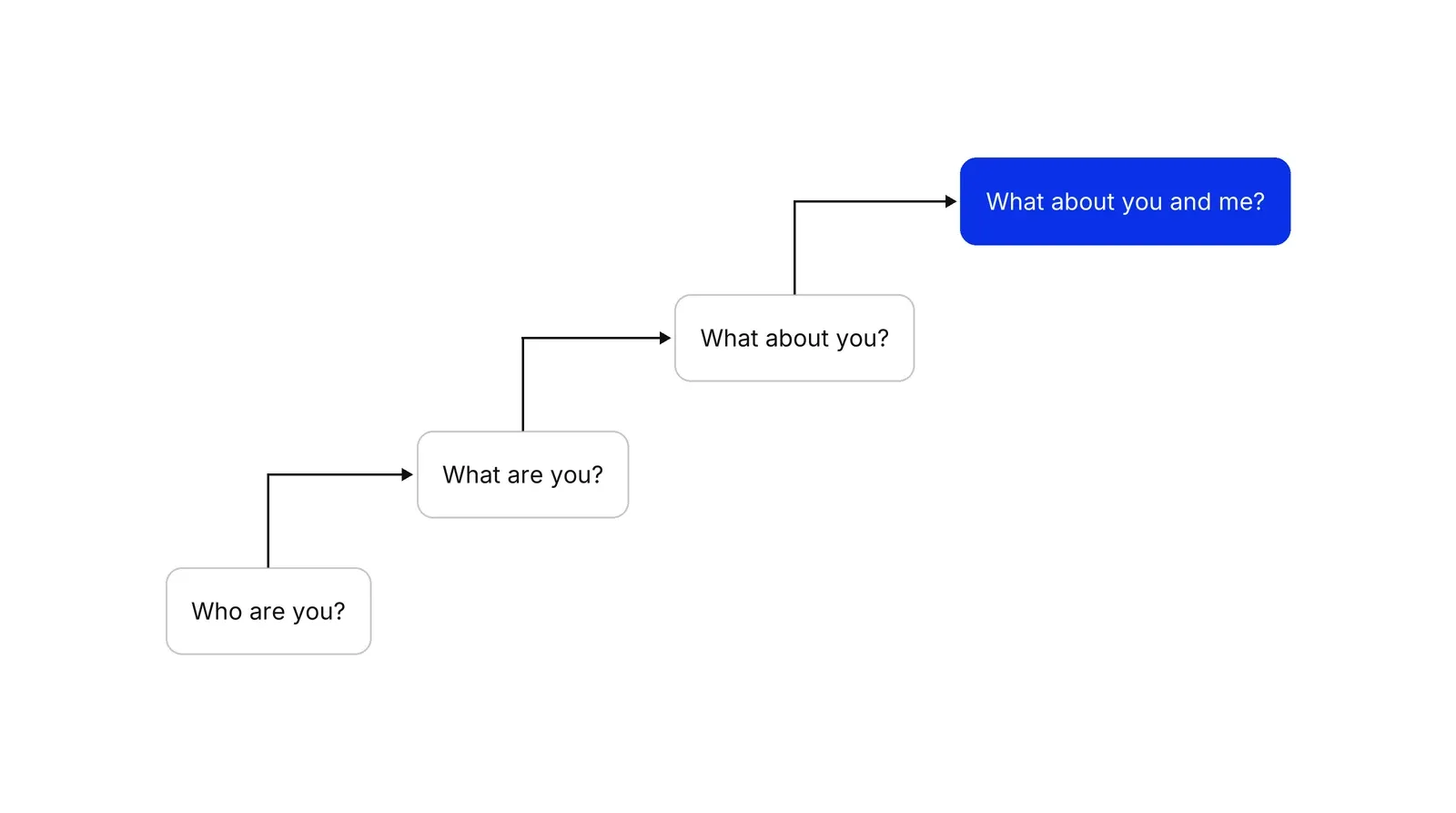
The order is the point. Meaning cannot form until identity exists, responses need meaning, and a relationship needs the right responses. Keller calls it a branding ladder.
The six building blocks
The six blocks are the things you measure at each step. Identity has one block, meaning and response have two each, and relationships have one.
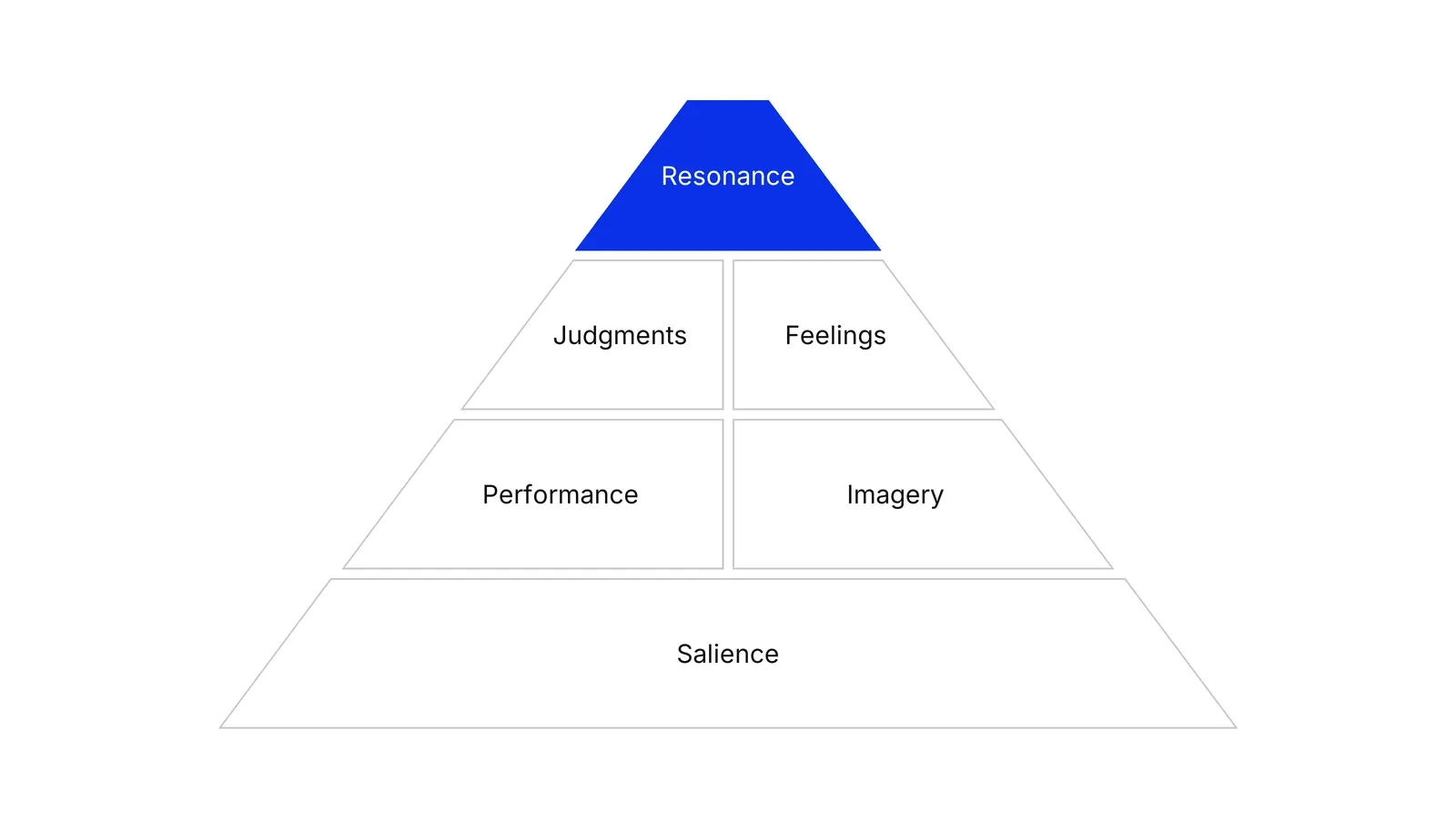
| Step | Block | What it covers in Keller’s 2001 report |
|---|---|---|
| Identity | Salience | Depth of awareness (how easily the brand comes to mind) and breadth (in how many situations) |
| Meaning | Performance | Features, reliability, service, style and design, price |
| Meaning | Imagery | Typical users, purchase and usage situations, personality and values, history and heritage |
| Response | Judgments | Quality, credibility, consideration, superiority |
| Response | Feelings | Warmth, fun, excitement, security, social approval, self-respect |
| Relationships | Resonance | Behavioral loyalty, attitudinal attachment, sense of community, active engagement |
Salience is about more than name recognition. Keller’s example is Campbell’s soup: everyone knows it, but more people might buy it if they thought of it as a side dish at dinner. That is breadth.
For meaning, Keller ranks the tests for associations: they must be strong, favorable and unique “in that order.” A unique association nobody values is worthless, and a valued one nobody remembers does nothing. The imagery block borrows Jennifer Aaker’s five dimensions of brand personality, the same thinking behind brand archetypes.
Resonance is the hardest block. It ranges from repeat purchase up to customers who join clubs, follow brand news and recruit others. It draws on research into consumer-brand relationships and brand communities, such as the Saab and Macintosh groups that Muniz and O’Guinn studied.
Two routes up: head and heart
The pyramid has a left and a right side. Going up the left means building performance and the judgments that follow from it. Going up the right means building imagery and the feelings it creates. Keller writes that strong brands such as Coca-Cola, Nike and Starbucks often do both, which gives customers more than one reason to stay and makes the brand harder to copy.
A clinic with excellent outcomes but no clear sense of who it is for has climbed only the left side. A fintech brand with a stylish campaign and an app that crashes has climbed only the right side, and the gap shows up in credibility scores.
How to measure it
Keller’s 2001 report ends with candidate survey questions for every block, from “What brands of this category can you think of?” to “I feel like I almost belong to a club with other users of this brand.” He warns that the bottom two levels need the most tailoring to each category.
Academic work has produced shorter scales. Lassar, Mittal and Sharma (1995) built one on five dimensions and found that brands scoring higher generally charged higher prices. Yoo and Donthu (2001) and Netemeyer and colleagues (2004) validated further scales, and Pappu, Quester and Cooksey (2005) showed with real consumers that awareness and associations are separate dimensions. A review by Christodoulides and de Chernatony (2010) sorts measures into direct and indirect and finds indirect ones, like Keller’s, better for diagnosis.
To check whether the survey numbers turn into money, pair them with an outcome measure: the revenue premium over a private label proposed by Ailawadi, Lehmann and Neslin, or the financial-market method of Simon and Sullivan.
Keller versus Aaker
Keller’s model is often confused with David Aaker’s, published two years earlier in Managing Brand Equity. Both talk about awareness, associations and loyalty, but they answer different questions.
| Keller (CBBE) | Aaker | |
|---|---|---|
| First published | 1991 working paper, 1993 article; pyramid 2001 | 1991 book |
| Point of view | What sits in the customer’s memory | Assets the firm owns and manages |
| Structure | Six blocks in a required order | Loyalty, awareness, perceived quality, associations, other proprietary assets, with no sequence |
| Measurement | Survey items per block | Ten measures in five groups, including market behavior |
| Best for | Finding where brand building stalls | Valuing and managing the brand as a business asset |
Limits and criticism
Keller himself sets the first limit: he writes that it is “virtually impossible” for people to feel intense loyalty to every brand they buy. Many categories never get past behavioral loyalty, and that is fine.
The second concerns the base. Romaniuk and Sharp (2004) argue that treating salience as top-of-mind recall is too narrow. They define it as the brand’s propensity to be noticed or come to mind in buying situations, closer to the idea of mental availability than to an awareness score. For a team, this means measuring recall against real buying cues, not one generic category prompt.
The pyramid earns its keep as part of a marketing operational system: a survey repeated on a schedule, one owner per block, and the weakest level written into the next budget.
How to apply Keller brand equity pyramid (CBBE), step by step
- Fix the category and the customer. Write down the category you want to be remembered in and the buyer you are measuring. A payments app for freelancers and one for importers will get different answers to every later question. Result: one sentence that frames the whole audit.
- Measure salience. Ask people which brands they can name in the category, first with a broad cue and then with narrower ones, and in which situations they would use each. This gives you depth (how easily you come to mind) and breadth (in how many situations). Result: recall and recognition rates, plus a list of situations where you are forgotten.
- Map performance and imagery associations. Collect what customers link to the brand, split into what it does (features, reliability, service, design, price) and what it stands for (typical user, usage situations, personality, history). Rate each association for strength, favorability and uniqueness. Result: a short list of associations that are strong, liked and yours alone.
- Survey judgments and feelings. Use Keller's four judgment questions (quality, credibility, consideration, superiority) and his six feelings (warmth, fun, excitement, security, social approval, self-respect). Result: a score per item that shows whether the head, the heart or both respond to the brand.
- Measure resonance. Add Keller's resonance statements on loyalty, attachment, community and engagement, such as 'I would really miss this brand if it went away.' Result: the share of customers at each level of resonance, segment by segment.
- Fund the lowest broken block first. Find the lowest block that scores badly and make it the brief for the next quarter, because the blocks above it cannot hold until it is fixed. Re-run the same survey every six to twelve months. Result: one brand priority with a number attached and a date to check it.
Examples
Southwest Airlines, Keller's own worked example
In his 2001 report Keller notes that few banks or airlines are strong brands, and names Southwest Airlines as the exception. His pyramid for it reads, from the bottom: the airline category; low prices and dependable service as performance; an irreverent, spunky personality and short-haul trips as imagery; good value, competent and trustworthy as judgments; fun and satisfaction as feelings; and loyalty, attachment and engagement as resonance. Every block is filled, and the left and right sides support each other.
Levi's, a diagnosis of decline
Keller used the same pyramid to explain how Levi's lost ground. His diagnosis shows decreasing stylishness and coolness at the meaning level, then falling credibility, relevance and uniqueness, then less excitement, and finally less resonance. He links it to a failure to innovate and stay relevant, which ended in a sizable drop in market share. The lesson he draws is that even strong brands must keep building, because associations change when competitors and customers do.
A dental clinic finding its weak block
Illustrative, no real clinic implied. A clinic surveys 200 patients and 200 local residents. Recall is good: 120 of the 200 residents name it unprompted. Performance scores are high on reliability, but imagery is vague, and only 30 of the 200 patients agree that 'this is a clinic for people like me.' Consideration among residents is low even though quality ratings are fine. The weak block is meaning, so the clinic stops buying reach and builds a clear patient profile and usage story first.
When to use it
Use it when a brand is well known but does not convert awareness into preference or loyalty, when a leadership team needs one shared picture of brand health before a repositioning, or when you are designing a brand tracking survey and want each question to map to a stage.
When not to use it
Skip it for an early startup that still has to prove product-market fit, where the job is getting noticed and getting the product right. It is also a weak guide for low-involvement categories where, as Keller himself writes, an intense loyalty relationship is unrealistic; there, salience and availability carry most of the weight.
Common mistakes
- Treating the pyramid as a slogan exercise and filling the blocks with what the team believes, instead of what customers say in a survey.
- Skipping identity and spending on image first, the error Keller saw in dot-com brands whose customers did not know what they did.
- Building only one side: a feature-led brand with no imagery, or an emotional campaign with a product that does not deliver.
- Expecting active engagement in every category. Keller says it is virtually impossible to have that relationship with every brand a person buys.
- Measuring once. Associations shift when rivals move, so the audit only works as a repeated track.
FAQ
What is Keller's brand equity model?
It is Kevin Lane Keller's customer-based brand equity (CBBE) model. His 1993 Journal of Marketing article defined brand equity as the different way customers respond to marketing because they know the brand. His 2001 Marketing Science Institute report turned it into a pyramid of six blocks across four steps: identity, meaning, response and relationships.
What are the four levels of the Keller brand equity pyramid?
Identity asks who are you and rests on salience. Meaning asks what are you and rests on performance and imagery. Response asks what about you and rests on judgments and feelings. Relationships asks what about you and me and rests on resonance. Each level depends on the one below it.
What is the difference between Keller's and Aaker's brand equity models?
Keller looks from the customer's memory: equity is the extra response that brand knowledge produces, built in a fixed order. Aaker, in his 1991 book Managing Brand Equity, treats equity as a set of assets the firm owns, such as loyalty, awareness, perceived quality and associations, with no required sequence.
What is brand resonance?
Brand resonance is the top block of Keller's pyramid. It describes how strongly customers feel in sync with a brand, in four forms: behavioral loyalty, attitudinal attachment, a sense of community with other users, and active engagement such as joining clubs or following brand news. Keller named Harley-Davidson, Apple and eBay as examples in his 2001 report.
How do you measure customer-based brand equity?
Keller's 2001 report includes candidate survey questions for each of the six blocks, from unaided recall to statements like 'I really love this brand.' Academic scales by Yoo and Donthu and by Lassar and colleagues measure it more compactly, and outcome measures such as the revenue premium over a private label check the result.
Sources
- Kevin Lane Keller, Conceptualizing, Measuring, and Managing Customer-Based Brand Equity, Journal of Marketing 57(1), 1993
- Stanford Graduate School of Business, Keller, Conceptualizing, Measuring, and Managing Customer-Based Brand Equity, Research Paper No. 1140, 1991
- Marketing Science Institute, Keller, Building Customer-Based Brand Equity: A Blueprint for Creating Strong Brands, Report 01-107, 2001
- Marketing Science Institute, Report 01-107, full text (PDF)
- Kevin Lane Keller, Brand Synthesis: The Multidimensionality of Brand Knowledge, Journal of Consumer Research 29(4), 2003
- Kevin Lane Keller, Building strong brands in a modern marketing communications environment, Journal of Marketing Communications 15(2-3), 2009
- Kevin Lane Keller, Donald R. Lehmann, Brands and Branding: Research Findings and Future Priorities, Marketing Science 25(6), 2006
- Kevin Lane Keller, Reflections on customer-based brand equity: perspectives, progress, and priorities, AMS Review 6, 2016
- Harvard Business Review, Kevin Lane Keller, The Brand Report Card, January-February 2000
- Tuck School of Business at Dartmouth, Kevin Lane Keller faculty profile
- David A. Aaker, Managing Brand Equity: Capitalizing on the Value of a Brand Name, Free Press, 1991, Open Library record
- David A. Aaker, Measuring Brand Equity Across Products and Markets, California Management Review 38(3), 1996
- Boonghee Yoo, Naveen Donthu, Developing and validating a multidimensional consumer-based brand equity scale, Journal of Business Research 52(1), 2001
- Richard G. Netemeyer et al., Developing and validating measures of facets of customer-based brand equity, Journal of Business Research 57(2), 2004
- Walfried Lassar, Banwari Mittal, Arun Sharma, Measuring customer-based brand equity, Journal of Consumer Marketing 12(4), 1995
- Ravi Pappu, Pascale G. Quester, Ray W. Cooksey, Consumer-based brand equity: improving the measurement, Journal of Product and Brand Management 14(3), 2005
- George Christodoulides, Leslie de Chernatony, Consumer-Based Brand Equity Conceptualisation and Measurement, International Journal of Market Research 52(1), 2010
- Kusum L. Ailawadi, Donald R. Lehmann, Scott A. Neslin, Revenue Premium as an Outcome Measure of Brand Equity, Journal of Marketing 67(4), 2003
- Carol J. Simon, Mary W. Sullivan, The Measurement and Determinants of Brand Equity: A Financial Approach, Marketing Science 12(1), 1993
- Jenni Romaniuk, Byron Sharp, Conceptualizing and measuring brand salience, Marketing Theory 4(4), 2004
- Susan Fournier, Consumers and Their Brands: Developing Relationship Theory in Consumer Research, Journal of Consumer Research 24(4), 1998
- Albert M. Muniz Jr., Thomas C. O'Guinn, Brand Community, Journal of Consumer Research 27(4), 2001
- Jennifer L. Aaker, Dimensions of Brand Personality, Journal of Marketing Research 34(3), 1997
Last updated Oct 9, 2026


The compliance layer under fintech marketing operations
A fintech marketing agency can build campaigns. It cannot own the compliance review, the KYC drop-off or the multi-market licensing rules that decide whether a lead ever becomes a customer.

Fractional CMO: what you get, and what has to exist underneath
A fractional CMO brings strategy and judgment. Without reporting, CRM hygiene and a named owner per number, the engagement produces a slide deck instead of a system.

The operations layer behind healthcare patient acquisition
Ads and search bring the request in. What happens between the click and the booked, attended visit decides whether the spend paid off.