Growth loops
Growth loops is a way of modelling growth as a closed cycle in which what one group of users produces (invites, content or revenue) brings in the next group, so a team can find and strengthen the one or two cycles that compound.
Growth loops are closed systems in which the output of one cycle, such as an invite, a piece of content or revenue, becomes the input that brings in the next users. Reforge's 2018 essay by Brian Balfour, Casey Winters, Kevin Kwok and Andrew Chen proposed them as a replacement for the one-way funnel, arguing that the fastest-growing products run on one or two major loops.
- Origin
- Brian Balfour, Casey Winters, Kevin Kwok and Andrew Chen (Reforge), 2018
- Level
- 201 · Tool
- Fits
- Startup, Scale-up
- Time to apply
- Half a day to draw your main loop; one full cycle of data to measure it
- What you need
- event data that links a new user back to the user, page or campaign that brought them in · a rough figure for revenue per user and cost to acquire one, if paid spend is in the mix · one owner for the loop's output, across product and marketing
A growth loop is a closed cycle in which the output of one round of user activity becomes the input for the next round. A user sends an invite, publishes a page that ranks in search, or pays money that funds an ad, and that output brings in new users who do the same thing. The model was set out in the July 2018 Reforge essay “Growth Loops are the New Funnels” by Brian Balfour, Casey Winters, Kevin Kwok and Andrew Chen. Growth and product teams at consumer apps, marketplaces and self-serve SaaS use it to decide where to spend their next quarter.
Why loops replaced funnels in growth teams
The essay’s case against the funnel has three parts. Funnels split strategy, because product, channel and pricing get planned separately although each shapes the others. They split teams, because one group owns acquisition and another owns activation, and each optimizes its own number, sometimes at the other’s cost. And in the essay’s words, “Funnels operate in one direction”: whatever comes out of the bottom is not fed back in, so next month starts from zero.
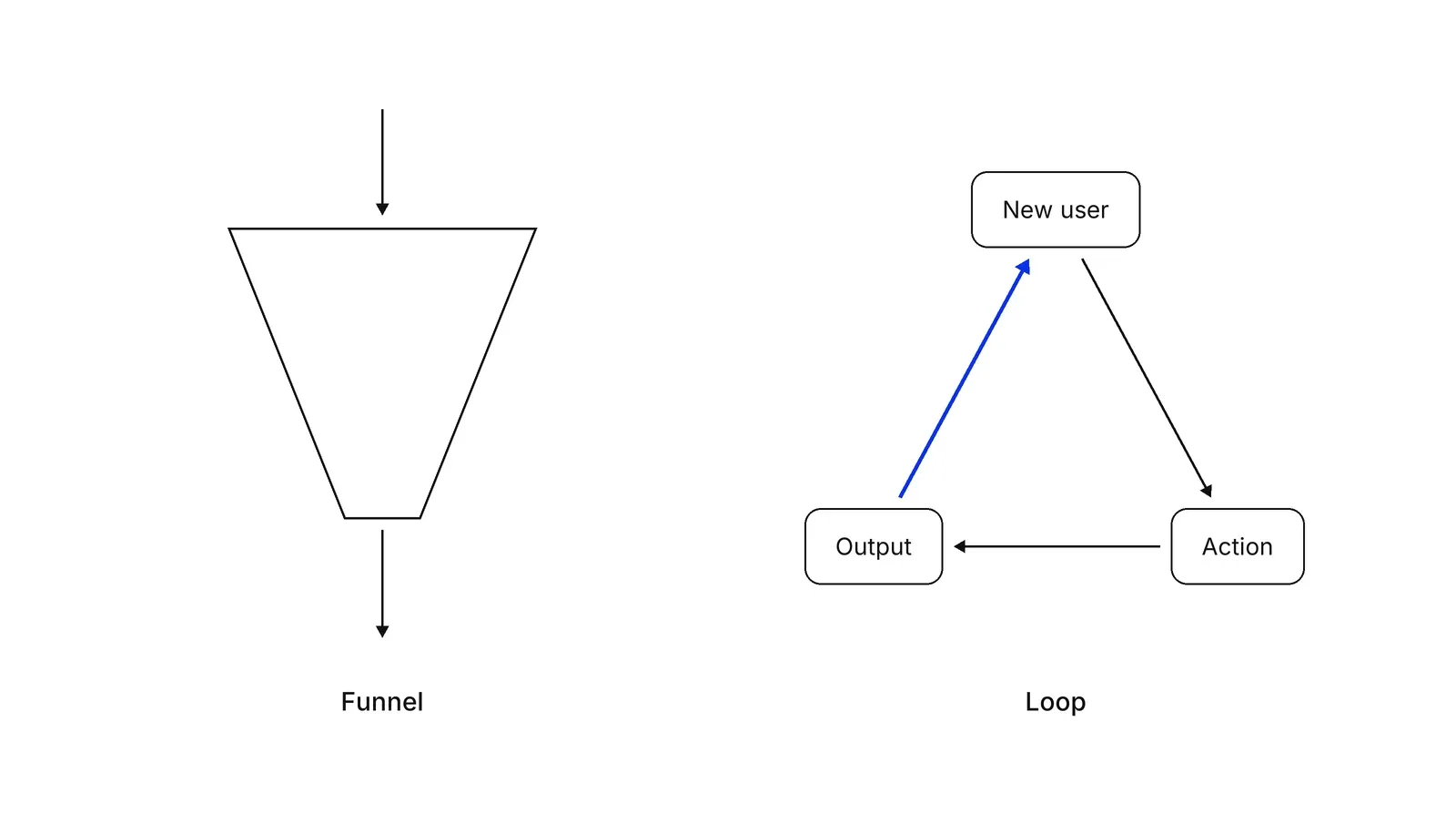
The funnel the essay argues against is the one most teams already track, often as AARRR pirate metrics, Dave McClure’s 2007 model of acquisition, activation, retention, referral and revenue. The doubt is older than Reforge. McKinsey’s 2009 study of the consumer decision journey already described buying as “a more circular journey” than the classic marketing funnel suggests.
A funnel still has a job. It shows where people drop out between two steps, which is exactly what you need to fix one step of a loop.
How a loop works: the Pinterest example
Every loop has the same shape: a new user arrives, does the core action, that action produces an output, and the output reaches people who are not users yet. The Reforge essay uses Pinterest to show it.
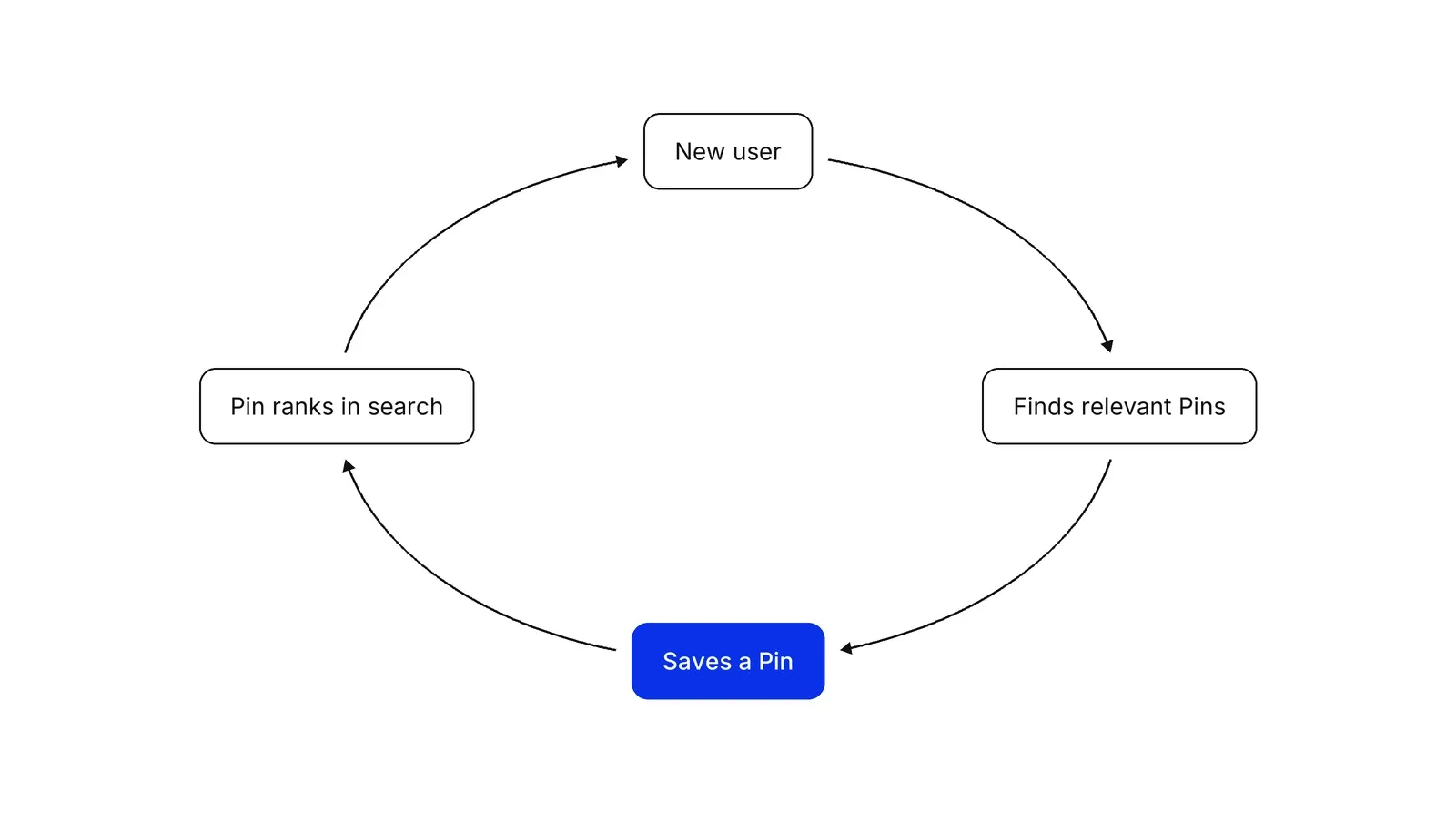
A person signs up or returns, finds Pins that match their interest, and saves or repins them. Those saves tell Pinterest which content is good, and the content is published to search engines, where it brings in the next visitor. Winters told First Round Review that when he joined, Pinterest had about 200 staff and 40 million active users and growth was slowing; the search-driven content loop produced a second wave. By the end of 2018 the company reported more than 250 million monthly users and over 175 billion saved Pins in its S-1 filing, and listed dependence on search engines as a risk. That risk is the other face of a content loop: one step runs on someone else’s platform.
Viral, content and paid loops
The 2018 essay groups loops by what they do (acquisition, retention, defensibility, efficiency), not by mechanism. The viral, content and paid labels came from practitioners describing acquisition loops by what gets reinvested.
| Loop | What gets reinvested | Key numbers | Documented example |
|---|---|---|---|
| Viral | Invites and shares from users | Invites per user, invite conversion, cycle time | Dropbox, Hotmail |
| Content | Pages created by users or the company | Pages indexed, search visits, sign-up rate | |
| Paid | Customer revenue spent on ads | Revenue per user, cost per user, payback months | Dropbox’s failed paid search test |
Viral loops
A viral loop runs on users bringing in other users. Its strength is the viral coefficient: invites per user multiplied by the share that convert. David Skok’s model shows why cycle time matters as much. Starting from 10 users with a coefficient of 2, a two-day cycle gives about 20,470 users after 20 days; a one-day cycle gives over 20 million.
Hotmail is the early case. After launch on 4 July 1996, investor Tim Draper pushed for a sign-up link at the foot of every email, and according to Adam Penenberg’s account the service reached 1 million users within six months. Product design changes the result. In a randomized trial covering 1.4 million friends of 9,687 Facebook users, Aral and Walker found that automatic broadcast notices raised peer influence by 246%, while adding personal invites raised it by a further 98%.
Content loops
A content loop turns what users or the company publish into traffic that brings in new users, who publish more. Reviews, listings, Q&A pages and public boards all work this way. Winters’ process starts with content that is useful to users and non-users alike, makes sharing easy, and puts effort where the target audience already spends time online. His blunter point: “Paid acquisition is a race to the bottom over time.”
Paid loops
A paid loop uses revenue from customers to buy the next customers. It works only if each customer returns more than they cost, fast enough to recycle the cash. Skok’s SaaS rules of thumb are a lifetime value above 3 times acquisition cost and payback under 12 months. Brian Balfour’s channel model fit essay adds that low revenue per user rules paid channels out and pushes a business toward virality or user-generated SEO. Paid loops also wear out: Andrew Chen notes banner click-through fell from 78% on HotWired in 1994 to 0.05% on Facebook in 2011.
Some writers argue paid acquisition is never a true loop, since it buys users instead of compounding. The useful test is the source of the cash: customer revenue makes it a loop, investor money makes it a channel.
What research says about referred users
Referred users are worth more than average, which strengthens viral loops. Schmitt, Skiera and Van den Bulte tracked about 10,000 customers of a German bank for almost three years and found referred customers were at least 16% more valuable, with higher retention. A 2018 follow-up traced this to better matching between referrer and friend. At a social network, Trusov, Bucklin and Pauwels found word-of-mouth referrals had longer-lasting effects on sign-ups than traditional marketing.
Loops, funnels and flywheels compared
| Model | Shape | Best for |
|---|---|---|
| Funnel | One way, stage by stage | Finding where people drop out |
| Growth loop | Closed cycle with a measurable output | Deciding which growth engine to invest in |
| Flywheel | Momentum built over many turns | Explaining long-term strategy |
Jim Collins’ flywheel describes momentum built by consistent effort, and HubSpot adapted it to put customers at the centre of growth. A growth loop is narrower and more measurable: every step has a conversion rate and the whole cycle has a duration. Balfour later described a “universal” loop in which growth attracts money and talent that fund the next round of growth, and warned that loops can run in reverse.
In Pushers’ Growth Lab work, drawing the loop comes before the channel plan, because the loop decides which channels are worth funding at all.
How to apply Growth loops, step by step
- Trace where your last 100 new users came from. Pull the source of your most recent sign-ups or first purchases: an invite, a search result landing on a user page, a paid ad, a sales call. Group them. Result: a ranked list of acquisition sources with their share of new users.
- Ask which source is fed by existing users. For each large source, check whether earlier users or earlier revenue produced it. Invites come from users; indexed pages come from user content; ad budgets can come from customer revenue. Sources nobody feeds are channels, not loops. Result: one or two candidate loops.
- Draw the loop as four or five steps. Write each step as an action: new user arrives, does the core action, produces an output, the output reaches non-users, some of them arrive. Result: a one-line loop diagram with no step missing.
- Put a number on every step. Measure the conversion at each step and the time one full cycle takes. For a viral loop that is invites per user, invite conversion and days per cycle. For a paid loop it is revenue per user, cost per user and months to payback. Result: a loop you can multiply through.
- Fix the weakest step, one at a time. Pick the step with the worst conversion or the longest delay and run one experiment on it. A shorter cycle often beats a higher rate, because the loop turns more times in the same period. Result: a before and after reading on that step.
- Goal one team on the loop's output. Give the loop's output, such as invited users who activate, a single owner and a single target that product, marketing and engineering share. Result: no team improving its own stage at another team's expense.
Examples
Dropbox's referral loop
Drew Houston's 2010 deck says a referral program with a reward for both sides permanently raised Dropbox sign-ups by 60%, and that referrals made up 35% of daily sign-ups, with 2.8 million direct invites sent in 30 days. The same deck reports paid search costing $233 to $388 per customer for a $99 product, which it labels a failure. Dropbox's 2018 S-1 still names word-of-mouth and in-product referrals as how it acquires users at low cost.
A payments app with a two-sided referral reward
Illustrative. A money transfer app gives sender and recipient a fee-free transfer when a new user signs up through a link. If each active user sends 2 links a month and 15% of recipients activate, every 100 users bring 30 new ones per monthly cycle (a K of 0.3). The loop does not grow the app alone, but it cuts the paid budget needed for each month's target.
A dental clinic's content loop
Illustrative. A clinic group publishes one page per treatment and city, built from patient questions its staff log after each visit. Pages that rank bring new patients, whose questions produce the next pages. If 40 pages each bring 5 bookings a month, that is 200 bookings, and every logged question is raw material for page 41.
When to use it
Use it when a product's users, content or revenue can plausibly bring in more users: consumer apps, marketplaces, collaboration tools, user-generated content sites and self-serve SaaS. It is most useful once you have enough new users per week to measure each step of a loop.
When not to use it
Skip it for businesses whose growth comes almost entirely from outbound sales or one-off purchases with no sharing, such as enterprise deals or home renovation. There the funnel and the sales pipeline are the better tools, and forcing a loop onto the page produces a diagram nobody can measure.
Common mistakes
- Calling any channel a loop. A loop exists only if existing users or revenue produce the next input; a one-off PR spike or a paid campaign funded by investors is a channel.
- Measuring the rate and ignoring the cycle time. A loop that turns daily can outgrow one with twice the conversion that turns weekly.
- Running five weak loops instead of one or two strong ones. Reforge's essay says the fastest-growing products usually run on one or two major loops.
- Assuming paid loops hold steady. Click-through rates on a channel fall as it fills with competitors, so the cost side of a paid loop drifts up.
- Leaving each step with a different team. A loop crosses functions, so stage-by-stage goals recreate the silos the model was meant to remove.
FAQ
What is a growth loop in simple terms?
A growth loop is a cycle in which what your current users do brings in your next users. A user invites a friend, writes a review that ranks in search, or pays money that funds the next ad. The new user repeats the action, so growth compounds instead of starting from zero every month.
What is the difference between a growth loop and a funnel?
A funnel moves people one way, from awareness to purchase, and ends there. A loop feeds the output of that journey back in as new input. Reforge's 2018 essay argued that funnels also split teams by stage, so each team optimizes its own number, while a loop gives everyone one shared output.
What are examples of growth loops?
Documented examples include Dropbox's two-sided referral program, Hotmail's sign-up link at the foot of every email, and Pinterest's content loop, in which saved Pins rank in search engines and bring in new users. Paid loops, where customer revenue funds more advertising, are common in e-commerce and subscription apps.
What is a viral coefficient and why does cycle time matter?
The viral coefficient, or K, is invites sent per user multiplied by the share of invites that convert. Above 1, each user brings more than one new user. Cycle time is how long one round takes. In David Skok's model, halving the cycle time from two days to one turns about 20,000 users into over 20 million in 20 days.
Is paid acquisition a growth loop?
Only when customer revenue pays for the next round of spending and each customer returns more than they cost to acquire. If investor money funds the ads, it is a channel, not a loop. Practitioners disagree on the label, but all agree a paid loop needs payback fast enough to recycle the cash.
Sources
- Brian Balfour, Casey Winters, Kevin Kwok, Andrew Chen, Growth Loops are the New Funnels, Reforge, 2018
- Brian Balfour, Universal Growth Loop, 2020
- First Round Review, Pinterest and Grubhub's Former Growth Lead on Building Content Loops, 2018
- Pinterest, Inc., Form S-1 Registration Statement, SEC, 2019
- David Skok, Lessons Learned: Viral Marketing, For Entrepreneurs
- Drew Houston, Dropbox Startup Lessons Learned, 2010
- Dropbox, Inc., Form S-1 Registration Statement, SEC, 2018
- TechCrunch, PS: I Love You. Get Your Free Email at Hotmail (excerpt from Adam L. Penenberg, Viral Loop), 2009
- Andrew Chen, The Law of Shitty Clickthroughs, 2012
- Andrew Chen, The Cold Start Problem (book announcement), Harper Business, 2021
- Brian Balfour, Why Product Market Fit Isn't Enough, 2017
- Brian Balfour, Get Out of the ARPU-CAC Danger Zone with Channel Model Fit, 2017
- David Skok, SaaS Metrics 2.0, For Entrepreneurs
- Sinan Aral, Dylan Walker, Creating Social Contagion Through Viral Product Design, Management Science 57(9), 2011
- Michael Trusov, Randolph E. Bucklin, Koen Pauwels, Effects of Word-of-Mouth versus Traditional Marketing, Journal of Marketing 73(5), 2009
- Philipp Schmitt, Bernd Skiera, Christophe Van den Bulte, Referral Programs and Customer Value, Journal of Marketing 75(1), 2011
- Christophe Van den Bulte, Emanuel Bayer, Bernd Skiera, Philipp Schmitt, How Customer Referral Programs Turn Social Capital into Economic Capital, Journal of Marketing Research 55(1), 2018
- Frank M. Bass, A New Product Growth Model for Consumer Durables, Management Science 15(5), 1969
- Dave McClure, Startup Metrics for Pirates (long version), SlideShare, 2007
- David Court, Dave Elzinga, Susan Mulder, Ole Jorgen Vetvik, The Consumer Decision Journey, McKinsey Quarterly, 2009 (Business Today reprint)
- Jim Collins, The Flywheel Effect
- HubSpot, The Flywheel
Last updated Oct 9, 2026


Marketing agency or growth system: when a company outgrows its agency
An agency is the right call while the founder still runs most of the company. Once the business starts copying itself into new locations or markets, it needs a system that sets goals, tests hypotheses and owns the result.

Why healthcare marketing agencies stall: the short, mid and long wins model we use with clinics
Most agencies own the click and nobody owns the front desk. How we structure clinic work in three horizons, the research behind each one, and one year of results.

Why channel tests stall after month three
Most paid channel tests do not end with a decision. They end when the budget runs out, the attribution model changes, or everyone quietly stops looking at the dashboard.