V2MOM
V2MOM is Salesforce's one-page planning method: a Vision, ranked Values, ranked Methods, named Obstacles and Measures, written by every team and person from the CEO down.
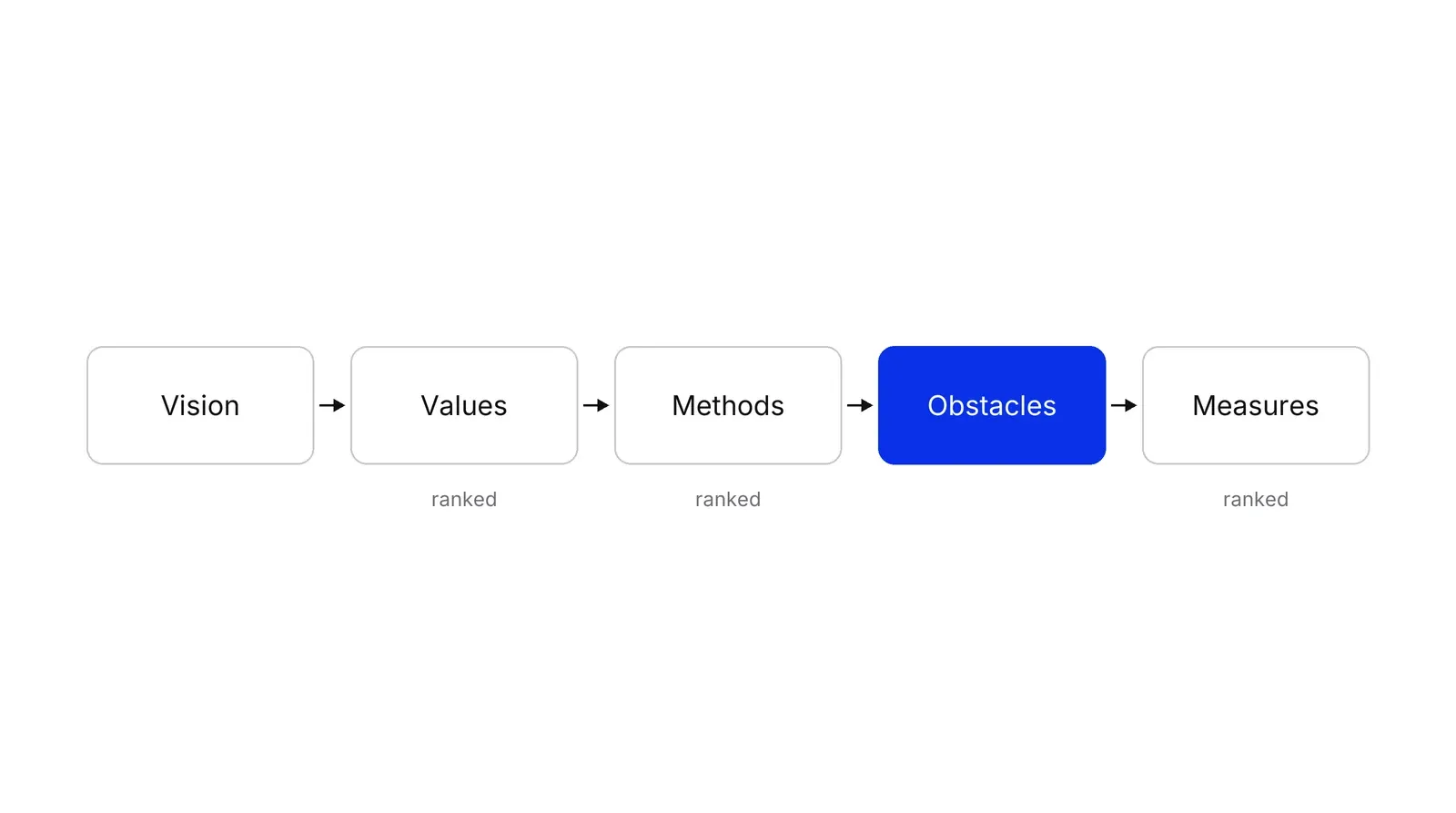
V2MOM stands for Vision, Values, Methods, Obstacles and Measures. Marc Benioff created it at Salesforce, and the company says every department and employee writes one each year. The Vision says what you want, Values set the priorities, Methods are the ranked actions, Obstacles name what blocks them, and Measures say how you will know you succeeded.
- Origin
- Marc Benioff, Salesforce, 1999; described in print in 2009
- Level
- 301 · Advanced
- Fits
- Scale-up, Enterprise
- Time to apply
- two to three hours for a first draft, then a review every six months
- What you need
- the plan or V2MOM of the level above you, if there is one · the person you report to, for an alignment conversation · a short list of what is currently blocking progress
V2MOM is a planning method from Salesforce that fits a plan on one page under five headings: Vision, Values, Methods, Obstacles and Measures. Marc Benioff, who co-founded Salesforce in 1999, describes it as a management process that kept the company aligned as it grew from four people to more than 50,000. That growth figure is Salesforce’s own claim, and nobody has tested whether the method caused it.
The method reached a wide audience through Benioff’s 2009 book Behind the Cloud, written with Carlye Adler. The publisher’s page does not mention V2MOM, but CRM magazine’s coverage of the book says the book discusses it, and Salesforce’s own article draws on excerpts from the book.
What are the five parts of a V2MOM?
Each part answers one question, and the order matters: the vision comes first, the measures last, and the obstacles sit between the plan and the proof.
| Part | Question | Salesforce’s guidance |
|---|---|---|
| Vision | What do you want to achieve? | One to three sentences, covering the effect on customers, employees and community |
| Values | What matters most on the way? | About three, ranked, each with a description of what living it looks like |
| Methods | How will you get there? | Five to eight actions, highest priority first, aligned with your manager’s |
| Obstacles | What stands in the way? | Specific barriers, each with a planned response |
| Measures | How will you know? | Outcomes rather than activities, ranked; either a target number or a done-or-not check |
The guidance in the table comes from Trailhead, Salesforce’s training platform. Benioff adds that ranking values forces trade-offs and that a yes-or-no judgment is not a measure. A good measure fits the SMART test, with a number and a date. “Achieve 30% market share in the United States by year end” passes. “Dominate the market” does not.
Why do ranked values matter?
Ranking turns a value into a rule for decisions. A list of three values in no order cannot settle a clash between speed and cost. A ranked list can: whichever sits higher wins. Salesforce’s own guidance says values guide everyday decisions and trade-offs. In the telehealth example above, safety ranks first, so a method that saves intake time at the expense of a safety question is rejected before anyone argues about it.
What makes the Obstacles part different?
Obstacles are the part most goal-setting formats do not have, and they are the reason V2MOM differs from OKR. Naming what blocks you before you start is a practice with some support in psychology. In the 1990s Peter Gollwitzer showed that if-then plans, which link an expected situation to a prepared response, help people reach their goals. Gabriele Oettingen and Doris Mayer found that dreaming about success without considering the obstacles weakened effort. A 2021 meta-analysis of 21 studies on combining the two, called mental contrasting with implementation intentions, found a small to medium effect (g = 0.34), and the authors say publication bias may make the true effect smaller.
Those studies test individuals, not V2MOMs. Gary Klein’s premortem, where a team assumes a project has already failed and lists why, aims at the same thing: making it safe to voice doubts early. The Obstacles box is a place to do that on one page. Salesforce asks for a response to each obstacle, and for innovation projects suggests three to five serious barriers, not routine tasks.
How does a V2MOM cascade through a company?
At Salesforce the company V2MOM starts with Benioff and his direct reports. It then moves down to functions, teams and individuals, who write their own. Salesforce says every department and employee drafts one each year, they are published on an internal social network, and an app lets people track progress against each item.
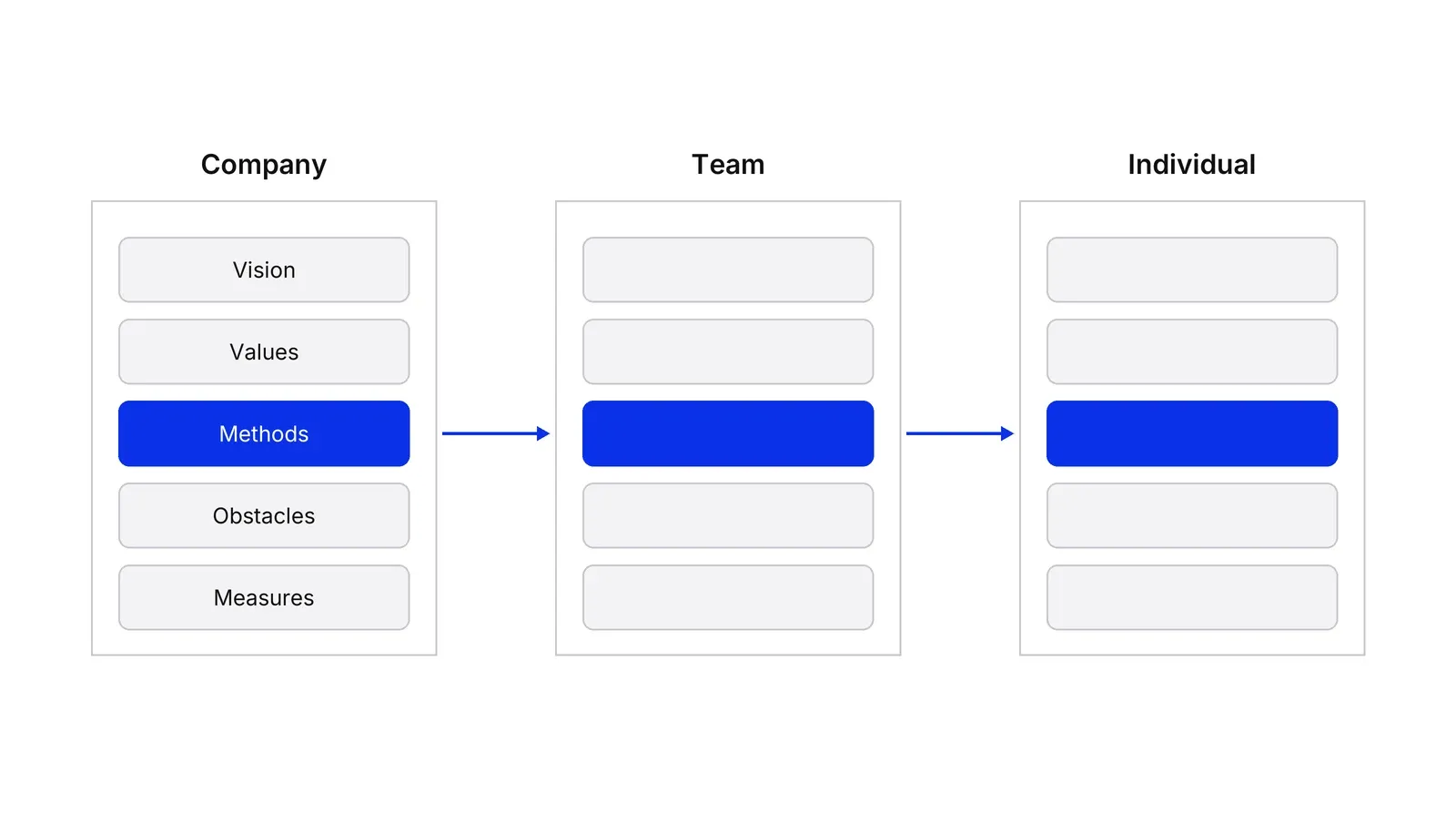
The alignment step is a conversation. Trailhead tells new writers to read the company and manager V2MOMs first, agree the methods and measures that apply to them, and share the draft with peers, because a peer may turn one of your obstacles into one of their methods. Salesforce also says it refreshes V2MOMs at least twice a year, so the page is never final.
V2MOM compared with OKR, OGSM and hoshin kanri
All four cascade goals down a company. They differ in what they write down besides the goal.
| V2MOM | OKR | OGSM | Hoshin kanri | |
|---|---|---|---|---|
| Typical horizon | One year, refreshed twice | One quarter | One to five years | One year, within a long-term aim |
| Priorities ranked | Values, methods, measures | Not required | Not required | Through negotiation between levels |
| Obstacles section | Yes | No | No | Not as a section |
| Strategy written down | In the methods | No | In the Strategies box | In the policy deployment |
OKR came from Andy Grove at Intel, and John Doerr introduced it to Google in 1999. OGSM puts the strategy in its own box. Hoshin kanri is, in the Lean Enterprise Institute’s words, a method that applies plan-do-check-act cycles and delegates accountability. The KPI vs OKR page explains why measures that run continuously belong on a dashboard and not in a plan. The 4 Disciplines of Execution fills the gap V2MOM leaves, a weekly rhythm for one goal.
What does the evidence say?
We found no independent peer-reviewed evaluation of V2MOM. Almost everything published about its results comes from Salesforce, from Benioff’s books or from consultancies that teach it, so statements that it drove Salesforce’s growth are company claims.
The case for a short shared plan rests on general research about strategy execution. Michael Mankins and Richard Steele wrote in 2005 that most companies’ strategies deliver only 63% of their promised financial value, and their first rule is to keep strategy simple. A London Business School survey of about 11,000 managers in more than 400 companies found only about one in three could name the firm’s top three priorities, a finding Donald Sull and colleagues set out in Harvard Business Review. For goals, Locke and Latham’s 35-year review reports that specific, difficult goals lead to higher performance than vague ones. None of this proves that the five-part format beats other formats; it shows that the parts address known problems.
A Growth Lab plan starts from the same idea: written priorities that the people doing the work can see and check.
How to apply V2MOM, step by step
- Write the vision in one to three sentences. Describe what you want to achieve and what difference it makes to customers, employees and the company. Salesforce's own guidance asks for 1 to 3 sentences. Result: a vision short enough to repeat from memory.
- Choose about three values and rank them. Pick the principles that matter most for this vision and explain what living each one looks like in practice. Put them in order, because ranking is what makes a value settle a trade-off. Result: three ranked values.
- List five to eight methods, highest priority first. Write the actions or chunks of work that will deliver the vision, and check that each one supports the methods of the person or team above you. Result: a ranked list of methods.
- Name the obstacles and one response for each. List the specific things that will make the methods hard: a missing skill, a dependency on another team, a budget limit. For each, write what you will watch for and what you will do. Result: three to five obstacles, each with a response.
- Define measures that prove the vision happened. Use outcomes, not activity. A progress measure sets a number or percentage, a completion measure says whether a specific thing is done. Rank them and give each a date. Result: measures anyone could mark as met or not met.
- Share it, revise it, review it twice a year. Show the draft to your manager and peers, revise it, then publish it where the people who depend on you can read it. Revisit it at least every six months. Result: a plan other people can see and check.
Examples
The first Salesforce V2MOM, 1999
CRM magazine reported in 2009 that the first V2MOM was written on the back of an American Express envelope in April 1999. It had five measures, and the last one read: we are all rich. It also exposed the company's biggest obstacle, a shortage of talent. This is Salesforce's own origin story, told by Benioff in his book and repeated in the trade press, and we found no independent record of the envelope.
A recession rewrite, 2009
CRM magazine says Benioff prefers to revisit the V2MOM about every six months, and that in early 2009 the recession forced two rewrites. About 250 employees were split into 16 teams, two teams per core initiative, to revise it. After the February revision the company reported more focus on existing customers and their success.
A telehealth startup, illustrative
Illustrative only, no real company implied. Vision: patients in two Spanish cities see a doctor the same day. Values, ranked: patient safety, speed, cost. Methods, ranked: sign 20 clinicians, cut intake to five minutes, open evening hours. Obstacle: clinicians fear losing their own patients; response: let them keep their patient lists inside the platform. Measure: median wait under 4 hours by December. Because safety ranks first, a method that cuts intake time but skips a safety question loses.
When to use it
Use it when a company or department has outgrown a plan that lives in one head, when teams interpret the strategy differently, or when you want every level of the business to write down how its work supports the level above and make that visible.
When not to use it
Skip it for a team of a few people who talk every day; a shared document will do. Do not use it as a replacement for a strategy: V2MOM records the choices you made and does not make them for you. It also gives little help for the weekly rhythm of a single goal.
Common mistakes
- Listing values nobody ranks, so they cannot settle a trade-off and read like a poster.
- Writing methods as a backlog of fifteen items. Salesforce guidance asks for 5 to 8, ranked.
- Leaving obstacles out, or listing routine tasks as obstacles. Trailhead says an obstacle is a serious barrier, such as something your sponsor must help with.
- Writing measures as a yes-or-no opinion. Benioff writes that a subjective judgment does not cut it.
- Writing it once in January and never reopening it. Salesforce says the V2MOM should be a living document.
FAQ
What does V2MOM stand for?
V2MOM stands for Vision, Values, Methods, Obstacles and Measures, pronounced vee-two-mom. Vision is what you want, Values are the ranked principles behind it, Methods are the ranked actions, Obstacles are what blocks them, and Measures are how you will know you succeeded.
Who created the V2MOM?
Marc Benioff, who co-founded Salesforce in 1999. Salesforce says the first one was written on an American Express envelope soon after the company began. CRM magazine dates it to April 1999. Benioff set out the method in his 2009 book Behind the Cloud, written with Carlye Adler.
How is a V2MOM different from an OKR?
An OKR pairs an objective with a few key results, usually for a quarter. A V2MOM adds ranked values that settle trade-offs and a section for obstacles, and Salesforce uses it for the year. The measures in a V2MOM resemble key results, and the methods are closer to a plan of work.
How many methods and obstacles should a V2MOM have?
Salesforce's Trailhead guidance suggests 5 to 8 methods, ranked, and about three values. For innovation projects it suggests 3 to 5 obstacles, each with a response. It sets no count for measures but asks for them to be ranked and specific. A short V2MOM is better than a long one.
Does V2MOM work outside Salesforce?
Probably, but no independent study has tested it. Salesforce says the same structure suits startups and public companies, and publishes free Trailhead training on it. We found no peer-reviewed evaluation, so treat claims that it drove Salesforce's growth as the company's own.
Sources
- Marc Benioff, Create Strategic Company Alignment With a V2MOM, Salesforce blog (2013; updated 2024)
- Salesforce, How to Build a Strategy Framework That Works, Salesforce 360 blog, 2020
- Salesforce Trailhead, Organizational Alignment (V2MOM) module
- Salesforce Trailhead, Creating Your Own V2MOM for Success
- Salesforce Trailhead, Achieve Organizational Alignment with V2MOM
- Salesforce Trailhead, Creating a V2MOM for Innovation Projects
- Salesforce Trailhead, Create Your Personal V2MOM for Success
- Joshua Weinberger, Salesforce.com's Secret Weapon, CRM magazine, November 2009
- Marc Benioff, Carlye Adler, Behind the Cloud, John Wiley & Sons (Jossey-Bass), 2009
- Gary Klein, Performing a Project Premortem, Harvard Business Review, September 2007
- Peter M. Gollwitzer, Implementation intentions: Strong effects of simple plans, American Psychologist 54(7), 1999
- Gabriele Oettingen, Doris Mayer, The motivating function of thinking about the future: Expectations versus fantasies, Journal of Personality and Social Psychology 83(5), 2002
- Guoxia Wang, Yi Wang, Xiaosong Gai, A Meta-Analysis of the Effects of Mental Contrasting With Implementation Intentions on Goal Attainment, Frontiers in Psychology 12, 2021
- Edwin A. Locke, Gary P. Latham, Building a Practically Useful Theory of Goal Setting and Task Motivation, American Psychologist 57(9), 2002
- What Matters (John Doerr), OKR meaning, definition and example
- Lean Enterprise Institute, Hoshin kanri
- Robert S. Kaplan, David P. Norton, The Balanced Scorecard: Measures That Drive Performance, Harvard Business Review, January-February 1992
- Michael C. Mankins, Richard Steele, Turning Great Strategy into Great Performance, Harvard Business Review, July 2005 (Bain reprint)
- London Business School, Two thirds of senior managers can't name their firm's top priorities, December 2015
- Donald Sull, Rebecca Homkes, Charles Sull, Why Strategy Execution Unravels and What to Do About It, Harvard Business Review, March 2015
Last updated Oct 9, 2026


Fractional COO or embedded operations team? How to choose at Series A
The two models solve different problems: how to tell which one your company needs, and what each costs in time and control.

What operational systems successful fintech startups use: lessons from ten companies
Starling, Monzo, Qonto, bunq, Lunar, Pleo, Tide, Ramp, Mercury and Column scaled on four operating systems. Regulators' findings show what breaks when one of them lags behind growth.

Marketing agency or growth system: when a company outgrows its agency
An agency is the right call while the founder still runs most of the company. Once the business starts copying itself into new locations or markets, it needs a system that sets goals, tests hypotheses and owns the result.