Messaging hierarchy
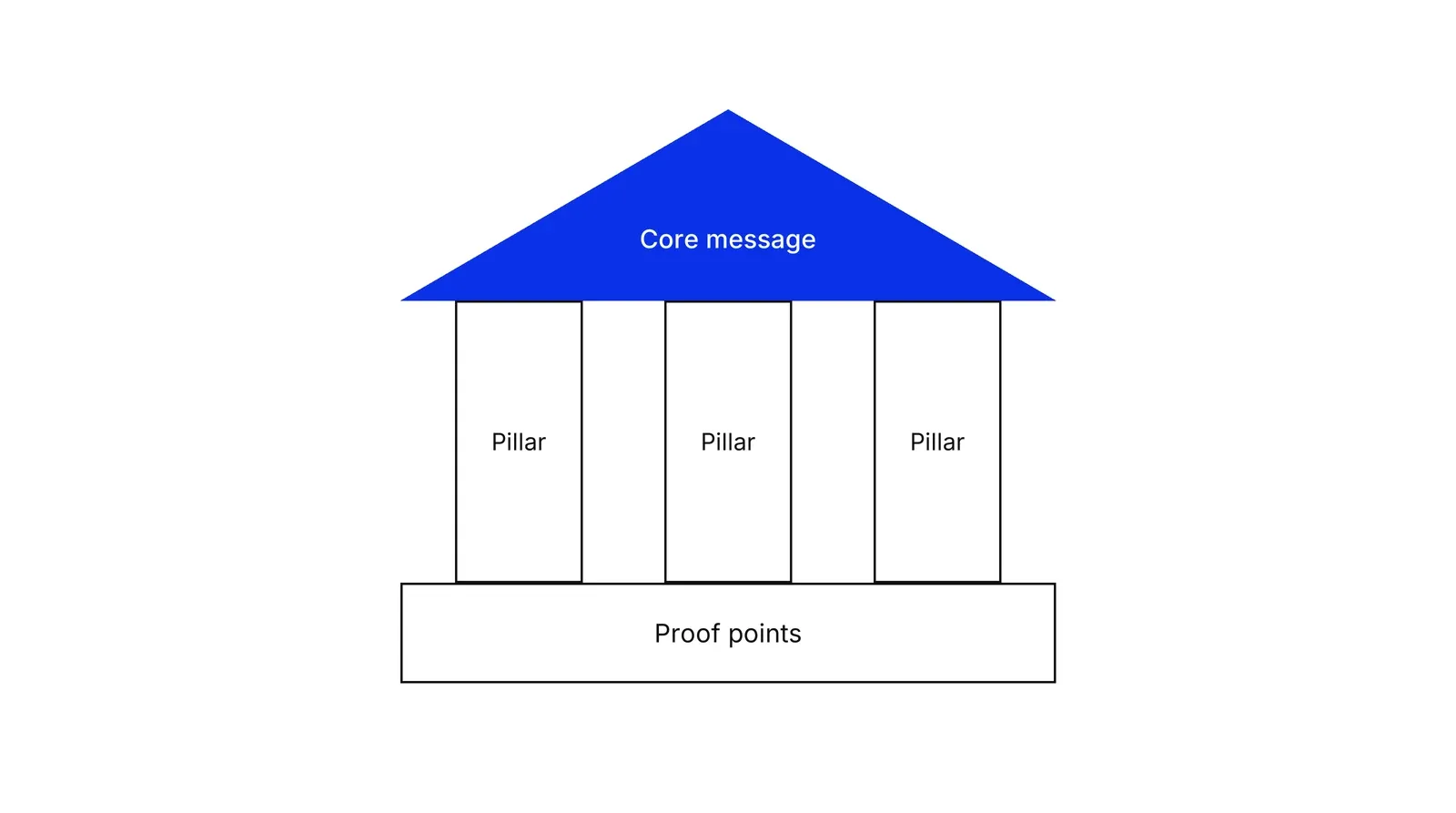
A messaging hierarchy, often drawn as a message house, ranks what a company says: one core message, a few supporting pillars and the proof under each, so every team tells the same story in the same order.
A messaging hierarchy is a ranked set of messages for one audience: a single core message at the top, usually three supporting pillars below it and proof points under each pillar. It is often drawn as a message house. Marketing, sales and PR teams use it so every ad, page and interview says the most important thing first and backs each claim with evidence.
- Origin
- No single inventor; a PR and corporate communications practice. Vincent Covello published the related message map method, Message mapping published 2006; the message house has no documented first use
- Level
- 201 · Tool
- Fits
- Startup, Small and mid-size, Scale-up
- Time to apply
- a half-day workshop for a first draft, then two to four weeks of testing
- What you need
- one named audience and the decision you want them to make · a list of the questions and objections that audience raises, from sales calls or support tickets · the evidence you can show today: numbers, customer names you may use, certificates, reviews
A messaging hierarchy is a ranked list of what a company says to one audience: a core message at the top, a few supporting messages (pillars) under it, and proof points under each pillar. Teams also call it a messaging framework, a message architecture or, when it is drawn as a diagram, a message house. Product marketers, PR teams and founders build one so that the website, the sales deck and a spokesperson in an interview all lead with the same idea and back it with the same evidence.
Where the message house comes from
Nobody can be credited with inventing it. The message house is a working tool from public relations and corporate communications, passed between agencies and in-house teams. Marc Fest, who runs the free MessageHouse.org toolkit, writes in its FAQ that he learned the method from a consultant while working at the Knight Foundation and did not invent it. We found no primary source that dates its first use.
Several fields arrived at the same shape on their own. Risk communication researcher Vincent Covello published message mapping in the Journal of Emergency Management in 2006, and the CDC later turned it into a message mapping guide with ORISE. Science communicators use the COMPASS Message Box. Consultants learn Barbara Minto’s pyramid principle, which organises a document “as a pyramid under a single point”. Content strategist Margot Bloomstein calls a message architecture a hierarchy of communication goals. The labels differ; the structure is the same.
The three layers
The core message is the one thing the audience should remember. Pillars are the reasons it is true. Proof points are the evidence a sceptic can check. In the house drawing, as the MessageHouse.org toolkit describes it, the roof holds the umbrella message, three columns hold core messages, and the foundation holds statistics, examples and testimonials.
| Layer | Question it answers | Length | Test |
|---|---|---|---|
| Core message | What should they remember? | One sentence, under ten seconds aloud | A new hire can repeat it after one reading |
| Pillars | Why is that true for them? | One sentence each, usually three | Each answers a different customer question |
| Proof points | How can they check it? | Two or three per pillar | A sceptic could verify it without asking you |
Order matters as much as content. The Nielsen Norman Group recommends the inverted pyramid for web writing, so that a reader who stops after one sentence still gets the main point. A messaging hierarchy applies that rule to every asset: the headline carries the core message, the next lines carry the pillars, and the detail comes last.
Why three pillars and not seven
Three pillars is a convention with evidence behind it. In a 2014 Journal of Marketing paper, Suzanne Shu and Kurt Carlson ran four experiments on claims about cereal, restaurants, politicians and a prospective date. When people knew the source wanted to persuade them, impressions improved up to three positive claims and fell at four, because the fourth claim made people sceptical of all of them.
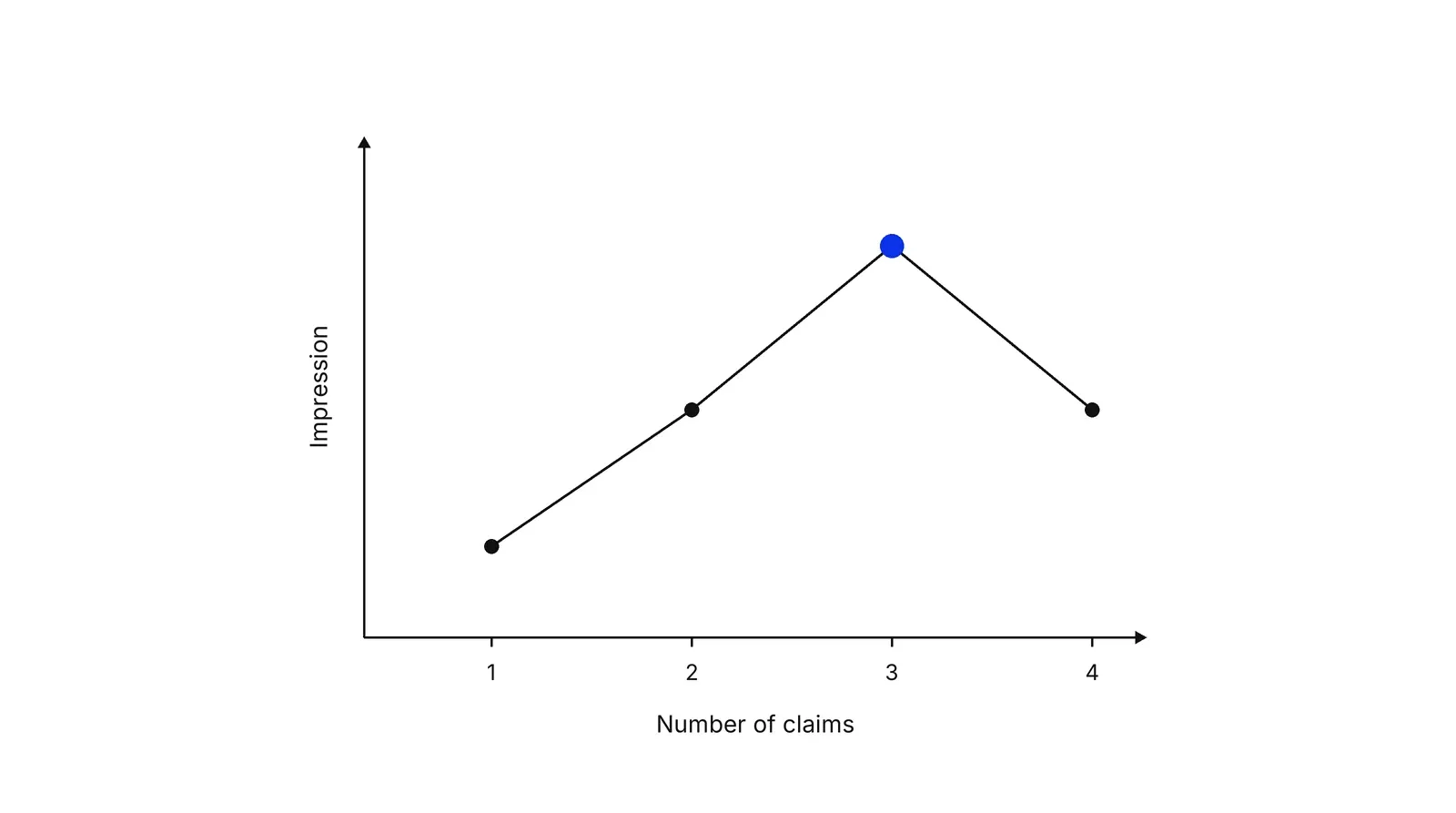
The effect has limits the authors state plainly. It disappeared when the source had no persuasion motive and when participants were under heavy cognitive load, and the samples were college students. Memory research points the same way: Nelson Cowan’s 2001 review puts short-term capacity at about four chunks and calls Miller’s famous seven “a rough estimate and a rhetorical device”.
Covello’s message map: the strict version
Covello’s method is the most disciplined form of a messaging hierarchy. In his tutorial for the CDC guide, a message map starts from a stakeholder’s question, gives three key messages that answer it, and lists supporting facts under each. The Step 4 transcript asks for three supporting facts per key message and ties the rule of three to how people process information under stress.
The famous 27/9/3 rule is where the sources disagree. The transcript reads as about 27 words in 9 seconds for a message. The guide’s reference card says each key message should be about 9 words, with 27 words across all three. For a business team the safe reading is the stricter one.
The card adds two rules that also apply outside a crisis. People remember the first message best and the middle one worst, so the second most important message goes last. And key messages should be written four reading grades below the audience’s level, with supporting facts two grades below.
Proof points: what counts as evidence
A proof point is evidence the audience can check: a number with its source, a named customer, a certification, a demo. Adjectives do not count, and abstract language is the usual way this layer fails. In a 2006 Harvard Business Review article, Chip and Dan Heath describe the curse of knowledge: leaders state strategy in abstract phrases that summarise data only they have seen, and frontline staff hear nothing concrete. Proof points are the concrete data put back.
Not every pillar has to be a point of difference. Keller, Sternthal and Tybout argued in HBR that a brand also needs points of parity, the basics a buyer expects from the category. A new payments company may need one pillar that simply proves it is licensed and safe before its speed claim is believed.
Repetition helps the core message stick, which is a reason to keep it identical everywhere. Fazio and colleagues found that repeated statements feel truer even to people who know better. That effect works on false claims too, so the foundation must hold only what is true.
Test it, because nobody predicts the winner
Treat a new house as a set of hypotheses. A 2024 study by Hewitt and colleagues analysed 617 ads tested by 51 campaigns and found that common theories of what makes a message persuasive predicted results only weakly. In a megastudy of 689,693 pharmacy patients, the best of 22 text reminders told people a flu shot was waiting for them, and neither experts nor lay people predicted it would win. At Bing, Kohavi and Thomke report, a shelved idea for ad headlines raised revenue 12% once someone tested it.
Testing a house is cheap. Put two orders of the same pillars into an email subject line or a search ad, or read the core message to five prospects and ask them to repeat it back.
How it fits with other tools
| Tool | What it fixes | Who reads it |
|---|---|---|
| Positioning statement | Target, category and main difference | The internal team |
| Value proposition | Which customer jobs and pains you address | Product and marketing |
| Messaging hierarchy | What to say first, second and as proof | Everyone who writes or speaks for you |
| COMPASS Message Box | Issue, problem, so what, solutions, benefits | Scientists talking to one audience |
Positioning comes first, then the hierarchy, then the copy. In Pushers’ marketing operations work, the house sits next to the content plan so every brief can point to the pillar it supports.
How to apply Messaging hierarchy, step by step
- Pick one audience and one decision. Name who the hierarchy is for (clinic owners, CFOs of mid-size retailers, journalists covering payments) and what you want them to do after hearing it. A house written for everyone gets vague at the top. Result: one sentence naming the audience and the decision.
- Collect their questions before writing answers. List the 10 to 20 questions and objections this audience raises, in their words, from call notes, tickets and reviews. Covello's message mapping guide puts this step before any message is written. Result: a ranked list of questions, with the three that come up most often at the top.
- Write the core message. Write one sentence that answers the most common question and says why it matters to this audience now. Keep it short enough to say aloud in under ten seconds and free of internal jargon. Result: a core message a new hire can repeat after one reading.
- Choose three pillars. Pick the three reasons that make the core message true for this audience, each answering a different question from your list. If you have five candidates, merge or drop two. Put the strongest pillar first and the second strongest last. Result: three pillars of one sentence each, in order.
- Attach proof to every pillar. Under each pillar, list two or three proof points the audience can check: a number with its source, a named customer, a certificate, a demo. Delete any pillar you cannot prove today. Result: a one-page house where every claim has evidence beneath it.
- Test the order and the wording. Run the core message and pillars past five to ten real prospects, or test two versions in ads or email subject lines. Note which pillar people repeat back and which one they question. Result: a revised house, plus the customer phrases that should replace your own.
Examples
A payout service for marketplaces
Illustrative, no real company implied. Audience: finance leads at online marketplaces that pay sellers weekly. Core message: pay every seller the same day without adding finance staff. Pillars: payouts settle in local currency on the day of the request; reconciliation files match the ledger automatically; the licence and safeguarding setup pass a bank's due diligence. Proof under the third pillar: the licence number, the safeguarding bank's name and a sample audit letter. Sales calls show the third pillar draws the most questions, so the team moves it to the first slot for enterprise prospects.
A dental clinic launching implants
Illustrative, no real clinic implied. Audience: adults aged 40 to 65 who have put off replacing missing teeth. Core message: a fixed tooth in one plan, with the full price agreed before treatment starts. Pillars: one surgeon follows the patient from scan to crown; the price in the plan does not change; sedation is available for anxious patients. Proof: the surgeon's training and case count, a sample signed plan, the anaesthetist's credentials. The front desk script, the landing page and the clinic's ads all open with the core message and use the same three pillars in the same order.
When to use it
Build one before a launch, a funding announcement, a rebrand, a crisis or a new sales hire, and whenever the website, the sales deck and the founder's interviews describe the company in different ways. It is most useful when many people speak for the company, and when buyers hear from you through several channels before they decide.
When not to use it
Do not start here if you have not settled who the customer is and what you are being compared with; write a positioning statement first, or the house will rank guesses. It is also overkill for a one-off email or a single ad test, and it does not replace creative work: the house says what to say, not how to make it memorable.
Common mistakes
- Writing pillars that are internal values (innovation, quality, customer focus) instead of reasons this audience should believe the core message.
- Piling five or six pillars into the house because every team wants its feature included.
- Leaving the foundation empty or filling it with adjectives, so the pillars rest on claims nobody can check.
- Treating the house as a script to be read word for word, which makes spokespeople sound rehearsed.
- Writing it once and never testing it, then wondering why ads built on it underperform.
FAQ
What is a message house?
A message house is a one-page diagram of a messaging hierarchy. The roof holds the core or umbrella message, three columns hold supporting messages, and the foundation holds proof points such as statistics, examples and testimonials. PR and marketing teams use it to brief spokespeople and writers so they all say the same thing.
What is the difference between a messaging framework and a messaging hierarchy?
Most teams use the terms interchangeably. A messaging framework is the broader document and may also cover tone of voice, audience variants and banned phrases. The hierarchy is the ranked core of it: which message comes first, which supports it and which evidence proves each one. If you build only one part, build the hierarchy.
How many messaging pillars should you have?
Three is the common choice and has research behind it. Shu and Carlson found in four experiments that impressions peaked at three positive claims when people knew the source was trying to persuade them, and a fourth claim raised skepticism. Covello's message maps for public health also use three key messages.
What is a proof point in messaging?
A proof point is a piece of evidence that makes a supporting message believable: a number with its source, a named customer result, a certification, a demo or a third-party review. Good proof points can be checked by the audience. An adjective such as fast or secure is a claim, not a proof point.
How is a messaging hierarchy different from a positioning statement?
A positioning statement is an internal sentence that defines the target customer, category and main difference. A messaging hierarchy turns that decision into things people will say and read: the headline message, the reasons behind it and the evidence. Write the positioning first, then build the hierarchy from it.
Sources
- ORAU and CDC, Message Mapping Guide, About this guide, 2010
- Vincent Covello, Introduction to Message Mapping, tutorial transcript, ORAU
- Vincent Covello, Step 4: Develop key messages, tutorial transcript, ORAU
- ORAU and CDC, Message Mapping Reference Card
- Vincent T. Covello, Risk communication and message mapping, Journal of Emergency Management 4(3), 2006
- Suzanne B. Shu and Kurt A. Carlson, When Three Charms but Four Alarms, Journal of Marketing 78(1), 2014
- CBIA, In Marketing Three's a Charm, February 2014
- Luke Hewitt et al., How Experiments Help Campaigns Persuade Voters, American Political Science Review 118(4), 2024
- Yale ISPS, summary of How Experiments Help Campaigns Persuade Voters
- Katherine Milkman et al., A 680,000-person megastudy of nudges to encourage vaccination in pharmacies, PNAS 119(6), 2022
- Ron Kohavi and Stefan Thomke, The Surprising Power of Online Experiments, Harvard Business Review, 2017
- Joshua Kalla and David Broockman, The Minimal Persuasive Effects of Campaign Contact in General Elections, American Political Science Review 112(1), 2018
- George A. Miller, The Magical Number Seven, Plus or Minus Two, Psychological Review 63, 1956
- Nelson Cowan, The magical number 4 in short-term memory, Behavioral and Brain Sciences 24, 2001
- Lisa Fazio et al., Knowledge does not protect against illusory truth, Journal of Experimental Psychology: General 144(5), 2015
- Chip Heath and Dan Heath, The Curse of Knowledge, Harvard Business Review, December 2006
- Chip Heath and Dan Heath, Made to Stick, 2007
- Nielsen Norman Group, Amy Schade, Inverted Pyramid, 2018
- Barbara Minto, The Pyramid Principle
- Kevin Lane Keller, Brian Sternthal and Alice M. Tybout, Three Questions You Need to Ask About Your Brand, Harvard Business Review, 2002
- COMPASS Science Communication, The Message Box
- Marc Fest, MessageHouse.org, the Message House method
- MessageHouse.org, Frequently asked questions
- Velir, Crafting a strong content strategy with Margot Bloomstein
- CDC, Crisis and Emergency Risk Communication (CERC) Manual
Last updated Oct 9, 2026


Marketing agency or growth system: when a company outgrows its agency
An agency is the right call while the founder still runs most of the company. Once the business starts copying itself into new locations or markets, it needs a system that sets goals, tests hypotheses and owns the result.

Why healthcare marketing agencies stall: the short, mid and long wins model we use with clinics
Most agencies own the click and nobody owns the front desk. How we structure clinic work in three horizons, the research behind each one, and one year of results.

The compliance layer under fintech marketing operations
A fintech marketing agency can build campaigns. It cannot own the compliance review, the KYC drop-off or the multi-market licensing rules that decide whether a lead ever becomes a customer.