Usage-based pricing
Usage-based pricing charges customers for what they consume, measured by a meter such as messages, gigabytes or compute seconds, so revenue rises and falls with customer activity.
Usage-based pricing is a pricing model in which the customer's bill follows measured consumption of the product, such as API calls, messages sent, data stored or compute time, instead of a fixed fee. It ties price to the value a customer gets, lowers the cost of starting, and makes revenue depend on how much customers actually use.
- Origin
- No single originator; economists modelled it as two- and three-part tariffs (Walter Oi, 1971); OpenView surveyed SaaS adoption (2021), 1971; 2021
- Level
- 301 · Advanced
- Fits
- Startup, Scale-up
- Time to apply
- A week to choose a meter and sketch the price list; one to two quarters of billing data to know if it works
- What you need
- a list of what customers actually consume, with the cost to you of each unit · event data that can be counted accurately per customer · finance and sales leads who will agree on how revenue is forecast and quota is set
Usage-based pricing is a pricing model in which a customer’s bill follows what the customer consumes, counted by a meter, instead of a fixed fee. The unit might be a text message, a gigabyte stored, a host monitored or a second of compute. Amazon Web Services states the idea plainly on its pricing page: you pay for what you use. Snowflake describes its business as consumption-based, and Twilio reports that most of its revenue is usage-based.
The idea is older than software. Economist Walter Oi analysed it in 1971 as a two-part tariff, an entry fee plus a price per unit, using an amusement park as the example (Quarterly Journal of Economics). Nobody owns the SaaS version. OpenView, a venture firm, surveyed SaaS adoption from 2021. Its report pages now redirect to the firm’s homepage, so we rely on press and newsletter coverage of the survey, not the report itself.
Four shapes of usage-based pricing
Most price lists use one of four shapes, and many mix two. Stripe’s guide names pay-per-unit, tiered, pay-as-you-go, prepaid credits, time-based and hybrid variants.
| Shape | How the bill is built | Public example |
|---|---|---|
| Pay as you go | Units counted and billed in arrears, no commitment | Twilio lists $0.0083 per outbound US SMS segment, plus carrier fees of $0.0035 to $0.005 on long codes (pricing page, October 2026) |
| Tiered | The unit price falls as volume rises | Twilio says discounts grow with volume and committed use is available |
| Prepaid credits or commit | A block bought up front and drawn down | Snowflake customers sign capacity arrangements of one to four years, or pay on demand monthly in arrears |
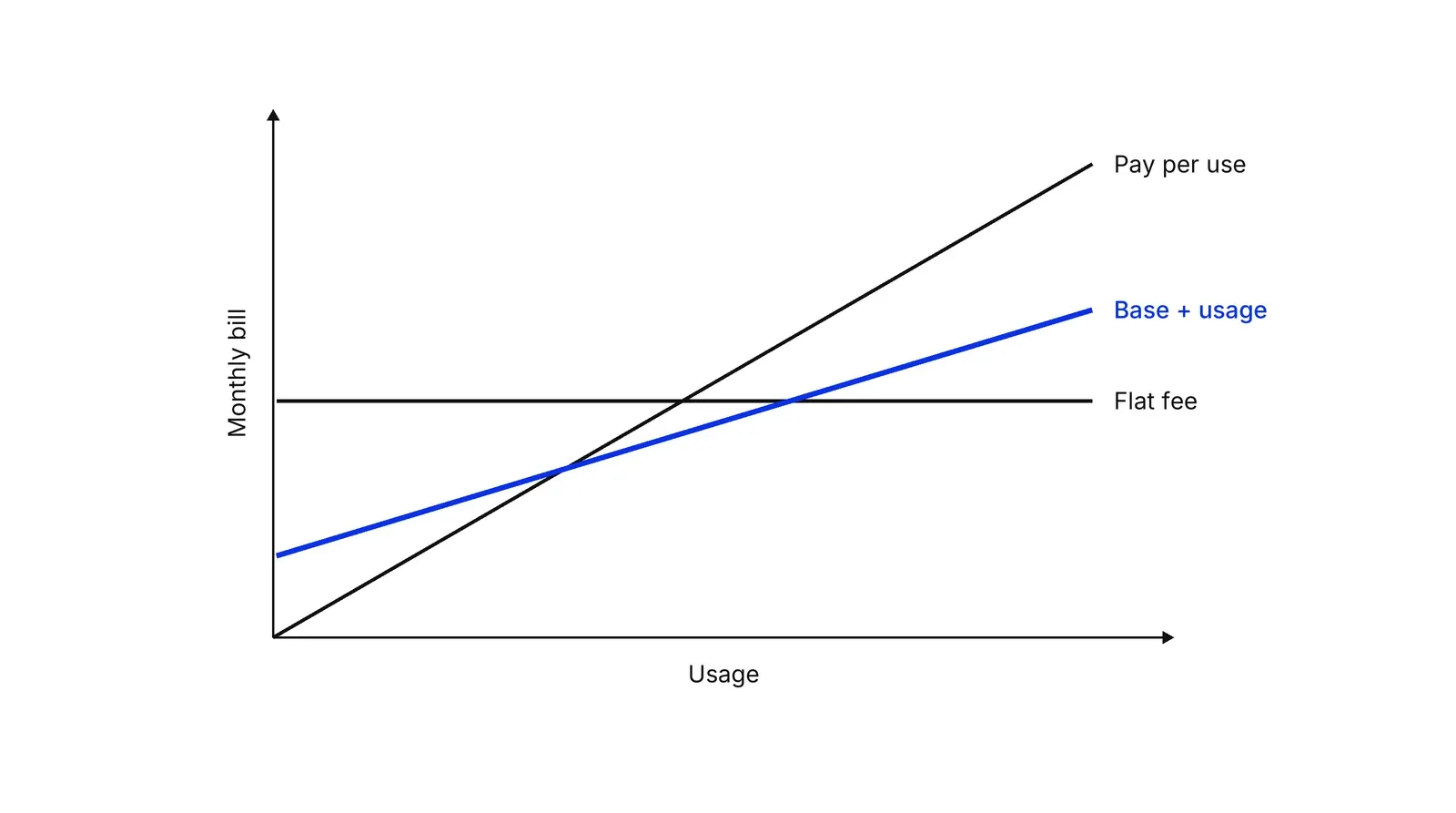
| Base plus usage | A fixed fee covers a floor, usage adds on top | Datadog’s Infrastructure Pro is $15 per host a month on annual billing or $18 on demand, with log ingestion from $0.10 per GB |
Snowflake’s consumption table shows how fine the meter can get: compute is billed per second after a one-minute minimum, and storage by the average terabytes held in a month. The more granular the meter, the closer the bill tracks value, and the harder it is to explain on one page.
The meter is the decision
A meter is the unit you count and bill, and choosing it is the main design choice. Bain’s 2022 report says a good meter is value-based, flexible, scalable, predictable and easy to monitor, and asks three questions: can you tie value to a clear metric, do customers and competitors expect it, and can you build the billing, forecasting and sales incentives to run it.
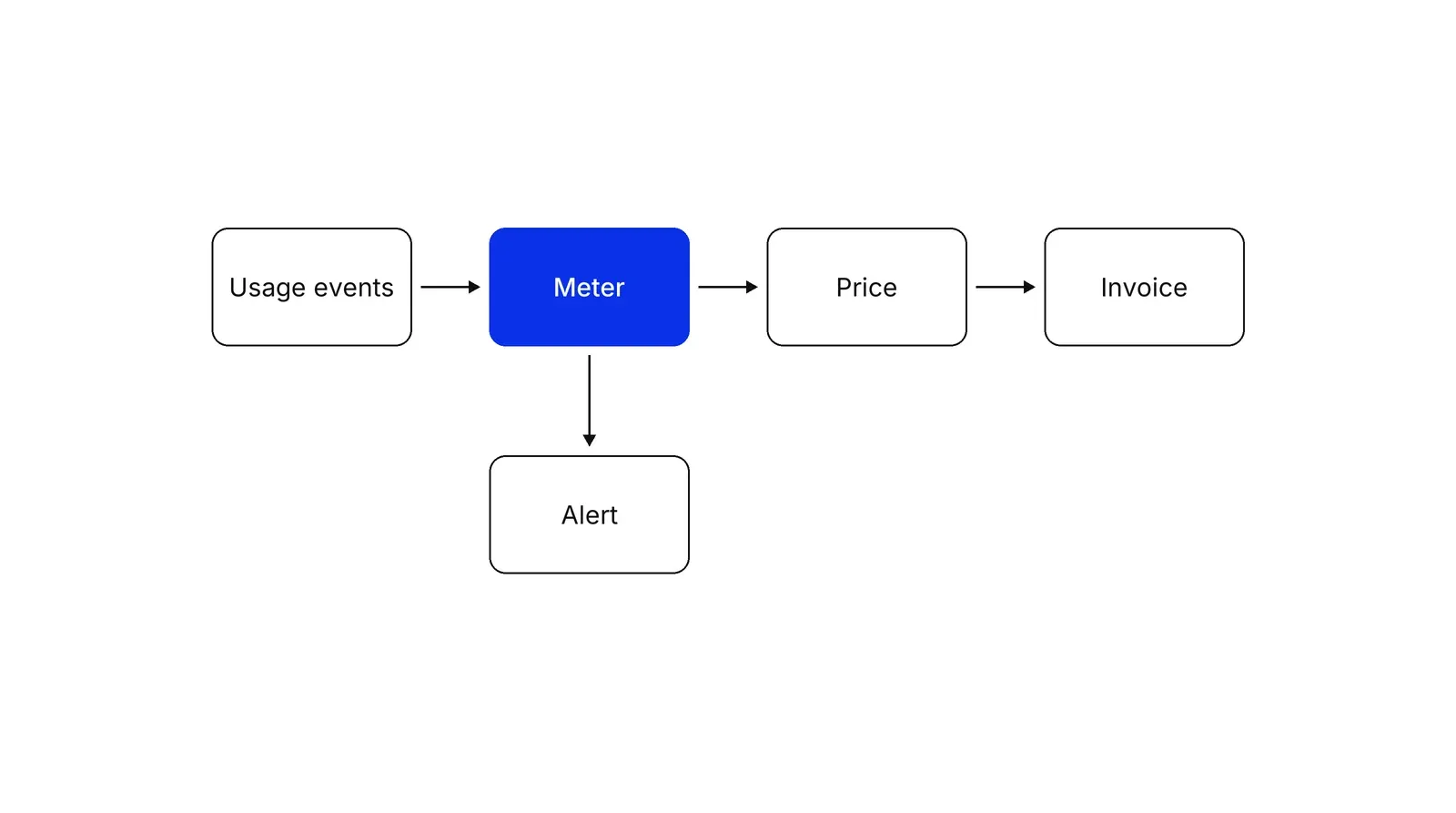
The mechanics are simple to state. Stripe’s documentation describes events reported per customer, aggregated by a meter over the billing period, rated against a price and turned into an invoice, with alerts when a customer crosses a usage threshold.
The meter also decides who bears risk. Under a flat fee the vendor carries the risk of heavy users. Under pure usage pricing the customer carries the risk of a large bill. Michael Grubb’s work on overconfident consumers argues that firms can profit from selling a block of usage and then charging steeply per extra unit, because buyers misjudge their own demand. Grubb and Osborne’s study of cellular bills estimated that overconfidence cost consumers about $76 a year at 2002 to 2004 prices.
What the filings show
Companies that bill on usage report a revenue line that moves with customer activity, and the filings show both directions.
| Company | Retention metric | Reported values |
|---|---|---|
| Snowflake | Net revenue retention rate | 133% (Jan 2024), 126% (Jan 2025), 125% (Jan 2026) |
| Twilio | Dollar-based net expansion rate | 103% (2023), 104% (2024), 108% (2025) |
| Datadog | Dollar-based net retention rate | mid-140s (Dec 2022), mid-110s (Dec 2023), high-110s (Dec 2024), about 120% (Dec 2025) |
The three firms define their metrics differently, so compare each across its own years. Snowflake’s 10-K ties its figure to customers moving more workloads onto the platform. Twilio’s 10-K says most revenue is usage-based and that most usage-based customers have no long-term commitment. Datadog’s 2023 filing attributes its drop in net retention to slower usage growth from existing customers, and its 2025 filing shows the recovery. Retention under a usage meter moves in both directions. For the mechanics of that metric, see net revenue retention.
Surveys point the same way but prove less. TechCrunch reported that OpenView’s 2021 survey of nearly 600 SaaS companies found 45% using usage-based pricing, up from 34% in 2020, a figure Kyle Poyar repeated. Bain found consumption sellers grew about 8 percentage points faster in 2021 and, among the most highly valued software firms, averaged 10 points higher net dollar retention. These are correlations: fast-growing infrastructure companies chose this model, and the model may not have made them grow.
Where it fits, and how it differs from a subscription
Andreessen Horowitz’s rule of thumb is that usage pricing works best when the end user is other software, because usage can grow sharply and telemetry makes billing easy, while people dislike watching a meter. A subscription charges for access whatever the customer does. Under usage pricing the price is a function of activity, which makes an expansion path (land and expand) automatic but revenue forecasts wider. Where a flat-rate product has a free tier, freemium shows how to gate it, and good-better-best tiering suits buyers who want a fixed price for a fixed bundle.
Economic research explains both sides. Peter Danaher’s field experiment with a cellular service found that access fees mainly moved retention and usage charges mainly moved consumption. Nevo, Turner and Williams, studying broadband on a three-part tariff, found that usage-based pricing eliminates low-value traffic, which is exactly what a vendor with real marginal costs wants. A base fee therefore protects retention and a usage charge steers behaviour.
Bain adds the objection every buyer raises: more than 90% of users who prefer subscriptions cite lack of predictability as the main downside of consumption models. Alerts, caps and prepaid credits answer it, and Stripe’s guide lists revenue forecasting and sales compensation as the internal work. A Growth Lab plan starts from a pricing and packaging review like this one: growth lab.
How to apply Usage-based pricing, step by step
- Find the unit that tracks value. List what a customer does with the product and ask which unit grows when the customer gets more out of it: messages delivered, gigabytes stored, checks completed. Drop units the customer cannot see or control. Result: one candidate meter that both sides can understand.
- Prove you can meter it. Check that each event is recorded once, attributed to the right account and visible to the customer in a dashboard. Billing disputes start where counting is unclear. Result: a usage report per customer that finance trusts.
- Choose a shape. Pick pay-as-you-go, tiered rates, prepaid credits or a base fee plus usage. Hybrids suit buyers who need a predictable budget, because the base fee covers the floor. Result: a draft price list with one shape.
- Set the rate from value and unit cost. Price one unit above what it costs you to serve and below what it is worth to the customer, using the method in [value-based pricing](/frameworks/value-based-pricing/). Result: a rate per unit and any volume breaks, with margin shown at each break.
- Build bill-shock protection before launch. Add usage alerts, spend caps or a monthly estimate in the account, so no customer first learns the total from an invoice. Result: alerts that fire at set thresholds, tested on a real account.
- Forecast with a range and track expansion by cohort. Forecast revenue as low, expected and high usage per cohort, and watch [net revenue retention](/frameworks/net-revenue-retention/) quarterly, because usage can fall as well as rise. Result: a revenue forecast with a stated range.
Examples
A KYC check API
Illustrative: a fintech sells identity checks on a [tiered rate](https://stripe.com/en-de/resources/more/usage-based-pricing-101-what-it-is-and-strategies-to-implement-it), $0.40 for early checks and $0.30 beyond a volume break. A lender whose month splits into 10,000 checks at the higher rate and 15,000 at the lower pays $4,000 + $4,500 = $8,500. The lender's bill follows its own applicant volume, which is also when it can afford more.
A clinic's appointment reminders
Illustrative: a clinic software vendor passes messaging through at cost plus a margin. Twilio's published US rate is $0.0083 per SMS segment plus a carrier fee of about $0.0035 to $0.005, so 4,000 reminders at a $0.0045 fee cost 4,000 x $0.0128 = $51.20 before the vendor's margin. The clinic pays only in months it sends.
An analytics tool with a base fee
Illustrative: a product costs $200 a month and includes 1 million events, with $0.50 per extra 10,000. A customer sending 3 million events pays $200 + 200 x $0.50 = $300. The $200 floor keeps revenue predictable while the overage tracks growth.
When to use it
Use it when the product's cost to serve rises with each unit, when customers' needs vary widely, and when you can measure the unit reliably. It suits infrastructure, APIs and data products whose end user is other software, where a flat fee would either overcharge small users or undercharge large ones.
When not to use it
Skip it when buyers need a fixed annual budget, when the product is used by people who dislike watching a meter, or when you cannot count the unit accurately. A seat-based or tiered plan fits these cases better, and a base fee with a usage allowance can cover the middle ground.
Common mistakes
- Choosing a meter the customer cannot predict or control, which turns every invoice into a surprise and every surprise into a churn risk.
- Launching without alerts or caps, so the first sign of a large bill is the bill itself.
- Forecasting revenue as if usage only rises, then discovering that customers cut consumption when budgets tighten.
- Setting the rate by copying a competitor's per-unit price without checking your own unit cost.
- Leaving sales compensation and finance reporting on a fixed-contract logic, so nobody is paid or measured for real consumption.
FAQ
What is usage-based pricing in simple terms?
It means the customer pays for how much of the product they use. A meter counts a unit, such as messages sent or data stored, and a price per unit turns the count into a bill. Variants include pay-as-you-go, tiered rates, prepaid credits and a base fee plus usage.
What is the difference between usage-based pricing and a subscription?
A subscription charges a recurring fee for access, whatever the customer uses. Usage-based pricing charges for measured consumption. Many companies combine them: a base fee plus usage above an allowance. Subscriptions give predictable revenue, and usage pricing links revenue to customer activity.
Does usage-based pricing grow revenue faster?
Evidence is correlational. Bain found that companies selling mainly on consumption grew about 8 percentage points faster than license and subscription sellers. OpenView's partner described gains of 15% to 25% at portfolio companies as anecdotal. Better companies may simply choose this model, so test it on your own data.
What are the main risks of usage-based pricing?
Revenue becomes less predictable, because usage can fall when customers cut costs. Datadog's net retention fell from the mid-140s to the mid-110s percent between 2022 and 2023 on slower usage growth. Customers may also face bill shock, which alerts and caps reduce.
Which products suit usage-based pricing best?
Andreessen Horowitz's rule of thumb is that it works best when the end user is other software, as with APIs, infrastructure and data platforms. Products used by people, who dislike monitoring a meter and whose use has a natural ceiling, usually fit subscriptions better.
Sources
- Snowflake Inc., Form 10-K for the fiscal year ended January 31, 2026, U.S. Securities and Exchange Commission
- Snowflake, Pricing options
- Snowflake, Service Consumption Table
- Twilio Inc., Form 10-K for the fiscal year ended December 31, 2025, U.S. Securities and Exchange Commission
- Twilio, SMS pricing in the United States
- Datadog, Inc., Form 10-K for the fiscal year ended December 31, 2025, U.S. Securities and Exchange Commission
- Datadog, Inc., Form 10-K for the fiscal year ended December 31, 2023, U.S. Securities and Exchange Commission
- Datadog, Pricing
- Amazon Web Services, AWS Pricing
- Amazon Web Services, AWS News Blog, Eight Years and Counting of Cloud Computing
- TechCrunch, Why more SaaS companies are shifting to usage-based pricing, 2021
- Kyle Poyar, Growth Unhinged, Why is usage-based pricing on the rise?, 2021
- Bain & Company, Is Consumption-Based Pricing Right for Your Software? Technology Report 2022
- Andreessen Horowitz, Tugce Erten and Mark Regan, Usage-Based Pricing Is Popular, But Is It Right For You? Our Rule of Thumb, 2023
- Stripe, How usage-based billing works (Billing documentation)
- Stripe, Usage-based pricing 101: what it is and strategies to implement it
- Walter Y. Oi, A Disneyland Dilemma: Two-Part Tariffs for a Mickey Mouse Monopoly, Quarterly Journal of Economics 85(1), 1971
- Peter J. Danaher, Optimal Pricing of New Subscription Services: Analysis of a Market Experiment, Marketing Science 21(2), 2002
- Michael D. Grubb, Selling to Overconfident Consumers, American Economic Review 99(5), 2009
- Michael D. Grubb and Matthew Osborne, Cellular Service Demand: Biased Beliefs, Learning, and Bill Shock, American Economic Review 105(1), 2015
- Aviv Nevo, John L. Turner, Jonathan W. Williams, Usage-Based Pricing and Demand for Residential Broadband, Econometrica 84(2), 2016
- Aviv Nevo, John L. Turner, Jonathan W. Williams, Usage-Based Pricing and Demand for Residential Broadband, NBER Working Paper 21321, 2015
- Jaewon Jang and Youngsun Kwon, Growing use of three-part tariffs by MNOs: Understanding incentives of MNOs, 25th European Regional ITS Conference, 2014
Last updated Oct 9, 2026


Marketing agency or growth system: when a company outgrows its agency
An agency is the right call while the founder still runs most of the company. Once the business starts copying itself into new locations or markets, it needs a system that sets goals, tests hypotheses and owns the result.

Why healthcare marketing agencies stall: the short, mid and long wins model we use with clinics
Most agencies own the click and nobody owns the front desk. How we structure clinic work in three horizons, the research behind each one, and one year of results.

How to calculate channel payback and unit economics
A CAC number that only marketing believes will not survive a finance review. This guide calculates channel payback so both teams work from the same model.