Generative engine optimization (GEO)
Generative engine optimization (GEO) is the practice of editing a page so that AI answer engines cite it more prominently, a term and a benchmark introduced in a 2023 academic paper.
Generative engine optimization (GEO) is the practice of changing a web page so that AI answer engines such as ChatGPT, Perplexity and Google AI Mode cite it more prominently. Aggarwal and colleagues named it in a 2023 paper and found that adding sources, quotations and statistics raised visibility in their tests, while keyword stuffing did not. Google says optimizing for AI search is still SEO.
- Origin
- Pranjal Aggarwal, Vishvak Murahari, Tanmay Rajpurohit, Ashwin Kalyan, Karthik Narasimhan, Ameet Deshpande, 2023 (KDD 2024)
- Level
- 401 · Expert
- Fits
- Startup, Small and mid-size, Scale-up
- Time to apply
- One afternoon to baseline 15 queries and rewrite 3 pages; re-test after a few weeks
- What you need
- 10 to 20 questions a buyer would ask an AI assistant · access to robots.txt and to the pages that should answer them · a source for every number or quote you plan to add
Generative engine optimization (GEO) is the practice of editing a page so that AI answer engines cite it more prominently. The term comes from a paper by Pranjal Aggarwal, Vishvak Murahari, Tanmay Rajpurohit, Ashwin Kalyan, Karthik Narasimhan and Ameet Deshpande, posted on arXiv in November 2023 and presented at the KDD 2024 conference. Search marketers use it for ChatGPT search, Perplexity, Google AI Mode and Yandex’s Alice AI, and the paper is the starting point for most GEO discussion.
Where does GEO act in an answer engine?
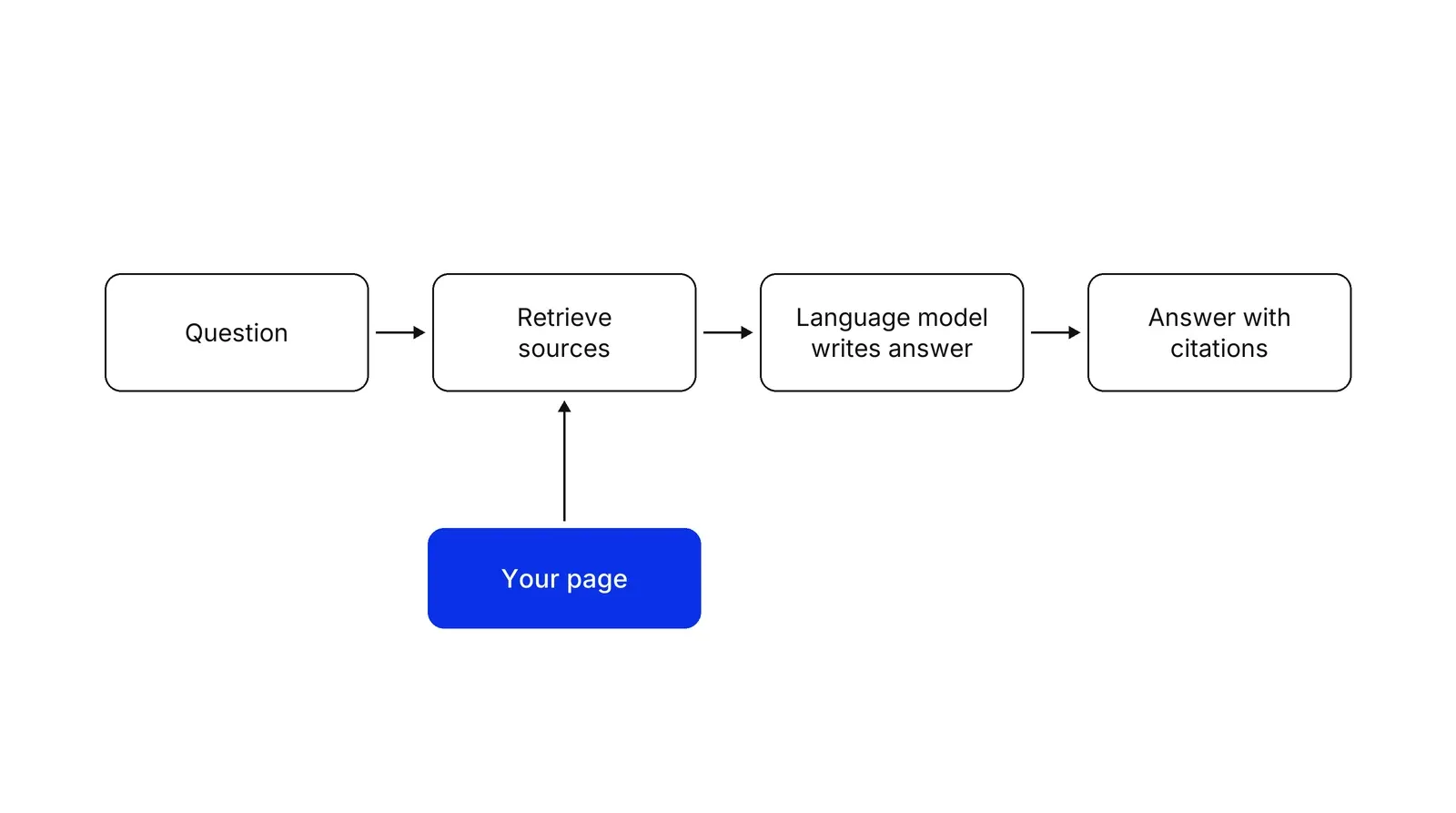
A generative engine first retrieves pages, then a language model writes an answer from them and cites its sources. The paper calls these systems generative engines and treats them as black boxes, the pattern known as retrieval-augmented generation. You cannot change the retrieval or the model. You can change the text of your page, and that is all GEO does.
How did the paper measure visibility?
It measured how much of an answer is built from your page. The authors built GEO-bench, 10,000 queries split 8,000, 1,000 and 1,000 into training, validation and test sets, drawn from nine datasets across 25 domains. Each query carries the text of its top five Google results. About 80% are informational queries.
The test engine fetched those five results and passed them to gpt-3.5-turbo, which wrote the answer; five answers were sampled per query. For each query one source was rewritten by a language model under a given tactic, and the authors compared its share of the answer before and after. Two metrics were used. Position-adjusted word count is the share of answer words tied to your citation, weighted down for later positions. Subjective impression is a model’s score on seven facets such as relevance and likelihood of a click.
Which tactics worked?
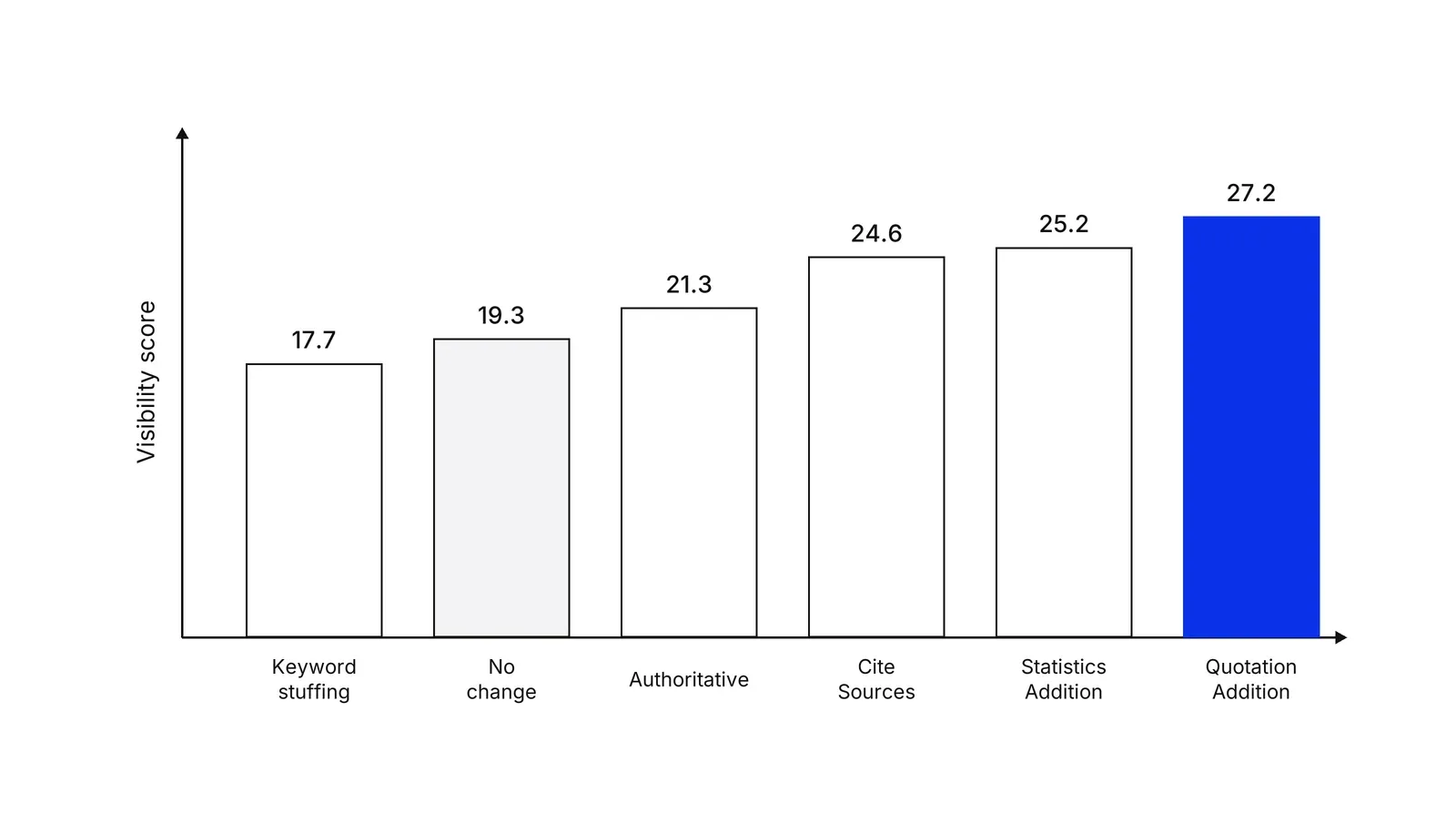
Adding quotations, statistics and cited sources worked best, and keyword stuffing did not work. The paper tested nine tactics against an unchanged baseline of 19.3 on overall position-adjusted word count.
| Tactic | What changes in the text | Overall score |
|---|---|---|
| Quotation Addition | Adds quotes from credible sources | 27.2 |
| Statistics Addition | Replaces qualitative claims with numbers | 25.2 |
| Fluency Optimization | Improves how the text reads | 24.7 |
| Cite Sources | Adds citations to reliable sources | 24.6 |
| Authoritative | Rewrites in a more persuasive tone | 21.3 |
| Keyword Stuffing | Repeats the query’s keywords | 17.7 |
The best tactic beat the baseline by 41% on the first metric and 28% on the second. The authors report that quotations, statistics and cited sources gave 30 to 40% on position-adjusted word count and 15 to 30% on subjective impression, and that fluency edits added 15 to 30% too. They found no significant gain from a more authoritative tone, and keyword stuffing offered little to none.
On Perplexity.ai the pattern held. Quotation Addition moved position-adjusted word count from 24.1 to 29.1, Statistics Addition moved subjective impression from 24.7 to 33.9, and keyword stuffing dropped to 21.9 on the first metric. The best tactic also depended on the topic: citations helped factual questions, statistics helped law and government and opinion queries, and quotations helped people and society, explanation and history. Combining fluency edits with statistics did best, more than 5.5% above any single tactic, on a 200-query subset.
Why did lower-ranked pages gain most?
When every source is optimized, a page ranked fifth in Google gains far more than the first. In the paper’s Table 2, Cite Sources raised the visibility of fifth-ranked sources by 115.1% and lowered the first-ranked source by 30.3% on average. The authors read this as a chance for smaller sites, arguing that because the engine reads page content, backlinks should matter less.
Treat that with care. Only the top five results were fetched, the rewrites were done by a model, and the authors state they did not test effects on search rankings.
What does GEO not tell you?
It tells you how a page already in front of the model gets used, not how it gets there. Martinez’s 2026 survey of 45 GEO studies concludes that the original gains hold once a source is already in context, that topical relevance and context position are the most reproducible levers, that generic tactics transfer poorly and that no technique has shown a stable long-term effect on discoverability. That reading is one author’s, so weigh it as such.
Citations are also loose. Liu, Zhang and Liang found that on average 51.5% of answer sentences in four commercial engines were fully supported by their citations. That is why the numbers you add must be true: the engine may repeat them with your name attached.
What do the engines say?
Google says GEO is still SEO. Its guidance asks for original content, crawlable pages and good page experience, and it says AI features need no special markup and Search does not use llms.txt. Eligibility for AI Overviews and AI Mode is the same as for a snippet in Search.
Other engines publish crawler controls. OpenAI says OAI-SearchBot decides whether a site appears in ChatGPT search answers, while GPTBot relates to training. Perplexity recommends allowing PerplexityBot, and Anthropic runs Claude-SearchBot for search. Vercel’s analysis of crawler traffic in late 2024 found that GPTBot, ClaudeBot and PerplexityBot do not render JavaScript. For Russian-language markets, Yandex says Neuro favours pages that rank well in its Search, and its Webmaster has a visibility report for Alice AI.
Later studies add more signals. Chen et al. found AI search leans heavily toward earned media over brand-owned pages, which is why earned media and link building belong in a GEO plan. Zhang et al. found influential pages hold extractable definitions, numbers and comparisons.
Where to start
Start with the questions buyers ask, a fixed test list and the pages that should answer them; the entity and E-E-A-T work behind those pages decides whether anyone trusts them. Original data from original research gives engines something to quote. Measuring the result is covered in AI share of voice, and what a citation does to clicks in zero-click search strategy. In Pew Research’s browsing data, people clicked a result link in 8% of visits with an AI summary and 15% without one. A Growth Lab plan starts from the buyer’s questions, then picks the pages worth fixing first.
How to apply Generative engine optimization (GEO), step by step
- Write the question list. Collect 10 to 20 questions buyers ask before they choose a supplier: price, risk, comparison, how it works. Use sales calls, support tickets and Search Console queries. Result: a fixed question list you will re-run later.
- Record a baseline. Ask each question in ChatGPT, Perplexity, Google AI Mode and, for Russian-language markets, Alice AI. Repeat each five times, because answers change between runs. Note whether your domain is cited and which page. Result: a table of cited and not cited per engine.
- Remove access blockers. Check that robots.txt allows the search crawlers you want, such as OAI-SearchBot, PerplexityBot and Claude-SearchBot, and that the answer sits in the page's HTML, not behind JavaScript. Result: a list of blockers fixed.
- Rewrite the pages that should answer. On each page, state the answer in the first lines, add numbers that carry a source, add named quotations from people who said them, and link the primary source for each claim. Result: revised pages where every added fact can be traced.
- Smooth the language. Cut filler, shorten sentences and fix awkward phrasing. The paper found fluency edits lifted visibility on their own. Result: pages a stranger can read once and quote.
- Re-run and compare. After the engines have recrawled, repeat the five-run test on the same questions and compare against the baseline. Result: a before and after table, and a decision on which edits to repeat on other pages.
Examples
A dental clinic
Illustrative. A clinic's implant page says implants are 'affordable and long lasting'. The rewrite lists the clinic's own price range per stage, quotes the treating dentist by name on healing time, and links the health authority's patient guidance. Because this is health content, every figure is checked by a clinician before it goes live.
A payments provider
Illustrative. A page on chargebacks gives the card scheme's dispute deadlines with a link to the scheme rules, the provider's own median settlement time with the date it was measured, and a quote from the head of risk on what evidence wins disputes. The page answers the question a merchant types into an assistant.
A B2B software company
Illustrative. A comparison page replaces 'faster than alternatives' with a table of tested import times, the test method and the date, plus one named customer quote used with permission. Each claim links to the documentation that supports it.
When to use it
Use GEO when buyers in your market ask AI assistants for recommendations or explanations, when you already have pages that deserve to be cited, and when you can source the facts you add.
When not to use it
Do not use it as a shortcut for thin pages, as a reason to invent figures or quotes, or as a replacement for indexing and crawl basics. If your audience does not use AI assistants for research, spend the time on ordinary search and sales content.
Common mistakes
- Stuffing keywords. In the paper's test it scored below the unchanged page, and on Perplexity it fell about 10% below the baseline.
- Adding numbers or quotes you cannot source. Engines cite loosely, and a wrong statistic on a health or finance page is a liability regardless of the engine.
- Judging results from one run. The paper sampled five answers per query because a single answer is noisy.
- Blocking the search crawler and expecting citations, or hiding the answer in JavaScript that AI crawlers do not run.
- Treating a citation as traffic. Click behaviour changes when an AI summary appears, so track visits and enquiries as well as citations.
FAQ
What is generative engine optimization?
Generative engine optimization is editing a page so AI answer engines cite it more prominently. The term comes from Aggarwal et al., who defined generative engines, built the GEO-bench benchmark and tested nine content tactics, reporting visibility gains of up to about 40% in their setup.
Is GEO different from SEO?
Google says it is not: optimizing for its AI features is still SEO, and its guide says no extra technical requirements, schema or AI text files are needed. The paper treats GEO as a separate problem, because a model writing from sources responds to different edits than a ranking algorithm.
How do I optimize a site for neural networks?
Make sure the search crawlers of each engine can fetch your pages and that answers are in the HTML. Then state answers early, add sourced numbers and named quotations, and test with a fixed question list. The paper's best edits were quotations, statistics and cited sources.
Does keyword stuffing work in AI search?
No. In Aggarwal et al.'s tests, keyword stuffing scored 17.7 against 19.3 for an unchanged page on position-adjusted word count, and on Perplexity it came out about 10% worse than the baseline. Sourced facts and clear writing performed better.
How do I get into Yandex Neuro and Alice AI answers?
Yandex says Neuro draws on pages that rank well in Yandex Search and answer the question, and that a site can opt out with a rule for YandexAdditional. Webmaster has a report on site visibility in Alice AI. Yandex's advice for that report is expert, useful, original, thorough content.
Sources
- Aggarwal et al., GEO: Generative Engine Optimization (arXiv 2311.09735, KDD 2024)
- GEO project page, Generative Engine Optimization
- GEO-optim, GEO code repository
- Hugging Face, GEO-optim geo-bench dataset
- Google Search Central, Guide to optimizing for generative AI features on Google Search
- Google Search Central, AI features and your website
- Google Search Central, Creating helpful, reliable, people-first content
- OpenAI, Overview of OpenAI crawlers
- Perplexity, Perplexity crawlers
- Anthropic, Does Anthropic crawl data from the web
- Vercel, The rise of the AI crawler
- Pew Research Center, Google users are less likely to click on links when an AI summary appears
- Lewis et al., Retrieval-Augmented Generation for Knowledge-Intensive NLP Tasks
- Liu et al., Lost in the Middle: How Language Models Use Long Contexts
- Liu, Zhang and Liang, Evaluating Verifiability in Generative Search Engines
- Kumar and Lakkaraju, Manipulating Large Language Models to Increase Product Visibility
- Chen et al., Generative Engine Optimization: How to Dominate AI Search
- Kumar and Palkhouski, AI Answer Engine Citation Behavior: An Empirical Analysis of the GEO16 Framework
- Zhang et al., From Citation Selection to Citation Absorption
- Martinez, Optimizing Visibility in Generative Engines: A Critical Survey of GEO (2023-2026)
- Yandex Webmaster blog, Yandex launched Neuro: how it works
- Yandex Webmaster blog, Site visibility in Alice AI answers
Last updated Oct 9, 2026


The compliance layer under fintech marketing operations
A fintech marketing agency can build campaigns. It cannot own the compliance review, the KYC drop-off or the multi-market licensing rules that decide whether a lead ever becomes a customer.

Fractional CMO: what you get, and what has to exist underneath
A fractional CMO brings strategy and judgment. Without reporting, CRM hygiene and a named owner per number, the engagement produces a slide deck instead of a system.

The operations layer behind healthcare patient acquisition
Ads and search bring the request in. What happens between the click and the booked, attended visit decides whether the spend paid off.