End-to-end analytics
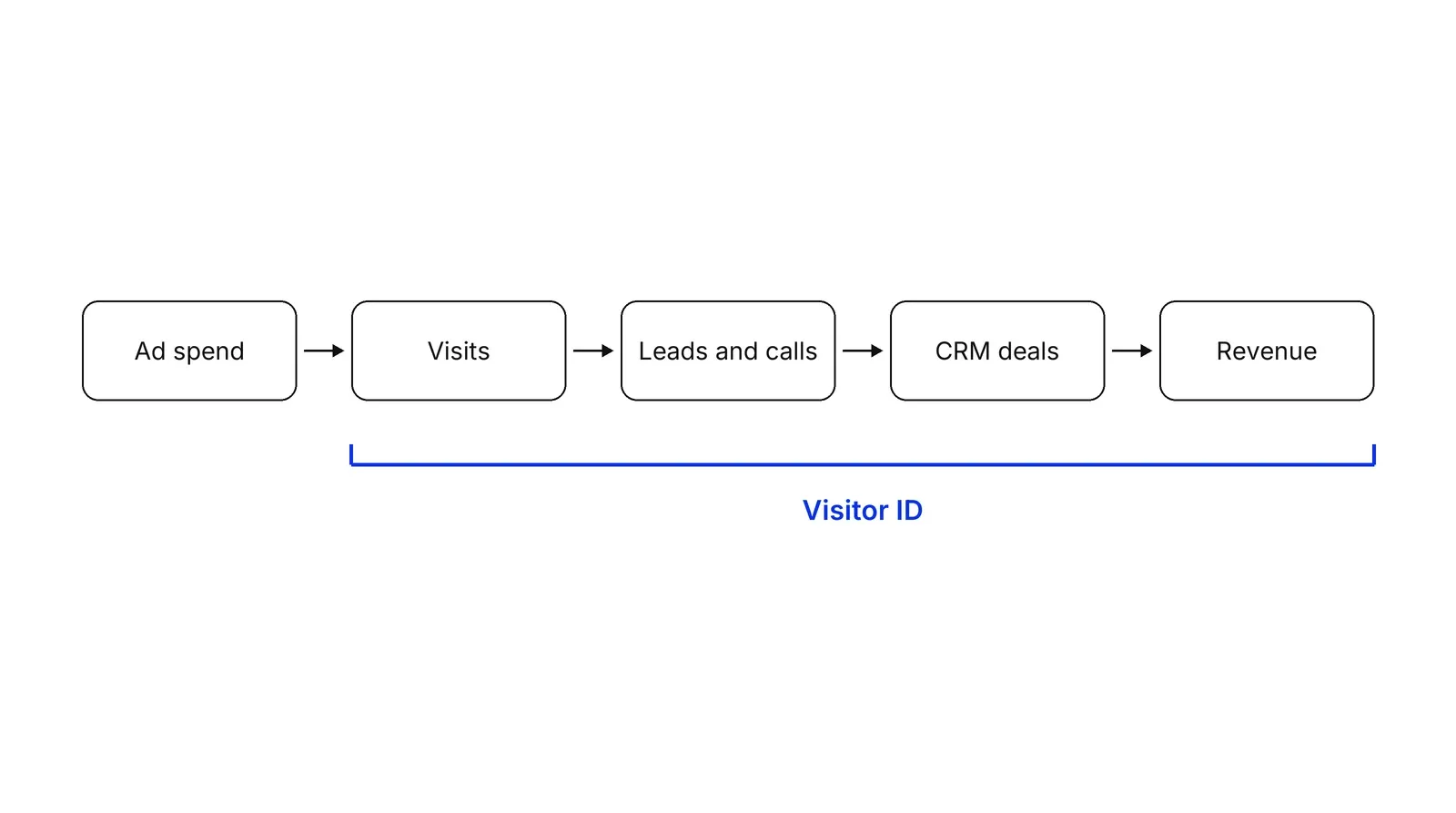
End-to-end analytics links ad spend to visits, leads, calls, CRM deals and revenue, so channels are judged by money earned.
End-to-end analytics (Russian: сквозная аналитика) is a measurement setup that links each ad rouble or dollar to the visits it bought, the leads and calls those visits produced, the CRM deals that followed and the revenue they brought. It lets a team compare channels by cost per paying customer, not by cost per click or per lead.
- Origin
- Runet marketing practice, no single inventor (Yandex Metrica and Russian analytics vendors use the term), No documented origin year
- Level
- 201 · Tool
- Fits
- Startup, Small and mid-size, Scale-up
- Time to apply
- 1 to 2 weeks for a first working chain on one channel
- What you need
- a CRM where every lead and deal is recorded, with a status and an amount · an analytics tag on the site and tagged ad links · a call tracker if phone calls bring in customers · one person who owns the data and can ask developers for changes
End-to-end analytics is a measurement setup that connects advertising spend to site visits, to leads and phone calls, to deals in a CRM and finally to revenue. The name is a translation of the Russian “сквозная аналитика”, a common term in Runet marketing. Yandex Metrica has a menu section called End-to-end analytics, and Russian vendors such as Roistat sell it as a product. Outside that market the same idea goes by closed-loop reporting or lead-to-revenue attribution.
Why stop counting leads
A lead is not a sale. Two channels can bring equal leads at an equal price while only one brings paying customers. Roistat describes the goal as showing which channels generate profit and which only produce costs.
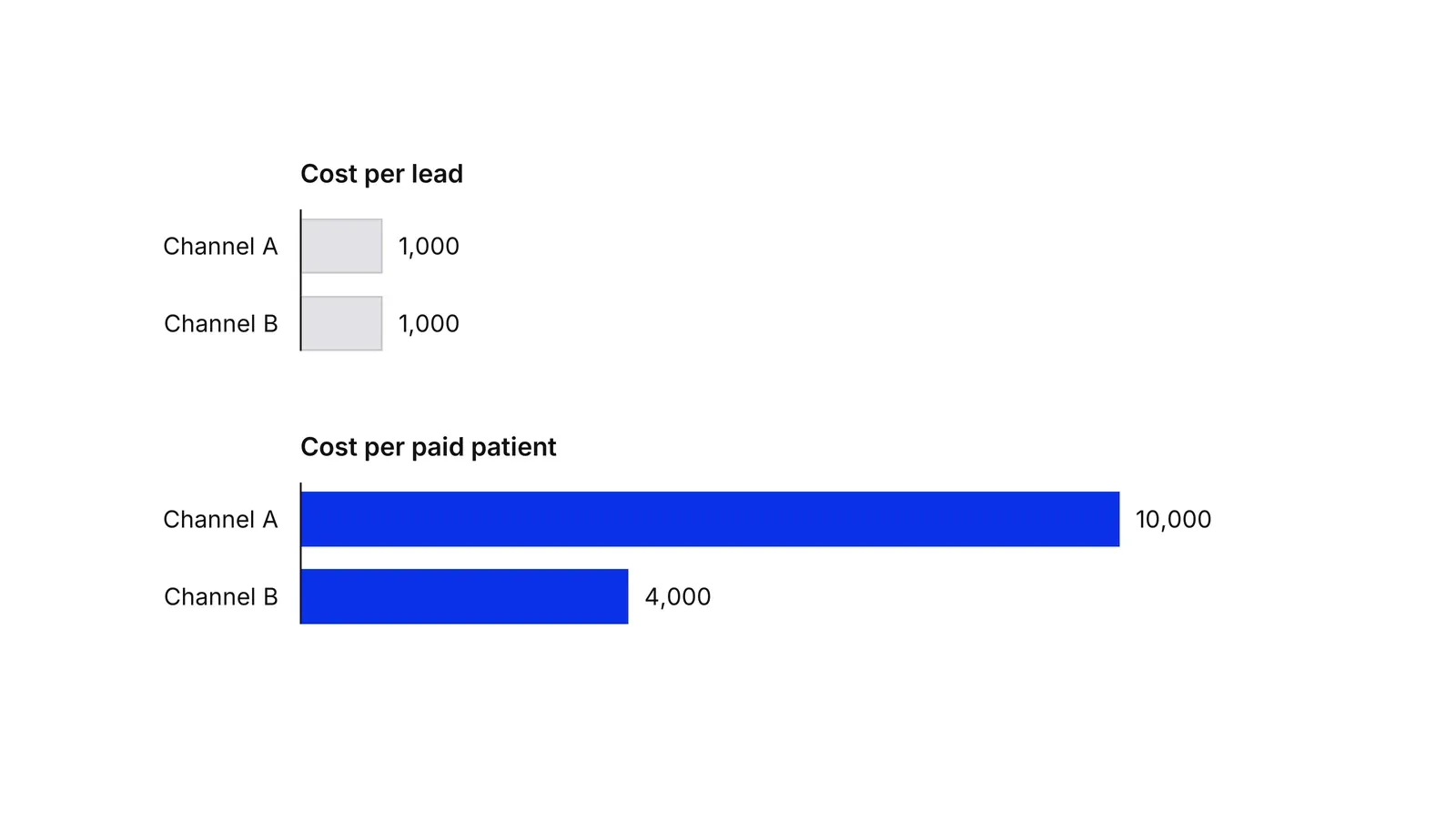
Take the dental clinic from the examples: 1,000 per lead on both channels looks fine, but the CRM shows 10,000 per paid patient on one and 4,000 on the other.
How the pieces join
Each link uses a different key, and most failures come from a missing key. Four joins matter.
Spend to visits runs on tags. Google’s help for campaign URLs says to always use utm_source, utm_medium and utm_campaign, and warns that values are case sensitive. GA4 cost import matches rows on utm_source, utm_medium and the date, then shows non-Google cost per click and return on ad spend under Reports, Acquisition, Non Google campaign. Yandex Metrica pulls Yandex Direct costs automatically, connects Google Ads, Facebook Ads, myTarget and VK Ads through integrations, and takes a CSV for other systems. Its Sources, costs, and ROI report sits under End-to-end analytics.
Visits to leads runs on a visitor ID. Yandex Metrica’s ClientID is the value of the _ym_uid cookie, and its help calls it the most precise way to match offline data. GA4 uses client_id for the same purpose. Google Ads uses a click ID (GCLID), plus hashed email under enhanced conversions for leads, and Yandex Direct uses a yclid. Meta’s Conversions API takes offline events the same way. The site must store the ID in a hidden form field and pass it to the CRM. The event tracking plan is where that field and its name get defined.
Calls to visits needs a call tracker. Metrica’s help describes two modes. With dynamic tracking the service shows each session its own number, and Metrica links the call to the nearest session by time. Static numbers are not linked to sessions at all. A call-tracking vendor such as smrtPhone describes the same mechanism: JavaScript swaps the displayed number according to the visitor’s source. Yandex Direct’s help adds a warning: calls to static numbers can be up to 80% of all calls, and only a CRM upload can attribute them.
Deals to visits runs on the CRM. Metrica accepts CRM orders with an order ID, customer ID, status, revenue and cost, lets you edit them for 111 days, and matches them through ClientID, phone or email (hashed with MD5 if you prefer). Bitrix24 has a ready integration that links the first 21 days of orders on its first run and then refreshes hourly, feeding the Order sources from CRM report, and Roistat maps deal statuses to four groups (Not included, In work, Paid, Cancelled) and stores its own visit number in a cookie called roistat_visit and writes it into a CRM field. For GA4, the Measurement Protocol sends server-side or offline events, but Google states it is meant to augment tag collection from gtag or Tag Manager, not replace it.
Bitrix24 leads reach Metrica as orders only if the Upload leads option is on, and Roistat’s proxy-lead route holds a lead for 2 days if the CRM is down.
Yandex Direct’s help ranks the quality of the match: ClientID plus phone or email is the best, ClientID alone is good, and phone or email alone gives about half the attribution.
Where the chain breaks
The chain is only as long as its shortest window. Yandex Metrica adds offline conversions, uploaded as CSV or through its API with a JavaScript-event goal and a Unix timestamp, only when 21 days or less have passed since the visitor’s last session. GA4 requires an offline event for ad export within 63 days of the latest online event, and a custom timestamp within the last 72 hours. A treatment that closes in two months will fall out of the first window unless the visitor returned.
Calls follow the same 21-day rule: Metrica does not link a call whose session ended after the call or more than 21 days before the data was sent. Upload mechanics add their own delay. Yandex Metrica shows call data within 3 hours of upload, Google Ads asks you to allow 24 to 48 hours for imported conversions, and GA4 attaches an offline event to a session only if it carries a session_id and arrives within 24 hours of that session’s start. Yandex Direct’s Conversion center takes CRM files over FTP, SFTP, an HTTP link or Google Sheets, so a daily export is easy to automate. Roistat’s duplicate check covers the last 12 hours, which matters when a manager re-creates a deal.
Metrica’s own attribution rule also shapes the report, and its automatic attribution option is calculated from April 8, 2023. Its Last click, Last non-direct click and First click models read session history with a 90-day break, and its help page schedules the legacy First click and two Yandex Direct models for removal on May 20, 2026.
Browsers cut the visitor ID itself. Safari’s Intelligent Tracking Prevention, built on WebKit, deletes script-written storage after 7 days without a visit and caps cookies at 24 hours when the landing URL carries a click ID. A patient who clicks an ad, thinks it over for ten days and then books may arrive as a new, unattributed visitor.
Lag also bends recent numbers. Google Ads says conversions can be reported up to 90 days after the click, advises ending report ranges at least 30 days ago, and offers a Days to conversion segment to measure your own lag. In a long-cycle business the last month will always look worse than it is.
Privacy is the last limit. Google’s Analytics policy forbids sending data it could recognize as personally identifiable, such as emails or phone numbers. For a clinic, a diagnosis in a custom field is worse. Send amounts and statuses, and check local health-data law with a lawyer.
What it does not prove
End-to-end analytics counts what happened. It cannot say what would have happened without the ad. In a study of 15 Facebook experiments, Brett Gordon, Florian Zettelmeyer and co-authors found observational methods often failed to match randomized results, even with extensive data. A follow-up by Gordon, Robert Moakler and Zettelmeyer on 663 experiments found the same with machine-learning methods: for lower-funnel outcomes the experiments’ median lift was 5%, while double/debiased machine learning estimated 24% and propensity matching 64%. Ron Berman of Wharton showed in Marketing Science in 2018 that last-touch credit can overpay ad exposures and cut advertiser profit, and that the Shapley value method does better. Which touch gets credit is a separate question, covered by attribution models. To test whether a channel adds sales, run incrementality testing next to the report. The numbers also feed ROAS and DRR, and sit inside the wider unified measurement approach.
If visitor IDs live in several tools, a customer data platform can hold them in one profile, and customer journey analytics extends the joined data to whole paths. A Growth Lab plan starts from the CRM statuses and the budget decision the report must support.
How to apply End-to-end analytics, step by step
- Agree what counts as a lead and a sale. Write down the CRM statuses for qualified, booked, paid and cancelled, and who changes them. Result: a short status list the sales team accepts.
- Tag every ad link. Add utm_source, utm_medium and utm_campaign in lowercase to every paid link and to cost files. Result: one naming sheet that ads and analytics follow.
- Capture the visitor ID with every lead. Save the analytics client ID, and the ad click ID where the ad system provides one, in a hidden field of every form and pass it to the CRM. Result: each new lead record carries the ID of the visit that produced it.
- Track calls. Install a call tracker that swaps the number for each session and sends calls to your analytics tool. Result: calls from the site arrive with a source.
- Send deal results back. Upload paid orders and amounts from the CRM to the analytics tool, within its upload window. Result: reports that show revenue by campaign.
- Reconcile once a month. Compare the CRM total with report revenue and count deals with no source. Result: a known share of unattributed revenue.
Examples
A dental clinic, two channels
Illustrative. A clinic spends 100,000 on each of two channels and gets 100 leads from each, so cost per lead is 1,000 for both. The joined CRM data shows 10 paid patients from channel A and 25 from channel B, so cost per paid patient is 10,000 and 4,000. A report that stopped at leads would call them equal.
A fintech onboarding funnel
Illustrative. A payments company buys search ads and partner banners. Sign-ups are cheap on banners, but the CRM marks most as rejected at verification. Joining status to source shows banner traffic costs far more per approved account, so the team moves budget to search.
When to use it
Use it when you pay for traffic and the sale closes later in a CRM, by phone or in person, as in clinics, B2B services, education or financial products. It pays off once you run more than one channel.
When not to use it
Skip it for an online shop whose checkout already reports revenue to the ad platform, or when a handful of monthly leads lets sales name every source. It counts what happened, so it cannot alone prove a channel caused sales.
Common mistakes
- Buying a service before cleaning the CRM. Empty statuses and duplicate deals flow straight into the report.
- Tagging links with mixed spellings. Imported cost rows match only on exact utm values, so Facebook and facebook become two campaigns.
- Reading recent weeks as final. Deals close weeks after the click.
- Sending names, phone numbers or diagnoses to an analytics tool in plain form. Google's Analytics policy forbids passing personally identifiable information.
- Treating attributed revenue as proof of cause. Observational attribution can disagree sharply with experiments.
FAQ
What is end-to-end analytics?
A setup that follows a customer from the paid ad through the visit, the lead or call and the CRM deal to booked revenue, giving cost and profit per channel or campaign. Western teams call it closed-loop or lead-to-revenue reporting.
How is end-to-end analytics different from web analytics?
Web analytics stops at the site: sessions, goals, online orders. End-to-end analytics adds what the site cannot see: phone calls, CRM statuses and later offline payments. Yandex Metrica and Google Analytics 4 accept that data by import or API.
Which tools do you need?
A web analytics tag, a CRM, a call tracker if calls matter, and a way to load costs. Some teams use Yandex Metrica or GA4; others buy a service such as Roistat. Keeping one visitor ID from first visit to paid deal matters more than the brand.
Why do the numbers never match the ad platform?
Each system uses its own attribution rule and window. Yandex Metrica notes its figures can differ from Yandex Direct, Yandex Market, Google Ads and Facebook Ads. Treat the CRM as the source of truth for revenue and compare against it.
How long can a CRM sale still be linked to a visit?
Yandex Metrica adds offline data only if 21 days or less passed between the last session and the upload. GA4 accepts events for ad export up to 63 days after the last online event. Upload paid deals soon after they close.
Sources
- Yandex Metrica Help, Importing offline data
- Yandex Metrica Help, How to track calls in Yandex Metrica
- Yandex Direct Help, Offline conversions
- Yandex Direct Help, Call and request conversions
- Yandex Metrica Help, Connecting to Bitrix24 to upload data from a CRM
- Yandex Metrica Help, Sources, costs, and ROI report
- Yandex Metrica Help, Attribution model
- Google, Measurement Protocol overview for GA4
- Google, Measurement Protocol use cases for GA4
- Google Analytics Help, Import cost data
- Google Analytics Help, Collect campaign data with custom URLs
- Google Analytics Help, Best practices to avoid sending personally identifiable information
- Google Ads Help, Upgrading offline conversion imports
- Google Ads Help, About offline conversion imports
- Google Ads Help, Find out how long it takes for your customers to convert
- Meta for Developers, Conversions API
- Roistat (vendor), Setting up end-to-end analytics
- Roistat (vendor), End-to-end analytics
- smrtPhone (call tracking vendor), Dynamic number insertion overview
- WebKit, Tracking Prevention in WebKit
- Ron Berman, Beyond the Last Touch: Attribution in Online Advertising, Marketing Science 37(5), 2018
- Brett R. Gordon, Florian Zettelmeyer, Neha Bhargava, Dan Chapsky, A Comparison of Approaches to Advertising Measurement, Marketing Science 38(2), 2019
- Brett R. Gordon, Robert Moakler, Florian Zettelmeyer, Close Enough? Non-Experimental Approaches to Advertising Measurement, arXiv
Last updated Oct 9, 2026


The compliance layer under fintech marketing operations
A fintech marketing agency can build campaigns. It cannot own the compliance review, the KYC drop-off or the multi-market licensing rules that decide whether a lead ever becomes a customer.

Fractional CMO: what you get, and what has to exist underneath
A fractional CMO brings strategy and judgment. Without reporting, CRM hygiene and a named owner per number, the engagement produces a slide deck instead of a system.

The operations layer behind healthcare patient acquisition
Ads and search bring the request in. What happens between the click and the booked, attended visit decides whether the spend paid off.