Rule of 40
The Rule of 40 is a benchmark for software companies: annual revenue growth rate plus profit margin should add up to at least 40%, which ties how much you may lose to how fast you grow.
The Rule of 40 is a benchmark for software companies that says annual revenue growth rate plus profit margin should add up to at least 40%. A company growing 20% should earn a 20% margin, and one growing 40% can break even. Venture investors Brad Feld and Fred Wilson popularized it as a quick check on the balance between growth and profitability.
- Origin
- Brad Feld and Fred Wilson (popularized); an unnamed late-stage investor (first stated), 2015
- Level
- 301 · Advanced
- Fits
- Scale-up
- Time to apply
- an hour to compute the score from last year's accounts, then a quarterly review
- What you need
- twelve months of revenue or recurring revenue, to compute year-over-year growth · your profit statement and cash flow statement, so you can pick one profit measure · a decision on who owns the number, usually the finance lead
The Rule of 40 is a benchmark for software companies that says revenue growth rate plus profit margin should total at least 40%. It ties two things that usually pull against each other, spending to grow and earning a profit, into one number. Venture investors use it as a fast health check on SaaS (software as a service) companies once they reach scale.
Brad Feld, a venture investor, published the rule on 3 February 2015. He wrote that he had heard it at a board meeting from a late-stage investor whose firm called it the 40% rule, and he never named that person. Fred Wilson, another investor who was at the same meeting, posted his own version a week later. So the rule has two popularizers and an anonymous originator, and later sources, including Bain, simply say venture capitalists began to popularize it in 2015.
How do you calculate it?
Add the annual revenue growth rate to the profit margin, both in percent. Feld’s examples: growth of 20% needs a 20% profit, growth of 40% can be a 0% profit, and growth of 50% can lose 10%. Wilson’s go further: 100% growth allows a 60% loss, and a business shrinking 10% needs a 50% margin.
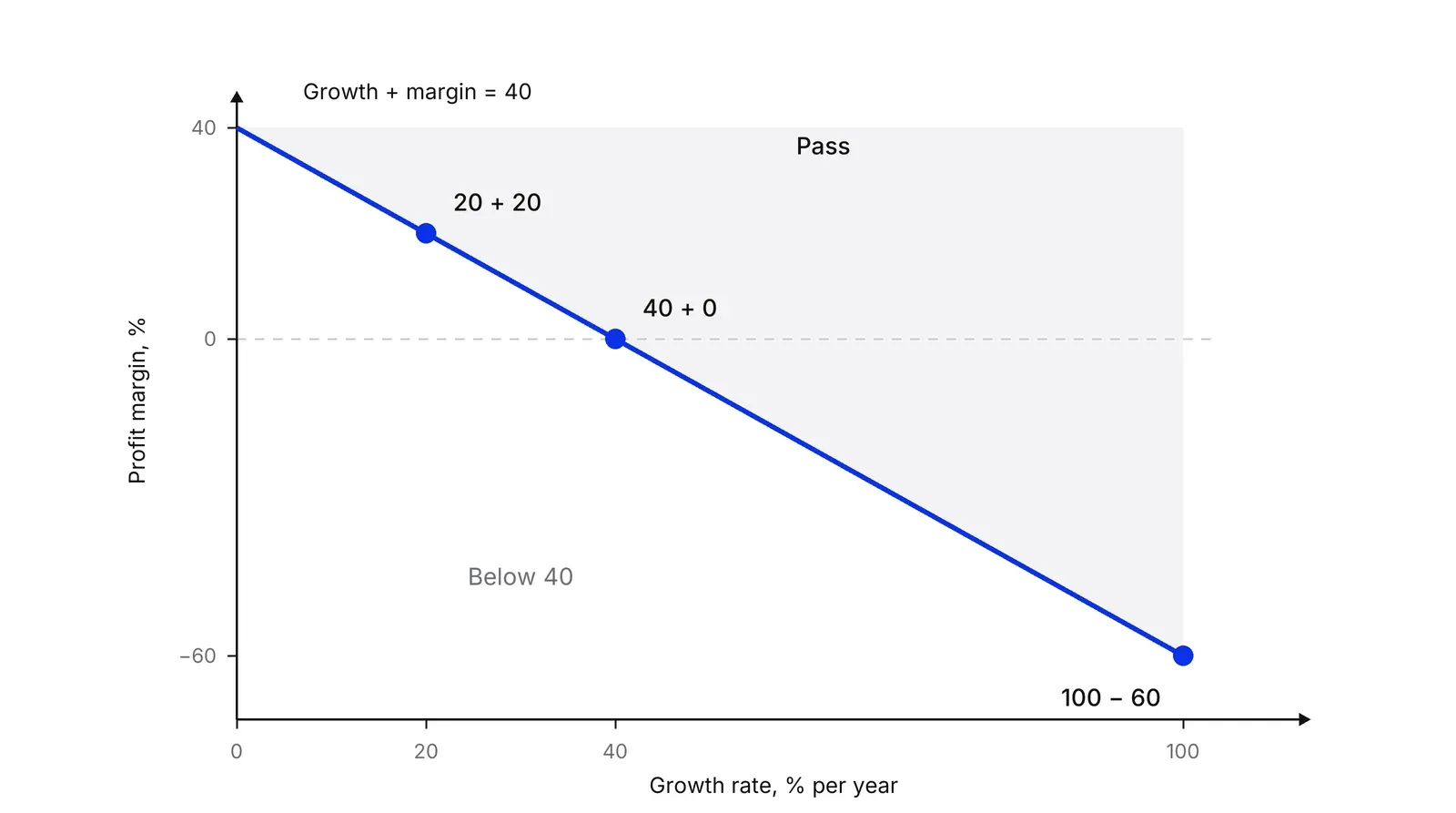
Feld said the rule is for SaaS companies at scale, which he put at around $50 million in revenue, and that his product-market fit heuristic lines up with it once monthly recurring revenue reaches about $1 million. His advice to venture-backed founders was to chase growth first, along the T2D3 path (triple, triple, double, double, double) that Neeraj Agrawal of Battery Ventures described, and then turn to the 40% rule. Wilson later added that it suits businesses with a well-understood link between value and revenue that are reasonably developed. Wilson also wrote that there is no magic in the number 40, and that he liked the idea of tying acceptable losses to growth.
Which profit measure should you use?
There is no agreed answer. Feld preferred EBITDA (earnings before interest, tax, depreciation and amortization) as the baseline and advised back-testing with operating income, net income and free cash flow, because they diverge for companies that run their own infrastructure. Wilson first wrote operating margin, then pre-tax operating margin. Bain says analysts have differed, that most use EBITDA, and uses it too.
McKinsey and Bessemer use free cash flow, which McKinsey defines as cash flow from operations minus capital expenditure. Meritech, which publishes public benchmarks, goes further and also subtracts capitalized software costs and uses next-twelve-month figures, according to its March 2026 note. Ray Rike of SaaS Barometer notes that private companies often use free cash flow margin with recurring revenue growth, while some accept EBITDA at earlier stages.
The practical point is to choose one definition and state it. For the plain mechanics of cash, see cash flow.
Does a high score mean a higher valuation?
On average, in public software, yes, but the size of the effect depends on who measured it and when. Bain’s 2018 brief reported that companies above the line had enterprise value to revenue double those below it, with returns up to 15% above the S&P 500. Its 2020 article, using different data, said companies that beat the rule were about three times more valuable on that ratio, and that higher growth lifted value about twice as much as stronger cash flow.
McKinsey’s 2021 article found that top-quartile SaaS companies earned nearly three times the multiples of the bottom quartile. An academic test by King Fuei Lee on 1,771 SaaS companies from 2003 to 2022 found the rule added value as a stock-selection screen, and proposed a “Rule of 65” that did better.
These are correlations, and few companies stay above the line. McKinsey found software companies exceeded the rule 16% of the time across more than 200 firms over 2011 to 2021. Bain found that of 86 public companies from 2013 to 2017, only 16% beat it in all five years. KeyBanc’s 2021 private survey, as analyzed by SaaStr, had 50 of 173 companies above $5 million in recurring revenue qualify, about 29%. KeyBanc and Sapphire’s own survey of more than 100 private companies, with median 2023 recurring revenue of about $26 million, reported the benchmark improving, mainly through EBITDA margin gains.
Why the same score can mean different companies
Two companies can both score 40 and look nothing alike. SaaS Capital notes that one growing 40% at breakeven and one with zero growth and a 40% free cash flow margin are fundamentally different companies.
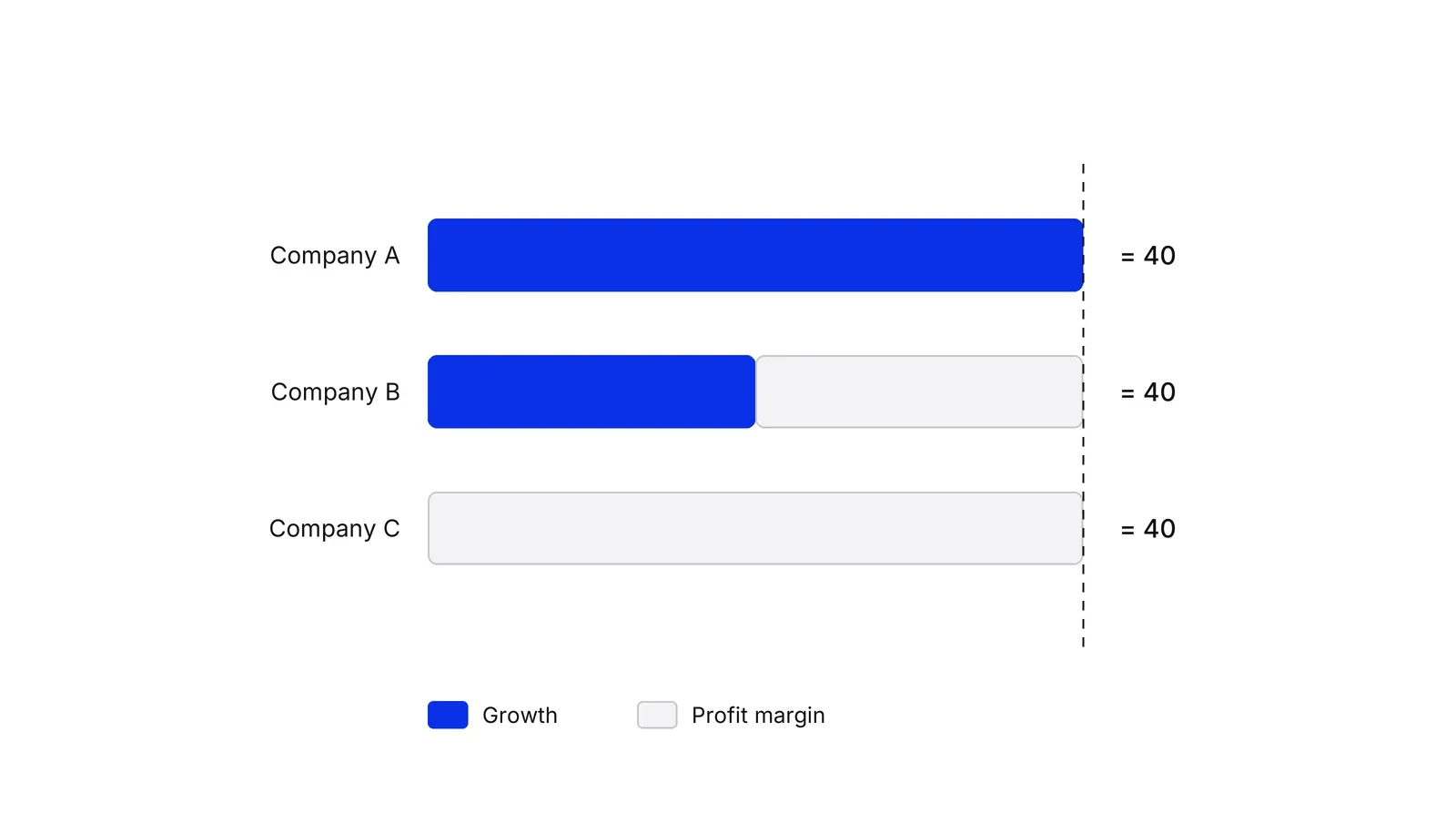
Meritech’s data shows the market notices. In its March 2026 note, companies with similar scores had a median multiple of 9.3 when growth drove the score, against 3.3 when high free cash flow margins did. Check the growth and margin parts, then look at the drivers behind each: net revenue retention, payback and the wider set in unit economics. The magic number and the other SaaS metrics sit underneath both halves.
Where does the rule break?
It breaks when the two halves are treated as equal. Bessemer’s Byron Deeter and Sam Bondy argued in January 2024 that for late-stage companies growth should count two to three times as much as free cash flow margin, and proposed the Rule of X: growth multiplied by that weight, plus free cash flow margin. Jamin Ball’s Clouded Judgement put the weight public markets applied in February 2024 at 3.0. Deeter told Fortune the rule still works for earlier stages but is being applied to all stages incorrectly. Feld, who started it, answered in 2026 that weighting the inputs shows the flat number was never the whole story.
Bessemer had already offered an Efficiency Score in 2016: growth plus free cash flow margin, the same idea with cash in place of profit. Wilson, for his part, proposed in 2017 a different test: annual value created should be a multiple of the cash consumed.
Slow growth is the other trap. SaaS Capital’s 2025 survey of private B2B companies found Rule of 40 scores fell from 2023 to 2025 at almost every size, with falling revenue growth the main driver. A Growth Lab plan starts from which side of the sum is cheaper to move.
How to apply Rule of 40, step by step
- Fix how you measure growth. Choose one growth figure and keep it: year-over-year growth of monthly recurring revenue (Feld's preference), annual recurring revenue, or total revenue. Strip out one-off services revenue so it does not inflate the number. Result: a single growth percentage you can repeat every quarter.
- Choose one profit measure. Pick EBITDA margin, operating margin or free cash flow margin and write down which. Sources disagree, and the three can differ a lot for a company with heavy equipment, capitalized software or stock-based pay. Result: a written definition of profit that finance and investors both accept.
- Add the two numbers. Growth of 25% with a 10% margin scores 35. Growth of 15% with a 30% margin scores 45. Compute it for the last twelve months and, separately, for next year's plan. Result: a trailing score and a forward score.
- Read the mix, not only the sum. Look at how much of the score comes from growth and how much from margin. Public-market data from Meritech shows that companies with similar scores trade at very different revenue multiples depending on that split. Result: a note saying whether your score is growth-led or margin-led.
- Compare with companies of your size. Benchmarks for a small private company and a large public one are different things. Use private surveys for private firms and public data for public ones. Result: a peer range you can hold your score against.
- Turn the gap into a budget rule. If you are below 40, decide which side to move, and by how much, before the next planning round. For example: hold growth at 30% and add ten points of margin through lower acquisition cost. Result: one stated target for growth and one for margin.
Examples
A payments software vendor
Illustrative arithmetic, no real company implied. Per 100 of last year's revenue, a B2B payments software vendor adds 55 and burns 20 in free cash flow, so its score is 55 minus 20, or 35, five points short. Because its growth is high, the board asks for margin gains first, and the team looks at sales and marketing efficiency, using CAC payback and the LTV to CAC ratio, before cutting product spend.
A clinic scheduling platform
Illustrative arithmetic, no real company implied. A healthcare scheduling platform adds 12 per 100 of revenue and keeps 30 as EBITDA, so it scores 42 and passes. Bain's 2018 brief found that software companies growing faster than 10% in the mid-2000s later averaged growth below 10% and did not recover, so a pass built mostly on margin needs a growth plan next to it.
The same 40 reached two ways
SaaS Capital points out that a company with 40% growth and zero profit and a company with 40% free cash flow margin and zero growth both score 40 and are very different businesses. The first is spending to expand and the second is harvesting. Compare the two parts every time you report the total.
When to use it
Use it when a software or subscription business has passed early product-market fit and the board is arguing about whether to spend on growth or protect margin. It gives that argument a single line to point at. It also works as a quick screen when comparing your company with peers or with investment targets.
When not to use it
Skip it before product-market fit, where burn multiples and retention matter more, and for businesses without recurring revenue or high gross margin, unless you read the trend over several years as Feld suggests for hardware. Bessemer also says it should not be applied to every stage and that late-stage companies near breakeven should weight growth more.
Common mistakes
- Mixing definitions between periods, for example EBITDA margin one quarter and free cash flow margin the next, so the score moves without the business changing.
- Treating the sum as the whole story. A 40 from growth and a 40 from margin are different companies with different valuations.
- Using recognized revenue when one-time implementation fees are large, which flatters growth. Feld recommends checking against recurring revenue.
- Chasing the number by cutting spending that drives next year's growth, then missing the next year's score.
- Applying a rule Feld wrote for scaled SaaS to a company that has only just found product-market fit, where the benchmarks and the economics differ.
FAQ
What is the Rule of 40?
It is a SaaS benchmark saying revenue growth rate plus profit margin should total at least 40%. Feld's February 2015 post says he heard it from an unnamed late-stage investor at a board meeting, and Wilson posted his own version a week later. It works as a quick check, not as an accounting standard.
Should the Rule of 40 use EBITDA or free cash flow?
Sources disagree. Feld prefers EBITDA and back-tests with other measures. Wilson used operating margin. Bain uses EBITDA, while McKinsey and Bessemer use free cash flow. The right answer is to pick one, state it, and keep it constant, because the choice can move the score by many points.
Do companies that pass the Rule of 40 have higher valuations?
In studies from Bain and McKinsey, yes, on average. Bain's 2018 brief reported about double the enterprise value to revenue ratio, and Bain's 2020 article about triple. McKinsey's 2021 article reported nearly three times between top and bottom quartiles. These are correlations in public software, and Meritech shows growth carries more weight than margin.
How many companies actually meet the Rule of 40?
Few do for long. McKinsey's 2021 analysis found software companies beat it only about one time in six across more than 200 firms. Bain's 2018 brief found 40% of 124 public companies passed in a single year, but only 16% of 86 passed in all five years studied.
Does the Rule of 40 work outside SaaS?
Only loosely. Wilson's 2017 post says it suits businesses with a well-understood link between revenue and value. Feld's 2026 hardware post argues it can apply to hardware if you read the multi-year curve rather than one snapshot, because hardware lacks the early, steady margins of software.
Sources
- Brad Feld, The Rule of 40% For a Healthy SaaS Company, Feld Thoughts, 3 February 2015
- Brad Feld, Does the Rule of 40 Work for Hardware?, Feld Thoughts, 15 June 2026
- Brad Feld, The Illusion of Product/Market Fit for SaaS Companies, Feld Thoughts, January 2015
- Fred Wilson, The 40% Rule, AVC, 10 February 2015
- Fred Wilson, Profits vs Growth, AVC, June 2015
- Fred Wilson, Some Thoughts On Burn Rates, AVC, September 2017
- Neeraj Agrawal, The SaaS travel adventure, TechCrunch, 1 February 2015
- Thierry Depeyrot and Simon Heap, Hacking Software's Rule of 40, Bain & Company, 20 December 2018
- Mark Brinda and Bill Radzevych, The Five Habits of Highly Successful Software Companies, Bain & Company, 10 July 2020
- Paul Roche and Sid Tandon, SaaS and the Rule of 40: Keys to the critical value creation metric, McKinsey, 3 August 2021
- Byron Deeter and Sam Bondy, The Rule of X, Bessemer Venture Partners, 2 January 2024
- Fortune, Bessemer Venture Partners says the Rule of 40 valuation metric is changing, 17 January 2024
- Jeff Epstein and Josh Harder, How to estimate a company's health without really trying, TechCrunch, 28 November 2016
- Jamin Ball, Clouded Judgement 2.23.24, Rule of X
- Meritech Capital, Meritech Software Pulse, 6 March 2026
- Ray Rike, SaaS Barometer Newsletter: Rule of 40 vs Rule of X, 3 February 2024
- SaaS Capital, Growth, Profitability, and the Rule of 40 for Private SaaS Companies, 21 August 2025
- SaaS Capital, The Rule of 40 is Dead... Long Live the Rule!, 14 March 2024
- Matt Harney, SaaS Rule of 40 Drivers Using KeyBanc's 2021 SaaS Survey, SaaStr
- Sapphire Ventures, KeyBanc Capital Markets and Sapphire Ventures Private SaaS Company Survey press release
- King Fuei Lee, Evaluating Stock Selection in the SaaS Industry: The Effectiveness of the Rule of 40, MPRA Paper 121568, 2024
Last updated Oct 9, 2026


How to calculate channel payback and unit economics
A CAC number that only marketing believes will not survive a finance review. This guide calculates channel payback so both teams work from the same model.

Fractional CFO vs finance operations: which gap do you actually have
A fractional CFO is a person. Finance operations is a system. Companies searching for one are often missing the other, or both.