Peak-end rule in CX
The peak-end rule says people judge a past experience mostly by its most intense moment and its last moment, so a service team can change how a visit is remembered by fixing the worst point and redesigning the ending.
The peak-end rule is a finding from memory research: when people look back on an experience, they judge it mostly by its most intense moment and by how it ended, and give little weight to how long it lasted. In customer experience it tells a team where to spend effort: remove the worst moment of a visit and design the final minutes on purpose.
- Origin
- Daniel Kahneman, Barbara Fredrickson, Charles Schreiber, Donald Redelmeier, 1993
- Level
- 301 · Advanced
- Fits
- Small and mid-size, Scale-up
- Time to apply
- a half-day workshop to map one visit and score its moments; a few weeks to change the peak and the ending
- What you need
- a map of one customer visit, step by step, from first contact to the last thing the customer sees · real customer feedback on how each step felt, not only a final score · someone who owns the end of the visit, such as billing or the exit conversation
The peak-end rule is the finding that people judge an experience mostly by its most intense moment and by how it ended, and give little weight to how long it lasted. Daniel Kahneman and colleagues showed it in a 1993 cold-water experiment. Customer experience teams use it as a prioritization rule: the visit the customer remembers is a short summary, so the worst point and the last point of the visit deserve the most attention.
What the experiments showed
The cold-water study is the clearest picture of the effect. Thirty-two students put one hand in water at 14 °C for 60 seconds, and the other hand in water at 14 °C for 60 seconds followed by 30 more seconds while the water warmed to 15 °C. The second trial held all of the first one’s discomfort plus an extra half minute, and it ended a little better. Offered a third trial, 22 of the 32 (69%) chose to repeat the longer one; in a replication, 24 of 37 did.
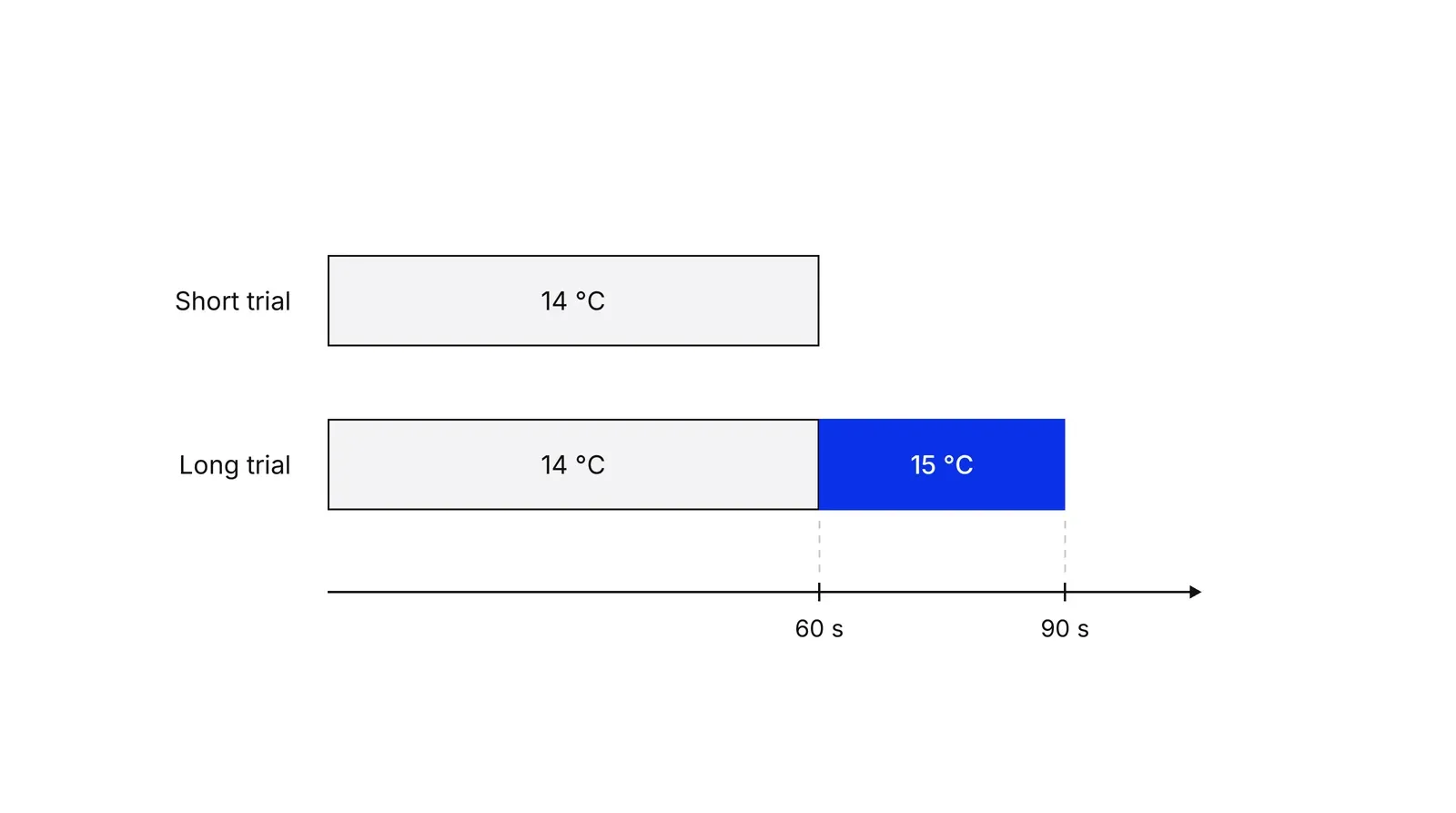
The effect appears outside the lab. In a 1996 study of 154 colonoscopy and 133 lithotripsy patients, remembered pain tracked the peak intensity and the last 3 minutes, and long procedures were not remembered as worse. The 2003 randomized trial described below then tested it by changing the ending.
Kahneman also talks about the pattern as two selves: an experiencing self and a remembering self. The colonoscopy trial below suggests the remembering self is the one that decides about coming back.
How strong is the effect?
A 2022 meta-analysis pooled 174 effect sizes. It found a large peak-end effect on retrospective summary evaluations (r = 0.58, 95% confidence interval 0.49 to 0.66) and an effect of duration that was essentially nil. The peak-end effect beat the first moment and the lowest-intensity moment, and was comparable to the plain average of the whole experience. That last point matters: the rule is a strong summary of memory, not proof that averages are wrong.
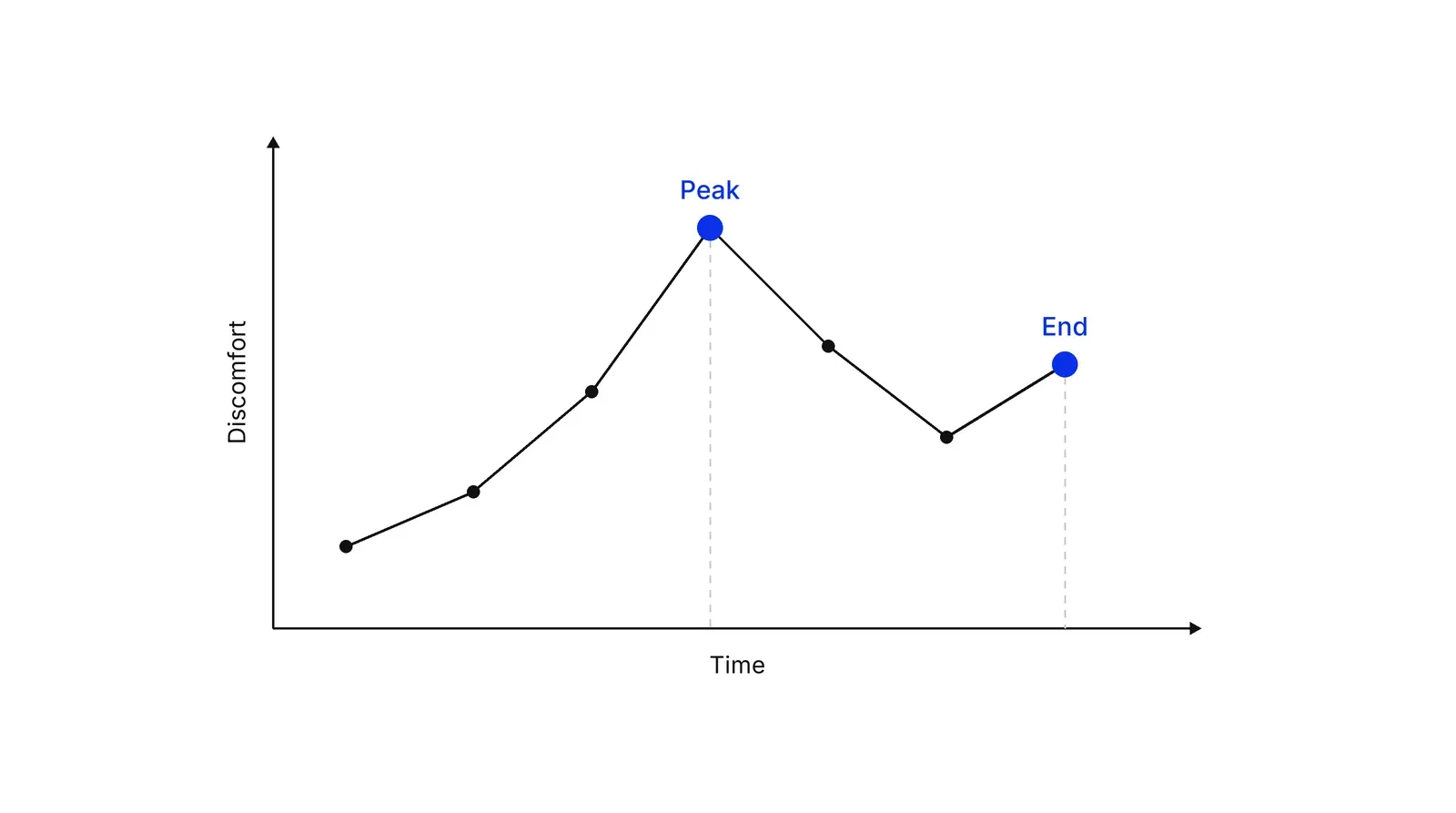
The earlier work explains why. Fredrickson and Kahneman described retrospective judgment as a weighted average of snapshots of the experience, as if duration did not matter. Ariely and Carmon call the few features people summarize with “gestalt characteristics”: the trend, the peak and the end.
Where the rule weakens
The rule is not a law, and four findings limit it.
Long or complex experiences fit it less well. In a study of 49 students on vacations averaging 7 days, the peak-end rule was not an outstandingly good predictor. A day-reconstruction study of about 2,400 adults in three countries found the duration-weighted average was the best predictor of how a day was judged, and that ends were ignored.
Time weakens it. Two experiments found people built evaluations from peak and end only over a short retention interval, with the cutoff likely between 3 and 7 weeks. A virtual-reality study found peak valence predicted immediate memory but average valence predicted memory a week later.
Format matters. Liersch and McKenzie showed that when people see an experience as a graph instead of a list of numbers, duration neglect can disappear. And in service encounters, Verhoef and colleagues found that average performance mattered, with peak experiences adding to satisfaction on top of it.
Intensity changes duration’s role too: Ariely’s 1998 pain experiments found duration had little impact for steady stimuli but did play a role when intensity changed over time.
Good moments count too
The rule is not only about pain. Do, Rupert and Wolford found strong evidence that it applies to material goods as well as pain, and Diener, Wirtz and Oishi found that people rated a wonderful life that ended abruptly as better than one with extra mildly pleasant years. For a service team this means a positive peak is worth building on purpose: one moment the customer will tell others about, such as a clear explanation from the doctor or a handwritten recovery plan, often costs less than raising every step a little.
| Peak-end rule | Plain average of the visit | |
|---|---|---|
| What it weights | The most intense moment and the last one | Every moment equally |
| Best predicts | Memory of a short, bounded episode | Judgment of long or multi-episode experiences |
| Fix first | The worst point and the ending | The step with the lowest score |
Using it on a service visit
Treat it as a way to choose what to fix first. The practical sequence is to map the visit, find the worst moment, and design the ending. Nielsen Norman Group gives the same advice for products: strengthen the positive peaks, remove the frustrating ones and finish gracefully.
A clinic shows the logic. A patient’s visit has booking, arrival, a wait, treatment, payment and a goodbye. The payment step is the last thing that happens, so a surprise on the invoice becomes the end of the memory, whatever the treatment was like. Moving the price conversation before treatment, and ending with a clear summary and next appointment, changes the last moment without touching the clinical work. A customer journey map shows the sequence, and a service blueprint shows which backstage step creates the bad peak.
Measurement needs the same care. A score taken at the door records the ending. Compare it with an answer a few days later, and read it next to CSAT and CES, which ask about one interaction, and net promoter score, which asks about the relationship. Effort is a useful peak to look for: a CEB study found effort predicted loyalty better than delight.
The ethical limit
The 2003 colonoscopy trial made a patient’s experience longer to make it end better, which raises the question of whether prolonging anything is acceptable. A 2025 ethical analysis concludes that the approach fits beneficence and justice but raises concerns about autonomy and non-maleficence, since patients are not told. The workable use for a business is to lower the peak and make the ending clear, not to pad the experience. A Growth Lab plan starts from the moments of the customer journey that carry the most weight.
How to apply Peak-end rule in CX, step by step
- Split one visit into moments. Take a single visit and list its moments in order: booking, arrival, waiting, the service itself, payment, the goodbye, the follow-up message. A customer journey map gives you the skeleton. Result: 6 to 10 named moments in sequence.
- Score how each moment felt. Ask recent customers to rate each moment from 0 (awful) to 10 (great), or mark the points where they felt worst and best. Use interviews and comments, not only a survey total. Result: a line of feeling across the visit, built from customer answers.
- Find the peak and the end. Mark the most intense moment, usually the worst one, and the last thing that happens. Compare the plain average of your scores with the average of those two. Result: two moments that carry most of what customers will remember.
- Remove or soften the worst peak. Take the single worst moment and fix its cause: a long unexplained wait, a surprise charge, a confusing form. A service blueprint shows which backstage step causes it. Result: one named fix with an owner and a date.
- Design the ending on purpose. Script the final minutes: state the result, the price and the next step, then close with a person or a message that confirms everything is settled. Result: an ending that is calm, complete and the same every time.
- Check the memory, not only the moment. Ask about the whole visit a few days later as well as right after. Compare the two answers and read the comments on the ending. Result: evidence of whether the new peak and ending changed what customers remember.
Examples
A dental clinic and the last five minutes
Illustrative arithmetic. Rate discomfort from 0 to 10 across four moments of a visit: check-in 2, waiting 6, treatment 7, payment 5 because the invoice was higher than the patient expected. The plain average is 5.0 and the peak-end average of 7 and 5 is 6.0. Now the front desk explains the price before treatment and walks the patient out, so payment scores 1. The plain average is 4.0 and the peak-end average of 7 and 1 is 4.0. The treatment did not change, only the ending.
A documented clinical trial: colonoscopy
In a randomized trial of 682 patients, half had the scope left in place for up to 3 extra minutes at the end of the procedure, causing mild discomfort that was lower than the peak. Those patients rated the final moments as less painful (1.7 against 2.5 on a 10-point scale) and the whole procedure as less unpleasant, and their repeat-colonoscopy rate over a median 5.3 years of follow-up was slightly higher (odds ratio 1.41). The authors tested a memory effect; the example shows the principle, not a method clinics should copy.
A fintech card dispute
Illustrative. A card issuer finds that customers rate the dispute form as the worst moment, while the refund arrives silently days later. It rewrites the form to ask for evidence once, and ends the case with a message that names the refund amount, the date it reaches the account and the case number. The peak is lower and the ending is now a clear confirmation instead of silence.
When to use it
Use it when a customer goes through a bounded experience with a clear start and finish, such as a clinic visit, an onboarding, a claim, a delivery or a support case, and you can change how it ends or soften its worst point.
When not to use it
Do not use it to decide where to invest across a long, repeating relationship, where the average of many episodes matters more, or to hide a poor core service behind a pleasant goodbye. It also does not replace measuring each moment as it happens.
Common mistakes
- Decorating the ending while leaving the worst moment untouched. A friendly goodbye does not cancel a painful peak.
- Treating the rule as a law. Studies of multi-episode events and long experiences find the average often predicts as well or better, and the effect fades over weeks.
- Measuring only the post-visit score. A survey sent right after the visit shows the ending; it cannot show what customers will remember later.
- Lengthening or padding an experience so it ends better, which costs the customer real time or discomfort for a better memory.
- Ignoring positive peaks. The rule applies to good moments too, and one memorable good moment is worth designing.
FAQ
What is the peak-end rule?
It is the finding that people judge a past experience mostly by its most intense moment and its final moment, and give little weight to its length. Kahneman and colleagues demonstrated it in a 1993 cold-water experiment, and later work extended it to medical procedures, consumer products and service visits.
Is the peak-end rule real or has it been debunked?
It holds up in aggregate. A 2022 meta-analysis of 174 effect sizes found a large peak-end effect on retrospective evaluations (r = 0.58) and almost no effect of duration. Other studies find it weaker for long or multi-episode experiences and after several weeks, so treat it as a strong tendency.
How do you apply the peak-end rule to customer experience?
Map one visit, find its worst moment and its last moment, and work on those two first. Fix the cause of the worst moment, then script the ending so the customer leaves with the result, the price and the next step clear. Check the effect with a delayed survey.
What is the difference between the peak-end rule and recency bias?
Recency bias is a general tendency to weight recent events more. The peak-end rule is narrower: it gives heavy weight to the single most intense moment as well as the last one. In the meta-analysis below, the peak-end effect was stronger than the effect of the first moment.
Is it ethical to use the peak-end rule on customers or patients?
Improving the ending and removing a painful peak is uncontroversial. Prolonging a procedure to shape memory is contested: a 2025 ethical analysis argues it can undermine informed consent and non-maleficence. A safer route is reducing the peak itself and making the ending clear.
Sources
- Daniel Kahneman, Barbara L. Fredrickson, Charles A. Schreiber, Donald A. Redelmeier, When More Pain Is Preferred to Less: Adding a Better End, Psychological Science 4(6), 1993
- Donald A. Redelmeier, Daniel Kahneman, Patients' memories of painful medical treatments, Pain 66(1), 1996
- Donald A. Redelmeier, Joel Katz, Daniel Kahneman, Memories of colonoscopy: a randomized trial, Pain 104(1-2), 2003
- Balca Alaybek and colleagues, All's well that ends (and peaks) well? A meta-analysis of the peak-end rule and duration neglect, Organizational Behavior and Human Decision Processes 170, 2022
- Barbara L. Fredrickson, Daniel Kahneman, Duration neglect in retrospective evaluations of affective episodes, Journal of Personality and Social Psychology 65(1), 1993
- Dan Ariely, Ziv Carmon, Gestalt characteristics of experiences: the defining features of summarized events, Journal of Behavioral Decision Making 13(2), 2000
- Dan Ariely, Combining experiences over time: the effects of duration, intensity changes and on-line measurements on retrospective pain evaluations, Journal of Behavioral Decision Making 11(1), 1998
- Amy Do, Alexander Rupert, George Wolford, Evaluations of pleasurable experiences: the peak-end rule, Psychonomic Bulletin & Review 15(1), 2008
- Ed Diener, Derrick Wirtz, Shigehiro Oishi, End effects of rated life quality: the James Dean effect, Psychological Science 12(2), 2001
- Peeter C. Verhoef, Gerrit Antonides, Arnoud N. de Hoog, Service encounters as a sequence of events, Journal of Service Research 7(1), 2004
- Talya Miron-Shatz, Evaluating multiepisode events: boundary conditions for the peak-end rule, Emotion 9(2), 2009
- Xianyou Geng and colleagues, Hedonic evaluation over short and long retention intervals: the mechanism of the peak-end rule, Journal of Behavioral Decision Making, 2013
- Eran Chajut, Avner Caspi, Rony Chen, Moshe Hod, Dan Ariely, In pain thou shalt bring forth children: the peak-and-end rule in recollections of labor pains, Psychological Science 25(12), 2014
- Simon Kemp, Christopher D. B. Burt, Laura Furneaux, A test of the peak-end rule with extended autobiographical events, Memory & Cognition 36(1), 2008
- Michael J. Liersch, Craig R. M. McKenzie, Duration neglect by numbers and its elimination by graphs, Organizational Behavior and Human Decision Processes 108(2), 2009
- Wim Strijbosch and colleagues, From experience to memory: on the robustness of the peak-and-end-rule for complex, heterogeneous experiences, Frontiers in Psychology 10, 2019
- Richard C. Armitage, Prolonging medical procedures to exploit the peak-end rule: an ethical analysis, Journal of Evaluation in Clinical Practice 31(6), 2025
- John Broome, More pain or less?, Analysis 56(2), 1996
- Lexie Kane, Nielsen Norman Group, The Peak-End Rule: How Impressions Become Memories, 2018
- Jakob Nielsen, UX Tigers, Peak-End Rule
- Daniel Kahneman, The riddle of experience vs. memory, TED, 2010
- Matthew Dixon, Karen Freeman, Nick Toman, Stop Trying to Delight Your Customers, Harvard Business Review, July-August 2010
Last updated Oct 9, 2026


The compliance layer under fintech marketing operations
A fintech marketing agency can build campaigns. It cannot own the compliance review, the KYC drop-off or the multi-market licensing rules that decide whether a lead ever becomes a customer.

Fractional CMO: what you get, and what has to exist underneath
A fractional CMO brings strategy and judgment. Without reporting, CRM hygiene and a named owner per number, the engagement produces a slide deck instead of a system.

The operations layer behind healthcare patient acquisition
Ads and search bring the request in. What happens between the click and the booked, attended visit decides whether the spend paid off.