Moments of truth (ZMOT)
Moments of truth are the points where a customer forms the judgment that decides what they do next: before buying (zero), at the choice (first) and in use (second).
Moments of truth are the points in a customer relationship where a judgment gets formed that decides what happens next. Procter & Gamble named the first (the shelf choice) and second (using the product) in 2005. Google added the zero moment, the online research before any shop visit, in 2011. Teams use the set to see where a brand wins or loses buyers.
- Origin
- Richard Normann and Jan Carlzon (service contacts at SAS); A.G. Lafley, P&G (first and second moments); Jim Lecinski, Google (zero moment), early 1980s; 1987 book; 2005; 2011
- Level
- 301 · Advanced
- Fits
- Small and mid-size, Scale-up, Enterprise
- Time to apply
- half a day for a first audit of one purchase, plus a week of pulling search and review data
- What you need
- one product or service and one buyer type to audit · search queries, review pages and support or sales notes for that buyer · one person who can change what a buyer finds, sees or gets at each moment
A moment of truth is a point where a customer forms a judgment about a company that decides what they do next. The phrase has three separate histories. Service managers around the airline SAS used it in the early 1980s for short contacts between customers and staff. In 2005 Procter & Gamble (P&G) used “first” and “second” moment of truth for the shelf choice and for using the product. In 2011 Google added a “zero” moment, the research a buyer does before either. They share a name and little else, and treating them as one idea is the usual mistake on this topic.
Who coined “moment of truth”?
The service idea came out of SAS in the early 1980s, and sources disagree on whether to credit Richard Normann or Jan Carlzon.
| Claim | Who makes it | What the evidence shows |
|---|---|---|
| Carlzon coined it | Many business writers; the host of a 2006 interview credits him and he does not object | His book Moments of Truth, published by Ballinger in 1987, spread the phrase; a Harvard case excerpted from it uses it freely and credits no one |
| Richard Normann coined it | Swedish service-management writing | A 2008 Lund University thesis credits Normann’s 1983 book Service Management and says he illustrated the term with bullfighting. A student thesis is a pointer, not proof |
| P&G coined it | Common in digital marketing | P&G’s use dates from 2005 and means the shelf. It is a later, narrower sense |
Carlzon’s version is about people. In the German edition, as quoted by the Vienna University of Economics and Business, each of SAS’s 12 million customers met five employees for about 15 seconds each, so the airline “is created” 60 million times a year (same source). Retellings give other totals, so quote the pattern, not the totals. Academic work backs the premise: Bitner, Booms and Tetreault collected 700 customer incidents at airlines, hotels and restaurants in 1990 and opened with “the service encounter frequently is the service from the customer’s point of view.”
What are the first and second moments of truth?
P&G’s first moment of truth is the few seconds when a shopper stands at the shelf and picks one brand over another. The second is using the product at home and finding it good or not. A.G. Lafley, then P&G’s chief executive, wrote that “the best brands consistently win two moments of truth” in his foreword to Kevin Roberts’ book Lovemarks, as Google’s ebook quotes it.
Most of what we know about the 2005 timing comes from Google. Lecinski’s ebook says a Wall Street Journal front-page story of 21 September 2005 covered the seven seconds after a shopper meets a shelf, and that P&G had created a Director of FMOT post, filled by Dina Howell. Two details are disputed. Secondary retellings of the window vary, so treat seven seconds as Google’s account of the story. Lecinski places Lafley’s foreword in the same year, 2005, and we could not check which edition of Lovemarks carries it. We could read the Journal story only through Google’s account.
Shelf speed is plausible. A 2012 study by Milosavljevic and colleagues found that in rapid food choices visual prominence moved choices more than preferences did, and most when people had no strong preference.
What is the zero moment of truth?
The zero moment of truth (ZMOT) is the stage before the shelf when a buyer researches online. Jim Lecinski, then a Google sales and service executive, set it out in a 2011 ebook that Google announced in July and that Lecinski described in an interview with Wharton as a “new mental model for modern marketing.” Google did not invent the words: his own end note credits a SymphonyIRI Group report of October 2009 as the first use he knew of.
The evidence is a Google-commissioned online survey, run by Shopper Sciences with 5,000 recent buyers. The average shopper used 10.4 sources of information in 2011, up from 5.3 in 2010, and the count varied widely by category.
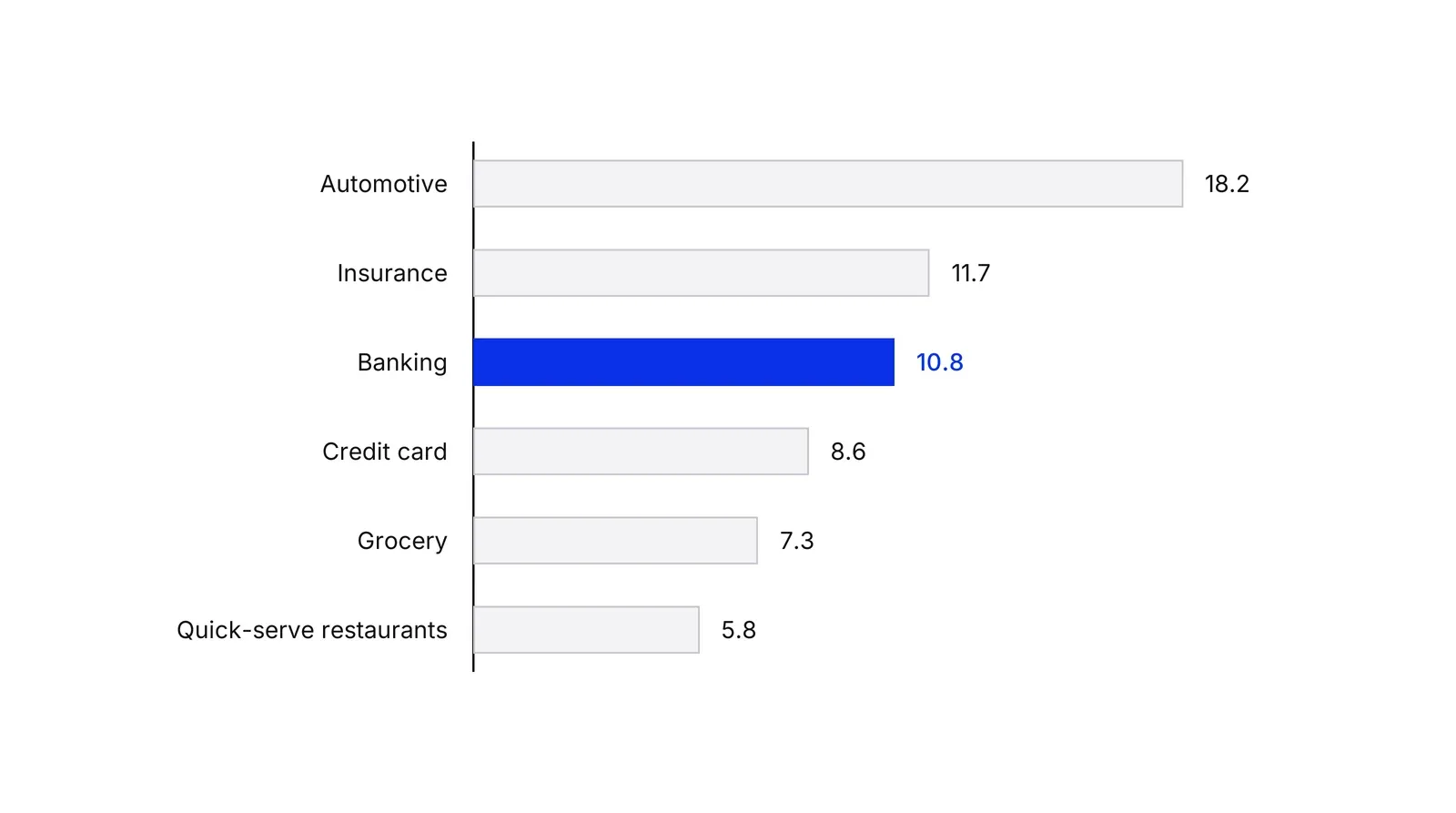
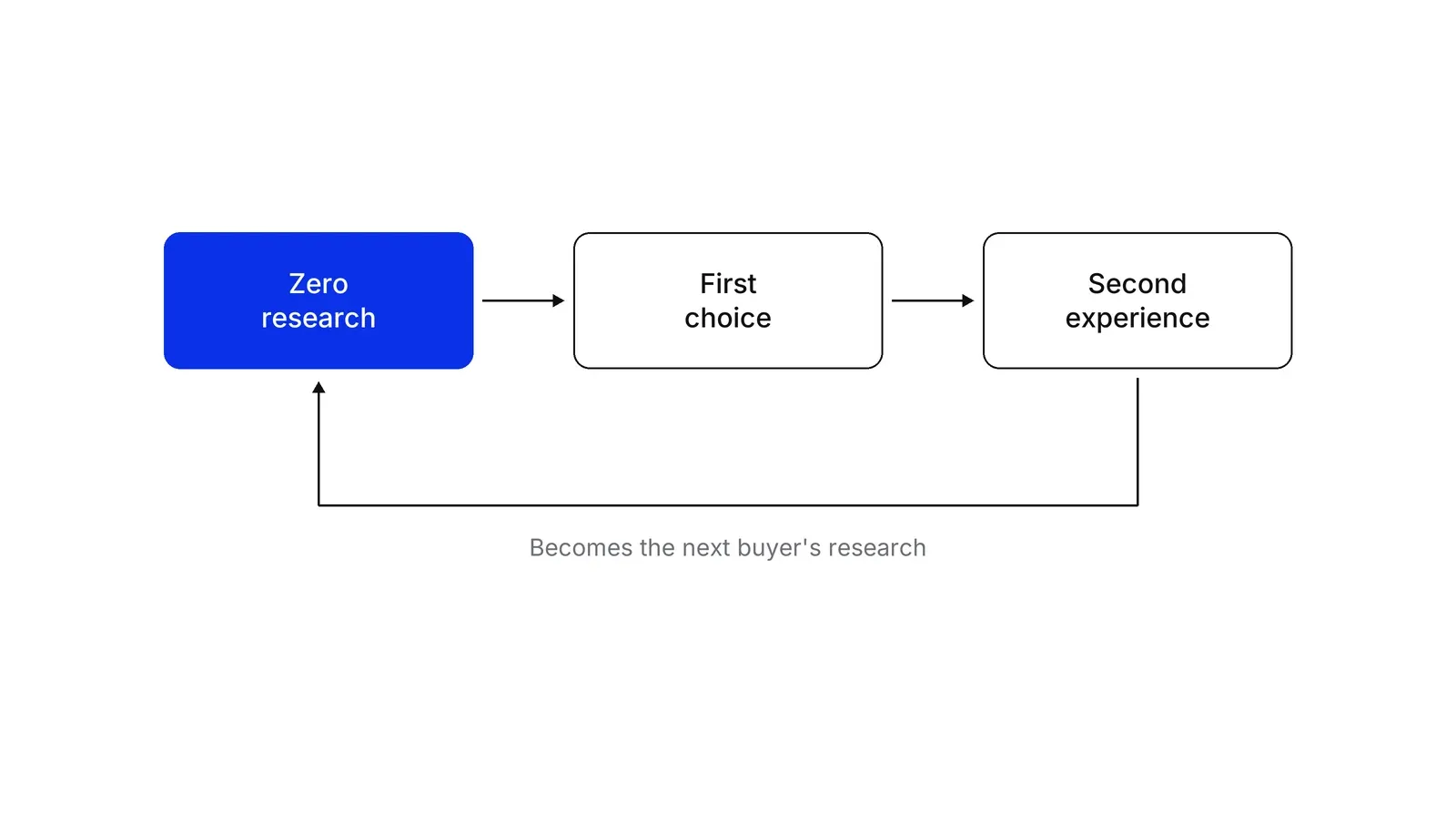
The same study’s appendix tables show 91% of bank shoppers and 61% of grocery shoppers were influenced at the zero moment. Lecinski also shows how the three moments connect: a buyer’s second moment, the experience, becomes the next person’s zero moment, through reviews and word of mouth.
The moments side by side
| Moment | Named by | When | What it covers |
|---|---|---|---|
| Service moment of truth | Normann and Carlzon, SAS | early 1980s; book 1987 | Any contact between customer and employee |
| First (FMOT) | P&G | 2005 | The shelf choice |
| Second (SMOT) | P&G | 2005 | Using the product against its promise |
| Zero (ZMOT) | Google, Lecinski | 2011 | Research before any visit |
| Third (TMOT) | Pete Blackshaw, credited by Brian Solis’s republished article | 2006 | Sharing the experience |
Google later argued the model was too short. Matt Lawson’s 2015 paper said that instead of a few moments of truth there is “a series of micro-moments” on a phone: I-want-to-know, to-go, to-do and to-buy.
Moments of truth, journeys and availability
A customer journey map puts every contact in order for one customer, and moments of truth are the ones on it that decide the outcome. A service blueprint, introduced by G. Lynn Shostack in 1984, decides who meets the customer at each of them, and Bitner, Ostrom and Morgan’s 2008 article has a section titled “Designing the Moments of Truth.” McKinsey partners Rawson, Duncan and Jones argued in 2013 that touchpoint scores can mislead because they hide the end-to-end journey, and Lemon and Verhoef’s Journal of Marketing review treats experience as built across many touchpoints. David Edelman argued in Harvard Business Review in 2010 that the internet had upended how consumers engage with brands. McKinsey’s 2009 study of 20,000 consumers replaced the funnel with a loop in which buyers keep changing the brands they consider.
What puts a brand into the zero moment at all is covered by category entry points, the buying situations that bring a brand to mind. Mental and physical availability asks whether the brand comes to mind and is easy to find once the buyer starts.
Where the evidence is thin
The 10.4 figure comes from a survey of recalled sources, and it counts television ads, in-store packs and conversations with family beside online reading. Independent clickstream work points the other way on depth: a 2013 conference paper found online consideration sets of only 2.31 to 2.6 brands in German retail panel data. That counts brands, not sources, so the two do not contradict each other, but together they warn against imagining every buyer as a long researcher.
Moments also carry unequal weight. Kahneman and colleagues showed in 1993 that people judge an unpleasant experience mostly by its worst point and its end, not its length. A moment matters more when it is the peak or the finish, so audit for those first.
A Growth Lab plan can start from the three moments: what a buyer finds, what happens at the choice and what they tell others.
How to apply Moments of truth (ZMOT), step by step
- Pick one buyer and one purchase. Choose a single buyer type and one product, such as a first account for a small business or a first dental consultation. Moments differ by category, so a mixed audit shows nothing clear. Result: one scope sentence.
- List the moments in the buyer's order. Write what happens before the choice (zero), at the choice (first), in use (second) and after, when the buyer tells others. Use the buyer's words, not department names. Result: four to five moments on one line.
- Gather evidence for each moment. For the zero moment, search the ten queries a buyer would type and read what appears, including reviews and comparison pages. For the first, look at the page or call where the choice is made. For the second, read support tickets and cancellation reasons. Result: a screenshot or quote per moment.
- Mark the moment you lose most. Compare each moment with the two closest competitors. Mark the one where they look clearly better or you are absent. Result: one priority moment, with proof.
- Give each moment an owner and a measure. Name a person and one number per moment: share of searches where you appear, conversion at the choice page, repeat or referral rate after use. Result: a short table anyone can read in a minute.
- Re-run after each change. Repeat the evidence step each quarter. Buyers change where they look, and a moment you won last year may be lost to a new review site. Result: a dated record of what moved.
Examples
A private dental clinic
Illustrative. Zero moment: a patient types the price of an implant and the district, then reads five review pages and asks a friend. First moment: the booking page or the first phone call, where the clinic has seconds to sound clear. Second moment: the first visit and the follow-up message. The audit finds the clinic has 40 reviews but none mentions price, so the zero moment loses buyers who want a number. The fix is a price page and a prompt asking each patient for a review.
A B2B payments startup
Illustrative. Zero moment: a finance lead compares providers on review sites, reads documentation and asks peers. First moment: the demo and the first session of onboarding. Second moment: the first successful payout. The audit shows buyers drop out in document checks, not at the demo. The owner of onboarding gets one measure, time from signup to first payout.
SAS in the 1980s
Documented. Jan Carlzon described each SAS customer meeting five employees for about 15 seconds each, as quoted from the German edition of his book. His conclusion was that front-line staff needed authority to fix problems on the spot, because they, not managers upstream, shape the customer's impression.
When to use it
Use it when a buyer's decision happens across several places and nobody owns the whole path: search and review pages, a sales call, the product itself. It suits categories where people research before they buy, such as banking, insurance, health care, B2B software and cars.
When not to use it
Skip it for low-attention, habit purchases where little research happens, and when you need numbers to prioritise: the moments tell you where to look, not how much a fix is worth. To sequence a whole customer path, a journey map does that job better.
Common mistakes
- Treating the three moments as one idea. The service moment, the P&G shelf moment and Google's research moment come from different people and describe different things. Say which one you mean.
- Quoting Google's 10.4 sources as 10.4 searches. The count includes TV ads, in-store packs and talking to family.
- Optimising only the zero moment because it is digital. A buyer who finds you and then meets a slow call or a confusing checkout is lost at the first moment.
- Auditing from inside. If you only check your own pages, you miss what reviews, comparison sites and competitors show at the zero moment.
- Listing moments with no owner. A moment with no named person and no measure stays a slide.
FAQ
What is the zero moment of truth?
The zero moment of truth (ZMOT) is the stage before a purchase when a buyer researches online: searching, reading reviews, watching videos, asking friends. Jim Lecinski of Google popularised the term in a 2011 ebook. His earliest known use is a 2009 SymphonyIRI report, so Google did not coin the phrase.
What are the first, second and third moments of truth?
The first is the shelf or point of choice, where a buyer picks one brand over another. The second is using the product and judging it against the promise. Procter & Gamble named both around 2005. The third, usually credited to Pete Blackshaw around 2006, is the buyer sharing the experience with others.
Who invented moments of truth?
It depends on which one you mean. The service idea is credited to Richard Normann, who worked with SAS, and to Jan Carlzon, whose 1987 book spread it. P&G's first and second moments date from 2005, and Google's zero moment from 2011. Sources disagree on Normann's and Carlzon's shares.
How many seconds does the first moment of truth last?
Google's 2011 ebook says a Wall Street Journal story in September 2005 put it at seven seconds at the shelf. Retellings of the window vary, and it is not a measured constant: it depends on the category and the shopper.
What is the difference between ZMOT and micro-moments?
ZMOT is one research stage before a purchase. Micro-moments, from a 2015 Google paper, are many short phone moments of four kinds: I-want-to-know, to-go, to-do and to-buy. Google described them as replacing a few moments of truth with a series of small ones.
Sources
- Jim Lecinski, ZMOT: Winning the Zero Moment of Truth, Google, 2011
- Knowledge at Wharton, Google's Jim Lecinski on What the Zero Moment of Truth Means for Marketers, August 2011
- Google, The Zero Moment of Truth: A New Marketing Strategy, AdWords blog, July 2011
- Jan Carlzon, excerpt from Moments of Truth (Ballinger, 1987), Harvard Business School case 8-489-046
- Internet Archive, Moments of Truth, Jan Carlzon, Ballinger, Cambridge, Mass., 1987 (catalogue record)
- Vienna University of Economics and Business NPO-Institut, Alles für den Kunden von Jan Carlzon (German edition, Campus, 1988)
- CustomerThink, What Business Leaders Can Learn From Moments of Truth: An Interview With Former SAS CEO Jan Carlzon, 2006
- Andreas Nilsson, Sanningens ögonblick, master's thesis, Lund University, 2008
- Mary Jo Bitner, Bernard Booms, Mary Stanfield Tetreault, The Service Encounter: Diagnosing Favorable and Unfavorable Incidents, Journal of Marketing 54(1), 1990
- Mary Jo Bitner, Amy Ostrom, Felicia Morgan, Service Blueprinting: A Practical Technique for Service Innovation, California Management Review 50(3), 2008
- G. Lynn Shostack, Designing Services That Deliver, Harvard Business Review, January 1984
- Annette Franz Gleneicki, Why CX Professionals Should Care About the Four Moments of Truth, CustomerThink, republished by Brian Solis, 2016
- David Churbuck, The Third Moment of Truth (quoting Pete Blackshaw), October 2006
- Matt Lawson, I-Want-to-Go Moments: From Search to Store, Think with Google, April 2015
- Research Live, Purchase behaviour in need of a rethink, says McKinsey, June 2009
- David Edelman, Branding in the Digital Age: You're Spending Your Money in All the Wrong Places, Harvard Business Review, December 2010
- Katherine Lemon, Peter Verhoef, Understanding Customer Experience Throughout the Customer Journey, Journal of Marketing 80(6), 2016
- Alex Rawson, Ewan Duncan, Conor Jones, The Truth About Customer Experience, Harvard Business Review, September 2013
- C. P. Holland, J. A. Jacobs, Consumer search and online consideration sets, Oxford Retail Futures Conference, 2013 (University of Münster record)
- Milica Milosavljevic, Vidhya Navalpakkam, Christof Koch, Antonio Rangel, Relative Visual Saliency Differences Induce Sizable Bias in Consumer Choice, 2012
- Daniel Kahneman, Barbara Fredrickson, Charles Schreiber, Donald Redelmeier, When More Pain Is Preferred to Less: Adding a Better End, Psychological Science 4(6), 1993
Last updated Oct 9, 2026


Marketing agency or growth system: when a company outgrows its agency
An agency is the right call while the founder still runs most of the company. Once the business starts copying itself into new locations or markets, it needs a system that sets goals, tests hypotheses and owns the result.

Why healthcare marketing agencies stall: the short, mid and long wins model we use with clinics
Most agencies own the click and nobody owns the front desk. How we structure clinic work in three horizons, the research behind each one, and one year of results.

Why channel tests stall after month three
Most paid channel tests do not end with a decision. They end when the budget runs out, the attribution model changes, or everyone quietly stops looking at the dashboard.