Market segmentation
Market segmentation is the practice of splitting a market into groups of buyers whose needs or behavior differ, so a company can choose which groups to serve and shape its offer for each.
Market segmentation is the practice of dividing a market into groups of buyers who want different things or buy in different ways, so that a company can pick the groups it serves best and tailor product, price, channel and message to them. Wendell Smith named it in a 1956 Journal of Marketing article. Segments are usually built from geographic, demographic, psychographic or behavioral variables.
- Origin
- Wendell R. Smith, 1956
- Level
- 201 · Tool
- Fits
- Startup, Small and mid-size, Scale-up, Enterprise
- Time to apply
- two to four weeks for a first segmentation built on existing customer data; longer if it needs a new survey
- What you need
- a year of customer and transaction data, or at least 20 to 30 customer interviews · one business decision the segmentation has to inform, such as which product to build next or where to spend the acquisition budget · someone who can pull data by customer and someone who owns the go-to-market budget
Market segmentation is the practice of dividing a market into groups of buyers who want different things or buy in different ways, then deciding which groups to serve and how. A clinic that treats teenagers with acne and retirees with skin cancer screening is serving two segments, whether or not it calls them that. Segmentation makes the split deliberate, so product, price, channel and message can differ for each group.
The term comes from Wendell R. Smith, who published “Product Differentiation and Market Segmentation as Alternative Marketing Strategies” in the Journal of Marketing in July 1956. Smith opened with the 1930s work of economists Joan Robinson and Edward Chamberlin on imperfect competition: real markets are not uniform, buyers want different things. Today segmentation is the first step of the segmentation, targeting and positioning sequence taught in every marketing course, and Bain’s management tools guide lists its uses as deciding which products to build first, shaping campaigns, setting service tiers, designing sales channels and setting prices.
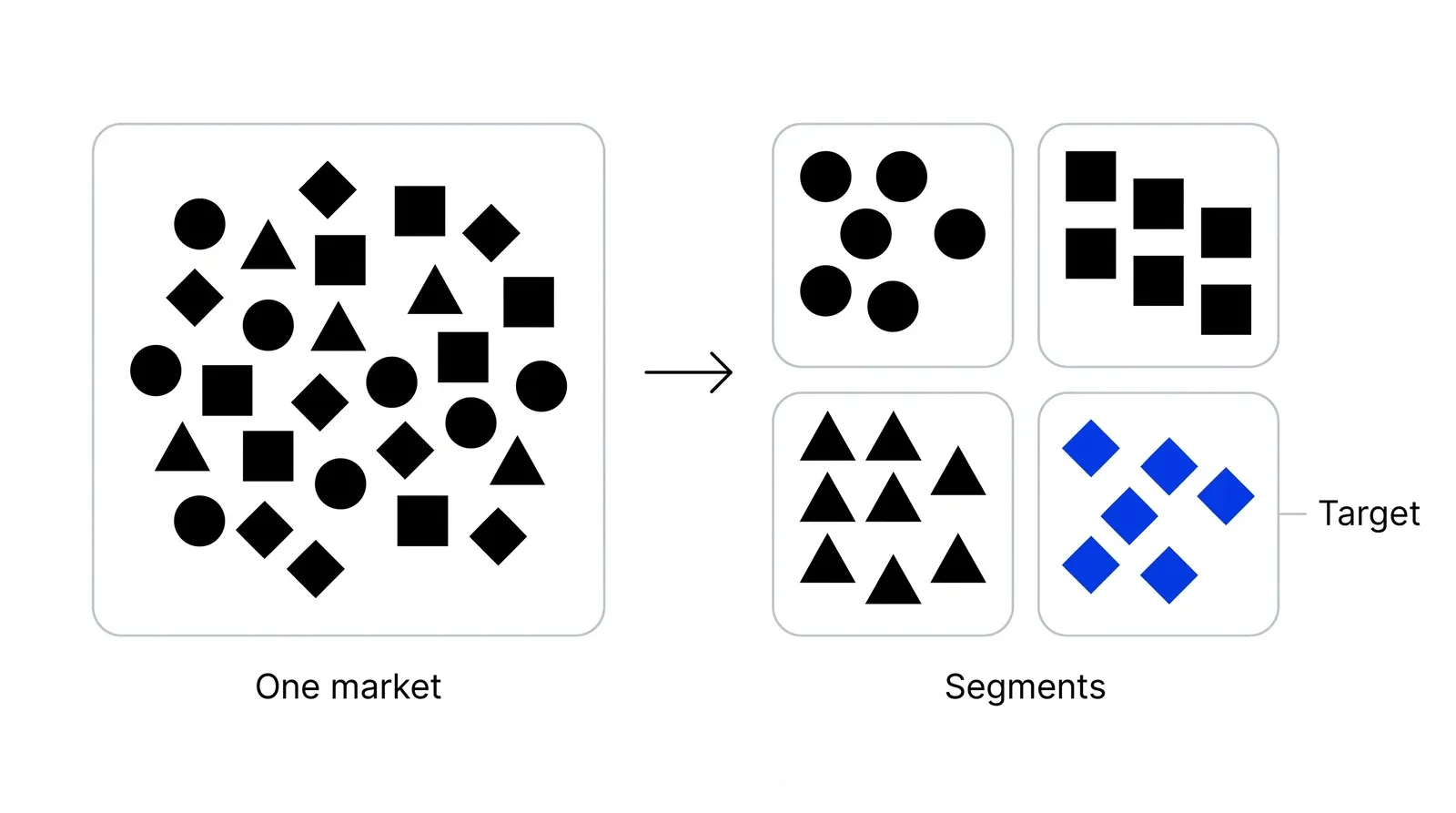
Segmentation or differentiation: Smith’s original choice
Smith described two ways to deal with a market where buyers differ. Product differentiation tries to pull demand toward what the company already makes, mostly through advertising and promotion. Market segmentation does the reverse: it adjusts the product and the marketing to fit what separate groups of buyers already want.
The two terms are still mixed up. Peter Dickson and James Ginter wrote in the Journal of Marketing in 1987 that there was “considerable misunderstanding” about both, three decades after Smith. The practical difference is the starting point.
| Product differentiation | Market segmentation | |
|---|---|---|
| Starts from | The product you have | The groups of buyers in the market |
| Main lever | Promotion that makes your product stand out | A different offer for each chosen group |
| Typical output | A brand message | A list of segments, targets and tailored offers |
| Works best when | Buyers are similar and switching is easy | Buyers want clearly different things |
The four bases of segmentation
A segmentation base is the variable you use to split buyers. Tynan and Drayton’s 1987 review lists the standard ones: geographic, demographic, psychographic and behavioral.
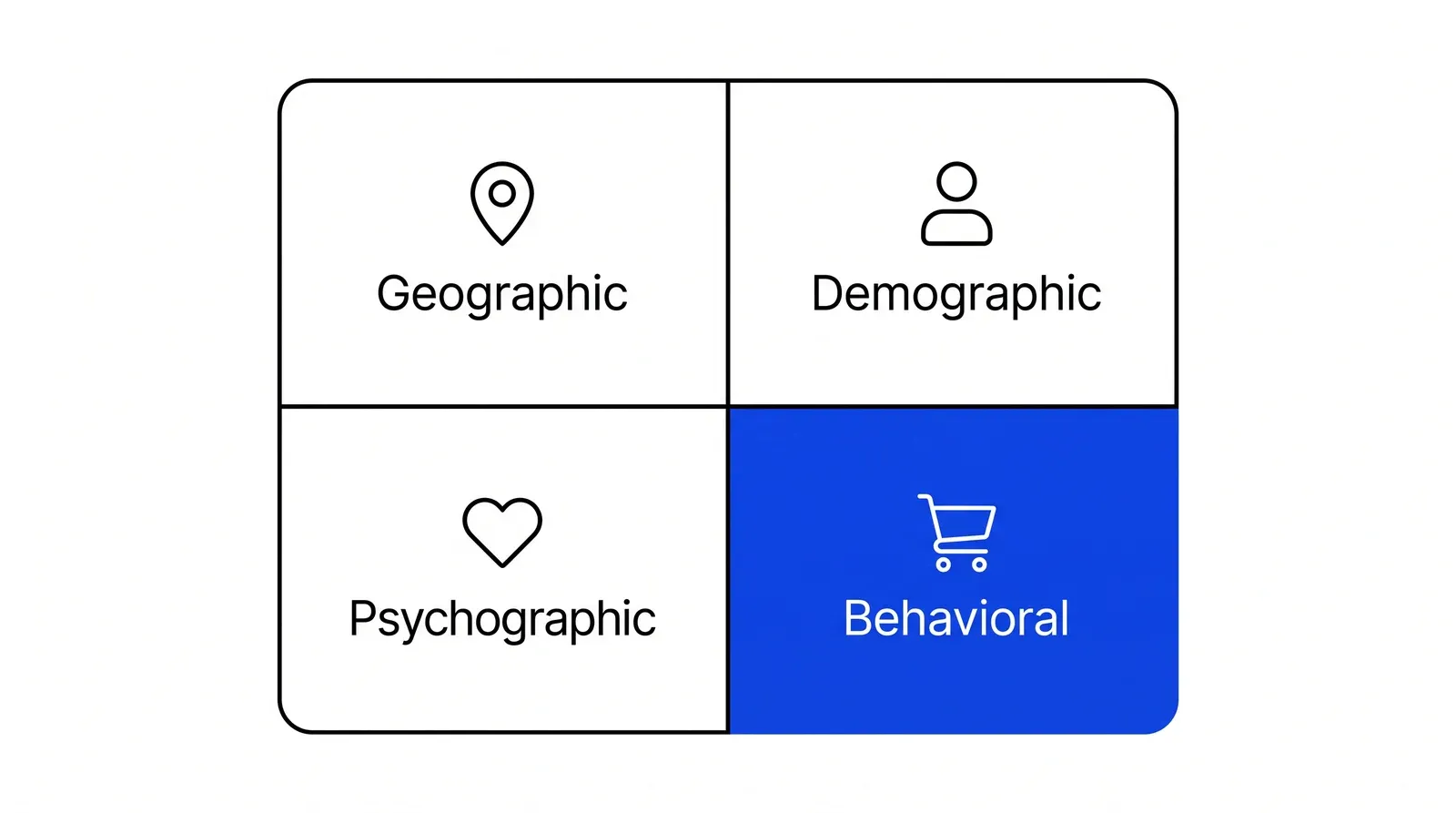
| Base | Example variables | Example in fintech or healthcare |
|---|---|---|
| Geographic | Country, region, city size, climate | A neobank launching only in the largest cities |
| Demographic | Age, income, family stage; in B2B, industry and company size | A clinic pricing packages differently for students and retirees |
| Psychographic | Values, attitudes, lifestyle | Investors who want control versus investors who want it done for them |
| Behavioral | Usage rate, loyalty, benefits sought, occasion | Merchants processing over 100,000 dollars a month versus occasional sellers |
Geodemographic systems combine the first two with spending data. Claritas’s PRIZM Premier sorts US households into 68 segments using demographic, behavioral and geographic data.
Why behavior beats description
Variables that describe a buyer are easy to collect, but they often fail to predict what the buyer will do. Russell Haley made this argument in his 1968 paper on benefit segmentation: descriptive factors predict future purchases poorly, and the benefits people seek are the real reason segments exist. Looking back in 1984, he noted that most large consumer goods companies had tried the method and results had varied.
Daniel Yankelovich pushed segmentation past age and income in HBR in 1964. Forty-two years later, he and David Meer argued in “Rediscovering Market Segmentation” that the practice had shrunk to serving advertising, and called modern psychographic profiling a mostly wasteful diversion. In their view the original purpose was to find customers whose behavior can be changed or whose needs are not being met.
Clayton Christensen’s jobs to be done theory makes the same point from another angle. The Christensen Institute contrasts it with marketing that focuses on demographics or product attributes, and in “Marketing Malpractice” Christensen, Scott Cook and Taddy Hall listed the usual ways of segmenting markets among marketing’s broken paradigms.
Segmenting business markets
B2B segmentation works with firms instead of people, and one product often serves several applications. Yoram Wind and Richard Cardozo set out an approach for industrial markets in 1974. Thomas Bonoma and Benson Shapiro then proposed the nested approach, first in a 1983 Marketing Science Institute working paper and then in “How to Segment Industrial Markets” in HBR in 1984, which is why sources give both years.
The nested approach starts with the outer layer, data anyone can see: industry, company size, location. It moves inward toward harder-to-collect variables and ends with the personal traits of the people who buy. A team stops at the first layer that produces segments it can act on. Most B2B teams now meet this logic as the ideal customer profile used in account-based marketing.
What makes a segment usable
A segment is usable when it passes four tests, which Tynan and Drayton attribute to Philip Kotler: measurability, accessibility, substantiality and actionability. In plain terms, you can count it, you can reach it, it is big enough to pay for a tailored offer, and you can build that offer.
Wind’s 1978 review in the Journal of Marketing Research treats segmentation as a full research process, from defining the problem to implementing the result. Wedel and Kamakura’s textbook covers the statistical side, from cluster analysis to mixture models.
Why segmentation projects fail
Most failures happen after the analysis. A 2006 Bain survey by Rob Markey, Gerard du Toit and James Allen found that 81% of executives called segmentation critical to growing profits, while fewer than 25% thought their own company used it effectively. Sally Dibb and Lyndon Simkin studied the same gap in B2B as implementation problems.
There is also a limit on what segmentation can explain. Kathy Hammond, Andrew Ehrenberg and Gerald Goodhardt studied panel data across more than 20 grocery categories and found little brand segmentation: competing brands were bought by similar kinds of people. Segments often differ by category need and buying occasion more than by brand. Segmentation is the first decision in Pushers’ Growth Lab work, and the test is always the same: does the split change where the money goes?
How to apply Market segmentation, step by step
- Name the decision. Write down what the segmentation is for: choosing a new market, setting prices, splitting the sales team, cutting churn. A segmentation built for advertising will not help with pricing. Result: one decision and the person who will make it.
- Pick variables that cause the difference. List the variables that might explain why customers buy differently: the job they need done, the benefit they look for, how often and how much they buy, industry and company size in B2B. Prefer variables that drive behavior over variables that only describe people. Result: a short list of candidate bases.
- Build the segments from data. Group customers either by a rule you choose in advance (for example, by monthly transaction volume) or by letting cluster analysis find groups in survey or usage data. Aim for a handful of segments the team can remember. Result: three to seven segments, each with a size and a plain-language name.
- Test each segment. Check that each segment can be measured, is large enough to pay for a tailored offer, can be reached through a channel you can buy or build, and would respond differently to a different offer. Merge or drop the ones that fail. Result: a shortlist of segments that pass all four tests.
- Choose targets and tailor the offer. Estimate revenue and cost to serve for each passing segment, then pick the ones where you can win against current competitors. Write what changes for each: product, price, channel, message. Result: one or two target segments with a written offer for each.
- Put the segments into the systems. Tag customers by segment in the CRM, report revenue, acquisition cost and churn by segment, and review the split every year. Result: segment-level numbers on the monthly dashboard, so the segmentation keeps driving decisions.
Examples
Milkshakes and the job customers hire them for
The Christensen Institute describes a fast-food chain whose milkshake sales did not move when it improved the product for its typical demographic. Watching buyers showed two groups with different jobs: morning commuters who wanted something filling and easy to hold in the car, and parents in the afternoon buying a treat for their children. In the morning the shake competed with bananas and bagels, not other shakes. Segmenting by circumstance, not by who the buyer was, explained the sales.
Patient segmentation in integrated care
In a 2016 Health Affairs article, Sabine Vuik, Erik Mayer and Ara Darzi describe how health systems split patient populations into groups with similar needs and then design care models for each. They separate strategies for the whole population, for subpopulations and for high-risk patients, and name the main trade-off: a simple segmentation is easier to use, a precise one fits patients better.
A payments company choosing its first segment
Illustrative, no real company implied. A payments startup has 900 merchant accounts. Grouping them by monthly volume and business model gives four segments; one, mid-sized online stores selling abroad, holds 120 accounts but more than half of revenue and has the lowest churn. The team targets that segment, builds multi-currency payouts for it and stops paid acquisition aimed at small offline shops.
When to use it
Use it when one offer is sold to everyone and results vary widely across customers, before entering a new market, when setting prices or service tiers, or when the sales or marketing budget needs to be split between customer groups. It is the first step of segmentation, targeting and positioning.
When not to use it
Skip a formal study when the business has a few dozen customers and the founder already talks to all of them; interviews will tell you more. Do not run one without a decision attached, and do not use a segmentation built for one purpose, such as ad creative, to make a different decision, such as pricing.
Common mistakes
- Segmenting only by demographics because the data is easy to get, when age or company size does not explain why customers buy.
- Building segments that no channel can reach, so the marketing team cannot act on them.
- Creating so many segments that nobody remembers them and every campaign ignores them.
- Running the study once, presenting it and never tagging customers in the CRM, so revenue is never reported by segment.
- Assuming competing brands have different buyers. Research on grocery brands found their buyers look much the same.
FAQ
What are the four types of market segmentation?
The four classic bases are geographic (country, region, city size), demographic (age, income, family, or industry and company size in B2B), psychographic (values, attitudes, lifestyle) and behavioral (usage, loyalty, benefits sought, buying occasion). Tynan and Drayton's 1987 review in the Journal of Marketing Management discusses all four. Most useful segmentations combine two or more of them.
What criteria should a market segment meet?
A usable segment is measurable, so you can size it; substantial, so it pays for itself; accessible, so you can reach it through some channel; and something you can build an offer for. These four tests, usually called measurability, substantiality, accessibility and actionability, are attributed to Philip Kotler. Many teams add a fifth: it must respond differently from other segments.
What methods are used for market segmentation?
There are two broad methods. In the first, you choose the variable in advance, such as region or order size, and split customers by it. In the second, you collect survey or usage data and let statistical methods, usually cluster analysis, find groups of similar customers. Wedel and Kamakura's textbook covers the statistical methods in detail.
What is the difference between market segmentation and targeting?
Segmentation describes the market by splitting it into groups. Targeting is the decision about which of those groups to serve, based on their size, profit potential and your ability to win them. Positioning comes after both and decides how you want the chosen segment to see your offer. Together they form the STP model.
Who invented market segmentation?
Wendell R. Smith introduced the term in a 1956 Journal of Marketing article that set segmentation against product differentiation as two strategies. He built on economists Joan Robinson and Edward Chamberlin, whose 1930s work on imperfect competition described markets where buyers want different things. Daniel Yankelovich extended it beyond demographics with a 1964 Harvard Business Review article.
Sources
- Wendell R. Smith, Product Differentiation and Market Segmentation as Alternative Marketing Strategies, Journal of Marketing 21(1), 1956
- Daniel Yankelovich, New Criteria for Market Segmentation, Harvard Business Review, March 1964
- Daniel Yankelovich, David Meer, Rediscovering Market Segmentation, Harvard Business Review, February 2006
- Russell I. Haley, Benefit Segmentation: A Decision-oriented Research Tool, Journal of Marketing 32(3), 1968
- Russell I. Haley, Benefit Segmentation: 20 Years Later, Journal of Consumer Marketing 1(2), 1984
- Joseph T. Plummer, The Concept and Application of Life Style Segmentation, Journal of Marketing 38(1), 1974
- Yoram Wind, Richard N. Cardozo, Industrial Market Segmentation, Industrial Marketing Management 3(3), 1974
- Yoram Wind, Issues and Advances in Segmentation Research, Journal of Marketing Research 15(3), 1978
- Thomas V. Bonoma, Benson P. Shapiro, Industrial Market Segmentation: A Nested Approach, Marketing Science Institute working paper, 1983
- Benson P. Shapiro, Thomas V. Bonoma, How to Segment Industrial Markets, Harvard Business Review, May 1984
- A. Caroline Tynan, Jennifer Drayton, Market Segmentation, Journal of Marketing Management 2(3), 1987
- Peter R. Dickson, James L. Ginter, Market Segmentation, Product Differentiation, and Marketing Strategy, Journal of Marketing 51(2), 1987
- Sally Dibb, Lyndon Simkin, Implementation Problems in Industrial Market Segmentation, Industrial Marketing Management 23(1), 1994
- Kathy Hammond, A. S. C. Ehrenberg, G. J. Goodhardt, Market Segmentation for Competitive Brands, European Journal of Marketing 30(12), 1996
- Michel Wedel, Wagner A. Kamakura, Market Segmentation: Conceptual and Methodological Foundations, Springer, 2000
- Clayton M. Christensen, Scott Cook, Taddy Hall, Marketing Malpractice: The Cause and the Cure, Harvard Business Review, December 2005
- Clayton M. Christensen, Taddy Hall, Karen Dillon, David S. Duncan, Know Your Customers' Jobs to Be Done, Harvard Business Review, September 2016
- Christensen Institute, Jobs to Be Done
- Bain & Company, Management Tools: Customer Segmentation
- Rob Markey, Gerard du Toit, James Allen, Find Your Sweet Spot, Bain & Company, November 2006
- Claritas, PRIZM Premier segmentation (MyBestSegments)
- Sabine I. Vuik, Erik K. Mayer, Ara Darzi, Patient Segmentation Analysis Offers Significant Benefits for Integrated Care and Support, Health Affairs 35(5), 2016
Last updated Oct 9, 2026


Marketing agency or growth system: when a company outgrows its agency
An agency is the right call while the founder still runs most of the company. Once the business starts copying itself into new locations or markets, it needs a system that sets goals, tests hypotheses and owns the result.

Why healthcare marketing agencies stall: the short, mid and long wins model we use with clinics
Most agencies own the click and nobody owns the front desk. How we structure clinic work in three horizons, the research behind each one, and one year of results.

The compliance layer under fintech marketing operations
A fintech marketing agency can build campaigns. It cannot own the compliance review, the KYC drop-off or the multi-market licensing rules that decide whether a lead ever becomes a customer.