Customer lifecycle marketing
Customer lifecycle marketing matches each message to the stage a customer has reached, so a new signup, a regular buyer and a lapsing customer each hear something different.
Customer lifecycle marketing is the practice of sending each customer messages that fit the stage of their relationship with a company, from acquisition and activation through engagement and retention to win-back. Stages are defined by behavior, such as a first purchase or 60 days of silence, not by calendar dates, and each stage has one goal, one trigger and one metric.
- Origin
- No single author; Robert Blattberg and John Deighton framed the acquisition and retention economics (Harvard Business Review), 1996
- Level
- 201 · Tool
- Fits
- Small and mid-size, Scale-up
- Time to apply
- Two to three weeks for a first welcome and win-back flow; a quarter to cover every stage
- What you need
- a customer list with signup date, last purchase or login date, and order or usage counts · one tool that can send email or push messages on a trigger, not only in batches · one agreed definition of an active customer for your business
Customer lifecycle marketing is the practice of communicating with a customer in a way that reflects where they are in their relationship with your company, and changing that communication as the relationship changes. Braze and Amplitude both describe it this way. Amplitude pairs onboarding with welcome emails and tutorials, and win-back with feedback forms that ask why a customer left. It is a practice, not a patented model, so there is no inventor to credit. The older root is retention economics: Frederick Reichheld and W. Earl Sasser Jr. made the case for services in Zero Defections, published in Harvard Business Review in September 1990. The economics behind it come from academic marketing in the 1990s, and the tooling comes from email and product-messaging vendors.
Why stages beat one blast to the whole list
Customers at different points need different things, and the money is unevenly spread across those points. In 1996, Robert Blattberg and John Deighton split marketing into acquisition and retention in Harvard Business Review and argued for managing the balance between the two. Later work put numbers on the retention side. A Journal of Marketing Research study by Sunil Gupta, Donald Lehmann and Jennifer Ames Stuart, covering five firms including Capital One and Amazon, estimated that a 1 percent gain in retention lifts customer value by 3 to 7 percent, against about 1 for margin and 0.02 to 0.3 for acquisition cost. Frederick Reichheld of Bain & Company reports that in financial services a 5 percent rise in retention produces more than a 25 percent rise in profit. He adds that not every customer can become profitable and long-standing, so he advises segmenting first and investing in the segment that can. The Gupta paper also quotes an acquisition cost of $26.94 per customer against $2.15 to retain one, taken from a 2001 study by Thomas. Harvard Business Review’s 2014 piece cites a range of 5 to 25 times for acquisition versus retention cost, without naming the studies behind it.
Two cautions keep this honest. The five-firm estimates come from one model on public data, so treat the ratios as direction, not law. And Werner Reinartz and V. Kumar studied three years of customer data from general merchandise direct marketing and and called it a gross oversimplification to equate long-life customers with high profit. Both long- and short-lived customers can be highly profitable. Lifecycle marketing should follow margin, not just tenure. Xavier Dreze and Andre Bonfrer’s Wharton working paper adds a budget warning: firms that maximize customer equity spend less on acquisition than firms that maximize each customer’s lifetime value, and end up with a larger, more profitable base.
The stages and what each one needs
The stage count differs by source. Braze lists acquisition, activation, engagement, retention and reactivation. HubSpot’s customer lifecycle article lists reach, acquisition, conversion, retention and loyalty. Google Analytics 4 groups its life cycle reports into acquisition, engagement, monetization and retention. HubSpot’s CRM property is different: its default lifecycle stages are Subscriber, Lead, Marketing Qualified Lead, Sales Qualified Lead, Opportunity, Customer and Evangelist, a sales-process list. The table uses five stages that most businesses can detect from their own data.
| Stage | Goal | Typical trigger | Typical message | Metric |
|---|---|---|---|---|
| Acquire | A signup or first inquiry | Form submit, lead magnet download | Welcome, what happens next | Signup rate |
| Activate | First value moment | Signup with no key action yet | One clear first step | Activation rate |
| Engage | Repeat use or purchase | Second visit, feature unused | Tips based on what they did | Repeat rate |
| Retain | Renewal or reorder | Renewal date near, usage drop | Reminder, recognition, check-in | Retention, net revenue retention |
| Win back | A return | No activity for a set period | Reminder of past value, an offer | Reactivation rate |
Stripe’s worked example of the retain metric starts with $100,000 in recurring revenue, subtracts $5,000 lost to churn and $2,000 to downgrades, adds $8,000 from upgrades, and gets net revenue retention of 101 percent.
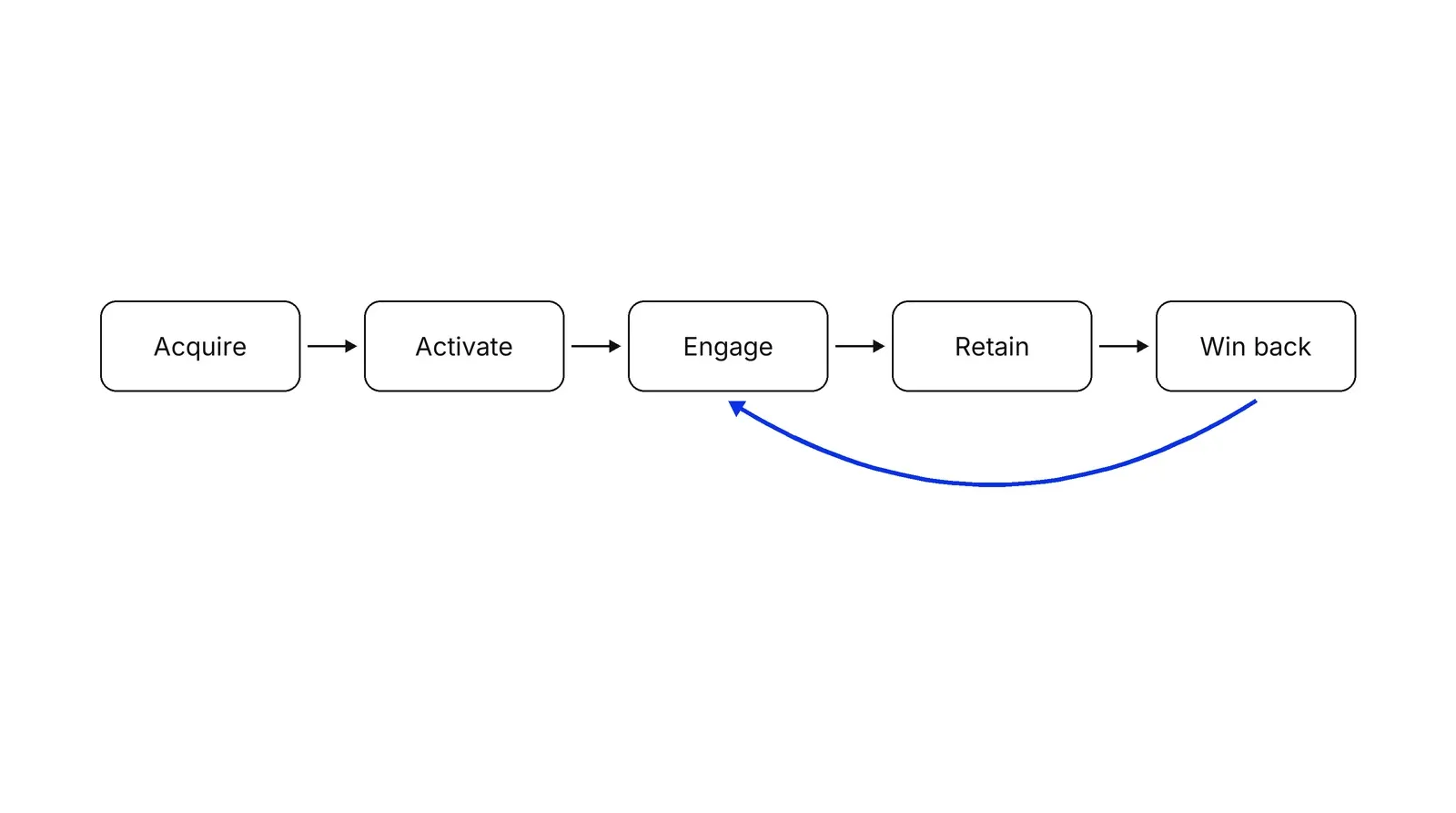
The return arrow is the main reason a lifecycle is not a funnel. A funnel ends at the purchase. A lifecycle has loops, and each loop needs its own message. Customer success usually owns the retain stage in B2B, while the customer journey map shows where customers actually stall between stages.
Define stages by behavior, not by the calendar
A stage should change when the customer does something, or stops doing it. Customer.io separates automations, which send as people become eligible, from broadcasts, which go to a list at a chosen time, and from transactional messages, which respond to one action such as a receipt or password reset. Lifecycle messages are the first kind. Segments, built from events and attributes, decide who is eligible.
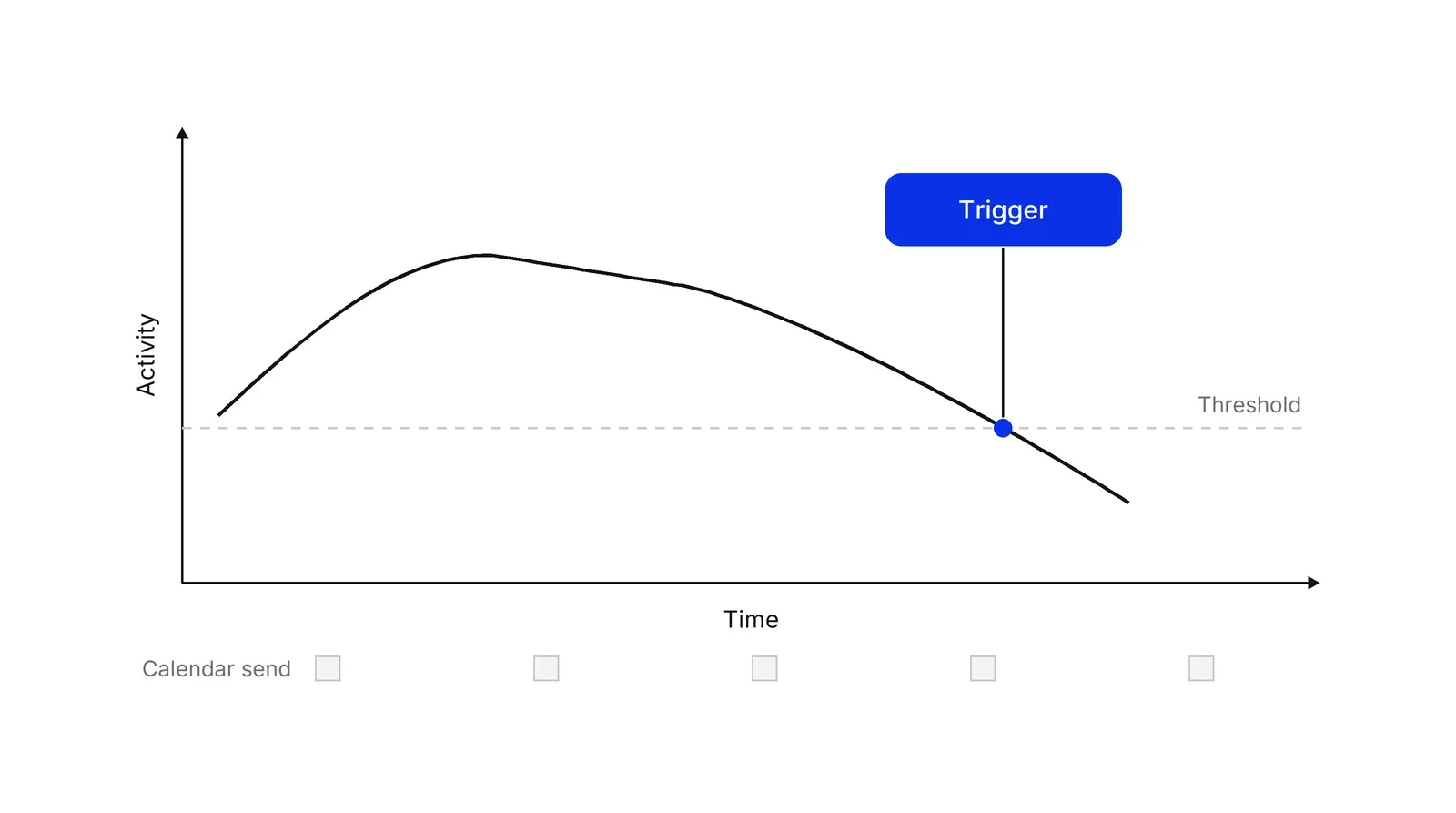
One trap sits in the CRM. HubSpot’s lifecycle stage property is built for the sales process, from subscriber to evangelist, and its default automatic updates only move the stage forward. A customer who stops buying stays a “customer.” Track lapsing status as a separate field or segment, such as days since last activity.
Channels follow the stage
Email is the default, but the stage often decides the channel. Braze’s examples show Fiverr testing a first-purchase activation push across mobile push, web push, in-app messages and email, and Blacklane running journeys for lapsed riders through email, push, in-app messages and Content Cards. PostHog’s handbook shows the same split inside one product: separate flows start on signup, on a feature-enrollment event and on joining a segment. Each flow needs its own trigger, its own exit and its own owner.
What the numbers say about automated messages
Braze reports that KFC Ecuador raised revenue by 15 percent after using automated journeys to cut abandoned mobile coupons, a vendor-reported result for one brand.
Automated flows carry weight beyond their volume. Klaviyo’s benchmark data shows flows making up 5.3 percent of sends but nearly 41 percent of email revenue, with revenue per recipient nearly 18 times that of campaigns. This is one vendor’s customer base, measured by last-touch attribution, so expect a smaller gap in a business with less ecommerce volume.
Be careful with welcome-email statistics. Stripo’s research roundup finds reported welcome open rates from 35 to 84 percent depending on the source. In GetResponse’s data, welcome emails open at 83.63 percent against 40.08 percent for newsletters and get a 16.60 percent click rate against 3.84 percent. The roundup also notes that mail clients which preload images make open rate unreliable. Omnisend reports about $6.16 in revenue per welcome email, the highest of any automated flow, though Stripo tags most of these figures as directional. Judge a welcome flow on clicks, conversions and revenue per recipient.
Rules that apply to every automated send
Automation sends fast and without a person checking each message, so the rules need to be built in. In the US, the Federal Trade Commission’s CAN-SPAM guide requires honoring an opt-out within 10 business days, keeping the opt-out mechanism working for at least 30 days after a send, and sets a penalty of up to $53,088 per violating email. Google’s sender guidelines, in force since February 1, 2024 for senders of more than 5,000 messages a day to Gmail accounts, require one-click unsubscribe for marketing mail from bulk senders to Gmail, ask them to keep the spam rate under 0.30 percent in Google Postmaster Tools, and expect SPF, DKIM and DMARC authentication. EU and UK consent rules are stricter and fall outside this page. The practical consequence for win-back is simple: suppress anyone who has opted out, and treat a long silence as a reason to ask, not to push.
Lifecycle marketing also feeds the loop described in the marketing flywheel, and its results show up in growth accounting as resurrected and retained users. A Growth Lab plan starts from this stage table and the one metric each stage owns.
How to apply Customer lifecycle marketing, step by step
- Define the stages by behavior. Write the exact event that moves a customer from one stage to the next: first purchase, first value moment, third order, 60 days without activity. Result: a stage table where every customer sits in exactly one stage on any given day.
- Give each stage one goal and one metric. Acquire aims at a signup, activate at a first value moment, engage at repeat use, retain at renewal or reorder, win back at a return. Pick one number per stage, such as activation rate or reactivation rate. Result: a scoreboard with five numbers.
- Build the triggers. Connect each stage change to an event in your tool, so a message goes out when the customer does something or stops doing it. Start with the welcome message and the lapsing message. Result: two automated flows running without manual sends.
- Write one message per trigger. Each message answers one question the customer has at that moment and offers one next step. A welcome message shows the first useful action, not the whole catalog. Result: a short draft set, one message per trigger, each with a single call to action.
- Set exits and frequency caps. Remove a customer from a flow the moment the goal is reached, and cap total messages per week across all flows. Result: no one gets an onboarding nudge after activating and no one gets four flows at once.
- Check opt-out and sender rules. Confirm a working unsubscribe, honored within 10 business days under US CAN-SPAM, and the one-click unsubscribe and spam-rate limits that Gmail sets for bulk senders. Result: a compliance checklist signed off before launch.
- Review each stage monthly. Compare each stage's metric with the month before and fix the weakest stage first. Result: a ranked list of the next improvement, with an owner.
Examples
A dental clinic recall flow
Illustrative: a clinic has 600 patients who have not booked in 9 months. A recall message at month 9, then one at month 12, reaches all of them. If 10% rebook, that is 60 visits. At $120 a visit, the flow brings back a little over seven thousand dollars without ad spend.
A payments platform and its merchants
Illustrative: a platform for online shops treats a merchant's first completed payout as the activation event. A merchant with no payout after 7 days gets a setup message; one whose weekly volume falls well below its own eight-week average gets a check-in from the account team. Service notices stay in a separate transactional category, away from marketing sends.
PostHog's onboarding flows
PostHog documents its own setup in its public handbook: a signup event starts an onboarding flow of more than 130 emails that branch on product behavior, aimed at activating a user within 7 days, and exits the person once they activate. A slower flow then brings dormant users back.
When to use it
Use it once you have repeat revenue to protect: subscriptions, memberships, clinics with recall visits, retail with reorder cycles, B2B accounts with renewals. It pays off when you already have a customer list and can see signup, purchase and activity dates per customer.
When not to use it
Skip it when almost no one buys twice, since there is no later stage to manage, and before you can identify customers across visits. If you have a few dozen customers, personal emails from the founder beat a flow diagram.
Common mistakes
- Defining stages by days since signup instead of by what the customer did, so an active customer gets an onboarding message in week three.
- Using a CRM stage field that only moves forward as the lifecycle map, so lapsing customers never show up as a segment.
- Treating long-lived customers as automatically the most profitable and pouring retention spend on all of them without looking at margin.
- Judging welcome emails by open rate, which mail clients that preload images now inflate, instead of clicks, conversions and revenue.
- Sending win-back offers to everyone who went quiet, including people who asked to unsubscribe or never agreed to marketing.
FAQ
What are the stages of the customer lifecycle?
Sources disagree on the count. Braze lists acquisition, activation, engagement, retention and reactivation; HubSpot's customer lifecycle article lists reach, acquisition, conversion, retention and loyalty. Pick the five or six your business can detect from data, and define each by a behavior.
What is customer lifecycle management?
Braze describes customer lifecycle management as guiding people through the stages of their relationship with a brand. It covers measuring where each customer is, choosing the message and channel that fit that stage, and moving them on or back as behavior changes.
How is lifecycle marketing different from a marketing funnel?
A funnel stops at the purchase and measures drop-off along the way. Lifecycle marketing continues after the sale and allows loops, such as a lapsed customer returning to active use. The funnel diagnoses acquisition; the lifecycle plans every message after it.
How many emails should a lifecycle program send?
There is no fixed number. Set a cap on total messages per customer per week across all flows, let each flow exit on its goal, and watch unsubscribe and spam-complaint rates. Gmail asks bulk senders to keep the spam rate below 0.30 percent.
Sources
- Braze, What is lifecycle marketing? Strategies, stages, and real examples
- Braze, What is customer lifecycle management?
- Amplitude, A guide to lifecycle marketing
- HubSpot, Customer lifecycle management
- HubSpot Knowledge Base, Use lifecycle stages
- Google, Analytics Help: Life cycle reports
- Robert C. Blattberg, John Deighton, Manage Marketing by the Customer Equity Test, Harvard Business Review, July-August 1996
- Sunil Gupta, Donald Lehmann, Jennifer Ames Stuart, Valuing Customers, Journal of Marketing Research 41(1), 2004
- Frederick Reichheld, Bain & Company, Prescription for Cutting Costs
- Frederick Reichheld, W. Earl Sasser Jr., Zero Defections: Quality Comes to Services, Harvard Business Review, 1990
- Amy Gallo, The Value of Keeping the Right Customers, Harvard Business Review, 2014
- Werner Reinartz, V. Kumar, On the Profitability of Long-Life Customers in a Noncontractual Setting, INSEAD working paper abstract
- Xavier Dreze, Andre Bonfrer, Moving from Customer Lifetime Value to Customer Equity, Wharton working paper, 2008
- Klaviyo, Email marketing benchmarks (flows versus campaigns)
- Stripo Research, Welcome email open rates
- Customer.io Docs, Introduction to Journeys
- PostHog Handbook, Onboarding and lifecycle emails
- Federal Trade Commission, CAN-SPAM Act: A Compliance Guide for Business
- Google, Email sender guidelines
- Stripe, Net revenue retention (NRR) for SaaS businesses
Last updated Oct 9, 2026


Marketing agency or growth system: when a company outgrows its agency
An agency is the right call while the founder still runs most of the company. Once the business starts copying itself into new locations or markets, it needs a system that sets goals, tests hypotheses and owns the result.

Why healthcare marketing agencies stall: the short, mid and long wins model we use with clinics
Most agencies own the click and nobody owns the front desk. How we structure clinic work in three horizons, the research behind each one, and one year of results.

Why channel tests stall after month three
Most paid channel tests do not end with a decision. They end when the budget runs out, the attribution model changes, or everyone quietly stops looking at the dashboard.