Lean management
Lean management is a way of running work that starts from what the customer values, removes every step and wait that adds nothing to it, and keeps improving the flow, a system that grew out of the Toyota Production System.
Lean management is a way of running operations that defines value from the customer's side, maps the steps that deliver it, removes waste, makes work flow, lets demand pull work through and repeats the cycle. It grew out of the Toyota Production System. The term 'lean' dates from John Krafcik's 1988 article, and the five principles come from Womack and Jones in 1996.
- Origin
- Toyota (Kiichiro Toyoda, Taiichi Ohno and colleagues); the term 'lean' from John Krafcik; the five principles from James Womack and Daniel Jones, 1950s at Toyota; term 'lean' 1988; five principles 1996
- Level
- 301 · Advanced
- Fits
- Small and mid-size, Scale-up, Enterprise
- Time to apply
- One day to map a single process, then a few weeks of small trials
- What you need
- one process that a customer waits for · the people who do the work, in the same room · timestamps: when an item arrived at each step and when it left
Lean management is a way of running operations in which every step is judged by whether the customer would pay for it, and everything else is treated as waste to be removed. It grew out of the Toyota Production System. Toyota describes that system as the complete elimination of waste in pursuit of the most efficient methods, and says it rests on two pillars: just-in-time and jidoka (Toyota).
Where lean came from
Lean began inside Toyota, and the word came later, from outside researchers. The Lean Enterprise Institute says the idea of just-in-time goes back to Kiichiro Toyoda in the 1930s, and that Taiichi Ohno took his first practical steps toward it in 1949 and 1950 (LEI). Toyota’s own history dates its supermarket method, in which each process treats the next one as its customer, to 1954, and says it grew into the kanban card system (Toyota).
John Krafcik, then a researcher at MIT’s International Motor Vehicle Program, used “lean” in a 1988 Sloan Management Review article, and the Lean Enterprise Institute says he coined the term (LEI). Mark Graban is more careful and says it was “arguably” first used there (LeanBlog). In that article Krafcik contrasted lean plants, which hold inventory at an absolute minimum so problems show up at once, with buffered plants that stockpile to keep machines busy. James Womack, Daniel Jones and Daniel Roos spread the idea in The Machine That Changed the World in 1990. Womack and Jones then set out the five principles in Lean Thinking in 1996 (LEI).
The five principles
The Lean Enterprise Institute states Womack and Jones’s five steps as follows (LEI).
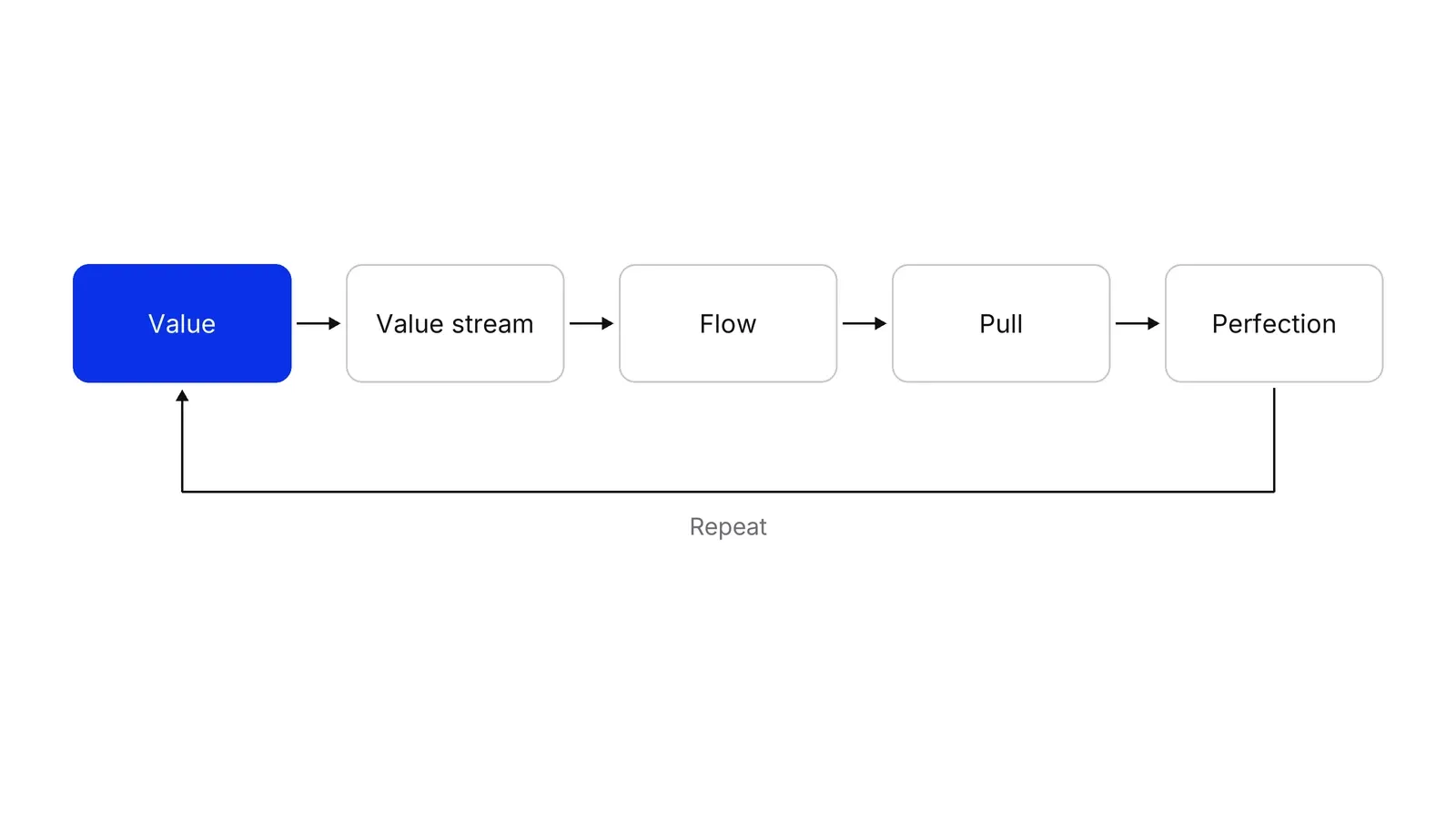
| Principle | What it asks | Illustrative question for a clinic |
|---|---|---|
| Value | What does the end customer value? | Does the patient value the intake form or the appointment? |
| Value stream | Which steps create that value, and which do not? | Which of the six hand-offs add nothing? |
| Flow | Can the remaining steps run in tight sequence? | Why does a file wait two days for a signature? |
| Pull | Does a step start only when the next one needs it? | Do we book scans before a doctor can read them? |
| Perfection | Does the cycle repeat until waste is gone? | Who reviews the new wait times next month? |
In 2007 Womack and Jones condensed the five steps into three words: purpose, process and people (same LEI page). The institute’s current framing asks five questions about purpose, process, capabilities, management system and basic thinking (LEI).
Waste and the work of seeing it
Waste, called muda in Japanese, is any activity that consumes resources without creating value for the customer (LEI). The institute credits Ohno with seven categories: overproduction, waiting, conveyance, processing, inventory, motion and correction, meaning inspection, rework and scrap. It calls overproduction the worst, because it feeds the other six (LEI). An eighth, non-utilized talent, was added as lean moved beyond factories (LEI).
Office work has the same wastes in different clothes. A document waiting for approval is waiting. A report nobody reads is overproduction. A form re-entered into a second system is processing.
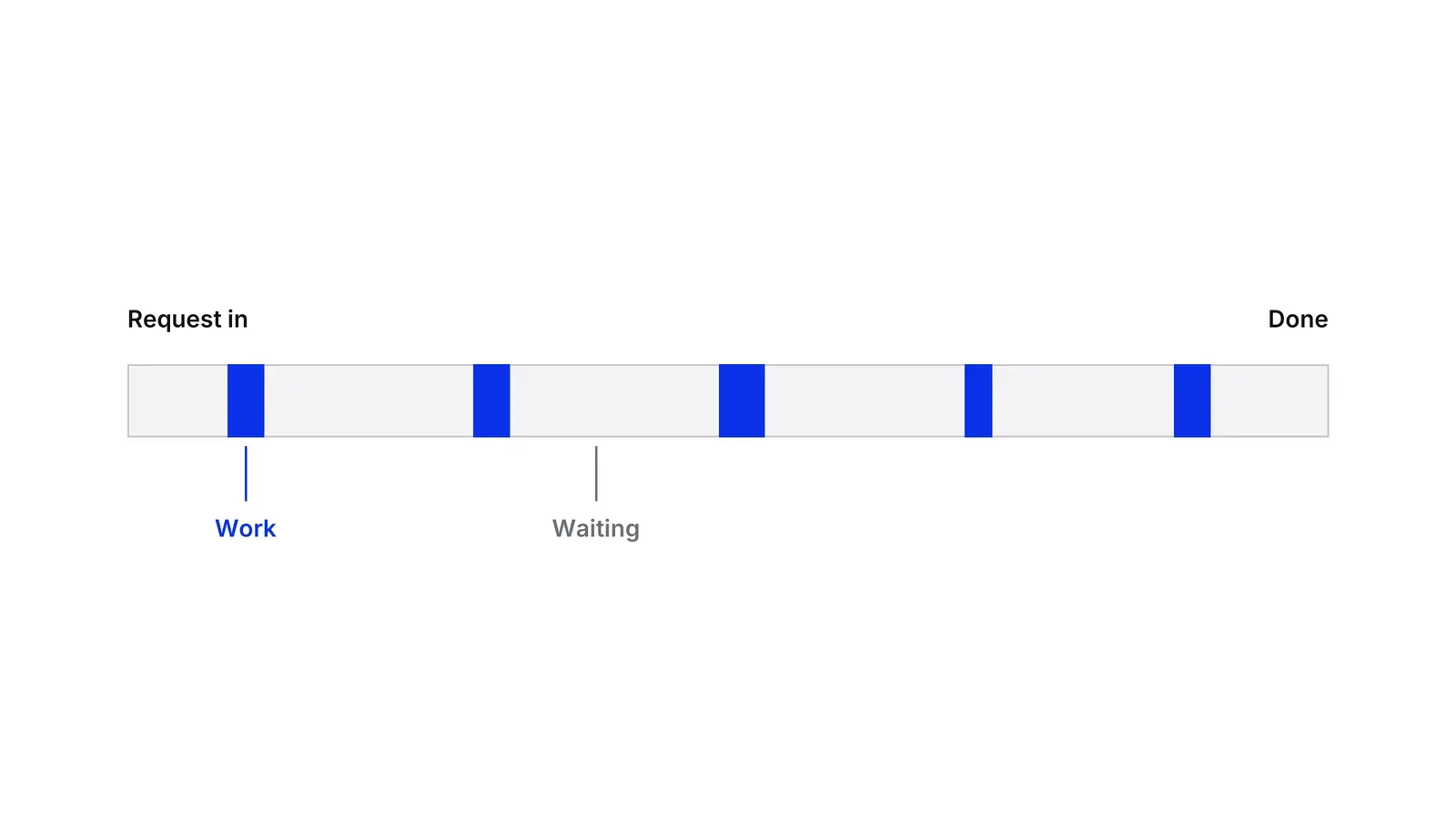
Value stream mapping is how you see them. It charts every step in the material and information flows from order to delivery (LEI). The useful measurement is the gap between the time someone works on an item and the time it sits in a queue. If you want a first, lighter view of a process before mapping it in detail, a SIPOC diagram lists suppliers, inputs, process, outputs and customers on one page, and BPMN process mapping records the detailed flow.
The management system behind the tools
Lean is more than a toolbox. Spear and Bowen argued in Harvard Business Review in 1999 that Toyota’s system rests on four unwritten rules about how work, connections, pathways and improvement are designed (HBS Working Knowledge). The authors reconstructed those rules, because Toyota never wrote them down.
A few practices recur in the lean literature:
- Pull and kanban. Downstream steps signal their needs to upstream steps, and upstream work starts only after the signal (LEI). The kanban page covers how this works on a board.
- Jidoka. Machines and operators can detect an abnormal condition and stop work at once; Toyota traces the idea to a loom that stopped itself when a thread broke (LEI).
- Standardized work and kaizen. Once the current method is written down, it becomes the object of continuous improvement (LEI). The improvement loop itself is PDCA, and a recurring problem is traced to its cause with 5 whys.
- Gemba walks. Leaders go to the place where the work happens, observe and ask questions before they act (LEI).
What the evidence says
Evidence on lean is better for factories than for hospitals, and it is mixed in both. In a sample of plants from IndustryWeek’s census of manufacturers, Rachna Shah and Peter Ward found that four bundles of practices (just-in-time, quality management, preventive maintenance and human resources) explained about 23% of the variation in operational performance (Journal of Operations Management, 2003).
Outside manufacturing, Harvard Business School reports that Wipro started a lean initiative in 2004, and that 8 of its first 10 software projects gained more than 10% in efficiency (HBS Working Knowledge).
Healthcare has been reviewed repeatedly, and the reviews disagree in emphasis:
- Mazzocato and colleagues reviewed 33 articles. All reported positive results, but the articles described early stages and technical aspects, and lean’s reach in the organization was limited (Quality and Safety in Health Care, 2010).
- Moraros, Lemstra and Nwankwo reviewed 22 articles that passed quality review. They found no statistically significant association with patient satisfaction or health outcomes, a negative association with financial costs and worker satisfaction, and potential but inconsistent benefits for process outcomes such as patient flow (International Journal for Quality in Health Care, 2016).
- D’Andreamatteo and colleagues selected 243 articles and concluded that lean results look promising but do not allow a final word on its impact (Health Policy, 2015).
- Radnor and colleagues studied four English NHS cases and found small-scale, local gains. They saw two limits: the customer and the commissioner are different people in healthcare, and services are mostly capacity-led (Social Science and Medicine, 2012).
A review of auto-industry studies by Landsbergis, Cahill and Schnall found little support for the claim that lean production empowers workers, and reported intensified work pace and demands (Journal of Occupational Health Psychology, 1999). Track workload and staff experience next to lead time.
A Growth Lab plan can start from one mapped process, with the baseline lead time written down before anything changes.
How to apply Lean management, step by step
- Define what the customer values. Write down what the end customer of this process would pay for and what they would not. A patient wants a diagnosis, not a form. Result: a one-line statement of value that every step is tested against.
- Map the value stream. Walk the process from request to delivery with the people who do it, and record each step, the time someone works on the item and the time it sits waiting. Result: a map that shows where the elapsed time actually goes.
- Remove waste and fix the flow. Cross out steps, hand-offs, approvals and rework that add nothing to the value statement. Then limit how many items are in progress at once so work stops piling up between steps. Result: a shorter map and fewer items waiting.
- Let demand pull the work. Start a step only when the next step has room and has asked for it, for example with a kanban board and a work-in-progress limit. Result: no step produces ahead of what the next one can use.
- Write down the standard, then improve it. Document the current best way to do each step in a few lines, so a change can be compared with a baseline. Hold a short weekly review at the place the work happens. Result: a standard that people change on purpose, not by drift.
- Repeat on the next constraint. Re-measure the end-to-end time, find the next longest wait and run the cycle again. Result: a steady series of small improvements with numbers attached.
Examples
A clinic's referral-to-appointment path
Illustrative. A patient referral is received on day 0, checked by a coordinator on day 2, insurance-verified on day 4 and booked on day 7. Only about 40 minutes of that is anyone working on the file. The rest is queue time between three people. Lean work starts by mapping those waits, then moves insurance checks to the moment the referral arrives and gives the coordinator a daily limit on open files. The aim is a shorter wait for the patient, with the same staff.
Onboarding at a payments company
Illustrative. A business customer's onboarding passes through sales, document review, a compliance check and account setup. Rework appears when documents come back incomplete. A lean team treats the returned file as a defect, finds out which missing item causes most returns, and puts that item on the first form. It also sets a work-in-progress limit for the compliance queue so reviewers finish files before opening new ones.
A marketing team's campaign approvals
Illustrative. A campaign brief waits for design, then legal, then the budget owner. Each step takes under an hour, but the brief spends days in inboxes. The team maps the stream, schedules a 30-minute daily review slot for all three approvers and counts the days from brief to launch. The number is the baseline for the next change.
When to use it
Use it when the problem is time, rework or queues in a process that repeats, such as onboarding, fulfilment, patient flow, support tickets or approvals. It fits when the people who do the work can be involved in redesigning it and when leaders will visit the place where the work happens.
When not to use it
Skip it when the process is not stable or repeated enough to measure, such as a one-off project, or when the real constraint is demand, price or product quality rather than flow. Do not run it as a headcount programme: the reviews cited below report worker-satisfaction and work-intensity problems.
Common mistakes
- Copying tools without the system. Spear and Bowen's point is that the visible practices sit on four unwritten rules about how work, connections, pathways and improvement are designed.
- Treating lean as a cost-cutting exercise. Moraros and colleagues found a negative association with worker satisfaction in healthcare studies, so measure staff experience as well as lead time.
- Making only local fixes. Mazzocato and colleagues found healthcare lean cases mostly narrow and technical, with limited organisational reach, although lean theory is about the whole system.
- Ignoring workload. Landsbergis and colleagues' review of auto-industry studies found lean production tended to intensify work pace and demands.
- Mapping once and stopping. A map is a baseline for the next cycle, not a deliverable.
FAQ
What are the five principles of lean?
Womack and Jones proposed them in Lean Thinking. Specify value from the customer's standpoint. Identify the value stream and remove steps that add no value. Make the remaining steps flow smoothly. Let the customer pull value from the next upstream activity. Repeat the cycle until perfect value is created with no waste.
What are the seven wastes in lean?
Taiichi Ohno's seven categories, as the Lean Enterprise Institute lists them, are overproduction, waiting, conveyance, processing, inventory, motion and correction (inspection, rework and scrap). The institute calls overproduction the worst, because it feeds the other six. A later eighth waste, non-utilized talent, is often added.
What is the difference between lean and the Toyota Production System?
The Toyota Production System is Toyota's own management system, built on just-in-time and jidoka. 'Lean' is the English term that researchers at MIT's International Motor Vehicle Program, starting with John Krafcik, used for the same kind of system when studying it outside Toyota. The words are often used interchangeably, but lean is the general version.
Does lean work in healthcare?
The evidence is mixed. A review of 33 studies found all reported positive results but mostly narrow, technical ones. A review of 22 quality-assessed studies found no significant link to patient satisfaction or health outcomes and inconsistent process benefits. A review of 243 articles said results looked promising but could not settle the question.
What tools does lean management use?
Common ones are value stream mapping, kanban and pull systems, standardized work, A3 problem-solving reports, jidoka (stopping work when a defect appears), heijunka (levelling the mix and volume of work) and gemba walks, where leaders watch the work in place. Tools only help if the principles behind them are in use.
Sources
- Toyota Motor Corporation, Toyota Production System
- Toyota Motor Corporation, 75 Years of Toyota: Modernization of Facilities (supermarket method and kanban)
- Lean Enterprise Institute, Lean Thinking and Practice
- Lean Enterprise Institute, What is Lean?
- Lean Enterprise Institute, A Brief History of Lean
- Lean Enterprise Institute, Lean Production (lexicon)
- Lean Enterprise Institute, Seven Wastes (lexicon)
- Jean Cunningham, The Eight Wastes of Lean, Lean Enterprise Institute, 2020
- Lean Enterprise Institute, Muda (lexicon)
- Lean Enterprise Institute, Value-Stream Mapping (lexicon)
- Lean Enterprise Institute, Kaizen (lexicon)
- Lean Enterprise Institute, Jidoka (lexicon)
- Lean Enterprise Institute, Just-in-Time (lexicon)
- Lean Enterprise Institute, Pull Production (lexicon)
- Lean Enterprise Institute, Standardized Work (lexicon)
- Lean Enterprise Institute, Gemba (lexicon)
- Lean Enterprise Institute, A3 Report (lexicon)
- Lean Enterprise Institute, Heijunka (lexicon)
- Mark Graban, The Evolution of 'Lean Production': Reflecting on 25 Years Since the Term Was Coined, LeanBlog, 2013
- Planet Lean, A fork in the road for lean research?
- Steven Spear, H. Kent Bowen, Decoding the DNA of the Toyota Production System, Harvard Business Review, September-October 1999
- Harvard Business School Working Knowledge, Decoding the DNA of the Toyota Production System
- Rachna Shah, Peter T. Ward, Lean manufacturing: context, practice bundles, and performance, Journal of Operations Management 21(2), 2003
- Harvard Business School Working Knowledge, Bringing Lean Principles to Service Industries, 2007
- P. Mazzocato, C. Savage, M. Brommels, H. Aronsson, J. Thor, Lean thinking in healthcare: a realist review of the literature, Quality and Safety in Health Care 19(5), 2010
- Moraros J., Lemstra M., Nwankwo C., Lean interventions in healthcare: do they actually work? A systematic literature review, International Journal for Quality in Health Care 28(2), 2016
- A. D'Andreamatteo, L. Ianni, F. Lega, M. Sargiacomo, Lean in healthcare: a comprehensive review, Health Policy 119(9), 2015
- Zoe Radnor, Matthias Holweg, Justin Waring, Lean in healthcare: the unfilled promise?, Social Science and Medicine 74(3), 2012
- Andersen H., Røvik K.A., Ingebrigtsen T., Lean thinking in hospitals: is there a cure for the absence of evidence? A systematic review of reviews, BMJ Open 4(1), 2014
- Paul A. Landsbergis, Janet Cahill, Peter Schnall, The impact of lean production and related new systems of work organization on worker health, Journal of Occupational Health Psychology 4(2), 1999
Last updated Oct 9, 2026


Fractional COO or embedded operations team? How to choose at Series A
The two models solve different problems: how to tell which one your company needs, and what each costs in time and control.

What operational systems successful fintech startups use: lessons from ten companies
Starling, Monzo, Qonto, bunq, Lunar, Pleo, Tide, Ramp, Mercury and Column scaled on four operating systems. Regulators' findings show what breaks when one of them lags behind growth.

What a revenue operations manager actually owns
Pipeline definitions, CRM hygiene, forecasting and the handoffs between marketing, sales and success. What the role covers, and how it differs from sales ops.