McKinsey 7S model
The McKinsey 7S model is a checklist of seven parts of an organization that have to fit together, used to diagnose why a change is stalling and to plan what else must move with it.
The McKinsey 7S model is a framework for checking whether the parts of an organization fit together. It names seven elements: strategy, structure, systems, shared values, style, staff and skills. Robert Waterman, Tom Peters and Julien Phillips of McKinsey published it in June 1980. Its main claim is that changing one element, such as structure, rarely works unless the other six are adjusted to match.
- Origin
- Robert H. Waterman Jr., Thomas J. Peters and Julien R. Phillips (McKinsey), with Anthony Athos and Richard Pascale, 1980
- Level
- 201 · Tool
- Fits
- Scale-up, Enterprise
- Time to apply
- two to three weeks for interviews and documents, then one half-day leadership session
- What you need
- one specific change the review has to serve: a reorganization, a merger, a new strategy · the org chart, the main management reports and the incentive plan · short interviews with 8 to 15 people across levels, not only the leadership team
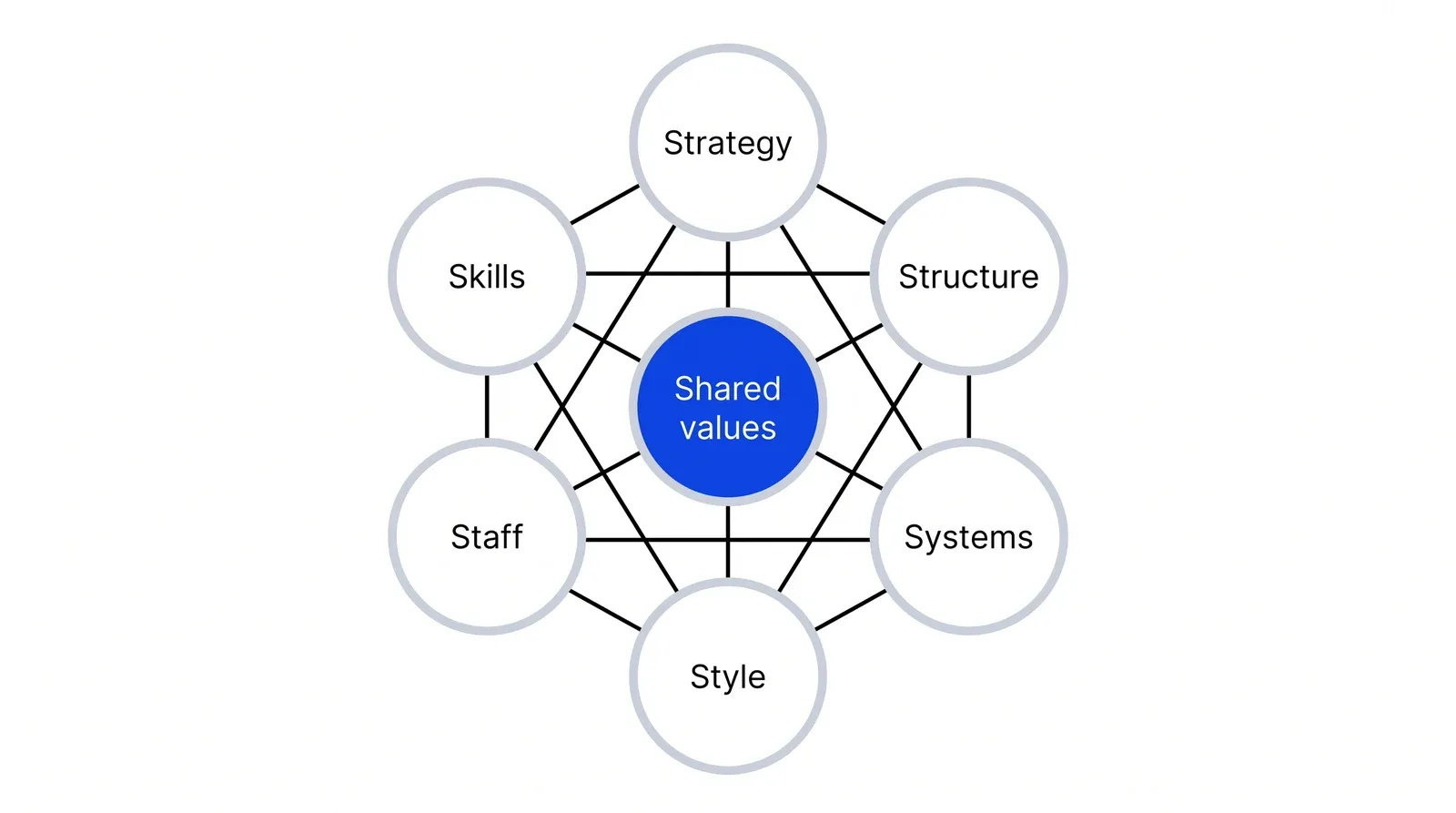
The McKinsey 7S model is a framework for checking whether the parts of an organization fit together. It names seven elements: strategy, structure, systems, shared values, style, staff and skills. Its argument is in the title of the article that introduced it, “Structure is not organization”, published by Robert Waterman, Tom Peters and Julien Phillips in Business Horizons in June 1980. Redrawing the org chart, the authors argued, changes little unless the other elements move with it.
Leadership teams use it before a reorganization, a merger or a new strategy, when they need to see what else has to change besides the reporting lines. Consultants and hospital managers have also used it as a diagnostic, a structured way to ask why a change is stalling.
Who created the 7S model?
The 1980 article has three authors, all at McKinsey: Waterman, Peters and Phillips. Many summaries credit only Peters and Waterman, and some credit Richard Pascale and Anthony Athos, so it helps to know the full story.
According to Tom Peters’ own account, McKinsey asked him in 1977 to study organization effectiveness, a side project in its San Francisco office supervised by Waterman. Waterman brought in Anthony Athos, a Harvard Business School professor of organizational behavior, as the Harvard Gazette obituary describes his field. Peters says Athos insisted on an alliterative model, which is where the seven S labels come from, and that Athos’s term “superordinate goals” became shared values. The model was finished at a two-day session in San Francisco attended by Waterman, Athos, Peters and Richard Pascale.
The model then appeared in two bestsellers: Pascale and Athos’s The Art of Japanese Management in 1981 and Peters and Waterman’s In Search of Excellence in 1982. That second book is why most people know it as McKinsey’s. McKinsey Quarterly dates the model to the late 1970s and links it to the book.
The seven elements
Each element answers one question about the organization. The table gives the plain meaning and a question to ask in interviews.
| Element | Type | What it means | Question to ask |
|---|---|---|---|
| Strategy | Hard | The plan for winning against competitors | What are we choosing not to do? |
| Structure | Hard | Who reports to whom, how work is divided | Who decides on pricing, hiring, launches? |
| Systems | Hard | The routines and reports that run the business | Which report changes decisions each week? |
| Shared values | Soft | What the organization stands for in practice | What gets people promoted or fired here? |
| Style | Soft | How leaders behave and spend their time | What do leaders spend most hours on? |
| Staff | Soft | Who the people are, how they are hired and developed | Which roles are hard to fill, and why? |
| Skills | Soft | What the organization as a whole is good at | What could a rival not copy within a year? |
Hard and soft elements
Strategy, structure and systems are called hard because management can write them down and change them by decision. The other four are soft. They live in habits and people, so they change slowly and are hard to see from the top. Peters’ summary of the point is that hard is soft and soft is hard.
There is some evidence for it. A 2022 study of Warsaw public hospitals surveyed 249 physicians from 22 departments and grouped the findings by the seven elements. The authors concluded that the social factors mattered more for how the hospitals worked, while strategy, structure and systems had a limited effect. A 2025 study of an ISO 9001 certified hospital centre in Casablanca used the 7S as its diagnostic and found the weak spots in internal communication and staff training, both soft areas.
Why no element comes first
The 7S has no hierarchy. Any element can be the one that blocks a change. McKinsey’s 2008 note reads the lack of hierarchy as a warning: big progress in one area is hard without work on the others.
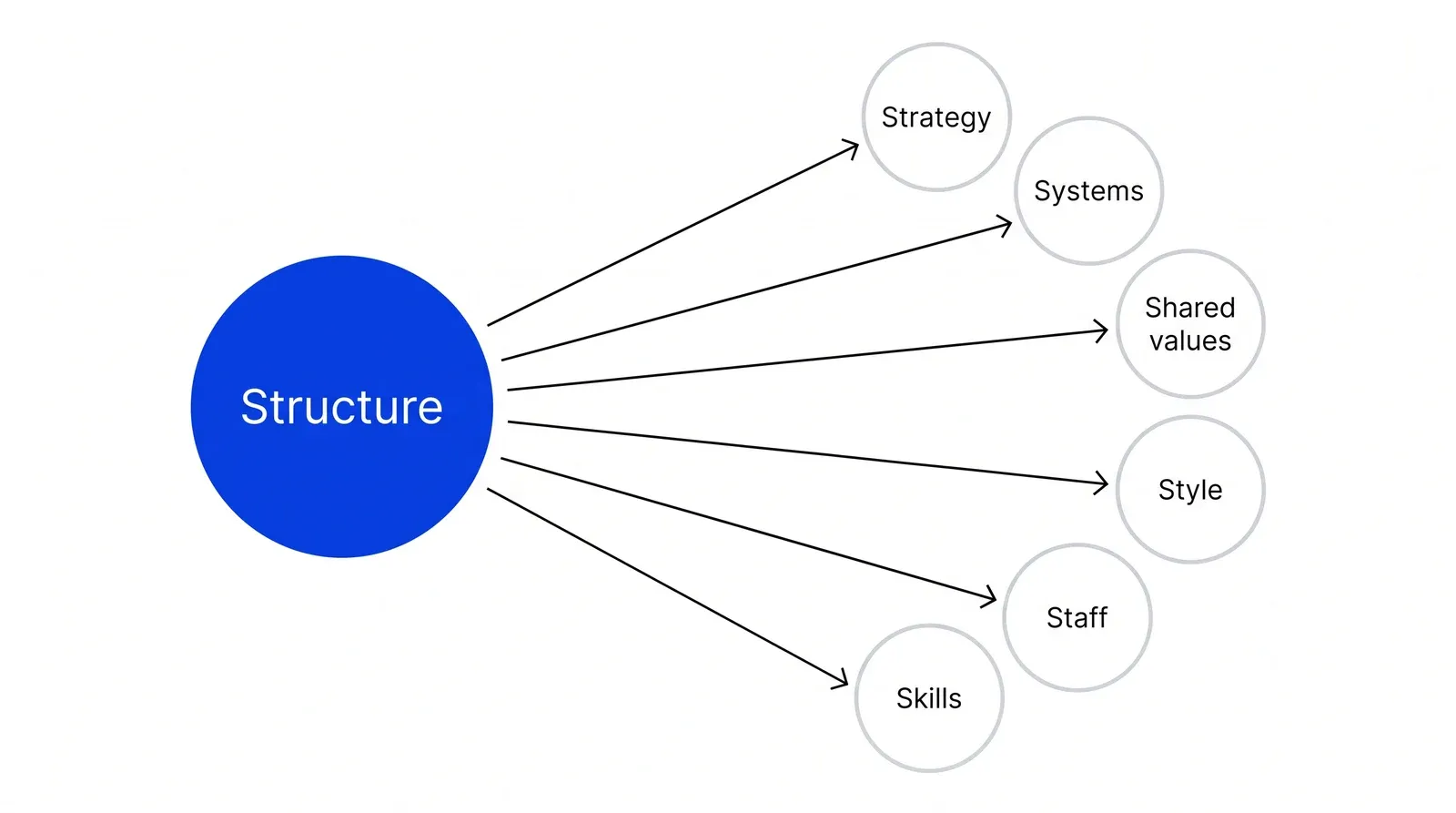
That is the main practical use. When a leadership team plans a new structure, the 7S forces six follow-up questions. Will the reports still reach the people who now decide? Do incentives reward the new behaviour? Does anyone have the skills the new structure assumes? Channon and Caldart’s encyclopedia entry describes this as going past the idea that structure follows strategy, which goes back to Alfred Chandler’s 1962 book Strategy and Structure.
Where the 7S model falls short
The model tells you where to look, not what causes what. It cannot say which element to fix first, and it has no measures of its own. Most published uses are studies of one organization or one city, such as the hospital papers above, rather than large tests that link fit to performance.
Later authors tried to fill these gaps. Robert Kaplan, co-creator of the balanced scorecard, argued in Strategy & Leadership in 2005 that the scorecard is a modern version of the 7S, with measures attached. James Higgins proposed eight S’s for strategy execution in the same year, replacing skills with resources and adding strategic performance. Burke and Litwin’s 1992 model set out to go beyond description and suggest causal links between organizational factors.
How it compares with other organization models
The 7S is one of several diagnostic models from the same period. They overlap, and the choice often comes down to what the team needs to see.
| Model | Year | Elements | What it adds |
|---|---|---|---|
| Weisbord six-box | 1976 | Purposes, structure, relationships, rewards, leadership, helpful mechanisms | Rewards and relationships as their own boxes |
| Nadler-Tushman congruence | 1980 | Task, individuals, formal organization, informal organization, judged against strategy | A stated hypothesis: the more fit between components, the more effective the organization |
| McKinsey 7S | 1980 | Strategy, structure, systems, shared values, style, staff, skills | Shared values at the centre, no element ranked first |
| Galbraith Star Model | Set out in Designing Organizations | Strategy, structure, processes, rewards, people | Framed as levers managers control |
| Burke-Litwin | 1992 | Transformational factors (mission and strategy, leadership, culture) and transactional ones (structure, systems, management practices, climate) | Causal links running from the environment to performance |
Using it in practice
A 7S review works best when it serves one decision, such as a merger, a reorganization or a new strategy. Write the current and target state for each element, then look at the pairs that conflict. Pay particular attention to systems and staff. A new role that exists on paper but has no report, routine or trained person behind it is the misfit the 1980 article warned about, and it is the same gap Pushers’ operational systems work is built to close.
How to apply McKinsey 7S model, step by step
- Name the change. Write down the change the organization is trying to make, such as moving from founder-led sales to a sales team, or merging two acquired clinics. The 7S review is only useful against a target. Result: one sentence that every finding has to relate to.
- Describe each S as it is today. For each of the seven elements, write what is true now, backed by documents and interviews: who reports to whom, which reports drive decisions, what people say gets rewarded, how leaders spend their week. Result: seven short descriptions of the current state, with evidence.
- Describe each S as it needs to be. For the same seven elements, write what has to be true for the change to succeed. Keep it concrete: a new role, a new weekly report, a skill the team lacks. Result: seven descriptions of the target state.
- Mark the gaps and the conflicts. Compare current and target for each element, then check pairs: does the new structure match the systems, do incentives match the stated values? Shared values sit at the centre, so check every element against them. Result: a list of gaps, with the worst misfits ranked first.
- Turn the gaps into a sequenced plan. Give each gap an owner, a first action and a date. Change the elements that block others first, which is often systems or staff, not structure. Result: a change plan that moves several elements together instead of only redrawing the org chart.
- Re-run the review after a quarter. Repeat the current-state description three months later and compare. Fit drifts as people leave, new tools arrive and strategy shifts. Result: a dated record of which gaps closed and which opened.
Examples
Public hospitals in Warsaw
Chmielewska and colleagues surveyed 249 randomly selected physicians from 22 in-patient departments in Warsaw public hospitals, using World Health Organization questionnaires grouped by the 7S elements. Their 2022 paper in BMC Health Services Research concluded that the social factors mattered more for how the hospitals worked, and that strategy, structure and systems, while important, had a limited effect on day-to-day operations. For a hospital manager the practical reading is that a new structure will do little if staff, style and skills are left as they were.
ERP readiness in two Iranian banks
Hanafizadeh and Ravasan built an ERP readiness assessment on the seven elements, published in the International Journal of Enterprise Information Systems (2011), and applied it to two Iranian banks. The idea is to score readiness on each S before buying and installing the system, so that weak spots such as missing skills or a structure that cannot own the new processes are fixed before the project starts rather than after it fails.
A payments company absorbing an acquisition
Illustrative, no real company implied. A payments company with 150 staff buys a 30-person fraud-scoring startup. Leadership plans only a structural change: the startup becomes a department. A 7S review shows more. The startup ships weekly while the parent releases monthly (systems), its engineers are paid partly in equity that no longer exists (staff), and its founders decide fast in chat while the parent decides in committees (style). The integration plan adds a release process, a retention bonus and a decision rule for fraud models, alongside the new reporting line.
When to use it
Use it before or during a large change that touches the whole organization: a reorganization, a merger or acquisition, a new strategy that needs different capabilities, or growth that has broken the way the company used to work. It is most useful when leaders are about to change only one thing, usually the org chart, and need a structured way to see what else has to move.
When not to use it
Skip it for narrow operational problems, such as a falling conversion rate or a slow approval process, which need funnel analysis or process mapping. It also adds little in a team of under 20 people, where all seven elements sit in the founders' heads. The model does not rank causes or measure anything, so do not use it alone to prove why performance fell.
Common mistakes
- Treating it as a list to fill in once. The value is in checking how the elements fit each other, pair by pair, against one specific change.
- Describing shared values as the slogans on the wall. Write what people say gets rewarded and what gets someone fired, which is what the organization values in practice.
- Interviewing only the leadership team. Style and shared values look different two levels down, and that is where misfits show.
- Changing structure first by default. The 1980 article was written against exactly this habit; a new org chart on top of old systems and incentives tends to fail.
- Presenting the review as evidence of what drives performance. The model describes; it does not test causes.
FAQ
What are the 7 S's of the McKinsey 7S model?
Strategy, structure, systems, shared values, style, staff and skills. The first three are usually called the hard elements because they are easy to write down and change by decision. The other four are the soft elements, which are harder to see and slower to change. Shared values sit at the centre and connect to all the others.
Who created the McKinsey 7S framework?
It was published by Robert Waterman, Tom Peters and Julien Phillips in the June 1980 issue of Business Horizons, in an article titled Structure is not organization. Peters credits Harvard professor Anthony Athos with the alliterative S labels and says Richard Pascale took part in the session where the model was finished.
What is the difference between hard and soft elements in the 7S model?
The hard elements, strategy, structure and systems, can be written down and changed by management decision. The soft elements, shared values, style, staff and skills, live in people and habits. A 2022 study of Warsaw public hospitals found the soft, social factors mattered more for how the hospitals worked.
How is the 7S model used in change management?
Teams describe each element as it is today and as it needs to be after the change, then look for gaps and conflicts between elements. The output is a plan that moves several elements together. Kaplan argued in a 2005 article that the balanced scorecard can be read as a modern version of the same alignment idea.
What are the limitations of the McKinsey 7S model?
It names what to look at but not which element causes which, so it cannot say where to start. It has no built-in measures, and published applications are mostly single-organization studies. Later models such as Burke and Litwin's 1992 model tried to add causal links that the 7S leaves out.
Sources
- Robert H. Waterman Jr., Thomas J. Peters, Julien R. Phillips, Structure is not organization, Business Horizons 23(3), June 1980
- Tom Peters, A brief history of the 7-S (McKinsey 7-S) model, tompeters.com, March 2011
- McKinsey Quarterly, Enduring ideas: The 7-S framework, March 2008
- Thomas J. Peters, Symbols, patterns, and settings: An optimistic case for getting things done, Organizational Dynamics 7(2), 1978
- Richard T. Pascale, Anthony G. Athos, The Art of Japanese Management, Simon and Schuster, 1981, Internet Archive record
- Thomas J. Peters, Robert H. Waterman Jr., In Search of Excellence, Harper & Row, 1982, Internet Archive record
- Richard T. Pascale, Zen and the art of management, Harvard Business Review, March 1978
- Harvard Gazette, Anthony G. Athos dies at 68, January 2003
- Derek F. Channon, Tommaso Caldart, McKinsey 7S model, Wiley Encyclopedia of Management, 2015
- Alfred D. Chandler Jr., Strategy and Structure: Chapters in the History of the Industrial Enterprise, MIT Press, 1962, Internet Archive record
- Robert S. Kaplan, How the balanced scorecard complements the McKinsey 7-S model, Strategy & Leadership 33(3), 2005
- James M. Higgins, The eight S's of successful strategy execution, Journal of Change Management 5(1), 2005
- Marvin R. Weisbord, Organizational diagnosis: Six places to look for trouble with or without a theory, Group & Organization Studies 1(4), 1976
- David A. Nadler, Michael L. Tushman, A model for diagnosing organizational behavior, Organizational Dynamics 9(2), 1980
- W. Warner Burke, George H. Litwin, A causal model of organizational performance and change, Journal of Management 18(3), 1992
- Yonatan Reshef, University of Alberta, The congruence model (course notes, after Nadler and Tushman)
- Jay R. Galbraith, Designing Organizations: An Executive Guide to Strategy, Structure, and Process, Jossey-Bass, 2002, Internet Archive record
- Galbraith Management Consultants, The Star Model
- Małgorzata Chmielewska et al., Evaluating organizational performance of public hospitals using the McKinsey 7-S framework, BMC Health Services Research 22, 2022
- Bounjerte et al., Evaluating organisational performance in healthcare: a mixed-method study using the McKinsey 7S framework, BMJ Open Quality 14(2), 2025
- Payam Hanafizadeh, Ahad Zare Ravasan, A McKinsey 7S model-based framework for ERP readiness assessment, International Journal of Enterprise Information Systems 7(4), 2011
Last updated Oct 9, 2026


Fractional COO or embedded operations team? How to choose at Series A
The two models solve different problems: how to tell which one your company needs, and what each costs in time and control.

What operational systems successful fintech startups use: lessons from ten companies
Starling, Monzo, Qonto, bunq, Lunar, Pleo, Tide, Ramp, Mercury and Column scaled on four operating systems. Regulators' findings show what breaks when one of them lags behind growth.

What a revenue operations manager actually owns
Pipeline definitions, CRM hygiene, forecasting and the handoffs between marketing, sales and success. What the role covers, and how it differs from sales ops.