Personal brand framework
A personal brand framework is a step-by-step way for a founder or executive to choose what they want to be known for, prove it in public and check that the reputation helps the company.
A personal brand framework is a structured process a founder or executive uses to decide what they want to be known for, by which audience, and what evidence backs it, then to publish that evidence on a steady schedule and measure the result. Founders use it so their own reputation brings the company trust, deals, hires and investor attention instead of random visibility.
- Origin
- No single inventor. Tom Peters popularised the idea in Fast Company; some writers credit Peter Montoya and Tim Vandehey, 1997
- Level
- 301 · Advanced
- Fits
- Startup, Small and mid-size
- Time to apply
- two working sessions to set the position, then 2 to 4 hours a week to publish and review
- What you need
- a written company strategy or positioning the founder's brand has to support · five to ten people who can say honestly what the founder is known for today · a list of proof: numbers, cases, decisions and documents the founder can show in public · one person who reviews posts for legal, financial and confidentiality risk
A personal brand framework is a structured process a founder or executive uses to decide what they want to be known for, by whom, and on what evidence, then to publish that evidence and check whether it helps the company. In a 2022 Brunswick survey of 3,600 employees, 82% said they would research a CEO’s online presence before joining a company. Buyers, candidates and investors look up the founder whether or not the founder has planned for it. The framework turns that lookup into something the company can use.
There is no single canonical model. The steps on this page are a synthesis of the process described in the academic reviews below and in Jill Avery and Rachel Greenwald’s 2023 Harvard Business Review article, adapted for people whose reputation is tied to a company.
Where the idea came from
Tom Peters popularised the term in “The Brand Called You”, a Fast Company cover story in August 1997. His own site reproduces the line that our most important job is to be “head marketer for the brand called You”. Peters later wrote that the piece was edited by Fast Company co-founder Alan Webber from a phone interview.
Credit is not settled. A 2020 review by Scheidt, Gelhard and Henseler, covering 518 publications, says Peters coined the term but gave no explicit definition. The 2018 review by Gorbatov, Khapova and Lysova notes that some writers credit Peter Montoya and Tim Vandehey instead, and that others trace the roots to Erving Goffman’s 1959 book The Presentation of Self in Everyday Life. Marketing scholars made the general case even earlier: Kotler and Levy argued in 1969 that marketing applies to organizations, persons and ideas.
Gorbatov and colleagues reviewed 100 academic publications and defined personal branding as “a strategic process of creating, positioning, and maintaining a positive impression of oneself”, based on a distinct mix of personal traits and a promise to a target audience. That definition is the working one on this page.
The position: where expertise, need and proof meet
A founder’s position is the one territory where three things overlap: what the founder knows deeply, what a specific audience needs, and what the founder can prove in public. Drop any one and the brand stops working for the company. A payments founder who writes about AI art may be expert and interesting, but importers’ CFOs will not read it. A founder who comments on every trend the audience cares about, with no cases or numbers behind the comments, gives readers nothing to check.
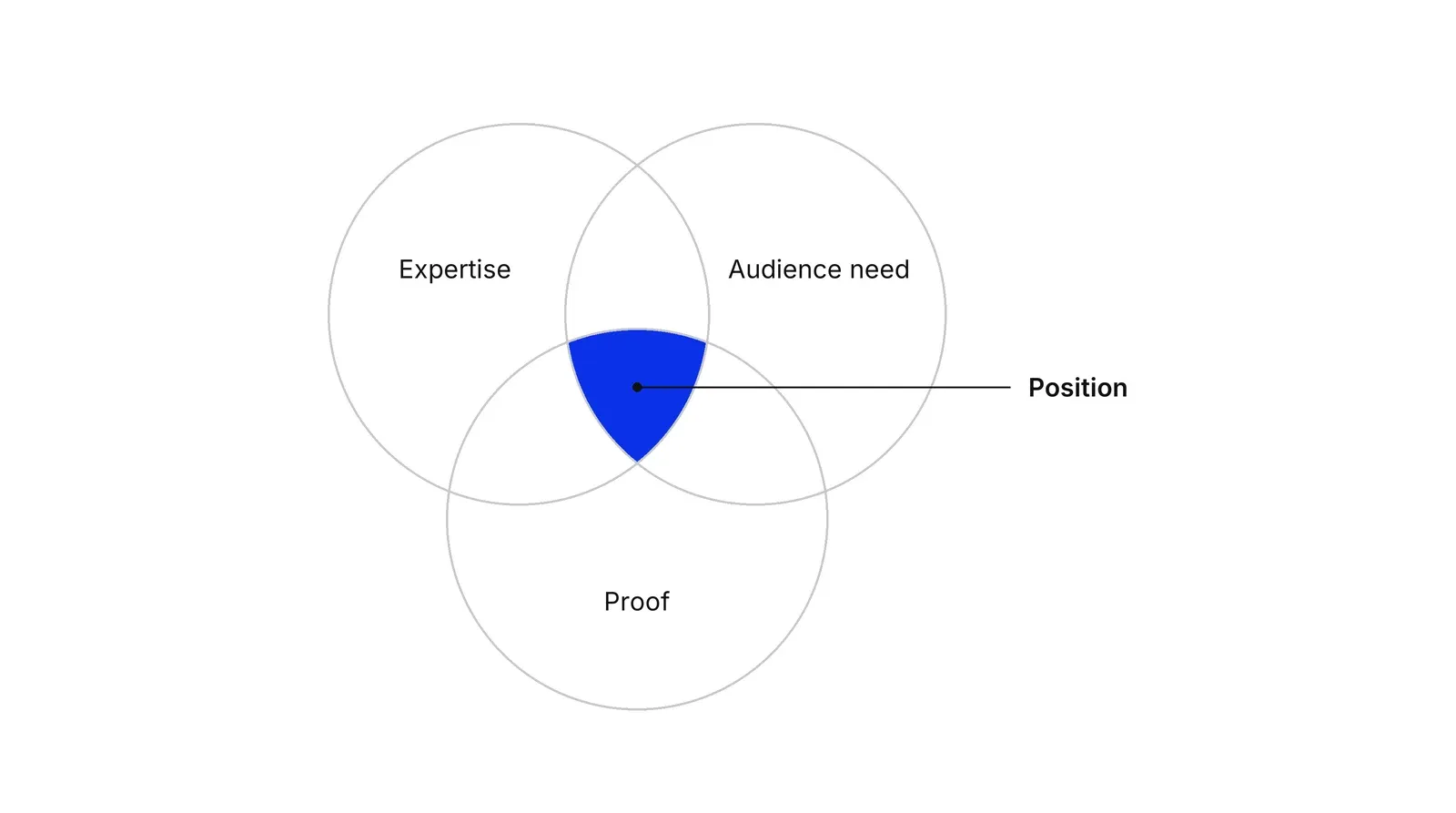
The research backs the emphasis on distinctiveness. Rangarajan, Gelb and Vandaveer interviewed 33 professionals in the US and Europe and found that competence and personal qualities counted roughly equally, and that distinctiveness mattered a great deal. Their starting point is useful for founders: everyone already has a personal brand, so the only choice is whether to manage it.
Distinct does not mean odd. Scheidt and colleagues list authenticity next to differentiation and visibility among the main ingredients of a personal brand, and a founder still has to sound like a credible member of their field. A fintech founder who sounds nothing like a finance professional loses trust, however memorable the posts are. A positioning statement for the company is the right input here, because the founder’s territory should sit inside it.
Founder brand and company brand
A founder brand and a company brand overlap but are not the same asset. The table shows how they differ.
| Founder’s personal brand | Company brand | |
|---|---|---|
| Who owns it | The individual | The business |
| What it signals | Judgement, values, expertise | Product, service, promise to customers |
| Strongest at | Early sales, fundraising, senior hiring | Scale, repeat purchase, exit value |
| Main risk | Leaves with the person; one bad post spreads to the company | Feels faceless without a visible leader |
Bendisch, Larsen and Trueman argued in the European Journal of Marketing that CEO brands are shaped by both personality and role, can raise or damage corporate brand value, and should be tracked by the organization. A Journal of Marketing study by Marie-Agnès Parmentier and Eileen Fischer, summarised by the American Marketing Association, found that a prestigious post both supplies and drains the resources a professional brand needs, and suggests treating the relationship between a firm and a high-profile person as a co-branding alliance with benefits and costs for both sides.
What the evidence says about payoff
Evidence for career benefits is real but limited. Gorbatov and colleagues’ 2019 study of 477 people in the Netherlands and China linked personal branding to career satisfaction, fully through higher perceived employability. The data were cross-sectional and self-reported, and the study did not measure pay or promotion.
For founders the more relevant evidence is about trust. In an experiment by Elliott, Grant and Hodge, investors trusted the CEO more and were more willing to invest when bad earnings news came from the CEO’s personal Twitter account rather than an investor relations channel. Brunswick’s 2022 survey found that 73% of employees and 86% of financial readers thought it important for CEOs to communicate about their company on social media.
How to measure a personal brand
Personal brand equity is measurable on three dimensions, according to the 12-item scale that Gorbatov, Khapova, Oostrom and Lysova validated across seven samples with 3,273 participants. Recognition asks whether the audience knows you. Differentiation asks whether they see you as different from peers. Appeal asks whether they like what you stand for. The scale predicted perceived employability, career success and job performance.
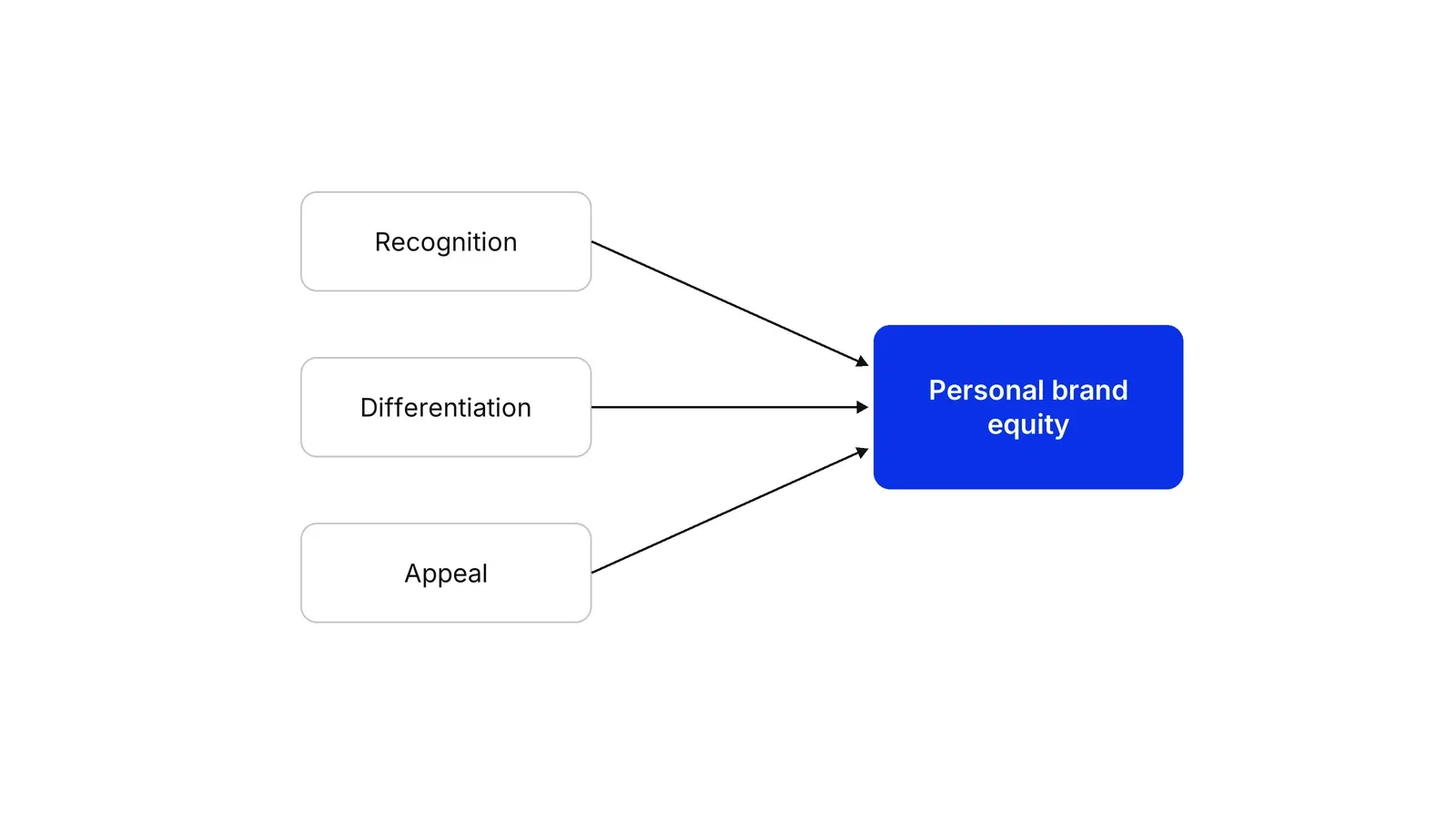
For a founder, turn each dimension into a business signal. Recognition shows up as inbound requests that mention the founder. Differentiation shows up when prospects repeat the founder’s specific argument back in sales calls. Appeal shows up in candidate interest and invitations to speak.
Risks and criticism
The strongest early critique came from Art Kleiner in strategy+business in 2001: personal branding is “structurally guaranteed to pay off for a few early experimenters” and frustrates the rest. Sociologists Vallas and Christin studied 163 workers and found the branding discourse widespread, with people responding to it in several different ways. Gorbatov’s review raises the commodification of the self and the blurring of private and working life.
Trust is also fragile. The 2025 Edelman Trust Barometer, as reported by the Australian Institute of Company Directors, found 68% of people believe business leaders deliberately mislead them. Herminia Ibarra warns in The Authenticity Paradox that a narrow idea of authenticity can hold leaders back, so a founder should expect the brand to change as the role does. Heavey and colleagues describe social media for leaders as offering both large opportunities and real risks.
In our marketing operational system work the founder’s channel is treated like any other channel: it gets a plan, an owner for review and a metric tied to pipeline.
How to apply Personal brand framework, step by step
- Audit what people already think. Ask customers, staff, investors and peers to describe the founder in three words and to name the topic they would call them about. Search the founder's name and read the first page of results. Result: a short gap list between the reputation the founder has and the one the company needs.
- Pick one audience and one territory. Name the people whose trust moves the company forward, such as hospital procurement heads, CFOs of mid-sized importers or seed investors in health tech. Then choose one topic where the founder's expertise meets what that audience needs. Result: a one-sentence position, for example 'the founder who explains cross-border payments for importers in plain numbers'.
- Collect proof before you publish. List the evidence that supports the position: metrics the company can disclose, customer stories with permission, decisions and the reasons behind them, credentials. Drop any claim you cannot back. Result: a bank of 20 to 30 pieces of proof that will feed the first quarter of content.
- Choose channels and a cadence you can keep. Pick one main channel where the audience already reads, often LinkedIn for B2B, plus one deeper format such as talks, a newsletter or industry articles. Set a rhythm the founder can sustain for a year, such as two posts a week and one long piece a month. Result: a calendar with owners and dates.
- Measure recognition, difference and appeal. Every quarter, check whether the target audience knows the founder, sees them as different from peers and likes what they stand for. Track inbound requests, speaking invitations, candidate mentions and investor replies alongside reach. Result: a quarterly note on what to keep, cut or change.
- Set guardrails with the company. Agree which topics are off limits, who reviews posts that touch on financial results, regulation or clients, and how the company brand continues if the founder steps back. Result: a one-page policy signed off by the founder and the board or leadership team.
Examples
A B2B payments founder
Illustrative. The founder of a cross-border payments startup sells to mid-sized importers. The audit shows peers see her as a sharp engineer, while CFOs at target clients have never heard of her. She picks one territory: the real cost of FX for importers, explained with numbers. Her proof bank holds anonymised fee comparisons and two client stories cleared by their legal teams. She posts twice a week on LinkedIn and gives one talk a quarter at trade associations. After two quarters, the sales team logs which inbound leads mention her posts, so the effect on pipeline is counted rather than guessed. Regulated claims go to compliance before publishing.
A clinic founder who is also the lead surgeon
Illustrative. A surgeon who founded a private orthopaedic clinic wants referrals from general practitioners. He chooses the audience of referring doctors, not patients, and one territory: recovery outcomes after knee replacement. Proof comes from the clinic's own audited outcome data and published guidelines, with no patient identifiable. He writes one article a month for a regional medical association newsletter and answers referral questions in a short video series. The clinic adds a second senior surgeon to every public piece, so referrals do not depend on one person.
Tesla and an unguarded founder channel
On 7 August 2018 Elon Musk told his 22 million Twitter followers he could take Tesla private and that funding was secured. The SEC said the claim lacked an adequate basis; Tesla's stock rose over six percent that day. In the September 2018 settlement Musk gave up the chair for three years, he and Tesla each paid $20 million, and Tesla agreed to add controls to oversee his communications. A founder's personal channel can move markets, so it needs the same review as any company disclosure.
When to use it
Use it when the founder is already the company's main source of trust: early-stage sales where buyers want to meet the person behind the product, fundraising, hiring senior people, or entering a market where nobody knows the company yet. It also helps when an executive is going to speak publicly anyway and the company wants that effort to support its strategy.
When not to use it
Skip it when the company has no clear positioning yet, because the founder will end up building a brand for a business that does not exist. Hold back when the founder cannot commit a few hours a week for at least a year, when regulation makes public commentary risky without a review process, or when the plan is to sell the company soon and buyers will discount value that walks out with one person.
Common mistakes
- Building a brand around the founder's interests instead of the company's audience. A brand that wins applause from peers but never reaches buyers, candidates or investors does not help the business.
- Posting opinions without proof. Labrecque and colleagues found people's online branding efforts are often misdirected or insufficient; claims without numbers or cases are the usual reason.
- Treating reach as the result. Count inbound requests, referrals and candidate mentions, not only followers and impressions.
- Letting the company depend on one face. If every customer story runs through the founder, the business carries key-person risk that investors and buyers will price in.
- Skipping review of posts that touch financial results, clients or regulated claims. One unreviewed post can create legal exposure for the company.
FAQ
What is a personal brand for a founder?
It is what a defined audience believes about the founder: what they know, what they stand for and whether they can be trusted. Gorbatov, Khapova and Lysova define personal branding as a strategic process of creating, positioning and maintaining a positive impression of oneself. For a founder, that impression should send trust to the company.
How do I develop a personal brand?
Start with an audit of what people already say about you, then choose one audience and one topic where your expertise meets their needs. Collect proof before you publish, pick one main channel and a cadence you can keep for a year, and review every quarter whether the right people know you and see you as different.
How do I build a personal brand on social media?
Choose the platform where your audience already reads, which for most B2B founders is LinkedIn. Publish evidence, not slogans: numbers, decisions, lessons from real work. Keep a steady rhythm, answer comments, and route anything about financial results, clients or regulated topics through a reviewer before it goes live.
What is the difference between a personal brand and a company brand?
A company brand belongs to the business and survives changes of leadership. A personal brand belongs to the individual and leaves with them. Bendisch, Larsen and Trueman showed CEO brands can strengthen or conflict with the corporate brand, so founders should align the two and keep the company recognisable on its own.
Who coined the term personal branding?
Tom Peters popularised it in The Brand Called You, a Fast Company cover story in August 1997. A 2020 bibliographic review by Scheidt, Gelhard and Henseler credits Peters, while the 2018 review by Gorbatov and colleagues notes that some writers credit Peter Montoya and Tim Vandehey. The practice of managing a public reputation is far older.
Sources
- Tom Peters, Brand You: 25th anniversary of The Brand Called You (Fast Company, August 1997), tompeters.com, 2022
- Tom Peters, Brand You: 1997 Remembered, tompeters.com, 2014
- Art Kleiner, Strike Up the Brand, strategy+business, Issue 23, 2001
- Sergey Gorbatov, Svetlana N. Khapova, Evgenia I. Lysova, Personal Branding: Interdisciplinary Systematic Review and Research Agenda, Frontiers in Psychology 9, 2018
- Sergey Gorbatov, Svetlana N. Khapova, Evgenia I. Lysova, Get Noticed to Get Ahead: The Impact of Personal Branding on Career Success, Frontiers in Psychology 10, 2019
- Sergey Gorbatov, Svetlana N. Khapova, Janneke K. Oostrom, Evgenia I. Lysova, Personal brand equity: Scale development and validation, Personnel Psychology 74(3), 2021
- Stefan Scheidt, Carsten Gelhard, Jörg Henseler, Old Practice, but Young Research Field: A Systematic Bibliographic Review of Personal Branding, Frontiers in Psychology 11, 2020
- Deva Rangarajan, Betsy D. Gelb, Amy Vandaveer, Strategic personal branding and how it pays off, Business Horizons 60(5), 2017
- Lauren I. Labrecque, Ereni Markos, George R. Milne, Online Personal Branding: Processes, Challenges, and Implications, Journal of Interactive Marketing 25(1), 2011
- Franziska Bendisch, Gretchen Larsen, Myfanwy Trueman, Fame and fortune: a conceptual model of CEO brands, European Journal of Marketing 47(3/4), 2013
- Ciaran Heavey, Zeki Simsek, Christina Kyprianou, Marten Risius, How do strategic leaders engage with social media?, Strategic Management Journal 41(8), 2020
- W. Brooke Elliott, Stephanie M. Grant, Frank D. Hodge, Negative News and Investor Trust: The Role of $Firm and #CEO Twitter Use, Journal of Accounting Research 56(5), 2018
- American Marketing Association, Journal of Marketing study by Marie-Agnès Parmentier and Eileen Fischer: Working It: Managing Professional Brands in Prestigious Posts
- Steven P. Vallas, Angèle Christin, Work and Identity in an Era of Precarious Employment: How Workers Respond to Personal Branding Discourse, Work and Occupations 45(1), 2018
- Philip Kotler, Sidney J. Levy, Broadening the Concept of Marketing, Journal of Marketing, 1969, Kellogg School of Management record
- Erving Goffman, The Presentation of Self in Everyday Life, Doubleday, 1959, Internet Archive record
- Jill Avery, Rachel Greenwald, A New Approach to Building Your Personal Brand, Harvard Business Review, May-June 2023
- Herminia Ibarra, The Authenticity Paradox, Harvard Business Review, January-February 2015
- Brunswick Group, Connected Leadership 2022 report
- U.S. Securities and Exchange Commission, Elon Musk Charged With Securities Fraud for Misleading Tweets, press release 2018-219
- U.S. Securities and Exchange Commission, Elon Musk Settles SEC Fraud Charges; Tesla Charged With and Resolves Securities Law Charge, press release 2018-226
- Australian Institute of Company Directors, Trust in business leaders, employers sinks: 2025 Edelman Trust Barometer
Last updated Oct 9, 2026


Marketing agency or growth system: when a company outgrows its agency
An agency is the right call while the founder still runs most of the company. Once the business starts copying itself into new locations or markets, it needs a system that sets goals, tests hypotheses and owns the result.

Why healthcare marketing agencies stall: the short, mid and long wins model we use with clinics
Most agencies own the click and nobody owns the front desk. How we structure clinic work in three horizons, the research behind each one, and one year of results.

Why channel tests stall after month three
Most paid channel tests do not end with a decision. They end when the budget runs out, the attribution model changes, or everyone quietly stops looking at the dashboard.