Buyer persona
A buyer persona is a research-based description of one type of buyer and how they make a specific purchase decision, used to decide what marketing and sales say, to whom and when.
A buyer persona is a short, research-based portrait of one type of buyer and the way they make a particular purchase: what triggers it, what result they expect, what holds them back, how they compare options and who else takes part. Teams use it to decide what to say, to whom and at which step. It works only when built from interviews with people who recently made that purchase.
- Origin
- Alan Cooper (personas for software design); Adele Revella (buyer personas built on buying insights), 1983 first use, 1999 in print (Cooper dates his book to 1998); 2015 Revella's book
- Level
- 201 · Tool
- Fits
- Startup, Small and mid-size, Scale-up
- Time to apply
- two to four weeks: one week to recruit buyers, one to two weeks of interviews, a few days to write it up
- What you need
- one buying decision you want to influence, such as a first purchase of your product category · access to 10 to 20 people who made that decision in the last year, including some who chose a competitor or did nothing · someone who can run open-ended interviews without selling
A buyer persona is a research-based description of one type of buyer and how that buyer makes a particular purchase decision. Marketing teams use it to choose messages and content, and sales teams use it to prepare for objections. The idea comes from software design, where Alan Cooper used fictional users called personas, and was adapted for marketing by Adele Revella, who founded the Buyer Persona Institute in 2010.
Judge a persona by what it changes. If nobody rewrites a headline, a sales script or a product decision because of it, the team made a poster.
Where personas came from
Cooper built his first persona in 1983, by his own account. While writing a project management program called Plan*It, he interviewed a handful of likely users, among them a traffic manager named Kathy at an advertising agency, then designed by role-playing her on walks around a golf course. In his 2008 essay he writes: “Kathy was the basis for my first, primitive, persona.”
The method took shape in 1995 at Sagent Technologies. Cooper interviewed about six intended customers, found three groups with different goals, tasks and skills, and presented his designs through three characters, Chuck, Cynthia and Rob. He calls them “the first true, Goal-Directed, personas.” He published the method in The Inmates Are Running the Asylum. Cooper dates the book to 1998; library records list the first Sams edition in 1999, and most researchers cite 1999.
Cooper’s priority is not settled. Practitioner Victor Lombardi pointed in 2003 to earlier persona-like work by Bruce Tognazzini and Laurie Vertelney. Microsoft researchers Jonathan Grudin and John Pruitt wrote in 2002 that abstract user representations started in marketing, citing Geoffrey Moore’s Crossing the Chasm. Their 2003 paper adds that Microsoft teams used “user archetypes” from about 1995.
The phrase “buyer persona” has no clear origin either. Tony Zambito, a sales and marketing consultant, credited Cooper with coining it, while his own author bio says he founded the concept in 2001. Revella’s book Buyer Personas (Wiley, 2015) made the term mainstream, and a revised edition with Jim Kraus followed in 2024.
User persona or buyer persona?
The two answer different questions. Pruitt and Grudin noted the split early: marketing cares about buyer behavior, product development about end users.
| User persona (Cooper) | Buyer persona (Revella) | |
|---|---|---|
| Describes | A person using a product | A person deciding to buy |
| Built around | Goals, tasks, skill | The purchase decision |
| Main users | Designers, engineers | Marketing, sales |
| Typical question | What would Cynthia do on this screen? | Why did this buyer pick a competitor? |
In consumer products one person often plays both roles. In B2B they split: an analyst uses the software, a manager and a finance lead approve it.
The five rings of buying insight
Revella’s main move was to drop the biography. The Buyer Persona Institute says profiles that only list characteristics “reveal little insight” into how to influence a buyer, and that a profile is “merely the cover sheet”. The substance is five kinds of insight, which she calls the Five Rings of Buying Insight.
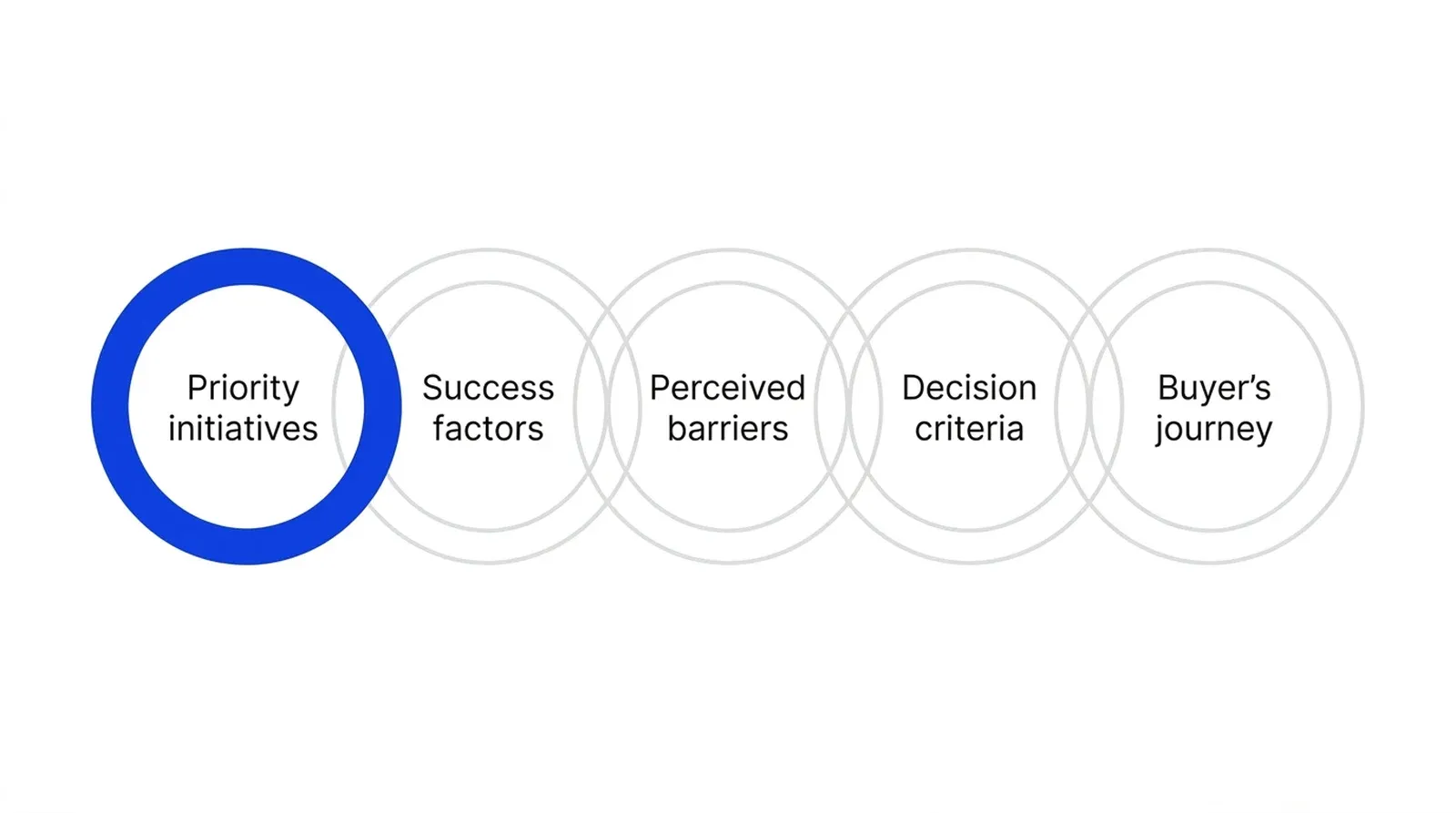
- Priority initiatives: the pain or event that makes a buyer look for a solution now.
- Success factors: the results the buyer expects from the purchase.
- Perceived barriers: the fears that lead to doing nothing or choosing a competitor.
- Decision criteria: the capabilities and questions buyers check while comparing options.
- Buyer’s journey: the steps, trusted sources and people involved at each stage.
The ring that teams most often get wrong is the third one. Barriers rarely surface in interviews with happy customers, because those customers already got past them. That is why the method asks for buyers who chose a competitor or did nothing.
How much evidence sits behind a persona
Personas range from guesses to statistics. Nielsen Norman Group sorts them into three types by the research behind them.
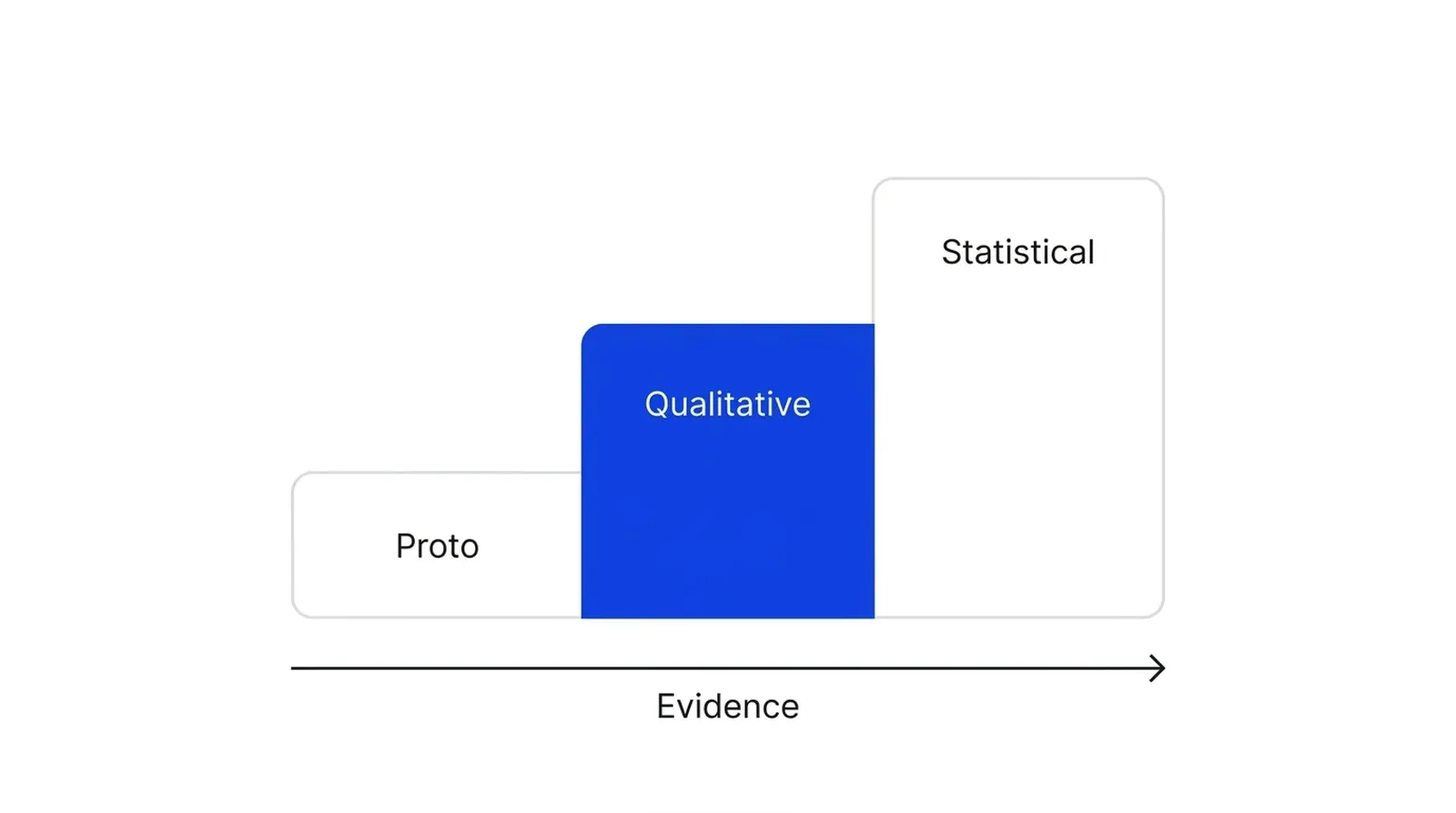
Proto personas come out of a two- to four-hour team workshop with no new research. Qualitative personas rest on interviews or field studies with about 5 to 30 people, which NN/g recommends for most teams. Statistical personas add a survey of at least 100 and ideally 500 or more respondents; NN/g calls that “massive overkill in most situations.” A 2020 review of 49 papers on data-driven personas by Joni Salminen and colleagues found “no standard methodology” for the statistical route.
The case against fictional personas
The criticism is old and comes from the method’s own supporters. Grudin and Pruitt wrote in 2002 that Cooper’s claims rested “on anecdote and on appeals to reason, not on data.” Their 2003 paper describes early persona efforts that failed because the characters were “designed by committee” and nobody could see the data behind them.
Field studies point the same way. Tara Matthews, Tejinder Judge and Steve Whittaker interviewed 14 experienced practitioners for a 2012 CHI paper. They used personas “almost exclusively for communication, but not for design” and found them abstract, impersonal, misleading and distracting. The authors concluded that personas cannot replace contact with real user data.
Invented detail also invites stereotypes. A 2017 CHI study by Charles Hill and colleagues notes that personas “are also known to promote stereotyping”. Nicola Marsden and Monika Pröbster warned in 2019 that thin personas are “prone to activate stereotypes.” A name, an age and a stock photo add exactly that kind of detail.
The jobs-to-be-done camp goes further. In a 2016 Harvard Business Review article by Clayton Christensen and colleagues, Intercom co-founder Des Traynor recalls: “We were using a personas-based approach to segmentation, but it wasn’t working.” His team had too many “typical users” defined by demographics or job titles. NN/g’s view is that the two methods are compatible: put the relevant jobs inside each persona.
There is counter-evidence. Lene Nielsen and Kira Storgaard Hansen ran 28 interviews in 13 Danish companies and found the method well integrated into everyday practice. Revella’s version answers much of the criticism by design: it describes a decision, keeps buyers’ own words and drops the made-up life story.
Persona, segment, ICP
A persona sits inside a larger targeting stack. Market segmentation splits the market and sizes each group. An ideal customer profile names the companies or customers worth pursuing. The buyer persona then explains how people inside that target decide, so the team knows what to say at each step. In our marketing operations work the five rings map straight onto the content plan: one asset per barrier, one message per trigger.
How to apply Buyer persona, step by step
- Name the buying decision. Write down the specific purchase you want to understand: switching payroll providers, buying a first MRI machine, choosing a private clinic for implants. A persona describes a decision, so a vague scope gives a vague persona. Result: one sentence that defines whose decision you study and when it happens.
- Recruit recent buyers, not fans. List people who made that decision recently. Include customers who chose you, buyers who chose a competitor and people who looked and kept the status quo. The Buyer Persona Institute goes further and interviews buyers who never considered the client at all. Result: a recruit list of 10 to 20 people across wins, losses and no-decisions.
- Interview for the story of the decision. Ask each buyer to walk you through the purchase from the day it became a priority to the final choice. Follow up on what they say instead of reading a questionnaire. Nielsen Norman Group suggests running interviews in rounds of about five until new patterns stop appearing. Result: transcripts in the buyers' own words.
- Sort what you heard into the five rings. Code each transcript under priority initiatives, success factors, perceived barriers, decision criteria and the buyer's journey. Keep verbatim quotes, since they are what convinces sales and product teams later. Result: one sheet per ring with the patterns and the quotes behind them.
- Split personas only where decisions differ. Create a second persona only when a group of buyers decides differently: other triggers, other criteria, other people involved. Job title or age is not a reason on its own. Result: the smallest set of personas that covers how your market buys.
- Put it to work and date it. Turn each ring into decisions: messages for each trigger, answers to each barrier, content for each step of the journey. Put the interview date on the persona and repeat a few interviews each year. Result: a persona that changes campaigns and sales calls, with a known age.
Examples
Sagent Technologies, 1995: three personas for one product
Alan Cooper's own account. The founders of Sagent, a business-intelligence software startup, could not name a single concrete use for their product because it could do so much. Cooper visited about six intended clients, found three groups that differed by goals, tasks and skill, and wrote them up as Chuck, an analyst using ready-made reports, Cynthia, an analyst who also built templates, and Rob, the IT manager who supported both. The product shipped with three matching parts of the interface, and engineers started asking what Cynthia would do.
A buyer persona for an MRI machine purchase
The Buyer Persona Institute publishes a sample persona for hospitals buying an MRI machine, built from interviews with buyers who had recently researched, evaluated and bought one. It is organized by the five rings: what made the purchase urgent, the outcomes buyers needed, their concerns about the investment and the vendor, the questions they asked about capabilities, and the steps, sources and people involved. It contains no invented name, hobby or stock photo.
A B2B payments provider
Illustrative. A payment provider for online shops interviews 15 merchants who switched providers in the past year. The team expected one persona, the founder who wants lower fees. The interviews show two decisions. Small shops switch after a payout is held and want faster settlement; fees matter less. Larger shops switch when entering a new country and are blocked by integration effort, with their developer as a key voice. Two personas, split by trigger and barrier rather than by company size alone, lead to two different landing pages and two sales scripts.
When to use it
Use a buyer persona when several people across marketing, sales and product need a shared picture of how customers decide: before a launch, a repositioning, a new market entry, or when win rates fall and nobody agrees why. It pays off most for considered purchases with long research and several people involved.
When not to use it
Skip it when you cannot reach real buyers and would have to invent the content: a persona built on guesses mostly confirms them. It adds little for impulse or low-price purchases where behavioral data already shows what works, and it should not replace segmentation sizing or an ideal customer profile when the question is which accounts to target.
Common mistakes
- Writing a fictional character from a workshop. Nielsen Norman Group warns that assumption-based personas can become an echo chamber for the team's wrong beliefs.
- Filling the page with age, hobbies and a stock photo. Research on personas links such details to stereotyping and distraction, and they rarely change a decision.
- Interviewing only happy customers. Lost deals and no-decisions show the barriers and criteria your current customers already got past.
- Making one persona per job title. Split only where buyers decide differently.
- Building it once and filing it. A persona with no interview date and no owner drifts away from the market within a year or two.
FAQ
What is a buyer persona?
A buyer persona is a research-based description of one type of buyer and how they make a specific purchase decision. A useful one covers what triggers the purchase, the outcome expected, the doubts that stall it, the criteria used to compare options and the people and sources involved. It is built from interviews with recent buyers, not from guesses.
How do you create a buyer persona?
Pick one buying decision, then interview 10 to 20 people who made it recently, including those who chose a competitor or did nothing. Let them tell the story of the decision. Sort what they say into triggers, desired outcomes, barriers, decision criteria and the buying journey. Split into separate personas only where decisions differ.
What is the difference between a buyer persona and a target audience?
A target audience is a group defined by shared traits, such as industry, company size or age, and tells you whom to reach. A buyer persona describes how one type of buyer decides: why they start looking, what worries them and what they compare. You usually pick the audience first, then build personas inside it.
How many buyer personas do you need?
As few as the market's decisions require. Cooper's Sagent project needed three, because three groups used the product differently. Nielsen Norman Group's persona workshops typically end with three to six. If two draft personas would get the same message, the same content and the same sales approach, merge them.
What is the difference between a user persona and a buyer persona?
A user persona describes the person who uses a product and guides design decisions. A buyer persona describes the people who decide to buy it and guides marketing and sales. They can be the same person in consumer products. In B2B they often differ: the analyst uses the software, while a manager and finance approve the purchase.
Sources
- Alan Cooper, The origin of personas, Cooper Journal, 2008 (Internet Archive copy)
- Open Library, Alan Cooper, The Inmates Are Running the Asylum, Sams, editions record
- Alan Cooper, Robert Reimann, David Cronin, Christopher Noessel, About Face, 4th edition, Wiley, 2014 (sample chapter)
- Victor Lombardi, The real origin of personas, Noise Between Stations, 2003
- Jonathan Grudin, John Pruitt, Personas, participatory design and product development: an infrastructure for engagement, PDC 2002
- John Pruitt, Jonathan Grudin, Personas: practice and theory, DUX 2003, Microsoft Research
- Lene Nielsen, Personas, The Encyclopedia of Human-Computer Interaction, 2nd edition, Interaction Design Foundation
- Open Library, Adele Revella, Buyer Personas, Wiley, 2015
- Wiley-VCH, Jim Kraus and Adele Revella, Buyer Personas, Revised and Expanded, 2024
- Buyer Persona Institute, What is a buyer persona
- Buyer Persona Institute, Buyer persona research and the Five Rings of Buying Insight
- Buyer Persona Institute, Who we are
- Buyer Persona Institute, Buyer Personas book, revised and expanded edition
- Buyer Persona Institute, Buyer persona example: MRI machine purchase
- Tony Zambito, The future of buyer personas is social, part 1, CustomerThink, 2011
- Nielsen Norman Group, Page Laubheimer, 3 persona types: lightweight, qualitative, and statistical, 2020
- Nielsen Norman Group, Page Laubheimer, Personas vs. jobs-to-be-done, 2017
- Harvard Business Review, Clayton Christensen, Taddy Hall, Karen Dillon, David Duncan, Know your customers' jobs to be done, 2016
- Tara Matthews, Tejinder Judge, Steve Whittaker, How do designers and user experience professionals actually perceive and use personas?, CHI 2012
- Lene Nielsen, Kira Storgaard Hansen, Personas is applicable: a study on the use of personas in Denmark, CHI 2014
- Charles Hill et al., Gender-inclusiveness personas vs. stereotyping: can we have it both ways?, CHI 2017
- Nicola Marsden, Monika Pröbster, Personas and identity, CHI 2019
- Joni Salminen et al., A literature review of quantitative persona creation, CHI 2020
- Joni Salminen, Bernard Jansen, Jisun An, Haewoon Kwak, Soon-gyo Jung, Are personas done? Evaluating their usefulness in the age of digital analytics, Persona Studies 4(2), 2018
Last updated Oct 9, 2026

Marketing agency or growth system: when a company outgrows its agency
An agency is the right call while the founder still runs most of the company. Once the business starts copying itself into new locations or markets, it needs a system that sets goals, tests hypotheses and owns the result.
Why healthcare marketing agencies stall: the short, mid and long wins model we use with clinics
Most agencies own the click and nobody owns the front desk. How we structure clinic work in three horizons, the research behind each one, and one year of results.

The compliance layer under fintech marketing operations
A fintech marketing agency can build campaigns. It cannot own the compliance review, the KYC drop-off or the multi-market licensing rules that decide whether a lead ever becomes a customer.