Radical candor
Radical candor is a feedback model from Kim Scott that asks a manager to care personally about a person and challenge them directly at the same time, and names the three ways of failing at it.
Radical candor is a management feedback model from Kim Scott, set out in a 2015 essay and her 2017 book. It says good feedback needs two things at once: caring personally about the person and challenging them directly. Dropping one gives ruinous empathy, obnoxious aggression or manipulative insincerity. It is a practitioner model, and no controlled study has yet tested it.
- Origin
- Kim Scott, 2015 essay; 2017 book
- Level
- 201 · Tool
- Fits
- Startup, Small and mid-size, Scale-up
- Time to apply
- One conversation, then a habit; allow a month before the team trusts it
- What you need
- one piece of feedback you have been putting off · a private place and 20 minutes with the person · a willingness to hear criticism of yourself first
Radical candor is a feedback model that asks a manager to care personally about a person and challenge them directly at the same time. Kim Scott, who worked at Google and later taught at Apple, wrote it up in a 2015 essay for First Round Review and then in a book published by St. Martin’s Press in 2017, with a revised edition in 2019. Most managers know they should be honest with their people. The model explains why they are not, and what to do about it.
What are the two axes?
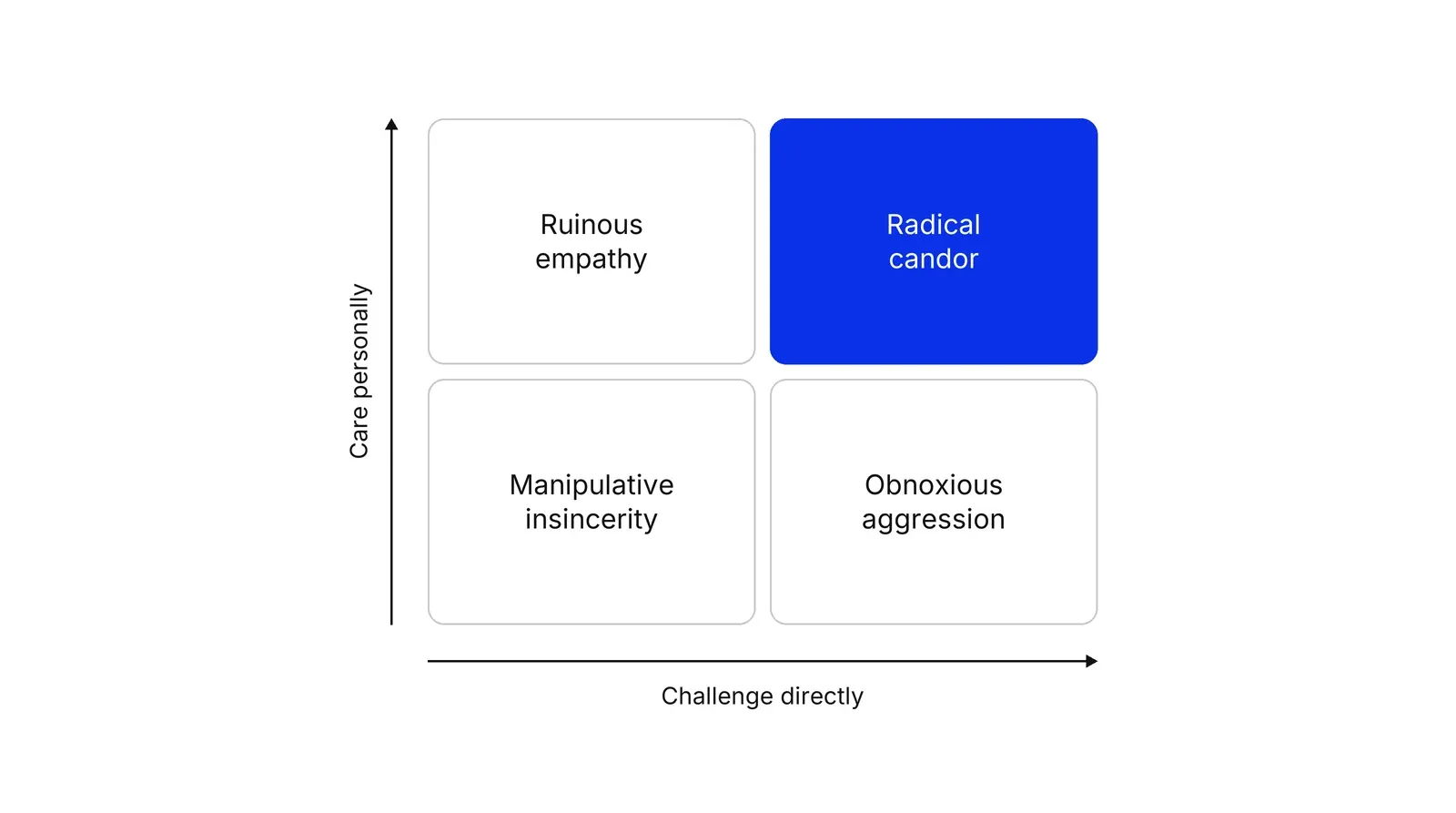
The two axes are care personally and challenge directly. On Scott’s own site, care means showing enough of yourself that people feel safe doing the same, and challenge means saying what you think instead of staying quiet. Neither is a personality. Both are things you do in a particular conversation.
Plot them against each other and you get four boxes. The model’s claim is that most feedback failures come from dropping one axis.
What are the three ways to fail?
Each of the other three boxes is a failure with its own cause.
| Quadrant | Care | Challenge | What it sounds like |
|---|---|---|---|
| Radical candor | High | High | “I think you can do better here, and this is why.” |
| Ruinous empathy | High | Low | “It’s fine, don’t worry about it.” |
| Obnoxious aggression | Low | High | “That was bad. Fix it.” |
| Manipulative insincerity | Low | Low | Praise to your face, complaints behind your back |
Ruinous empathy is where Scott says most people make most of their mistakes, her own included: in her 2015 essay she describes avoiding criticism of an underperformer for months. Obnoxious aggression gets results of a kind, but listeners get defensive and stop hearing the message. Rudeness is common enough to measure: Porath and Pearson found that half of the workers they polled in 2011 were treated rudely at least once a week, against a quarter in 1998. Manipulative insincerity is the worst box in Scott’s view, because it replaces feedback with politics.
Scott stresses that these are habits, not types. Her site says to use the grid as a compass and keep names out of the boxes.
What does the feedback research say?
Feedback is not automatically good, and that is the strongest argument for taking the manner of delivery seriously. A 1996 meta-analysis by Kluger and DeNisi pooled 607 effect sizes from 23,663 observations. Feedback helped on average, with a mean effect of d = 0.41, but more than a third of the interventions reduced performance. We looked for the often-repeated 38% and found it nowhere in the abstract, so we use the authors’ own wording.
Later work narrows down what separates helpful feedback from harmful. Hattie and Timperley’s review of classroom research found that praise aimed at the person, not the task, has low information value. A 2020 meta-analysis of 435 studies by Wisniewski, Zierer and Hattie found feedback that explains why an error happened and how to fix it averaged d = 0.99, against 0.24 for rewards and punishment. These are studies of students, not employees, so they show a pattern and not a rule for managers.
One experiment sits close to Scott’s idea. Yeager and colleagues ran three double-blind field experiments on critical feedback to teenagers. In the first, 44 seventh graders received the same criticism with either a neutral note or one stating the teacher’s very high expectations and belief that the student could meet them. Among African American students, an estimated 71% who got the wise-feedback note revised their essay, against 17% with the neutral one. The sample was small and the setting was a school, but it shows high standards and belief in the person working together, which is care and challenge in one sentence.
What is the evidence for radical candor itself?
There is none yet that tests the model directly. A 2016 paper in Central European Business Review, one of the few academic treatments, said the approach was popular with US and European companies but lacked empirical evidence. We found no controlled study since. Treat the grid as a well-organized heuristic that agrees with the feedback research, not as a proven method. Buckingham and Goodall go further in Harvard Business Review and argue that feedback does not help employees thrive, so the case is contested.
How do you give feedback in order?
Scott’s order of operations has three moves. Ask for criticism first, praise what is specific, and then criticize the behavior. The first move does the most work. Zenger and Folkman surveyed 3,875 people who had received negative feedback and found that employees whose managers had not listened first were significantly less interested in hearing it.
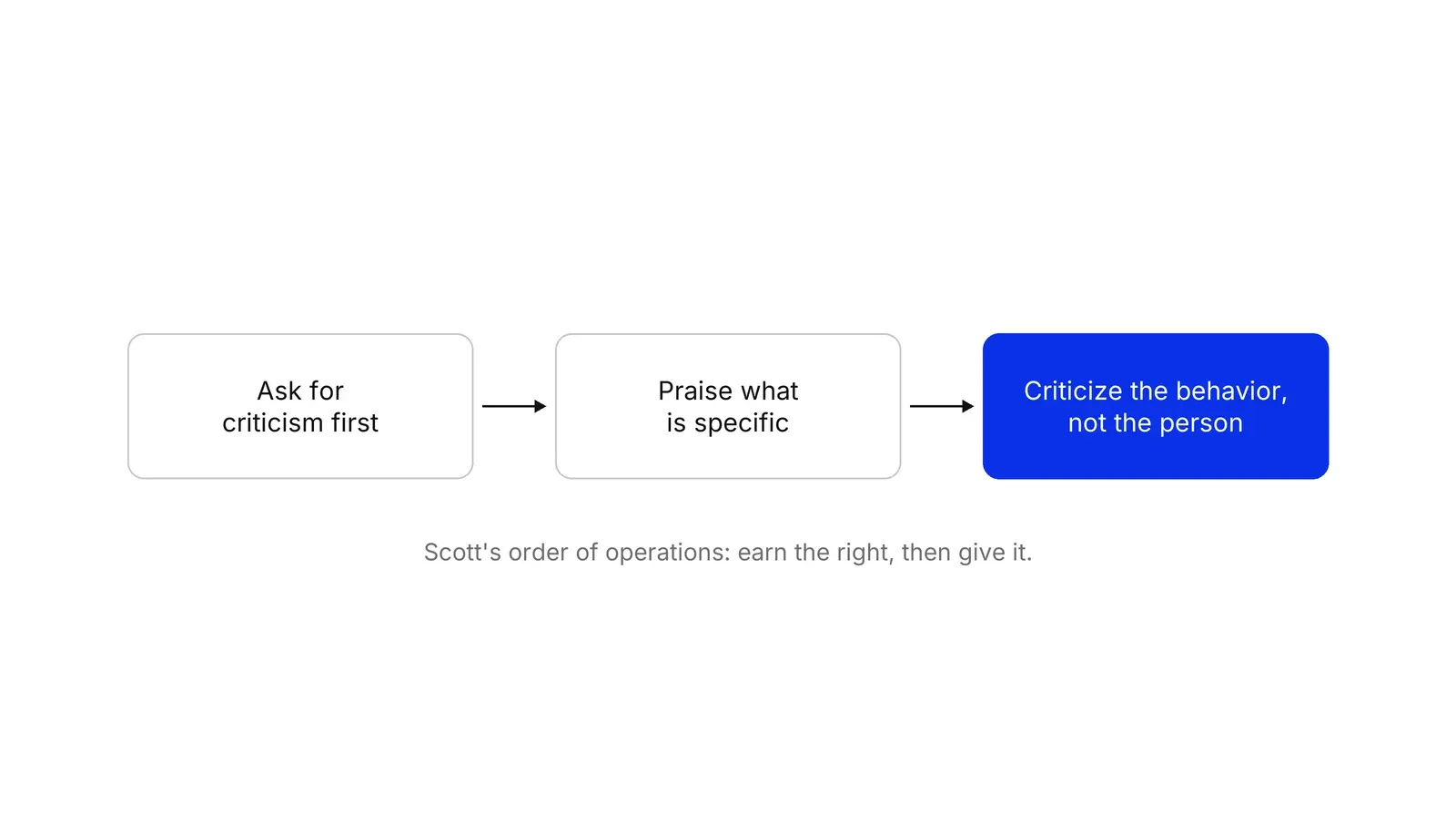
Scott’s HHIPP guide for the criticism itself says it should be humble, helpful, immediate, in person and not personal, given in private while praise goes in public. At Stanford GSB she also advises against the feedback sandwich of praise, criticism, praise, and for a live conversation, not a written one.
Where does it need help?
Candor depends on safety. Edmondson defined team psychological safety in 1999 as a shared belief that the team is safe for interpersonal risk taking, and Google’s study of 180 teams ranked it first among five dynamics. In a team without it, a direct challenge is heard as a threat, whatever the manager intended. Lencioni’s model reaches the same place from the other side: trust comes before conflict.
The model also assumes one style fits everyone, which it does not. Situational leadership matches the amount of direction to the person and the task, and a new hire may need more of both care and clarity than a veteran. Culture matters too: Erin Meyer’s Culture Map notes that the French, Dutch, Israelis and Germans skip the positives and get straight to the point, so the same sentence reads as candid in one office and harsh in another.
Finally, one conversation does not make a habit. Teams that make feedback routine bring it into the weekly rhythm of an operating rhythm and run an after action review when something goes wrong. A Growth Lab plan starts from the meetings a team already holds, because feedback needs a regular place before it can improve.
How to apply Radical candor, step by step
- Ask for criticism first. Before you give any, ask each report one specific question, such as what you could do or stop doing that would make you easier to work with. Stay silent for a few seconds after asking. Result: one piece of criticism you can act on, and proof that you can take it.
- Name the behavior and its effect. Write down what happened, when, and what it caused. Say 'you interrupted the client twice in Tuesday's call and she stopped asking questions', not 'you are rude'. Result: one sentence about an action, with no judgment of the person in it.
- Say you are helping, then say the hard part. Open with your intent and admit you may be wrong. Then state the criticism in the first two sentences, in person or on a call, and not by chat. Result: the person knows what you mean and why you are saying it.
- Praise the specific thing. Give praise as often as criticism, tied to a particular piece of work and its result. Result: praise that carries information, so people repeat what worked.
- Invite a reply and agree the next step. Ask what the person sees differently. If they get upset, get curious and not defensive. End with one agreed change and a date to look at it again. Result: a conversation, not a verdict.
Examples
A clinic manager and a late receptionist
Illustrative. A dental clinic manager has let a receptionist's late arrivals slide for three months because she is kind and well liked. Patients now wait at the door twice a week. The manager asks first what she could change about how she schedules shifts, hears that the rota is sent too late, fixes it, and then says plainly that the lateness has to stop and why it matters to patients. Result: the care was real from the start; the directness arrives with it.
A payments startup and a blunt lead engineer
Illustrative. The lead engineer of a payments team rejects pull requests with one-word comments, and two juniors have stopped submitting code. The head of engineering praises his review quality and speed, then names the behavior: terse rejections cost the team contributions. They agree on a short reason and one suggested fix with every rejection. Result: the standard stays high, and the juniors keep submitting.
When to use it
Use it when a team avoids hard conversations, when a manager is liked but results slip, or when a blunt manager is losing good people. It is a good first model for new managers, and it pairs well with a weekly one-to-one, where small feedback becomes routine.
When not to use it
Do not use it as a reason to say everything you think. It needs trust that has to exist first, and it does not replace clear goals, fair pay or a safe team. Be careful with remote or cross-cultural teams, where the same words land differently, and never apply it to a conflict that needs HR or a legal process.
Common mistakes
- Using 'in the spirit of radical candor' as cover for rude behavior. Scott's own site says this does not excuse harsh or rude conduct.
- Labelling people with the quadrants. Scott's site calls them behaviors people slip into, so no one's name should go in a box.
- Criticizing the person, not the behavior. Hattie and Timperley found feedback aimed at the self carries little information.
- Giving criticism by chat or email. Scott advises doing it live, in private.
- Skipping the asking step, so the first thing the team hears from you is criticism.
FAQ
What is radical candor?
Radical candor is Kim Scott's model of giving feedback by caring personally and challenging directly at the same time. Each is a separate axis on a two-by-two grid. High on both is radical candor. Low on one gives ruinous empathy or obnoxious aggression, and low on both gives manipulative insincerity.
What are the four quadrants of radical candor?
Radical candor combines care and direct challenge. Ruinous empathy cares but stays quiet or sugar-coats. Obnoxious aggression challenges without showing care. Manipulative insincerity does neither, such as flattery to someone's face and criticism behind their back. Scott describes them as habits we slip into, not personality types.
Does radical candor work?
There is no controlled test of the model itself. A 2016 conceptual paper in Central European Business Review said it lacked empirical evidence. Related research is supportive but mixed: a meta-analysis found feedback helps on average, yet over a third of interventions lowered performance, and how it is delivered matters.
What is the difference between radical candor and brutal honesty?
Brutal honesty is the obnoxious aggression quadrant: direct, with no sign of care. Radical candor adds the care. Scott's practical test is whether the person believes you are trying to help. Her HHIPP guide asks for feedback that is humble, helpful, immediate, in person and not personal.
Who wrote Radical Candor?
Kim Scott, a former Google leader who later taught management at Apple. She published the idea as an essay in 2015 and as a book from St. Martin's Press in 2017, with a revised edition in October 2019. She later wrote Just Work (2021) on bias and bullying.
Sources
- Radical Candor, Our approach
- Radical Candor, company home page
- Kim Scott, Radical Candor: The Surprising Secret to Being a Good Boss, First Round Review, 2015
- Stanford Graduate School of Business, Radical Candor: The Communication Shift That Can Transform Your Career, 2023
- St. Martin's Publishing Group, Radical Candor: Fully Revised and Updated Edition, 2019 (Apple Books listing)
- Pan Macmillan, Kim Scott, Just Work, 2021
- Avraham N. Kluger, Angelo DeNisi, The effects of feedback interventions on performance, Psychological Bulletin 119(2), 1996
- David Scott Yeager and colleagues, Breaking the cycle of mistrust: wise interventions to provide critical feedback across the racial divide, Journal of Experimental Psychology: General 143(2), 2014
- John Hattie, Helen Timperley, The power of feedback, Review of Educational Research 77(1), 2007
- Benedikt Wisniewski, Klaus Zierer, John Hattie, The power of feedback revisited: a meta-analysis of educational feedback research, Frontiers in Psychology, 2020
- Marcus Buckingham, Ashley Goodall, The feedback fallacy, Harvard Business Review, March 2019
- Jack Zenger, Joseph Folkman, How to give negative feedback to staff: the assumptions that make it hard
- Christine Porath, Christine Pearson, The price of incivility, Harvard Business Review, January-February 2013
- Marek Vich, Marina Y. Kim, Construction and application of radical candor: efficiency of criticism at work, Central European Business Review 5(4), 2016
- Susan J. Ashford, Ruth Blatt, Don VandeWalle, Reflections on the looking glass: a review of research on feedback-seeking behavior in organizations, Journal of Management 29(6), 2003
- Amy C. Edmondson, Psychological safety and learning behavior in work teams, Administrative Science Quarterly 44(2), 1999
- Google re:Work, Understand team effectiveness (Project Aristotle)
- Laura Delizonna, High-performing teams need psychological safety: here's how to create it, Harvard Business Review, August 2017
- Michael L. Frazier and colleagues, Psychological safety: a meta-analytic review and extension, Personnel Psychology 70(1), 2017
- Erin Meyer, The Culture Map
Last updated Oct 9, 2026


Fractional COO or embedded operations team? How to choose at Series A
The two models solve different problems: how to tell which one your company needs, and what each costs in time and control.

What operational systems successful fintech startups use: lessons from ten companies
Starling, Monzo, Qonto, bunq, Lunar, Pleo, Tide, Ramp, Mercury and Column scaled on four operating systems. Regulators' findings show what breaks when one of them lags behind growth.

What a revenue operations manager actually owns
Pipeline definitions, CRM hygiene, forecasting and the handoffs between marketing, sales and success. What the role covers, and how it differs from sales ops.