Value-based pricing
Value-based pricing sets the price from what the product is worth to the customer, found by pricing their best alternative and adding the money value of every difference, instead of starting from your cost or a rival's price.
Value-based pricing is a method of setting a price from what an offer is worth to the customer, not from what it costs to make or what rivals charge. The seller prices the customer's best alternative, adds the money value of every difference, and sets a price between the alternative's price and that total, so the buyer keeps part of the gain.
- Origin
- John L. Forbis and Nitin T. Mehta (economic value to the customer); Thomas T. Nagle (economic value estimation), 1981
- Level
- 201 · Tool
- Fits
- Startup, Small and mid-size, Scale-up
- Time to apply
- two to four weeks for a first value model of one segment, then a price test
- What you need
- the price and performance of what your best customers use today instead of you · access to five to ten customers, or sales staff who talk to them weekly, to ask what a difference is worth · your unit cost and contribution margin, so you can test a price change before making it · one person who can decide the price and is willing to defend it
Value-based pricing is a way of setting a price from what the product is worth to the customer. The usual starting points are your own cost or a rival’s price. This method starts from the buyer’s side: what does the customer do today, what does that cost them, and how much better off do they end up with you?
The idea comes from industrial marketing. John Forbis and Nitin Mehta set out value-based strategies for industrial products in a 1981 Business Horizons article. The approach is also known as economic value to the customer. Impact Pricing credits Thomas Nagle with creating economic value estimation, the version taught in his textbook. The current edition of his book, The Strategy and Tactics of Pricing, is written by Nagle, Georg Müller and Evert Gruyaert, and Routledge presents it as a core guide to value-based pricing.
The logic: reference value plus differentiation value
A product’s economic value is the price of the customer’s best alternative, called the reference value, plus the value of whatever makes your offer different, called the differentiation value. Hinterhuber’s 2004 paper states this definition and credits Nagle and Holden. The differences can be negative too, such as retraining staff, and those are subtracted.
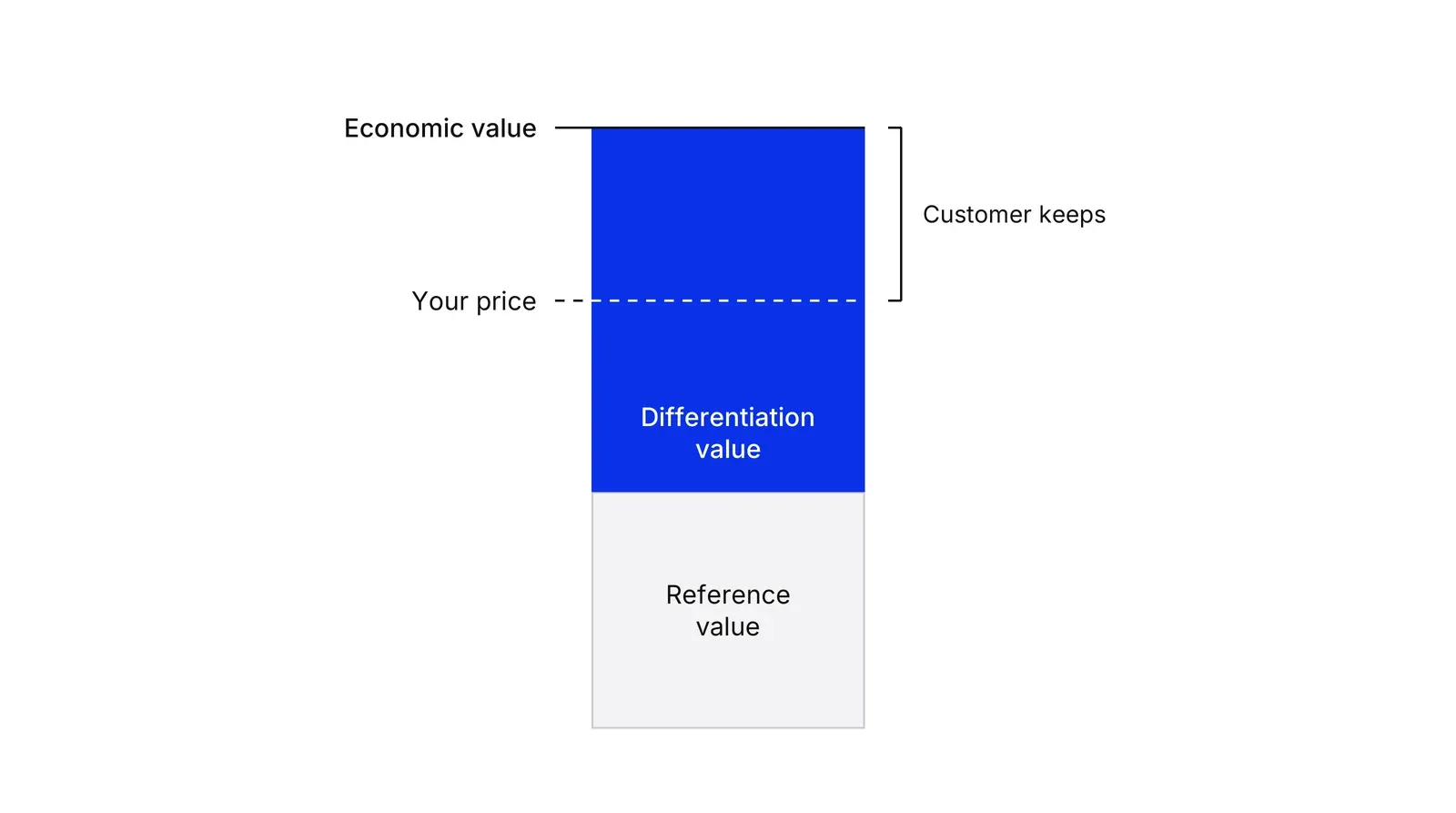
The economic value is a ceiling, not a price. Pricing right at the ceiling leaves the buyer nothing to gain and little reason to switch. Hinterhuber’s Japanese equipment case shows the gap in practice: the customer paid a premium of about $30,000 against more than $300,000 of estimated value, per the same paper, and the maker still sold more units than its US rival at home. The same paper warns that a premium of 600 percent over the best alternative would have felt unfair to buyers even though the maths supported it.
How is it different from cost-plus and competitor pricing?
Cost-plus starts at the floor of the range and competitor-based pricing starts at the reference value. Only the value-based method looks at the ceiling. Each approach answers a different question.
| Method | Starting question | Information needed | Weakness |
|---|---|---|---|
| Cost-plus | What does it cost us? | Unit cost, target margin | Ignores what the customer gains, so a high-value product is underpriced |
| Competitor-based | What do rivals charge? | Rival price lists | Copies the market price and ignores your differences |
| Value-based | What is it worth to the buyer? | The customer’s alternatives and the money effect of each difference | Needs customer research and sales discipline |
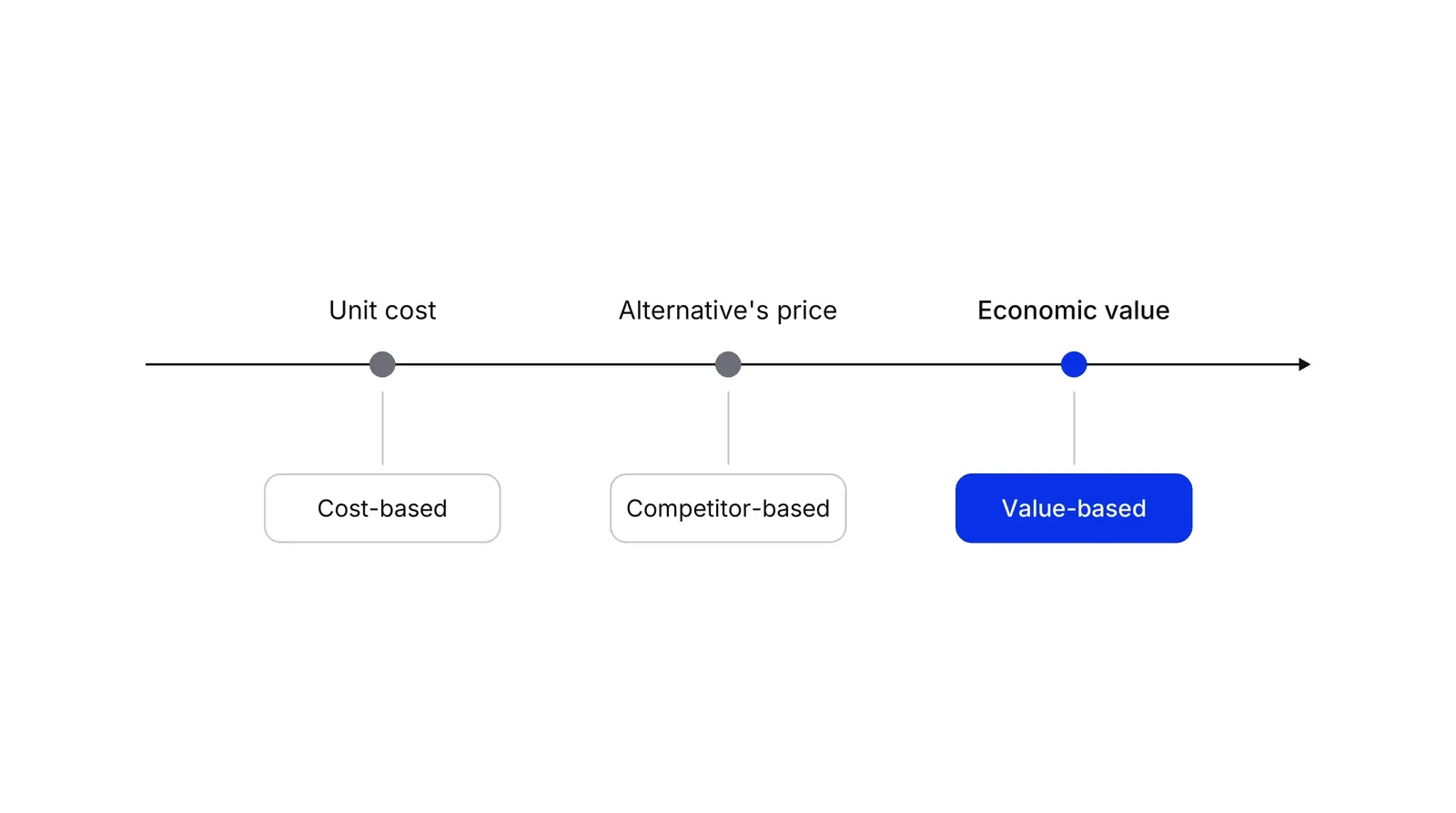
Noble and Gruca’s 1999 survey of 270 industrial pricing decisions found cost-plus the most cited strategy, at 56 percent. Hinterhuber’s 2008 article reports that more than 80 percent of companies still price mainly from cost or competitor levels, even though scholars regard value-based pricing as the best approach. A fair reading of both: the method is widely recommended and rarely used.
How do you estimate differentiation value?
Start with the customer’s money. Interviews and field data on how the product is used give the monetary effects: hours, errors, downtime, revenue. Anderson and Narus, in their 1998 Harvard Business Review article, call the main method field value assessment, with data gathered from customers directly whenever possible. For things buyers feel but cannot easily price, such as brand or design, use survey methods: conjoint analysis or the Van Westendorp price sensitivity meter.
Do it by segment. Hinterhuber’s insecticide example split a citrus market into six segments. Small-scale farmers valued efficacy and fewer sprays, about 50 euros per hectare, while export farmers valued low residue levels and gained 140 euros per hectare. One average value would have fitted neither group. A customer value map shows the market view of the same question, plotting each competitor by perceived quality against price.
Customers also judge fairness. Richard Thaler’s 1985 work on transaction utility holds that buyers compare a price with the one they expect to be fair. Value is only part of the decision.
Where does the price land?
Between the reference value and the economic value. A smaller premium over the alternative gives the buyer a larger gain; a larger premium takes more of it. Hinterhuber and Liozu give a worked case in MIT Sloan Management Review: a supermarket chain’s private-label yogurt cost €1.29, was planned at €1.99 against a €2.99 brand, and was valued at about €2.80 after counting a €0.30 health benefit and a €0.50 penalty for having no known brand. They recommended €2.49. The authors report profits nearly six times plan, which is one case and shows the method rather than proves it.
Test the price before you commit. The break-even formula in Hinterhuber’s paper divides the price change by the contribution margin plus the price change. Price matters: Marn and Rosiello’s 1992 analysis of 2,463 companies found that a 1 percent price improvement raised operating profit by 11.1 percent, against 3.3 percent for a 1 percent volume gain.
What does the research say about results?
The evidence is positive and conditional. Ingenbleek and colleagues, in a 2013 study of 144 companies, found that value-informed pricing had an unambiguous positive effect on relative price level and market performance. Their 2003 paper is more cautious: no practice is best everywhere, and success depends on relative product advantage and competitive intensity.
Capability matters as much as method. Töytäri and Rajala’s 2015 paper treats value-based selling as an organizational capability, and Anderson, Narus and van Rossum’s 2006 article finds that most value propositions claim savings without backing them up. A 2007 review argues that value-informed pricing rests on market research, customer relationships and internal knowledge of customers. In a 2021 study across four German industries, barriers were lowest in technology and highest in pharmaceuticals. Hinterhuber’s 2008 survey of 81 executives named five obstacles: value assessment, value communication, segmentation, sales force management and senior management support.
Pricing is not always smooth even with a value case. Gilead priced its hepatitis C drug Sovaldi at $84,000 a course, and a Senate Finance Committee report, as PBS reported, found the company aimed to maximize revenue. Gilead disagreed and said the drug compares favorably on a cost-per-cure basis. The case shows that a value argument is also a public one.
When the price follows the outcome
Some sellers tie price directly to the result. Intercom’s Fin charges per resolved conversation, described above, and gain-sharing arrangements go further by splitting the customer’s savings. Keränen, Salonen and Terho note that buyers often resist these deals even when they pay off, so framing and reference cases matter.
For the competitor side of the same decision, see competitive pricing, and for how tiers carry different value to different buyers, see offer architecture. A Growth Lab plan starts from the customer’s alternative and the money value of each difference, see Growth Lab.
How to apply Value-based pricing, step by step
- Name the customer's best alternative. Ask buyers what they would do if your product did not exist. It may be a rival, an in-house team, a spreadsheet or doing nothing. Hinterhuber's six-step method says the alternative is chosen from the customer's side, not the seller's. Result: one to three alternatives per segment, each with a current price.
- Price the alternative as the customer pays for it. Add the full cost of the alternative, including fees, staff time and rework, not only the sticker price. This is the reference value. Result: a monthly or yearly figure for each alternative.
- List the differences and put money on each. For every way your offer is better or worse, find the effect in the customer's money: hours saved, errors avoided, revenue gained, switching cost paid. Use interviews and field data first, and conjoint analysis for things buyers cannot easily price. Result: a table of differences with a positive or negative amount each.
- Add it up by segment. Reference value plus differentiation value is the economic value. It will differ by segment, so keep a separate figure for each rather than one average. Result: a value pool, one economic value per segment.
- Choose a price inside the range and test the break-even. Set the price between the reference value and the economic value, leaving the buyer a visible gain. Then run the break-even: a price increase of 10 percent at a 70 percent contribution margin pays off unless volume falls by more than about 12.5 percent. Result: a price, plus the volume loss you can tolerate.
- Prove the value in the sales conversation. Give the buyer the calculation in their own numbers and check that the price still feels fair against what they expect to pay. Result: a one-page value case per segment that sales can use, and a review date.
Examples
A Japanese equipment maker priced against its US rival
Per Hinterhuber's 2004 paper, a Japanese industrial equipment manufacturer sold a standard model at the equivalent of $80,000 while its main US competitor charged $50,000. For a printing ink customer the company's own model counted start-up savings, operating savings, fewer rejected batches, less changeover and downtime, and subtracted retraining and extra energy and supervision cost. Net benefit came to about $120,000 a year. Over a four-year life at 8 percent, Hinterhuber puts the positive differentiation value at well over $300,000, so the $30,000 premium was less than 10 percent of it. Source: Hinterhuber, Industrial Marketing Management, 2004.
Intercom prices its AI support agent per resolution
Intercom charges for its Fin AI agent per outcome, listed at $0.99, counted when the customer confirms the issue is solved or stops asking for help. Per Stripe's account of the launch, Intercom says per-seat pricing would shrink its revenue as Fin got better, because Fin reduces the number of support staff. Paying per resolved issue ties the price to the value the customer receives. Stripe also reports that Fin resolves over a million conversations a week and earned tens of millions of dollars in under a year.
A payout platform for a marketplace
Illustrative, no real company implied. Source: arithmetic in the economic value method of Hinterhuber, 2004. A marketplace sends $2 million a month to sellers abroad through a provider charging 1.8 percent, which is $36,000 a month. A new platform saves 60 hours of reconciliation at $40 an hour ($2,400) and avoids 300 failed payouts at $15 each ($4,500), but migration costs $30,000, or $1,250 a month over two years. Differentiation value is $5,650, so economic value is $41,650 a month. Pricing at 1.9 percent ($38,000) leaves the marketplace $3,650 a month better off.
When to use it
Use it when your product has measurable effects on the customer's revenue or costs, when buyers compare you with a clear alternative, and when you are pricing a new offer or have not changed price for years. It fits B2B products, services, software and clinics where the benefit can be counted in money.
When not to use it
Skip it for commodities that buyers compare on price alone, or when you cannot learn what the alternative costs the customer. Where the benefit is mostly taste or status and cannot be stated in money, use survey methods such as Van Westendorp or conjoint to price it instead. It is also a poor first step before you know who the customer is.
Common mistakes
- Using the seller's view of the alternative. Hinterhuber stresses that the comparison set comes from what the customer sees as the best substitute, not from your product category.
- Counting every benefit at full value. Buyers pay for effects that matter to them, as in the citrus segment where small farmers valued efficacy and fewer sprays and would not pay for the other features.
- Charging the whole economic value. Hinterhuber notes that a price far above the reference price can feel unfair even when the maths is sound, and the buyer needs a visible gain.
- Working out the value once and filing it. Competitors change, and so does the alternative's price, so the model needs a yearly refresh.
- Giving sales the new price without the value case. The research on why companies resist lists weak value communication and sales force management among the five main obstacles.
FAQ
What is the value-based method of pricing?
It sets price from the worth of the product to the customer. You find the cost of the customer's best alternative, add the money value of what makes your offer different, and set a price below that total. It is the opposite starting point to cost-plus pricing, which begins with your own cost.
How do you calculate a value-based price?
Add the reference value, which is what the customer pays for their best alternative, to the differentiation value, which is the money effect of each difference. That sum is the economic value. The price sits between the reference value and the economic value, usually closer to the lower end if you are unknown.
What is the difference between value-based and cost-plus pricing?
Cost-plus adds a margin to your cost, so a customer who would gain far more still pays the same. Value-based pricing starts from the customer's gain. Noble and Gruca found cost-plus the most cited strategy in a 1999 survey of 270 industrial pricing decisions, at 56 percent.
Does value-based pricing work for SaaS and services?
Yes, when the effect on the customer can be counted. Intercom prices its Fin agent per resolved issue because seat pricing would fall as the product improved. It works less well when the benefit cannot be measured, or when buyers have no clear alternative to compare against.
Why do so few companies use value-based pricing?
Hinterhuber's 2008 article reports that more than 80 percent of companies still price mainly from cost or competitors. In a survey of 81 executives he found five obstacles: weak value assessment, weak value communication, poor market segmentation, poor sales force management and little support from senior management.
Sources
- Thomas T. Nagle, Georg Müller, Evert Gruyaert, The Strategy and Tactics of Pricing, 7th edition, Routledge, 2023
- John L. Forbis, Nitin T. Mehta, Value-Based Strategies for Industrial Products, Business Horizons 24(3), 1981
- Andreas Hinterhuber, Towards Value-Based Pricing: An Integrative Framework for Decision Making, Industrial Marketing Management 33(8), 2004
- Andreas Hinterhuber, Customer Value-Based Pricing Strategies: Why Companies Resist, Journal of Business Strategy 29(4), 2008
- Stephan Liozu, Andreas Hinterhuber, Industrial Product Pricing: A Value-Based Approach, Journal of Business Strategy 33(4), 2012
- MIT Sloan Management Review, Setting Prices Based on Customer Value (summary of Hinterhuber and Liozu), 2012
- Michael V. Marn, Robert L. Rosiello, Managing Price, Gaining Profit, Harvard Business Review, September-October 1992
- James C. Anderson, James A. Narus, Business Marketing: Understand What Customers Value, Harvard Business Review, November-December 1998
- James C. Anderson, James A. Narus, Wouter van Rossum, Customer Value Propositions in Business Markets, Harvard Business Review, March 2006
- James C. Anderson, Nirmalya Kumar, James A. Narus, Value Merchants, Harvard Business School Press, 2007, Kellogg record
- Peter T. M. Ingenbleek, Marion Debruyne, Ruud T. Frambach, Theo M. M. Verhallen, Successful New Product Pricing Practices: A Contingency Approach, Marketing Letters 14(4), 2003
- Peter T. M. Ingenbleek, Ruud T. Frambach, Theo M. M. Verhallen, Best Practices for New Product Pricing, Journal of Product Innovation Management 30(3), 2013
- Hooman Estalami, Sarah Maxwell, Peter Ingenbleek, Value-Informed Pricing in Its Organizational Context, Journal of Product and Brand Management 16(7), 2007
- Peter M. Noble, Thomas S. Gruca, Industrial Pricing: Theory and Managerial Practice, Marketing Science 18(3), 1999
- Florian Steinbrenner, Jana Turčínková, Industry-Specific Factors Impeding the Implementation of Value-Based Pricing, European Journal of Business Science and Technology 7(1), 2021
- Pekka Töytäri, Risto Rajala, Value-Based Selling: An Organizational Capability Perspective, Industrial Marketing Management 45, 2015
- Richard H. Thaler, Mental Accounting and Consumer Choice, Marketing Science 4(3), 1985, AcaWiki summary
- Joona Keränen, Anna Salonen, Harri Terho, Gain-Sharing Arrangements in Value-Based Pricing, Elgar Encyclopedia of Pricing, 2024
- Stripe, Intercom innovates outcome-based pricing for its Fin AI agent
- Intercom, Pricing
- Impact Pricing, Economic Value Estimation: What and Why
- PBS NewsHour, report on Gilead's pricing of its hepatitis C drug, 2015
Last updated Oct 9, 2026


Marketing agency or growth system: when a company outgrows its agency
An agency is the right call while the founder still runs most of the company. Once the business starts copying itself into new locations or markets, it needs a system that sets goals, tests hypotheses and owns the result.

Why healthcare marketing agencies stall: the short, mid and long wins model we use with clinics
Most agencies own the click and nobody owns the front desk. How we structure clinic work in three horizons, the research behind each one, and one year of results.

Why channel tests stall after month three
Most paid channel tests do not end with a decision. They end when the budget runs out, the attribution model changes, or everyone quietly stops looking at the dashboard.