Topical authority
Topical authority is an SEO term for the idea that a site covering one subject deeply and accurately is more likely to rank for it; Google documents a topic authority system only for news, and the site-wide model comes from practitioners.
Topical authority is an SEO term for the idea that a site covering one subject deeply and accurately is more likely to rank for queries about it. Google has no ranking factor by that name, but it documents a topic authority system for news queries. The site-wide version is a practitioner model, associated with Koray Tuğberk Gübür, and it has little independent evidence behind it.
- Origin
- Google (topic authority system for news, announced by Jen Granito); Koray Tuğberk Gübür (SEO methodology), May 2023 for Google; 2021 to 2022 for the SEO model, dates differ
- Level
- 301 · Advanced
- Fits
- Small and mid-size, Scale-up
- Time to apply
- two days to map a topic, then 3 to 6 months of publishing before results can be judged
- What you need
- one subject close to what you sell, where your team has first-hand expertise · Google Search Console data for the last 12 months · a list of the questions buyers ask, from sales calls and support tickets · an editor who can merge, rewrite or remove existing pages
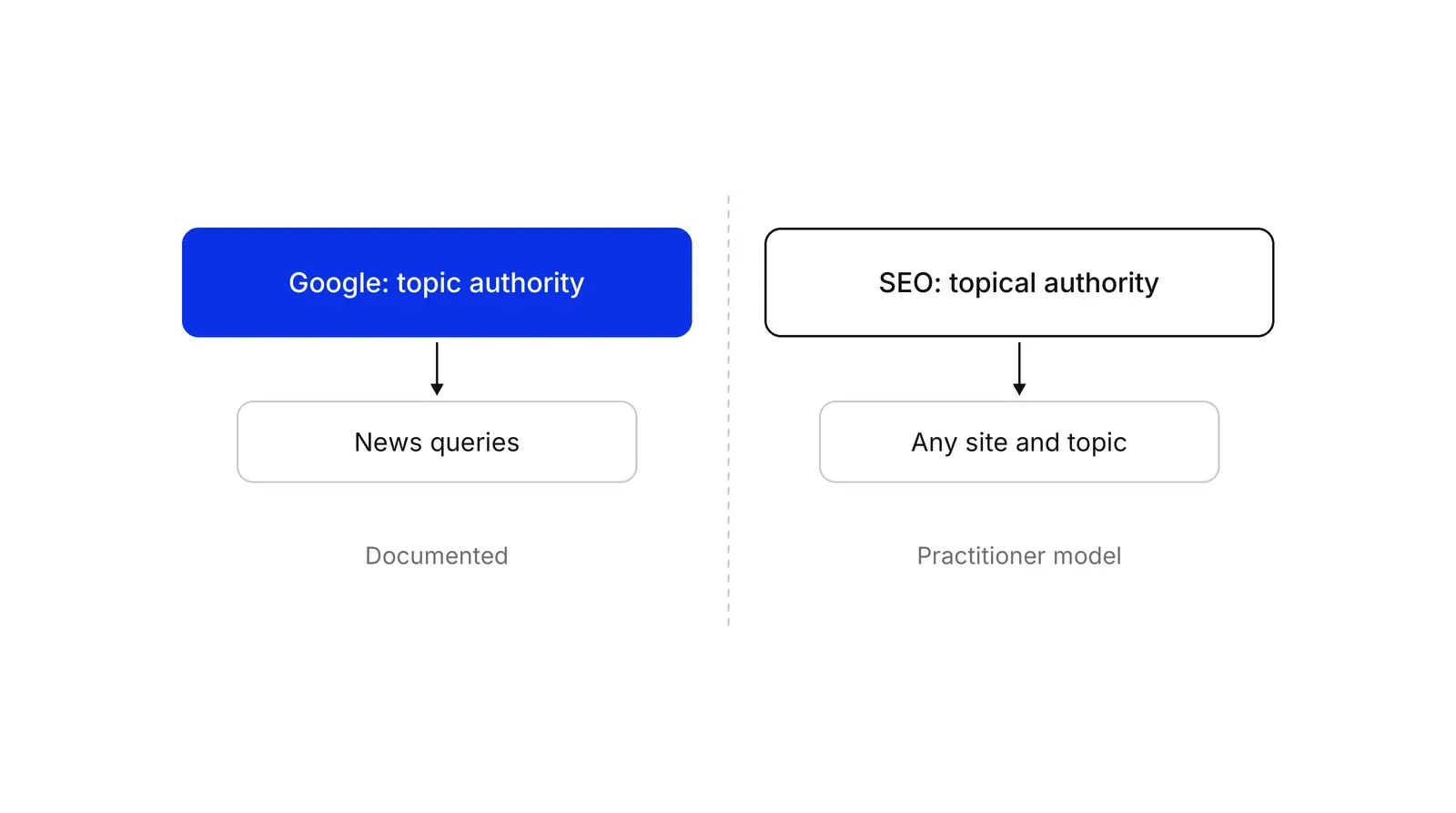
Topical authority is the idea that a website which covers one subject in depth, accurately and from experience, is more likely to rank for questions about that subject than a site that touches many subjects lightly. The term is SEO vocabulary. Two different things travel under it, and mixing them up is the most common mistake on the topic. One is a system Google has described in public. The other is a model built by SEO practitioners.
What has Google actually said?
Google has described one system called topic authority, and it is built for news. In a May 2023 Search Central post, Jen Granito of Google wrote that the system helps decide which expert sources are useful for a news query in areas such as health, politics or finance. Its main signals are how notable a source is for a topic or place, how other publishers cite its original reporting, and its record of quality work. Google’s Search Liaison said the system has been used for several years, and the system does not appear in the ranking systems guide as of its December 2025 update.
For ordinary sites Google’s statements are cautious. John Mueller said in a June 2019 Webmaster Central hangout that Google does not evaluate a site’s authority, and at SearchLove in 2018 he said Google has site-wide metrics that are not purely link-based. In a Reddit thread he answered a comment calling the term a rebrand of relevancy with “This” and later told people not to worry about it, according to Roger Montti’s November 2023 report in Search Engine Journal.
Google’s documentation still points the same way. Its helpful content questions, first published in the August 2022 helpful content update, ask whether a site has a primary purpose or focus, and whether you are producing lots of content on many topics in the hope some will rank. The November 2023 rater guidelines overview says a site’s reputation includes the opinion of experts in the topic of the website. The ranking systems guide adds that site-wide signals exist but that ranking works mainly at page level.
What did the 2024 leak add?
It showed that Google stores topic-focus data about sites, but not how much it matters. In May 2024 internal Content Warehouse API documentation became public. Michael King’s iPullRank analysis quotes two fields: siteFocusScore, a number for how much a site is focused on one topic, and siteRadius, the measure of how far page embeddings deviate from the site embedding. King also writes that the weight of such features in scoring is unknown.
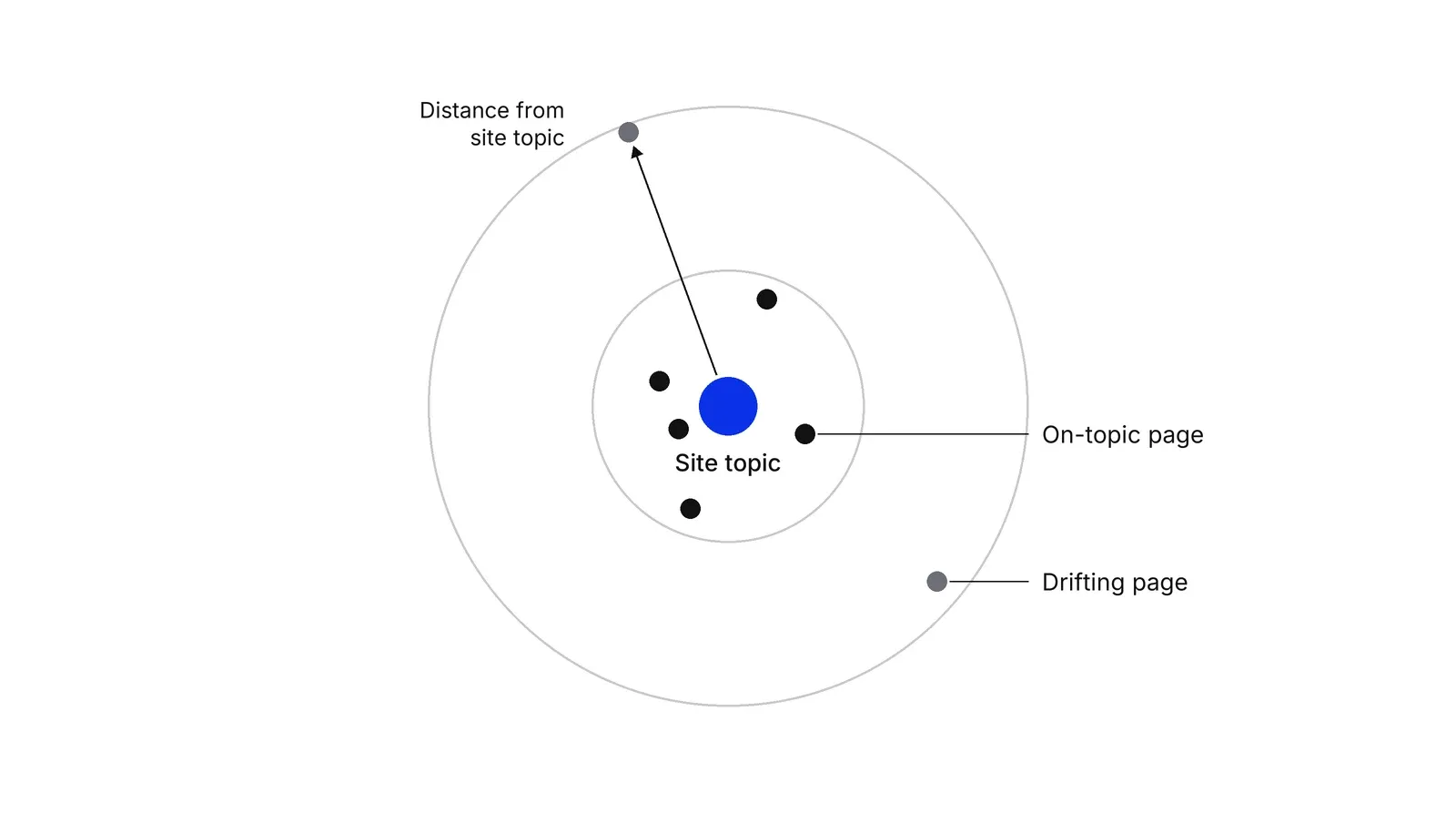
Rand Fishkin adds two cautions: a feature’s existence is not proof it is used in ranking, and the newest date in the documents is August 2023. A Google patent application filed on 10 August 2018, with Yevgen Tsykynovskyy as inventor and published on 13 February 2020, describes website representation vectors that group sites by knowledge domain and quality score. Its status is abandoned.
What does the practitioner model add?
It turns the idea into a production method. Koray Tuğberk Gübür’s Holistic SEO page defines topical authority as a semantic SEO methodology that ranks pages by covering connected topics and the queries that follow from them with accurate, expert information. The page says he founded the concept on 18 May 2022, yet its header shows a February 2021 first-publication date, so the origin date is unclear. His method plans questions into a topical map, orders sub-topics in a contextual hierarchy, links pages with about 10 contextual links per page, and ramps publishing from one article every 3 days to as many as 3 a day. He presents it as a way to improve rankings without backlinks. The page also quotes John Mueller on 5 February 2021 saying that for search engines you are building a reputation of knowledge on a topic. The entity language echoes Amit Singhal’s May 2012 Knowledge Graph post, which described search moving to “things, not strings”.
Vendors have made it a standard playbook. Ahrefs defines it as being recognised as the expert source on a subject and adds link building and content refreshes. Sydney Go’s June 2024 Semrush guide contrasts it with domain authority, which covers a whole site, and gives 6 steps that include link outreach.
| Question | Google’s own statements | Practitioner model |
|---|---|---|
| Name | Topic authority | Topical authority |
| Scope | News queries in areas such as health, politics, finance | Any site and subject |
| Signals named | Notability for a topic, citations of original reporting, source reputation | Topic coverage, entity coverage, contextual hierarchy, internal links |
| Source | Search Central post, May 2023 | Practitioner write-ups, patents read by practitioners, case studies |
What does the evidence show?
Topic-specific authority is an old research idea, but nobody has isolated the SEO model’s effect. Sergey Brin and Lawrence Page’s 1998 paper ranked pages by link structure with one score per page. Taher Haveliwala’s Topic-sensitive PageRank, presented at WWW 2002, proposed computing several PageRank scores, each biased toward a topic. Jon Kleinberg’s paper on authoritative sources framed authority around a set of topic pages and the hubs that link to them. These show that topic-level authority is a sound concept in search research, not that Google scores your site this way.
The practitioner proof is thinner. Koray Tuğberk Gübür’s main case, one of 4 projects on his page, reports growth from 0 to about 128,000 organic visits in 123 days and 12,000 clicks a day by day 162, from his own Search Console screenshots. Surfer cites its own studies of about 253,800 and 1 million search results, including pages that cover about 74% of relevant subtopics outperforming those that cover 50%. These are correlations from a software vendor. Ahrefs shows a specialist e-bike retailer with a Domain Rating of 15 outranking Amazon, at 96, for competitive e-bike keywords, which is an illustration, not a controlled test. A site that covers a topic well usually also has links, brand demand and a long history, so none of this isolates the effect.
How does it fit with clusters and E-E-A-T?
Topic clusters are one way to organise the pages, and E-E-A-T is the quality bar each page has to clear. The topic clusters page covers the pillar and the link rules, and the E-E-A-T page covers what raters look for. Google’s AI features guide says AI Overviews may issue related searches across subtopics and that no extra requirements apply to appear. Breadth across subtopics helps in that setting only because each page answers a question well.
Treat topical authority as a discipline for focus and depth, with a baseline you measure against. A Growth Lab plan starts from that baseline, not from a promise of rankings.
How to apply Topical authority, step by step
- Choose the subject and the reader. Write one sentence naming the subject and the people who would ask about it. Google's helpful content questions ask whether a site has a primary purpose or focus and an existing or intended audience. If the sentence needs the word 'and' three times, the subject is too wide. Result: a subject statement every page has to fit.
- Map the questions. List every question on the subject from Search Console queries, 10 recent sales calls and support tickets, then group questions that share one search intent. Allow half a day. Result: a topical map, a list of 20 to 60 questions each assigned to one page.
- Compare the map with your pages. Mark each question as covered well, covered thinly, covered twice or not covered. Pages that sit far from the subject statement go on a separate list. Allow half a day. Result: a gap list and a list of pages to merge or remove.
- Fill gaps with first-hand knowledge. Publish the gaps that matter most to buyers first. Each page needs something a competitor's page does not have: your own data, a named practitioner, a worked example. Result: pages that add information instead of repeating the top results.
- Link and prune. Link related pages in the body text with descriptive anchors, and merge or delete off-topic pages that dilute the site. The link rules are on the topic clusters page. Result: a site where every important page is reachable and on subject.
- Measure against a baseline. Record impressions, average position and clicks for the topic's query set in Search Console before you start, then compare at 90 and 180 days. Add branded searches that include the topic. Result: a before and after you can show a finance lead.
Examples
A regional newspaper in Google's own example
Google's May 2023 post says people looking for Nashville high school football often turn to The Tennessean. The system looks at how notable a source is for a topic or place, how often other publishers cite its original reporting, and its record of quality work. This is the documented case, and it concerns news queries, not every site.
A dental clinic and implants
Illustrative. A clinic with 400 patients a month maps 40 questions about dental implants, finds 12 already answered, 6 answered twice and 22 missing. It merges the duplicates, writes the missing pages with dentists as named authors, and removes 15 old posts about unrelated topics. After 6 months it compares Search Console impressions for the implant query set with the baseline.
A cross-border payments startup
Illustrative. A startup selling to 50 to 200 person companies picks one subject, paying overseas suppliers. Because the subject touches money and regulation, each claim about licences or limits cites the regulator's own document, and a compliance lead reviews pages before publishing. Blog posts about unrelated growth tactics are left off the site so the subject stays clear.
When to use it
Use it when you sell something buyers research for weeks, your team has real expertise in one subject, and your site is a mix of unrelated posts that rank for little. It also fits a site that has grown by publishing whatever had search volume, since the exercise shows what to cut.
When not to use it
Skip it when you expect a guaranteed ranking effect: no independent study isolates the effect and Google does not document a site-wide topical authority score. Skip it for a subject where your team has no first-hand knowledge, and do not use it as a reason to publish hundreds of thin pages, which Google's spam policies call scaled content abuse.
Common mistakes
- Treating topical authority as a number Google gives your site. Google documents a topic authority system for news, and John Mueller said on Reddit that people should not worry about topical authority.
- Publishing for coverage alone. Google's helpful content questions warn against producing lots of content on many topics in the hope that some will rank.
- Copying the case-study tactics of one practitioner as proof. The 128,000-visit result on Koray Tuğberk Gübür's page is self-reported and cannot be separated from other changes.
- Letting off-topic pages stay. Keeping posts that stray from the subject weakens the focus the whole exercise depends on.
- Measuring only rankings. Compare impressions, clicks and branded topic searches against a baseline, or you cannot tell whether the work helped.
FAQ
Is topical authority a Google ranking factor?
Not under that name. Google has not published a topical authority score. It does document a topic authority system that helps surface expert sources for news queries. Ahrefs wrote in June 2026 that Google has never published a formal specification for topical authority. Treat it as a practitioner idea about topic depth.
What is the difference between topic authority and topical authority?
Topic authority is Google's May 2023 term for a system that picks expert news sources in areas such as health, politics and finance. Topical authority is the SEO term for a whole site being recognised as an expert on a subject. The first is documented by Google; the second is a practitioner model.
Who invented topical authority?
No one person did. Koray Tuğberk Gübür's Holistic SEO page says he founded the concept on 18 May 2022, although the same page shows a February 2021 first-publication date. Google used a topic authority system for news for several years, per its Search Liaison. Sources disagree, so credit the SEO methodology to him with that caveat.
How do I build topical authority?
Pick one subject, map the questions buyers ask, find which your site covers poorly or twice, publish the gaps with first-hand expertise, link related pages and remove off-topic ones. Track Search Console impressions for the topic against a baseline. Expect months, not weeks.
Do I need backlinks for topical authority?
Practitioners disagree. Koray Tuğberk Gübür's page presents the method as a way to improve rankings without backlinks, while Ahrefs and Semrush both include link building in their steps. No independent test settles it. Google's topic authority post for news lists citations by other publishers as a signal.
Sources
- Google Search Central Blog, Understanding news topic authority
- Google Search Central, A guide to Google Search ranking systems
- Google Search Central, Creating helpful, reliable, people-first content
- Google Search Central Blog, What creators should know about Google's August 2022 helpful content update
- Google Search Central, Spam policies for Google web search
- Google Search Central, AI features and your website
- Google, Search Quality Rater Guidelines: An overview
- Google Official Blog, Introducing the Knowledge Graph: things, not strings
- Google Patents, US20200050707A1 Website representation vector
- Search Engine Journal, Google's topic authority system for news (Matt G. Southern, 2023)
- Search Engine Journal, Google on topical authority: don't worry about it (Roger Montti, 2023)
- Search Engine Journal, Google: we don't evaluate a site's authority (Matt G. Southern, 2019)
- Brainlabs, John Mueller interview at SearchLove
- Holistic SEO and Digital, Importance of topical authority for SEO (Koray Tuğberk Gübür)
- Ahrefs, Topical authority (Despina Gavoyannis, 2026)
- Semrush, Topical authority (Sydney Go, 2024)
- Surfer, Topical authority
- iPullRank, Google's search API leak analysis (Michael King, 2024)
- SparkToro, An anonymous source shared thousands of leaked Google Search API documents (Rand Fishkin, 2024)
- Taher Haveliwala, Topic-sensitive PageRank, WWW 2002
- Jon Kleinberg, Authoritative sources in a hyperlinked environment, Journal of the ACM
- Sergey Brin and Lawrence Page, The anatomy of a large-scale hypertextual web search engine
Last updated Oct 9, 2026


The compliance layer under fintech marketing operations
A fintech marketing agency can build campaigns. It cannot own the compliance review, the KYC drop-off or the multi-market licensing rules that decide whether a lead ever becomes a customer.

Fractional CMO: what you get, and what has to exist underneath
A fractional CMO brings strategy and judgment. Without reporting, CRM hygiene and a named owner per number, the engagement produces a slide deck instead of a system.

The operations layer behind healthcare patient acquisition
Ads and search bring the request in. What happens between the click and the booked, attended visit decides whether the spend paid off.