VRIO framework
The VRIO framework is a four-question test, from strategy scholar Jay Barney, that tells you which of a company's resources and capabilities can give it a lasting edge over rivals and which only keep it level.
The VRIO framework is a four-question test for a company's resources and capabilities: is it valuable, is it rare, is it costly to imitate, and is the company organized to exploit it? Jay Barney built it on his 1991 resource-based model and set it out as VRIO in 1995. Each answer places a resource on a ladder from competitive disadvantage to sustained competitive advantage.
- Origin
- Jay B. Barney, 1991 as VRIN; 1995 as VRIO
- Level
- 301 · Advanced
- Fits
- Scale-up, Enterprise
- Time to apply
- half a day for a first pass with the leadership team, then a yearly review
- What you need
- a list of 10 to 20 resources and capabilities the team believes explain why customers choose you · honest data on two or three direct rivals: what they own, what they can do, how fast they copied you before · one person from operations who knows whether the company uses each resource in practice
The VRIO framework is a test of whether a company’s resources and capabilities can give it an edge that rivals cannot erase. It asks four questions of each resource in order: is it valuable, is it rare, is it costly to imitate, and is the company organized to exploit it? The answers tell you which strengths are worth protecting and which only keep you level with the market.
The framework comes from Jay Barney, a strategy professor now at the University of Utah, whose university calls his early work foundational to the resource-based view. Strategy teams use it for internal analysis, the inward-looking half of strategy that sits next to market tools such as Porter’s five forces.
Where VRIO came from: VRIN first, then VRIO
VRIO grew out of a 1991 paper and took its current shape in 1995. In “Firm Resources and Sustained Competitive Advantage” (Journal of Management, 1991), Barney named four indicators of a resource that could support a lasting advantage: value, rareness, imitability and substitutability. That version is often called VRIN.
Four years later, in “Looking Inside for Competitive Advantage” (Academy of Management Executive, 1995), he turned the idea into questions a manager could use. The article opens with the gap it was meant to fill: tools for analyzing threats and opportunities had developed much faster than tools for analyzing a firm’s own strengths and weaknesses. The 1995 version keeps value, rarity and imitability and adds organization. Many summaries date VRIO to 1991 because the 1995 questions rest on the earlier paper, so you will see both years quoted.
Barney built on earlier work. In 1984 Birger Wernerfelt published a paper titled “A Resource-Based View of the Firm”, which proposed analysing firms from the resource side rather than the product side.
The four questions and what each answer means
Each question is a gate. A resource that fails one gate stops there, and the gate it fails tells you what kind of position it gives you.
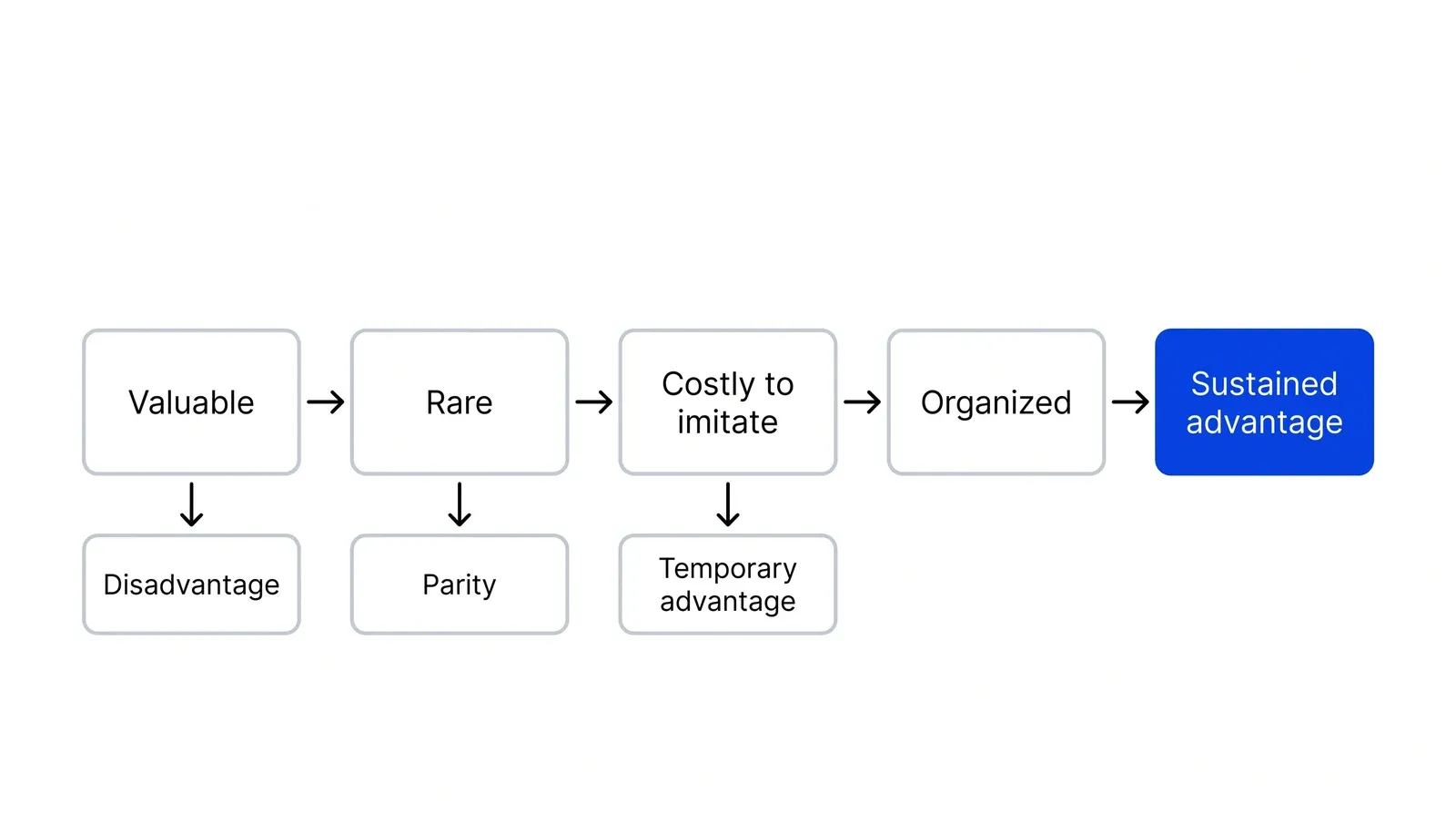
| Valuable? | Rare? | Costly to imitate? | Organized to exploit? | What it gives you |
|---|---|---|---|---|
| No | Competitive disadvantage | |||
| Yes | No | Competitive parity | ||
| Yes | Yes | No | Temporary advantage | |
| Yes | Yes | Yes | No | An advantage you are not using |
| Yes | Yes | Yes | Yes | Sustained competitive advantage |
The outcome labels follow the version taught in strategy courses, for example the Oregon State University open textbook, which pairs disadvantage with below-normal performance, parity with normal performance, and both kinds of advantage with above-normal performance.
Valuable means the resource lets you take an opportunity or neutralize a threat. A clinic’s online booking system is valuable if it fills slots that would otherwise stay empty. Rare means few direct rivals have it. Value without rarity still matters: a payments firm without a license cannot trade at all, but holding one only puts it level with licensed rivals.
Why imitation cost is the question that decides
The imitation question is where most claimed advantages fail, because rivals who see you earning more will try to copy you. Barney’s 1991 paper names three reasons copying can be expensive. A resource may depend on a unique history, such as a reputation built over decades. Cause and effect may be unclear, so rivals cannot tell which part of your operation produces the result. And the resource may be socially complex, resting on culture, trust or relationships that no one can buy.
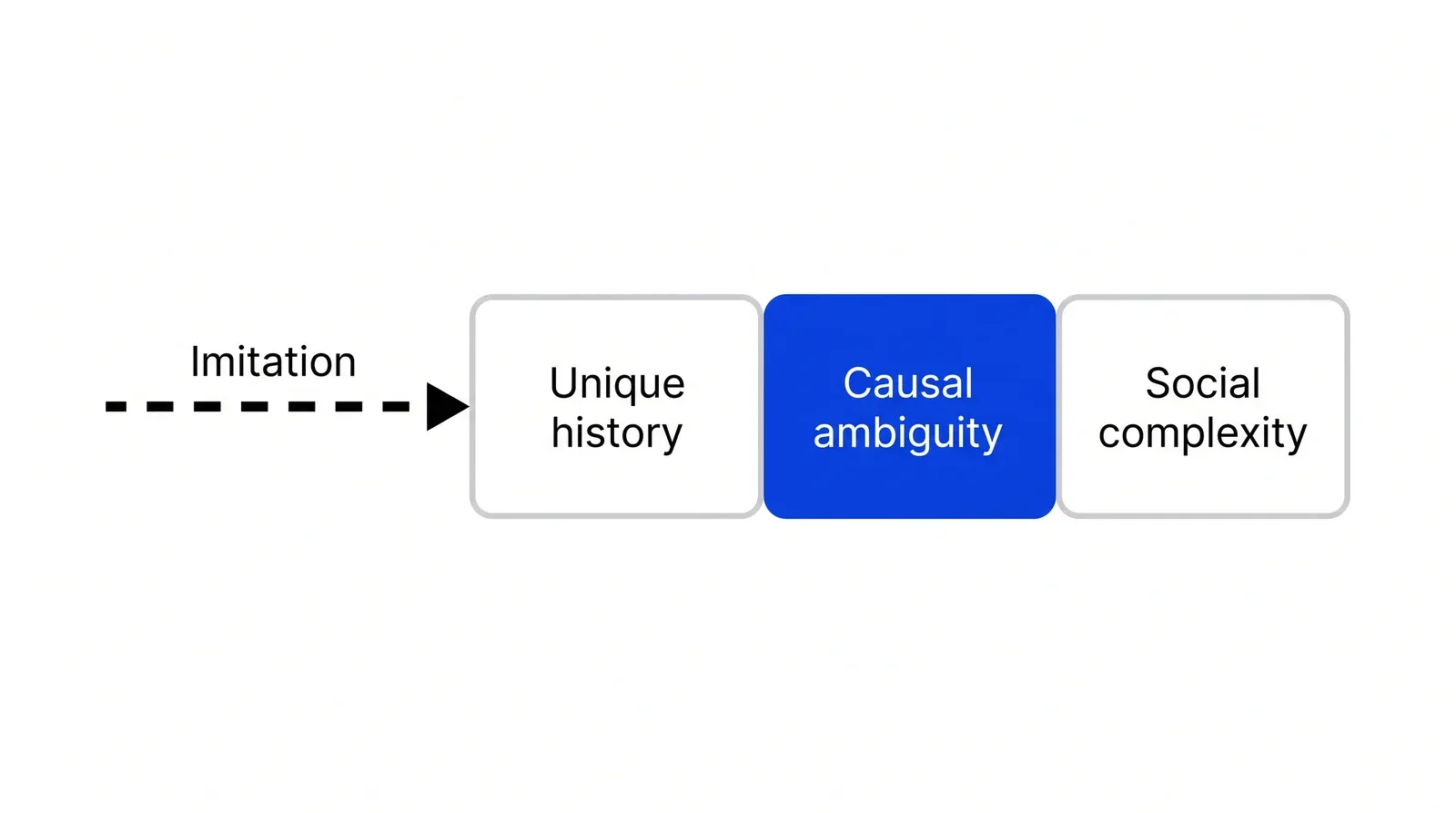
Each barrier has its own research line. Lippman and Rumelt modelled uncertain imitability in 1982. Dierickx and Cool argued in Management Science in 1989 that key assets are built up over time rather than bought, so a rival who starts late cannot catch up just by spending more. Barney had earlier argued that organizational culture can be exactly this kind of resource. Michael Ryall’s 2009 formal model adds a caution: causal ambiguity is necessary for a lasting capability advantage but not enough on its own.
Substitutes belong in this question too. If a rival can reach the same result by a different route, your resource is not costly to imitate in any sense that matters.
The organization question: is the resource in use?
The organization question asks whether your structure, reporting, controls and pay put the resource to work. A resource can pass the first three questions and still earn nothing, because nobody is set up to sell it, price it or build on it.
Read the O carefully. Some course materials gloss it as the resource being owned by the organization. Barney’s question is whether the firm is organized to exploit what it has. That is a test of how the company is managed.
VRIO compared with SWOT and core competence
VRIO is often mixed up with two older ideas. The table shows where each fits.
| Tool | What it asks | Output |
|---|---|---|
| SWOT analysis | What helps and hurts us, inside and outside? | Four lists |
| Core competence (Prahalad and Hamel, 1990) | Which skills run across our businesses? | A few company-wide skills |
| VRIO | Which resources can give a lasting edge? | A ranked verdict per resource |
A sound sequence is SWOT to collect the strengths, then VRIO to test them, then the value chain to see where in the business each surviving advantage sits.
What the research says about VRIO
The evidence supports the idea in part, and critics have pressed on its definitions. Crook and colleagues pooled 125 studies covering more than 29,000 organizations in 2008 and estimated a correlation of 0.22 between strategic resources and performance, rising to 0.29 when resources met the resource-based criteria. Scott Newbert’s 2007 review of empirical studies found only modest support overall.
On theory, Priem and Butler argued in 2001 that the view is not yet a theory and leaves value undefined, and Barney replied in the same issue. Kraaijenbrink, Spender and Groen reviewed the critiques in 2010 and concluded that the core message holds, but that the meaning of resource and value remains loose. Teece, Pisano and Shuen’s work on dynamic capabilities answers the static side of VRIO by asking how a firm builds new resources when markets shift. In Pushers’ Growth Lab work, that is the practical lesson: run VRIO yearly, and use it to choose what to protect before deciding what to build.
How to apply VRIO framework, step by step
- List resources and capabilities. Write down what the company owns (licenses, data, brands, contracts, equipment) and what it does well (processes, skills, relationships). Make each item specific: 'a fraud model trained on six years of our own transactions', not 'good technology'. Result: a list of concrete items, each one something a rival could in principle try to get.
- Ask the value question. For each item ask: does it let us take an opportunity or blunt a threat that we can point to in revenue, cost or risk? If nobody can say how it moves a number, mark it not valuable. Result: a shorter list of items that matter to customers or to the cost base.
- Ask the rarity question. For each valuable item ask: how many direct rivals have it too? If most of them do, it keeps you level with the market and nothing more. Result: the valuable items split into common ones (parity) and rare ones.
- Ask the imitation question. For each rare item estimate what it would cost a rival to build or buy it, and how long it would take. Look for the three barriers in Barney's 1991 paper: a unique history, unclear cause and effect, and social complexity. Result: rare items split into temporary advantages and candidates for a lasting one.
- Ask the organization question. For each item that passed the first three questions ask: do our structure, reporting, incentives and budgets put it to work? Name the gap if they do not. Result: a short list of sustained advantages and a list of advantages the company is wasting.
- Turn the table into decisions. Protect and invest in the sustained advantages, stop overspending on parity items, and fix the organization gaps first, since they are the cheapest wins. Result: three to five decisions with an owner and a review date.
Examples
A B2B payments company
Illustrative. The team lists four items. An e-money license is valuable, but six of its eight direct rivals hold one, so it gives parity. A same-day payout feature is valuable and rare today, yet a rival with a good engineering team could copy it in two quarters: a temporary advantage. A fraud model trained on six years of the company's own merchant data is valuable, rare and costly to copy, because a new entrant cannot buy six years of history. The test fails on organization: the risk team owns the model, but sales cannot show its lower fraud rate to prospects, so no deal is won on it. The first decision is to give sales a monthly fraud-rate figure they can quote.
A private clinic group with three sites
Illustrative. A new MRI scanner is valuable but every competing clinic in the city has one, so it gives parity and should not be the centre of the marketing. A referral network built over twelve years with 40 local general practitioners is valuable, rare and hard to copy, because it rests on personal trust and history. The organization question exposes a gap: referrals arrive by phone and email with no tracking, so the clinic cannot see which doctors send patients or when a relationship goes quiet. A simple referral log with a named owner turns the network into a managed advantage.
When to use it
Use VRIO when you need to decide where to invest to stay ahead: before a strategy review, before an acquisition (to test what you are really buying), when margins are falling and you need to know which strengths are real, or after a SWOT analysis to rank the strengths list. It suits companies with a track record and known rivals, which is why it fits growth-stage and enterprise teams best.
When not to use it
Skip it for an idea-stage startup with no resources to test yet; customer discovery is a better use of the time. Do not use it to judge whether an industry is attractive at all, which is a job for Porter's five forces. In a market that changes every few months, treat its answers as temporary and pair it with a review of how fast the company can build new capabilities.
Common mistakes
- Listing vague items such as 'our people' or 'strong brand'. Ask what exactly about the people is valuable and why rivals have not hired them away, as the Oregon State open textbook on strategy suggests.
- Answering the rarity question without looking at rivals. Every team thinks its assets are rare until it checks what competitors own.
- Confusing 'hard for us to build' with 'hard for a rival to copy'. A well-funded competitor may buy in a year what took you five.
- Skipping the organization question. A resource that passes three tests but sits unused gives no advantage at all.
- Treating the result as permanent. Imitation costs fall as technology and talent markets change, so repeat the test every year.
FAQ
What does VRIO stand for?
VRIO stands for Valuable, Rare, costly to Imitate and Organized to exploit. The four letters are questions asked of each resource or capability in turn. A resource must pass all four to give a sustained competitive advantage. Failing earlier questions means a disadvantage, parity with rivals, or an advantage that lasts only until competitors copy it.
What is the difference between VRIO and VRIN?
VRIN is the earlier version from Jay Barney's 1991 paper: valuable, rare, imperfectly imitable and non-substitutable. In his 1995 article Barney presented the questions of value, rareness, imitability and organization, folding substitutes into the imitation question and adding whether the firm is organized to use the resource. VRIO is the version most textbooks teach.
Who created the VRIO framework?
Jay B. Barney, a strategy professor now at the University of Utah's David Eccles School of Business. He set out the resource conditions in 1991 in the Journal of Management and the VRIO questions in 1995 in the Academy of Management Executive. Some sources give 1991 as the VRIO date because the 1995 version grew directly out of that paper.
How is VRIO different from SWOT?
SWOT lists strengths, weaknesses, opportunities and threats without saying which strengths matter most. VRIO tests the strengths. Barney's 1995 article says it was written because tools for analyzing internal strengths had lagged behind tools for the external environment. A common sequence is SWOT first, then VRIO on the strengths list.
Does VRIO predict performance?
Partly. A 2008 meta-analysis of 125 studies by Crook and colleagues found a positive link between strategic resources and performance, stronger when resources met the resource-based criteria. Newbert's 2007 review of empirical studies found only modest support overall. Treat VRIO as a disciplined way to argue about advantage, not a forecast.
Sources
- Jay B. Barney, Firm Resources and Sustained Competitive Advantage, Journal of Management 17(1), 1991
- Jay B. Barney, Looking Inside for Competitive Advantage, Academy of Management Executive 9(4), 1995
- Jay B. Barney, Strategic Factor Markets: Expectations, Luck, and Business Strategy, Management Science 32(10), 1986
- Jay B. Barney, Organizational Culture: Can It Be a Source of Sustained Competitive Advantage?, Academy of Management Review 11(3), 1986
- Birger Wernerfelt, A Resource-Based View of the Firm, Strategic Management Journal 5(2), 1984
- Ingemar Dierickx, Karel Cool, Asset Stock Accumulation and Sustainability of Competitive Advantage, Management Science 35(12), 1989
- Steven A. Lippman, Richard P. Rumelt, Uncertain Imitability: An Analysis of Interfirm Differences in Efficiency under Competition, Bell Journal of Economics 13(2), 1982
- Robert M. Grant, The Resource-Based Theory of Competitive Advantage: Implications for Strategy Formulation, California Management Review 33(3), 1991
- Margaret A. Peteraf, The Cornerstones of Competitive Advantage: A Resource-Based View, Strategic Management Journal 14(3), 1993
- Richard L. Priem, John E. Butler, Is the Resource-Based View a Useful Perspective for Strategic Management Research?, Academy of Management Review 26(1), 2001
- Jay B. Barney, Is the Resource-Based View a Useful Perspective for Strategic Management Research? Yes, Academy of Management Review 26(1), 2001
- Jay Barney, Mike Wright, David J. Ketchen Jr., The Resource-Based View of the Firm: Ten Years After 1991, Journal of Management 27(6), 2001
- Scott L. Newbert, Empirical Research on the Resource-Based View of the Firm: An Assessment and Suggestions for Future Research, Strategic Management Journal 28(2), 2007
- Scott L. Newbert, Value, Rareness, Competitive Advantage, and Performance, Strategic Management Journal 29(7), 2008
- T. Russell Crook, David J. Ketchen Jr., James G. Combs, Samuel Y. Todd, Strategic Resources and Performance: A Meta-Analysis, Strategic Management Journal 29(11), 2008
- Jeroen Kraaijenbrink, J.-C. Spender, Aard J. Groen, The Resource-Based View: A Review and Assessment of Its Critiques, Journal of Management 36(1), 2010
- David J. Teece, Gary Pisano, Amy Shuen, Dynamic Capabilities and Strategic Management, Strategic Management Journal 18(7), 1997
- Michael D. Ryall, Causal Ambiguity, Complexity, and Capability-Based Advantage, Management Science 55(3), 2009
- C.K. Prahalad, Gary Hamel, The Core Competence of the Corporation, Harvard Business Review, May-June 1990
- David J. Collis, Cynthia A. Montgomery, Competing on Resources: Strategy in the 1990s, Harvard Business Review, July-August 1995
- John Morris, Strategic Management, Oregon State University open textbook, VRIO Analysis
- David Eccles School of Business, University of Utah, Jay Barney honored with U.'s Rosenblatt Prize of Excellence
Last updated Oct 9, 2026


Marketing agency or growth system: when a company outgrows its agency
An agency is the right call while the founder still runs most of the company. Once the business starts copying itself into new locations or markets, it needs a system that sets goals, tests hypotheses and owns the result.

Why healthcare marketing agencies stall: the short, mid and long wins model we use with clinics
Most agencies own the click and nobody owns the front desk. How we structure clinic work in three horizons, the research behind each one, and one year of results.

Why channel tests stall after month three
Most paid channel tests do not end with a decision. They end when the budget runs out, the attribution model changes, or everyone quietly stops looking at the dashboard.