Competitive pricing
Competitive pricing is the practice of setting your price in relation to what rivals charge, and deciding how to respond when they move, without crossing the legal line on coordinating prices.
Competitive pricing is setting a price by reference to what rival firms charge for comparable offers. A company chooses to price below, at or above its rivals, then decides how to answer their price moves. Competition law limits the method: agreeing prices with rivals, or exchanging future pricing plans, is illegal in the EU and the US, while independently matching a public price is not.
- Origin
- No single originator; competitor analysis in Michael Porter's Competitive Strategy, signalling theory by Oliver Heil and Thomas Robertson, 1980; 1991
- Level
- 201 · Tool
- Fits
- Startup, Small and mid-size
- Time to apply
- one working session for the price map and the response rules, then a check every quarter
- What you need
- list prices and package contents for three to five rivals, taken from public sources · your own unit cost and contribution margin · one person who owns price changes and can say no to a reflex cut
Competitive pricing is the practice of setting your price by reference to what rival firms charge, and of deciding how to respond when they change theirs. It has no single inventor. It grew out of competitor analysis, which Michael Porter’s 1980 book Competitive Strategy treats at length, including a chapter on market signals. This page covers where to position a price, what a price war does, how signalling works, and where competition law sets hard limits. It is general information, not legal advice.
Three positions: below, at or above the market
A company can price below its rivals, at their level or above them, and each choice needs a different reason a buyer can see. A lower price needs a lower cost to survive, and a higher one needs a visible gain in quality, speed or lower risk.
| Position | What buyers must believe | Main risk |
|---|---|---|
| Below rivals | You are as good for less | A rival with lower cost cuts again, and you have no other advantage |
| At rivals | Something else makes you the better choice | Price offers no reason to switch, so the other reason must carry the sale |
| Above rivals | The extra price buys something real | The gap closes when rivals copy the feature, or buyers stop valuing it |
Price also acts as a quality cue. Rao and Monroe pooled 36 earlier experiments in 1989 and found that price had a positive, significant effect on how buyers rate product quality. A price far below rivals can therefore make a good offer look worse. Price and positioning statement must tell the same story.
Price against value, not against rivals alone
A rival’s price is only half of the comparison, because buyers compare what they pay with what they get. A fair-value line connects offers where more value costs proportionally more. Rivals sit near it. If you sit below it you offer a better deal, and if you sit above it you need a reason that does not show on the price list.
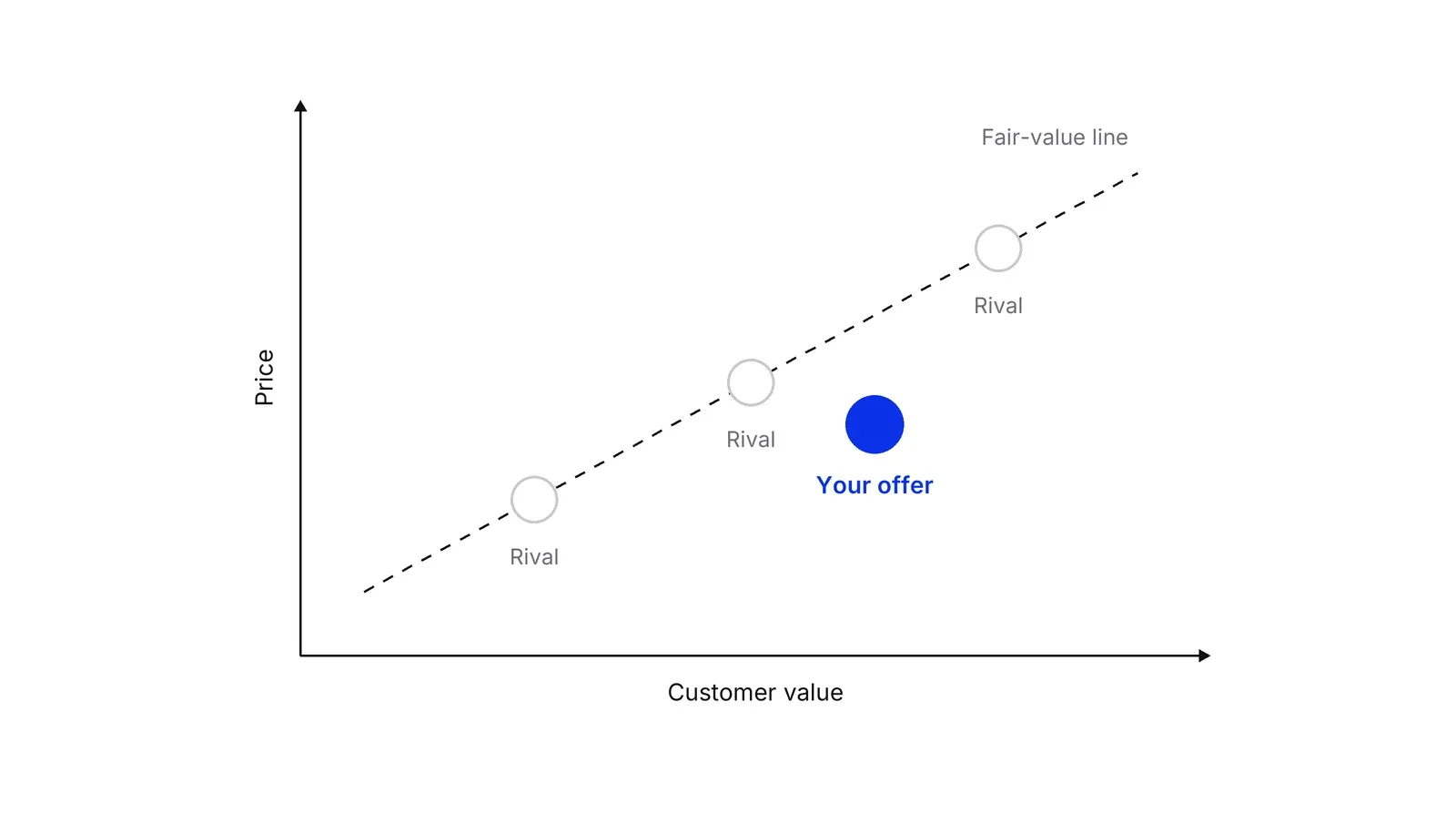
Building the map takes a list of rivals, which Porter’s five forces helps to widen, and an honest view of the value gap. A customer value map is the tool for scoring the value axis. To learn what buyers will accept, a Van Westendorp survey gives a range, and offer architecture shows how tiers can hold a position without a single price war.
What a price war does
A price war is a series of price cuts in which each side answers the other. Rao, Bergen and Davis wrote in Harvard Business Review in 2000 that in such a war the combatants all seem to end up worse off than before. Their opening case was the 1992 US airline fare war, where, they reported, some estimates put the industry’s losses above its combined profits since it began. In 1999 Sprint announced a night rate of 5 cents a minute, MCI matched it, and AT&T cut to 7 cents all day. On the day AT&T announced its cut, the three companies’ shares fell 4.7%, 2.5% and 3.8%.
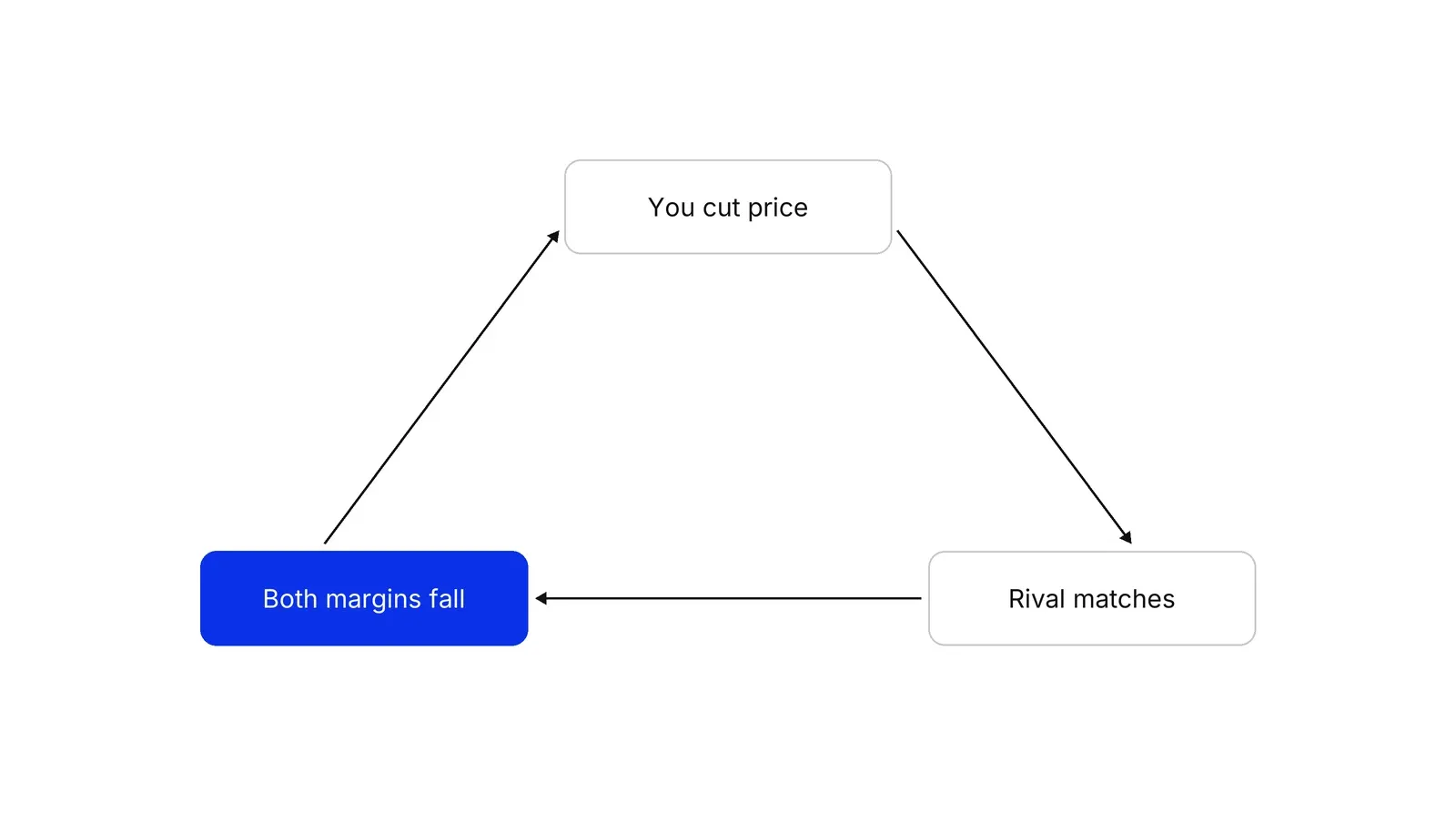
Who starts a war and who joins one is partly a matter of finance and exposure. Meghan Busse studied 14 US airlines from 1985 to 1992 and found that firms in worse financial condition were more likely to start price wars, especially highly leveraged ones. She also found that a firm was more likely to join an existing war when more of its traffic ran on routes served by the war’s leader.
Answering a rival’s cut without a matching cut
The first question after a rival cut is why it cut, because the answer decides the response. In the commodity supplier case in the 2000 article, a few phone calls showed the rival was underpricing in one local market while holding prices elsewhere. The supplier told customers that the short-term cuts could become long-term hikes if it were driven out, and avoided a loss-making match.
| Type of response | Example from the article |
|---|---|
| Non-price | The Ritz-Carlton Kuala Lumpur held rates and added services |
| Targeted price | McDonald’s bundled burgers, fries and drinks into value meals when Taco Bell cut |
| Flanking brand | 3M launched a low-priced diskette brand, Highland, against Kao |
| Direct match | Cut the regular price, the last resort for most firms |
Before any match, run the arithmetic: a 10% cut on a product with a 60% margin needs about 20% more volume to hold contribution.
Price signalling: the line between a message and a deal
A market signal is an announcement or preview of a possible action, sent to inform or to draw out rivals. Heil and Robertson defined it that way in 1991 and set out a research agenda on when signals are worth sending and how rivals read them.
Signals can help the whole market. Rao and colleagues describe how announcing that you will match prices, or that you compete on other dimensions, can tell rivals you do not want a price war. In their North Carolina example, after chains announced they would match Food Lion, the number of equal-priced items among 79 brands more than doubled in two years, and Food Lion’s prices rose. That outcome is exactly why regulators watch signals. A message meant to defuse a war can read as an offer to fix prices.
Where competition law stops you
Competition law forbids agreeing prices with rivals, and in both the EU and the US the rule reaches signals and information exchange, not only meetings. Independent behaviour stays lawful: you may watch public prices and match them, as long as you decide alone.
| Question | EU | US |
|---|---|---|
| Main rule | Article 101 TFEU bans agreements and concerted practices that directly or indirectly fix prices | Section 1 of the Sherman Act bans agreements that unreasonably restrain trade |
| Penalty | Fines up to 10% of total turnover under Regulation 1/2003 | Felony, up to $100 million for a company, $1 million and 10 years for a person |
| Proof | A single meeting can be a concerted practice (T-Mobile, 2009) | Parallel prices alone do not prove a conspiracy (Twombly, 2007) |
| Signals | Public announcements of future pricing can be a concerted practice | The FTC says invitations to coordinate raise concerns |
Four rulings and cases mark the edges. In T-Mobile Netherlands the EU Court of Justice held that one meeting can be enough. In Eturas it held that firms that knew of a discount cap sent through a shared booking system can be presumed to have joined it unless they publicly distance themselves. In the US, the Department of Justice’s 1994 settlement with airlines and their fare-data company dealt with fare filings used to float increases and trade counter-offers. The FTC’s 2010 order against U-Haul, which with Budget controlled over 70% of one-way truck rentals, barred it from inviting a rival to fix prices.
Chapter 6 of the EU’s 2023 Horizontal Guidelines lists exchanging current and future pricing intentions as a restriction by object, which is the most serious category. In healthcare, in August 2023 Teva agreed to a deferred prosecution agreement with a $225 million fine over generic-drug conduct from 2013 to 2015.
Lower limits exist too. Under Brooke Group, a US plaintiff alleging predatory pricing must show prices below an appropriate measure of cost and a reasonable prospect of recouping the losses. The EU’s 2009 enforcement guidance applies to dominant firms, and treats pricing below average avoidable cost as a clear sign of sacrifice. The guidance adds that dominance is generally unlikely below a 40% market share.
Algorithms are the live edge. Calvano and colleagues found that pricing algorithms using Q-learning consistently learned supracompetitive prices without communicating. In November 2025 the Department of Justice announced a proposed settlement with RealPage, alleging its software relied on nonpublic data shared by landlords. The agencies withdrew their 2000 collaboration guidelines in December 2024 and opened a public inquiry in February 2026, so ask counsel what applies today.
A Growth Lab plan starts from the price map and the response rules above, see Growth Lab.
How to apply Competitive pricing, step by step
- List the real alternatives. Write down the three to five options a buyer actually compares you with, including doing nothing. A private dental clinic is compared with the hospital department and the clinic across town, not with every clinic in the country. Result: a short rival list with the source of each price, which must be public (a website, a price list, a mystery shop).
- Place everyone on a price-value map. Put each rival on a chart with customer value on one axis and price on the other, and add your own offer. Use the same package contents for every row. Result: a map that shows whether you sit above, on or below the line that the rivals form.
- Choose a position and say why. Pick below, at or above the rivals and write one sentence of reasons, such as a higher price because patients wait two days instead of two weeks. Result: a stated position that a salesperson or a receptionist can defend.
- Work out what matching a cut would cost. For any price you might cut, compute how much extra volume is needed to keep the same total contribution. The required rise equals the cut divided by the unit margin after the cut. Result: a break-even volume that tells you whether a cut can ever pay.
- Write the response rules before a rival moves. For each likely rival move, name the first answer, such as a non-price response, a targeted offer, a flanking product or a match, with the trigger and an owner. Result: a one-page rulebook so a rival's promotion does not start a reflex cut.
- Set legal guardrails and review. Use only public or independently obtained prices, never discuss current or future prices with a rival, and keep a log of where each competitor price came from. Review the map and the rules every quarter. Result: a pricing process that a lawyer can read in five minutes.
Examples
Schwab and the zero-commission brokerage
In October 2019, Charles Schwab announced that online commissions for U.S. stocks, ETFs and options would fall from $4.95 to $0 from 7 October, keeping a $0.65 per-contract fee on options. It is a public example of a price move at the bottom of the range. The same industry was already a price-war case in the year 2000, when Harvard Business Review reported that the prevailing price for a discount trade had fallen from $30 to $15 to $8 within a few years.
A Malaysian luxury hotel stays out of a price war
Harvard Business Review described luxury hotels in Malaysia cutting rates after the 1997 downturn in Southeast Asia, with one exception. The Ritz-Carlton Kuala Lumpur kept its rates above 200 ringgit and met arriving travellers with offers and extra services instead. According to the article, its occupancy was 60% against 50% in 1998. The hotel gave guests a reason other than price.
A dental clinic and a 10% rival cut
Illustrative, no real clinic implied. A clinic has 400 cleanings a month at 100 each, with a variable cost of 40, so each cleaning adds 60 and the month adds 24,000. A rival cuts to 90. Matching means 50 per cleaning, so the clinic needs 480 cleanings, 20% more volume, just to stand still. If it cannot add 80 patients, a targeted offer to its own recall list costs less than a general cut.
When to use it
Use it when your market has a handful of visible rivals and buyers compare prices, when a rival has cut its price and you must decide whether to answer, or when you are launching and need a defensible starting price. It also fits a quarterly pricing review, because competitor prices drift.
When not to use it
Do not let rivals set your price when buyers cannot compare offers, when your product is new to the category, or when your cost to serve is far above theirs. In those cases start from what customers value and what you can afford, and use rival prices only as a check.
Common mistakes
- Comparing list prices without comparing what is in the package, so a cheaper rival turns out to include less.
- Answering every promotion with a cut, without computing the extra volume needed to break even.
- Sending rivals a public message about future prices, which competition authorities have treated as an invitation to collude.
- Asking a rival, a former colleague or a trade association what prices will be next quarter.
- Building a rival-price chart from a mix of public prices and gossip, with no record of the source.
FAQ
What is competitive pricing?
Competitive pricing is setting your price relative to what rivals charge for comparable offers, then deciding how to respond when they change theirs. You choose to price below, at or above the market, and you back the choice with a reason buyers recognise, such as speed, quality or risk.
Is it legal to match a competitor's price?
Yes, when you decide on your own and the price is public. The US Federal Trade Commission says a company may match a rival's price if it acts independently. What is illegal is an agreement with rivals on prices, or exchanging future pricing plans. The same line runs through Article 101 TFEU.
What is price signalling and when does it become illegal?
Price signalling is announcing or previewing a price move so that rivals read it. A public price list is normal. It becomes a problem when the message invites rivals to raise prices together. The FTC treated that as unlawful in the 2010 U-Haul order, and EU guidelines say it can be a concerted practice.
How should I respond when a competitor cuts its price?
Diagnose why it cut before you answer. Harvard Business Review's price-war article lists non-price responses, targeted pricing such as bundles, a flanking brand, a direct match and retreat. Compute the volume needed to break even on a match first, because a general cut often costs more than it brings.
Can competitors share prices through a trade association or software?
Exchanging current or future prices between rivals is a high-risk area in both the EU and the US. The 2023 EU Horizontal Guidelines treat exchanging future pricing intentions as a restriction by object, and the US Department of Justice has alleged that sharing nonpublic data through pricing software harmed renters. Ask a competition lawyer first.
Sources
- Akshay R. Rao, Mark E. Bergen, Scott Davis, How to Fight a Price War, Harvard Business Review, March-April 2000
- Michael E. Porter, Competitive Strategy: Techniques for Analyzing Industries and Competitors, Free Press, 1980, Internet Archive record
- Oliver Heil, Thomas S. Robertson, Toward a Theory of Competitive Market Signaling: A Research Agenda, Strategic Management Journal 12(6), 1991
- Meghan Busse, Firm Financial Condition and Airline Price Wars, RAND Journal of Economics 33(2), 2002
- Akshay R. Rao, Kent B. Monroe, The Effect of Price, Brand Name, and Store Name on Buyers' Perceptions of Product Quality, Journal of Marketing Research, 1989, Marketing Science Institute record
- Rafi Mohammed, The Good-Better-Best Approach to Pricing, Harvard Business Review, September-October 2018
- Charles Schwab, Schwab Removes the Final Pricing Barrier to Investing Online by Eliminating U.S. Stock, ETF and Options Commissions, 1 October 2019
- European Union, Treaty on the Functioning of the European Union, Article 101, consolidated text
- European Commission, Competition law treaty articles (Articles 101 and 102 TFEU)
- Council Regulation (EC) No 1/2003 on the implementation of the competition rules, Article 23
- European Commission, Guidelines on the applicability of Article 101 TFEU to horizontal co-operation agreements, 2023
- European Commission, Guidance on enforcement priorities in applying Article 82 EC to abusive exclusionary conduct by dominant undertakings, 2009
- Court of Justice of the EU, T-Mobile Netherlands, Case C-8/08, 2009
- Court of Justice of the EU, Eturas, Case C-74/14, 2016
- European Commission, Antitrust and cartels: overview
- United States Code, Title 15, Section 1 (Sherman Act), Legal Information Institute, Cornell Law School
- U.S. Federal Trade Commission, Guide to Antitrust Laws: Price Fixing
- U.S. Department of Justice, Antitrust Division, Antitrust Laws and You
- Bell Atlantic Corp. v. Twombly, 550 U.S. 544 (2007), Legal Information Institute
- Brooke Group Ltd. v. Brown & Williamson Tobacco Corp., 509 U.S. 209 (1993), Legal Information Institute
- U.S. Department of Justice, Antitrust Division, press release on the airline fare-information settlement, 17 March 1994
- U.S. Federal Trade Commission, U-Haul International, Inc. and AMERCO matter
- U.S. Federal Trade Commission, FTC and DOJ withdraw guidelines for collaboration among competitors, 11 December 2024
- U.S. Federal Trade Commission, FTC and DOJ seek public comment on guidance for business collaborations, 23 February 2026
- Emilio Calvano, Giacomo Calzolari, Vincenzo Denicolo, Sergio Pastorello, Artificial Intelligence, Algorithmic Pricing, and Collusion, American Economic Review, 2020
- U.S. Department of Justice, Justice Department requires RealPage to end sharing of competitively sensitive information, 24 November 2025
- U.S. Department of Justice, Antitrust Division, case page, U.S. v. Teva Pharmaceuticals USA, Inc. and Glenmark Pharmaceuticals Inc.
- Teva Pharmaceutical Industries, Form 8-K on the deferred prosecution agreement, August 2023
Last updated Oct 9, 2026


Marketing agency or growth system: when a company outgrows its agency
An agency is the right call while the founder still runs most of the company. Once the business starts copying itself into new locations or markets, it needs a system that sets goals, tests hypotheses and owns the result.

Why healthcare marketing agencies stall: the short, mid and long wins model we use with clinics
Most agencies own the click and nobody owns the front desk. How we structure clinic work in three horizons, the research behind each one, and one year of results.

Why channel tests stall after month three
Most paid channel tests do not end with a decision. They end when the budget runs out, the attribution model changes, or everyone quietly stops looking at the dashboard.