Cialdini's principles of persuasion
Cialdini's principles of persuasion are seven psychological levers (reciprocity, commitment, social proof, authority, liking, scarcity and unity) that explain why people say yes, and a checklist for writing offers, pages and sales conversations that use them honestly.
Cialdini's principles of persuasion are seven shortcuts people use when deciding whether to say yes: reciprocity, commitment and consistency, social proof, authority, liking, scarcity and unity. Robert Cialdini described six in his 1984 book Influence and added unity later. Marketers use them to design offers and pages, but the research behind several of them is weaker than the popular summaries suggest.
- Origin
- Robert B. Cialdini, 1984; unity added 2016 and 2021
- Level
- 201 · Tool
- Fits
- Startup, Small and mid-size, Scale-up
- Time to apply
- About two hours to audit one offer or landing page
- What you need
- one page, email or sales script where people hesitate · a conversion or reply rate to compare against · someone who can say honestly which claims on the page are true
Cialdini’s principles of persuasion are seven shortcuts that people use when deciding whether to comply with a request. Robert Cialdini, a social psychologist, set out the list in his research and books. In a 2001 Harvard Business Review article he described “six basic laws” of persuasion. A seventh, unity, came later. The list is useful because it turns a vague wish to be more convincing into a set of specific questions about a page or a pitch. It is also repeated far more confidently than the research behind it justifies, and this page marks where.
Where did the seven principles come from?
Six come from Cialdini’s book Influence, first published in 1984. The seventh was added in his later work. Roger Dooley, who interviewed Cialdini about it, reports that Cialdini introduced unity in Pre-Suasion (2016) after earlier saying his original six covered the important ones. Cialdini’s own company site lists unity as the newest principle in the 2021 edition, Influence, New and Expanded, and Arizona State University’s coverage of that edition says it adds a 73-page chapter on it.
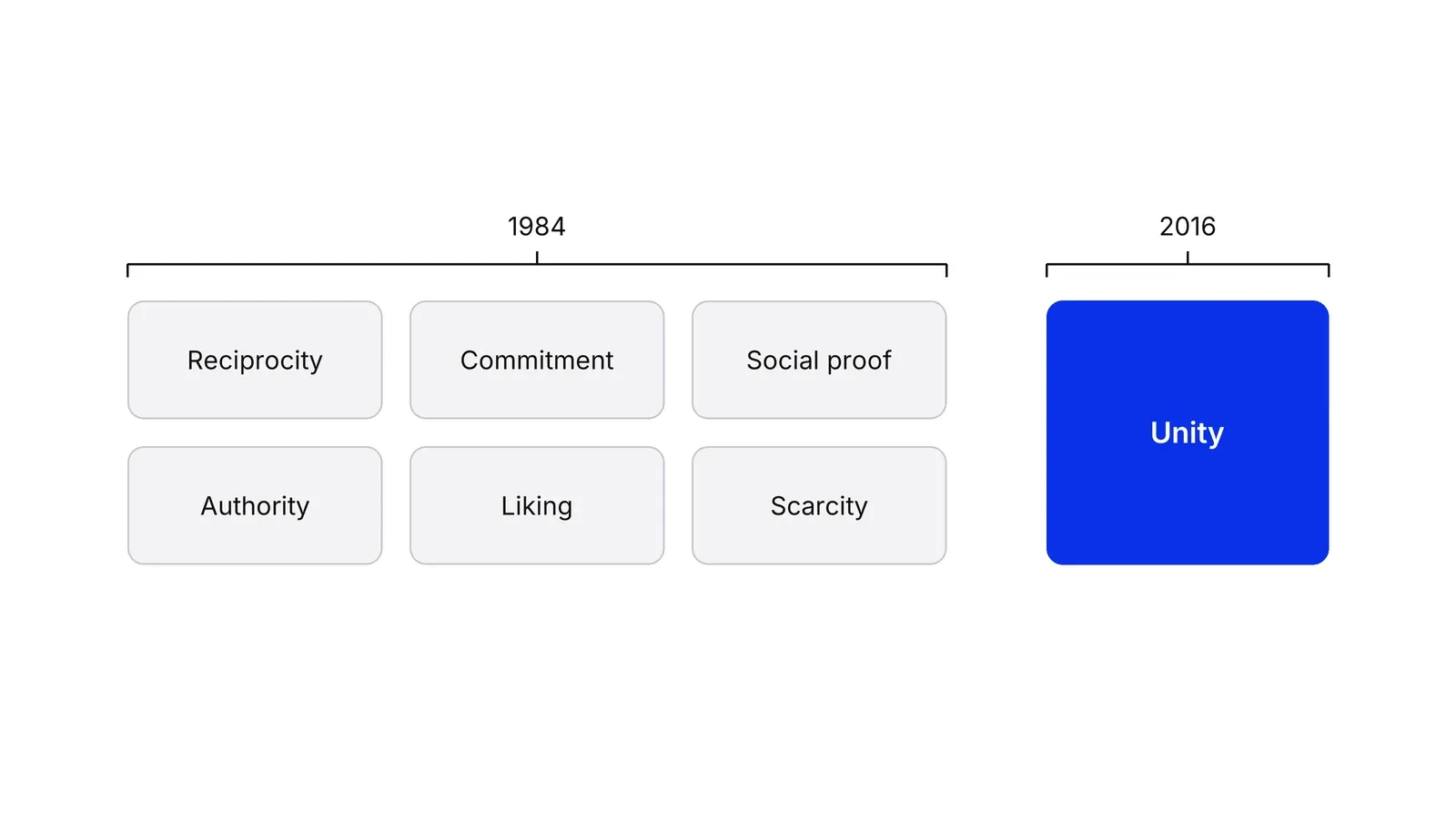
Cialdini and Noah Goldstein later argued that susceptibility to influence rests on three motives: wanting an accurate view of reality, wanting good relationships and wanting to protect one’s self-image. The principles are routes to those motives.
What each principle claims, and what the evidence shows
Reciprocity
Reciprocity is the pull to repay a favour. In a 1971 experiment, Dennis Regan found that people who had been given a small unasked favour, a soft drink, later bought more raffle tickets from the person who gave it. Armin Falk’s field experiment sent about 10,000 fundraising letters. Donation frequency rose 17% with a small gift and 75% with a large gift, compared with no gift.
The related door-in-the-face trick (make a big request, then a smaller one) is weaker than its reputation. A meta-analysis by Feeley, Anker and Aloe found a significant effect on verbal agreement but an insignificant one on people actually following through.
Commitment and consistency
People want to act in line with what they have already said or done. Freedman and Fraser’s 1966 study found that agreeing to a small request made a large one more likely. Jerry Burger’s review says the foot-in-the-door effect sometimes works, sometimes fails and sometimes reduces compliance, depending on conditions. His meta-analysis of the low-ball technique (agree first, learn the full cost later) found it reliable, strongest when the first agreement is public and the extra cost is small.
Social proof
Social proof is the habit of copying what similar people do. This page keeps it short because social proof has its own guide. Two warnings belong here. Goldstein, Cialdini and Griskevicius reported in 2008 that a hotel card saying most guests reuse towels beat a standard environmental message, 44.1% to 35.1%. Bohner and Schlüter then ran two German hotel studies and found the norm message did not beat the standard one; in one hotel the standard message did better, and their power for small effects was limited. And Schultz and colleagues found that telling households the neighbourhood average made below-average users consume more, until an approval message was added.
Authority
People defer to credible experts and visible symbols of expertise. Bickman’s 1974 field experiments found a man dressed as a guard got more compliance with street requests than a man in civilian clothes or a milkman’s uniform. Milgram’s 1963 study is the famous case: 26 of 40 men, recruited by newspaper advertisement, gave the highest shock.
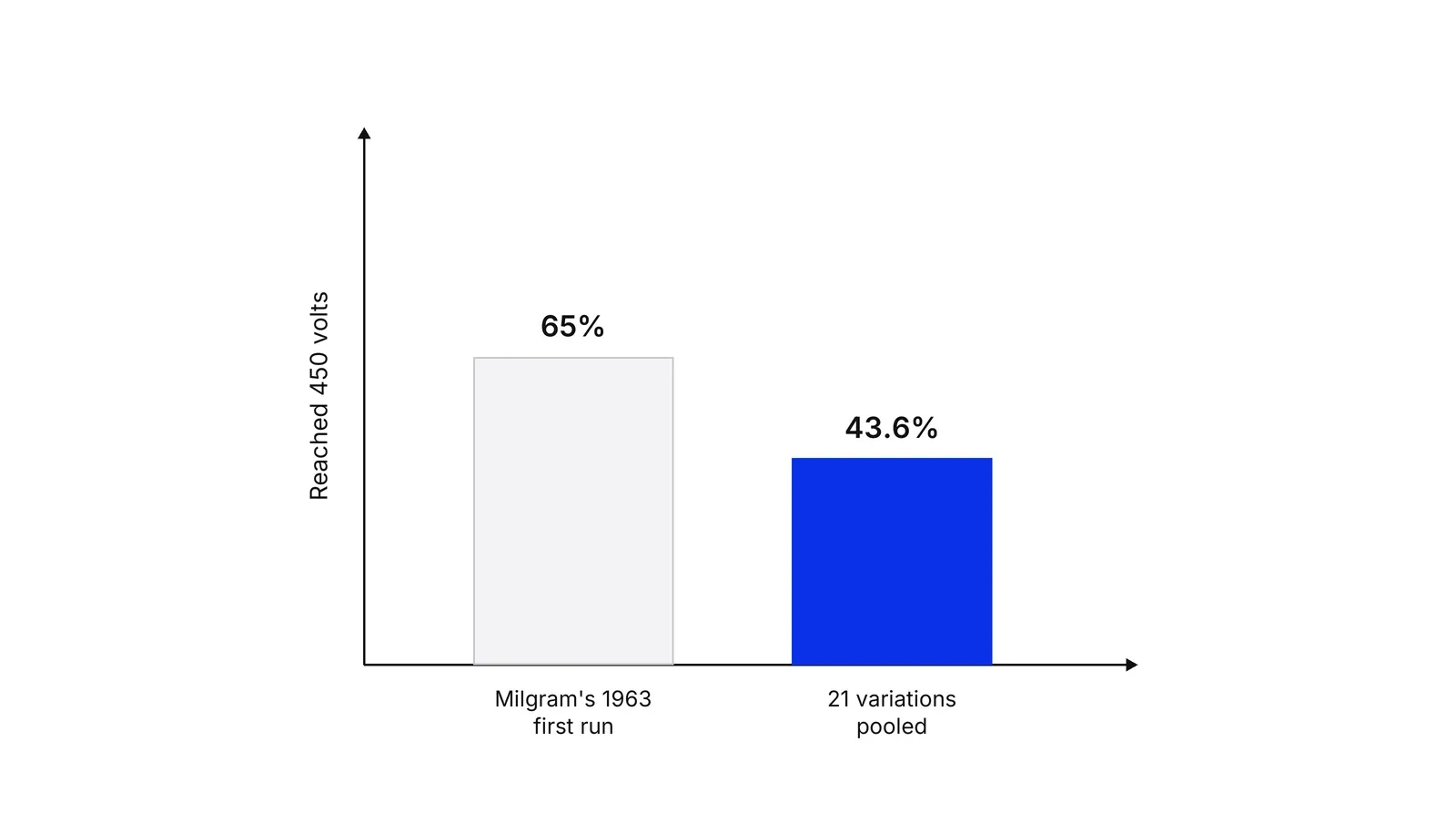
The Meta-Milgram analysis pooled 21 conditions (740 people) and found 43.6% went to 450 volts. Perry and colleagues, using an unpublished study from Milgram’s archive, found that in 18 of 23 variations the participants who believed the shocks were real gave lower shocks than those who doubted it. The authority effect is real, but the textbook number overstates it. For marketing, the safer reading is that credentials help when they are legitimate and checkable.
Liking
You say yes more readily to people you like, who are similar to you or who cooperate with you. Maddux, Mullen and Galinsky found that negotiators who subtly mimicked their counterpart reached a deal in 10 of 15 pairs (67%), against 2 of 16 (12.5%) without mimicry. The samples are tiny, so read it as a lead worth testing, not a rule.
Scarcity
Scarce things look more valuable. Worchel, Lee and Adewole gave 146 female students cookies from a jar with either 2 or 10 in it; the scarce cookies were rated as more desirable. Michael Lynn’s 1991 quantitative review pooled later studies of the same idea. Scarcity is also the principle most often faked. The FTC’s 2022 staff report lists false low-stock messages and baseless countdown timers as dark patterns, and Mathur and colleagues’ crawl of about 11,000 shopping sites found 1,818 dark-pattern instances.
Unity
Unity is the sense of shared identity: family, country, profession, a team. Cialdini and colleagues’ 1997 paper on “oneness” argued that people treat close others partly as part of the self, a nearby idea. The research behind this page found no meta-analysis of unity as a marketing lever, so it is the least tested of the seven. Where it is true, it works through a real shared membership: a clinic run by and for a neighbourhood, a fintech built by former finance-ops people for finance-ops people.
How reliable is the whole framework?
Cialdini’s principles are a classification, not a model that predicts outcomes. Several of the best-known studies are small, old or pooled to smaller effects. The wider field of nudging shows the same pattern. A 2022 meta-analysis found choice-architecture interventions work with an effect of d = 0.45, and a re-analysis in the same journal found no evidence of an effect once publication bias was adjusted for, though it left one category, decision structure, undecided. Use the principles to generate hypotheses and then test them, for example in an experimentation program with a control group.
A Growth Lab plan starts from the barrier in a funnel and tests one principle against it, which keeps the framework in its place as a checklist.
How to apply Cialdini's principles of persuasion, step by step
- Find the hesitation. Look at where people drop off or stall: the price, the form, the first call. Write down what the person is worried about in one sentence. Result: a named barrier, not a general wish to be more persuasive.
- Match one principle to the barrier. Doubt about whether the claim is true points to authority or social proof. Doubt about being taken advantage of points to reciprocity or liking. Hesitation to start points to a small commitment. Result: one principle chosen on purpose.
- Write the true version. Use only facts you can show: the real number of customers, the real credential, the real deadline. A principle built on a made-up fact is a lie with a psychology label. Result: a line of copy you could defend to a customer's face.
- Test it against the current version. Run the new version next to the old one, change one thing, and decide the success measure before you look. Published effects are often smaller in a new setting. Result: a measured difference instead of a borrowed claim.
- Check the exit. Read the page as a sceptical customer. Could they cancel as easily as they joined? Does the timer end for real? Result: a short list of anything that would embarrass you if a regulator or journalist quoted it.
Examples
A dental clinic's booking page
Illustrative. Patients start the form and stop at the phone-number field. The barrier is uncertainty about being chased by sales calls. The clinic picks reciprocity: it offers a free, no-obligation checklist of what to expect at a first visit, delivered before any data is asked for. It tests the page with and without the checklist for four weeks. If the checklist makes no difference, it is dropped.
A B2B payments startup's pricing page
Illustrative. Prospects read the page and leave without a demo request. The barrier is doubt that a young company can be trusted with money flows. The team uses authority and social proof: its licence number and regulator, plus named customers who agreed to be listed. It adds no counter of 'companies viewing this page', because that figure would be invented.
When to use it
Use the principles as a diagnostic when an offer, email or sales script underperforms and you need a short list of hypotheses to test. They also work as a review checklist before launch, to check that each claim on the page is true.
When not to use it
Do not treat them as a growth engine on their own. If the product does not solve a real problem or the price is wrong, a principle will lift a metric for a week at best. Do not use them to hide cancellation terms, invent scarcity or fake popularity.
Common mistakes
- Copying a headline result as if it were a law. The towel-reuse study that made social proof famous did not repeat cleanly in two German hotels.
- Stacking all seven on one page. A countdown, a testimonial wall, a free gift and a guarantee together read as pressure.
- Inventing the fact. 'Only 2 left' and 'offer ends in 59 minutes' without a real limit are listed as dark patterns in an FTC staff report.
- Using a principle without a control. Without a comparison group you cannot tell a lift from a good week.
- Confusing liking with unity. Shared hobbies make a person likeable; a shared identity makes the person one of us.
FAQ
What are Cialdini's 6 principles of persuasion?
Reciprocity, commitment and consistency, social proof, authority, liking and scarcity. Cialdini presented them in his book Influence (1984) as the main shortcuts people use when deciding whether to comply with a request. Each one describes a situation in which a person is more likely to say yes without long deliberation.
What is Cialdini's seventh principle?
Unity: people say yes more readily to those they see as part of their own group or identity, such as family, nationality or profession. Cialdini added it in Pre-Suasion (2016), and his own site lists it as the newest principle in the 2021 edition, Influence, New and Expanded.
Do Cialdini's principles still work?
Some hold well and some are smaller than advertised. A meta-analysis of the door-in-the-face technique found an effect on stated agreement but not significantly on follow-through, and two German hotel replications did not reproduce the original towel-reuse result. Treat each principle as a hypothesis to test, not a guarantee.
What is the difference between liking and unity?
Liking is about similarity, compliments and cooperation: you favour people you find pleasant. Unity is about shared identity: you favour people you count as part of your own group. Cialdini says shared surface traits belong under liking, and a sense of 'we' belongs under unity.
Are Cialdini's principles manipulative?
They can be used either way. Cialdini's own site says the principles should be applied ethically. The line is whether the fact behind the principle is true: real reviews, a real deadline and a real credential inform a decision, while a fake timer or invented viewer count deceives. The FTC lists the latter as dark patterns.
Sources
- Influence at Work (Cialdini's company), Books: Influence, Pre-Suasion and the principles
- Influence at Work, Pre-Suasion: the book page
- Influence at Work, The principles of persuasion aren't just for business
- Robert B. Cialdini, Harnessing the Science of Persuasion, Harvard Business Review, October 2001
- Arizona State University W. P. Carey, The 'Godfather of Influence' has a new way to be more persuasive, 2021
- Roger Dooley, Brainfluence podcast ep. 134: Unity, Robert Cialdini's surprising seventh principle
- Open Library, catalogue records for Cialdini's Influence editions
- Robert B. Cialdini, Noah J. Goldstein, Social influence: compliance and conformity, Annual Review of Psychology 55, 2004
- Dennis T. Regan, Effects of a favor and liking on compliance, Journal of Experimental Social Psychology 7(6), 1971
- Armin Falk, Gift exchange in the field, Econometrica 75(5), 2007
- Thomas Hugh Feeley, Ashley Anker, Ariel Aloe, The door-in-the-face persuasive message strategy: a meta-analysis of the first 35 years, Communication Monographs 79(3), 2012
- Jonathan Freedman, Scott Fraser, Compliance without pressure: the foot-in-the-door technique, Journal of Personality and Social Psychology 4(2), 1966
- Jerry M. Burger, The foot-in-the-door compliance procedure: a multiple-process analysis and review, Personality and Social Psychology Review 3(4), 1999
- Jerry M. Burger, Deanna Caputo, The low-ball compliance procedure: a meta-analysis, Social Influence, 2015
- Noah J. Goldstein, Robert B. Cialdini, Vladas Griskevicius, A room with a viewpoint: using social norms to motivate environmental conservation in hotels, Journal of Consumer Research 35(3), 2008
- Gerd Bohner, Nina Schlüter, A room with a viewpoint revisited: descriptive norms and hotel guests' towel reuse behavior, PLOS ONE, 2014
- P. Wesley Schultz and colleagues, The constructive, destructive, and reconstructive power of social norms, Psychological Science 18(5), 2007
- Stanley Milgram, Behavioral study of obedience, Journal of Abnormal and Social Psychology 67(4), 1963
- Nicholas Haslam, Steve Loughnan, Gina Perry, Meta-Milgram: an empirical synthesis of the obedience experiments, PLOS ONE, 2014
- Gina Perry and colleagues, Credibility and incredulity in Milgram's obedience experiments, Social Psychology Quarterly, 2019
- Leonard Bickman, The social power of a uniform, Journal of Applied Social Psychology 4(1), 1974
- William Maddux, Elizabeth Mullen, Adam Galinsky, Chameleons bake bigger pies and take bigger pieces, Journal of Experimental Social Psychology 44(2), 2008 (postprint)
- Stephen Worchel, Jerry Lee, Akanbi Adewole, Effects of supply and demand on ratings of object value, Journal of Personality and Social Psychology 32(5), 1975
- Michael Lynn, Scarcity effects on value: a quantitative review of the commodity theory literature, Psychology & Marketing 8(1), 1991
- Robert B. Cialdini and colleagues, Reinterpreting the empathy-altruism relationship: when one into one equals oneness, Journal of Personality and Social Psychology 73(3), 1997
- Stephanie Mertens and colleagues, The effectiveness of nudging: a meta-analysis of choice architecture interventions, PNAS 119(1), 2022
- Maximilian Maier and colleagues, No evidence for nudging after adjusting for publication bias, PNAS 119(31), 2022
- Arunesh Mathur and colleagues, Dark patterns at scale: findings from a crawl of 11K shopping websites, 2019
- US Federal Trade Commission, Bringing Dark Patterns to Light: staff report, September 2022
Last updated Oct 9, 2026


Marketing agency or growth system: when a company outgrows its agency
An agency is the right call while the founder still runs most of the company. Once the business starts copying itself into new locations or markets, it needs a system that sets goals, tests hypotheses and owns the result.

Why healthcare marketing agencies stall: the short, mid and long wins model we use with clinics
Most agencies own the click and nobody owns the front desk. How we structure clinic work in three horizons, the research behind each one, and one year of results.

Why channel tests stall after month three
Most paid channel tests do not end with a decision. They end when the budget runs out, the attribution model changes, or everyone quietly stops looking at the dashboard.