PEST and PESTLE analysis
PESTLE analysis is a checklist for scanning the political, economic, social, technological, legal and environmental changes outside a company, then scoring which ones will actually hit it.
PESTLE analysis is a framework for scanning a company's outside environment across six factors: political, economic, social, technological, legal and environmental. PEST is the original four-factor version. Teams use it to spot changes they cannot control, score each one for impact and likelihood, and feed the strongest into the opportunities and threats of a SWOT analysis.
- Origin
- Francis J. Aguilar (environmental scanning); later authors (acronyms), 1967; PEST and PESTLE forms later
- Level
- 101 · Basics
- Fits
- Small and mid-size, Scale-up, Enterprise
- Time to apply
- two to three hours for a first pass with three or four people, then a short review every quarter
- What you need
- a clear decision the scan serves, such as entering a market or setting next year's plan · people who read different sources: finance, legal or compliance, product, sales · a shared scale for impact and likelihood, agreed before anyone scores
PESTLE analysis is a structured scan of the changes outside a company that it cannot control but has to plan around: political, economic, social, technological, legal and environmental. PEST is the older four-letter version without the legal and environmental factors. Strategy teams, HR leaders and founders use it before entering a market, writing an annual plan or launching in a regulated field. The CIPD, the UK body for HR professionals, calls it a broad fact-finding exercise about the outside factors that could affect an organisation’s decisions.
What the six factors cover, and the questions to ask
Each letter is a prompt to look in one direction. The questions below turn the prompt into something a team can answer with a date and a source.
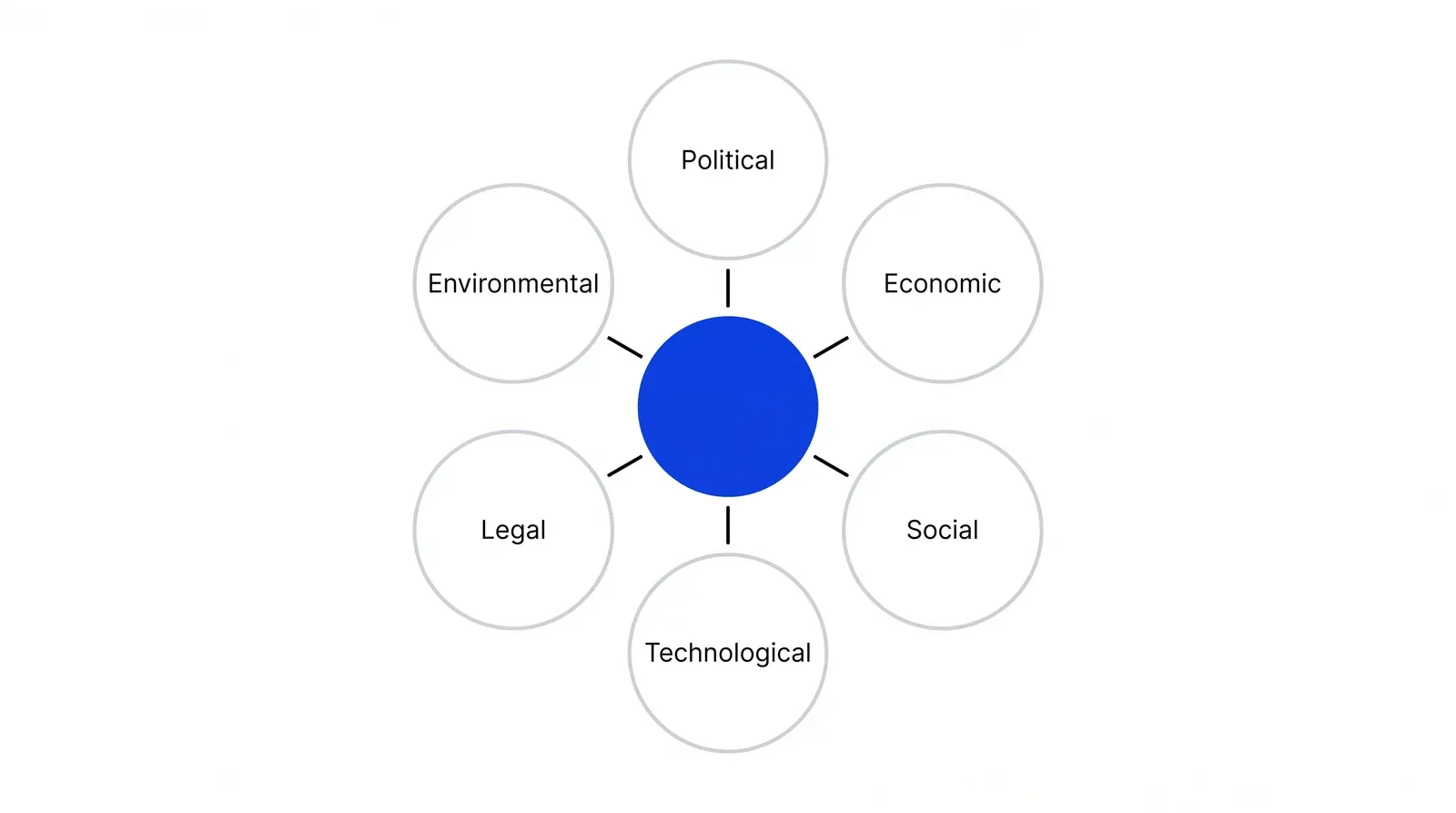
| Factor | What it covers | Questions to ask |
|---|---|---|
| Political | Government priorities, trade policy, taxes, stability | Which policy changes are announced or debated in our markets? Could a change of government or a trade dispute cut off a supplier or a customer group? |
| Economic | Interest rates, inflation, exchange rates, demand, wages | How would a rate rise or a currency swing change our costs and our customers’ budgets? Is hiring getting cheaper or harder? |
| Social | Demographics, habits, attitudes, health trends | Is our customer base growing, ageing or moving? What do customers now expect as normal that they did not two years ago? |
| Technological | New tools, infrastructure, automation, standards | What new technology makes our offer cheaper to copy or easier to deliver? Which platform or standard are we required to adopt? |
| Legal | Laws, regulation, licensing, court decisions | Which laws take effect within our planning horizon, and on what date? What does compliance cost, and who owns it? |
| Environmental | Climate, energy, waste, sustainability rules and expectations | Will energy, packaging or emissions rules change our costs? Do buyers or investors now ask for evidence we cannot yet supply? |
Political and legal overlap on purpose. Political is the direction of travel, such as a government promising faster payments. Legal is the specific rule with a deadline that follows. Splitting them matters most in finance and healthcare, where a single regulation can change a product’s economics.
Where PEST came from, and why the letters keep changing
The usual starting point is Scanning the Business Environment, a 1967 book by Francis J. Aguilar, who joined the Harvard Business School faculty in 1964 and taught there for three decades. HBS describes the book as a study of how companies acquire and use information about outside events and trends for strategic planning. Aguilar defined scanning as gathering information about events and relationships outside a company to help top management chart its future course, and he named modes such as undirected viewing, where managers absorb information with no specific purpose.
Business writers say Aguilar grouped the outside world into economic, technical, political and social sectors, abbreviated ETPS, and that later authors rearranged the letters into STEP and PEST. That story is repeated far more often than it is documented. Neither the HBS obituary nor the scanning research we checked uses the ETPS acronym, so treat the attribution as convention rather than settled history. What is documented: Liam Fahey and V.K. Narayanan’s 1986 textbook sorted the macroenvironment into social, technological, economic, environmental and political sectors (STEEP), and today’s PESTLE and STEEPLE versions add legal and ethical lines to the same idea.
Score impact and likelihood, or the list does nothing
A PESTLE list without scores is the most common way the tool fails. Twenty bullet points with equal weight give a reader no idea which three matter. The fix is borrowed from risk management: HM Treasury’s Orange Book defines the level of a risk by the likelihood of it occurring and the consequences should it happen. Apply the same two numbers to every PESTLE line.
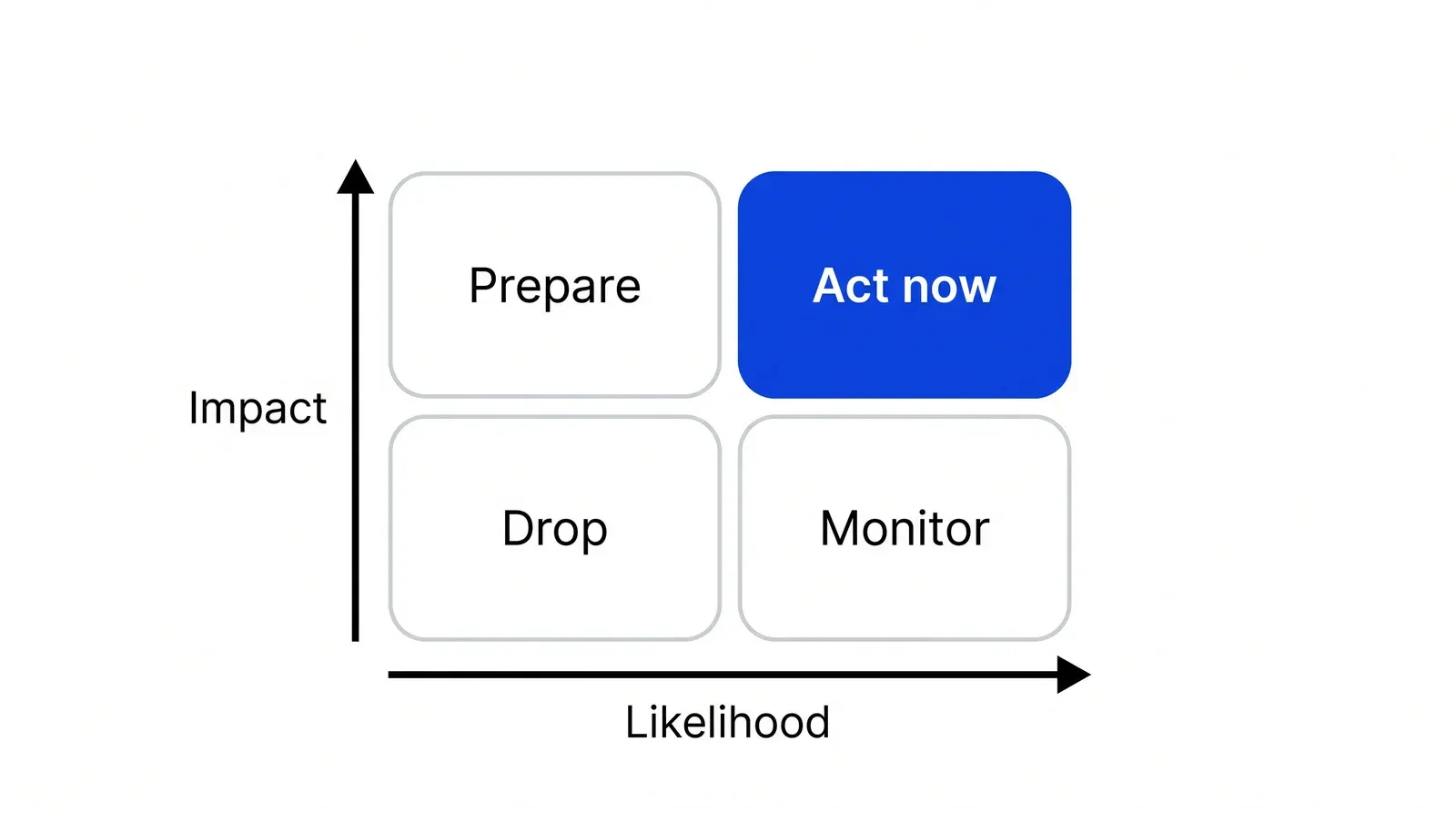
High impact and high likelihood means act now. High impact and low likelihood means write a plan you hope never to use. Low impact and high likelihood goes on a watch list. Everything else gets dropped, which is the point: a good scan ends shorter than it started.
Research on executives backs the scoring habit. Donald Hambrick tested in a 1982 Strategic Management Journal study whether executives scan in line with their company’s strategy and found the link differed from one industry to the next. Richard Daft, Juhani Sormunen and Don Parks interviewed chief executives of 50 manufacturing companies for a 1988 Strategic Management Journal study. Customer, economic and competitor sectors produced more strategic uncertainty than technological, regulatory and sociocultural ones, and executives at high-performing companies scanned more often and more broadly when uncertainty rose.
How PESTLE feeds the opportunities and threats in SWOT
PESTLE answers what is changing outside. SWOT asks what the company should do about it, combining internal strengths and weaknesses with external opportunities and threats. EBSCO’s reference entry on PEST notes that its factors can show up as either threats or opportunities in a SWOT. So the scored short list from PESTLE becomes the raw material for the outside half of SWOT. SWOT itself has a separate origin: Richard Puyt and colleagues traced it in 2023 to Robert Stewart’s SOFT approach, later relabelled SWOT.
| PESTLE | SWOT | Porter’s five forces | |
|---|---|---|---|
| Looks at | The wide environment outside any one industry | The company, inside and out | The structure of one industry |
| Answers | What is changing that we cannot control | What should we do next | How much profit this industry allows |
| Output | Scored list of outside changes | Four lists that lead to actions | Five scores and a verdict on the profit ceiling |
When the question is about competitors, buyers and suppliers in one industry, Porter’s five forces is the better tool. PESTLE sits one level wider, and the CIPD recommends using the two together.
A regulation-heavy scan, worked through
Illustrative company, real regulation. Take a payment institution based in an EU country outside the euro area that moves euro payments for business clients. In October 2026 it runs a PESTLE scan with a 12-month horizon.
| Factor | Change | Impact | Likelihood |
|---|---|---|---|
| Legal | The EU Instant Payments Regulation (2024/886): per the ECB’s deadline table, payment institutions must receive instant euro transfers by 9 April 2027, and in non-euro states send them and verify the payee by 9 July 2027 | 5 | 5 |
| Legal | FATF’s June 2025 revision of Recommendation 16 sets stricter payer and payee data in cross-border payment messages, due by the end of 2030 | 4 | 4, beyond the horizon |
| Political | The G20 target of an average cross-border payment cost of no more than 1% by end-2027, set out by the Financial Stability Board in 2021 | 3 | 2; the FSB said in October 2025 the targets are unlikely to be met on time |
| Economic | Instant transfers may cost no more than standard ones under the same regulation, which squeezes a fee earned on speed | 4 | 5 |
| Technological | Instant rails make speed standard for every competitor | 3 | 4 |
| Environmental | No material change for this business | 1 | 1 |
The scores make the decision obvious. Two legal lines and one economic line land in act now, and the engineering and compliance roadmap for the first half of 2027 follows from them. The FATF change goes to prepare, with a budget line in 2028. The G20 target goes on the watch list. The environmental line is dropped instead of padded.
Where PESTLE stops working
PESTLE describes changes that are already visible. George Burt and four co-authors argued in 2006 that PEST and its derivatives give managers weak guidance on the contextual environment and proposed scenario planning instead. George Day and Paul Schoemaker made a related point in Harvard Business Review in 2005: the threats that hurt most often come from the edge of a market, where a factor checklist rarely looks. Use PESTLE for the known changes and a scenario exercise for the unknown ones.
A Growth Lab engagement starts with this kind of outside scan before choosing where to compete; see Pushers’ growth work.
How to apply PEST and PESTLE analysis, step by step
- Name the decision and the time horizon. Write one line: what decision this scan informs and how far ahead it looks, for example 'enter Germany in 2027' or 'next year's budget'. Result: a boundary that tells everyone which changes count and which are background noise.
- Collect changes, factor by factor. Go through the six factors with the questions for each and list specific changes with a date or a source, such as a law that takes effect on a known day. Result: a list of 15 to 30 concrete changes, each traceable to where you read it.
- Score impact and likelihood. Rate each change on the scale you agreed, for example 1 to 5 for how hard it would hit the business and 1 to 5 for how likely it is within the horizon. Result: every line has two numbers instead of an opinion.
- Sort into act now, prepare, monitor, drop. High impact and high likelihood means act now. High impact and low likelihood means prepare a plan. Low impact and high likelihood means monitor. The rest you drop. Result: a short list of five to eight changes that deserve attention.
- Move the short list into SWOT. Each change on the short list becomes an opportunity or a threat in a SWOT, phrased for your company. Result: the outside half of SWOT rests on evidence instead of brainstorming.
- Assign owners and a review date. Give every act-now and prepare item one owner and set the next review, usually in three months. Result: the scan turns into a watch list someone keeps current.
Examples
A dental clinic group planning a second city
Illustrative. A group with three clinics wants a fourth in a new city. The scan turns up a local shortage of dental nurses (social, high impact, already happening), a planned change to how the regional insurer pays for check-ups (political and economic, high impact, likely next year) and rising rents near the city center (economic, medium). The group moves the opening to a district with lower rent and starts nurse hiring six months before the lease, the two decisions the scan actually changed.
An online shop selling into a second country
Illustrative. A home goods shop doing well at home looks at selling abroad. The scan lists different consumer protection and returns rules (legal, high impact, certain), packaging waste rules that differ from home (environmental, medium impact, certain) and a weaker local currency (economic, medium impact, likely). The returns rules alone change the unit economics, so the team prices returns into the margin before launch instead of discovering the cost in month three.
When to use it
Use it before a decision that depends on things outside your control: entering a new country or segment, writing the annual plan, raising money, or launching a product in a regulated field such as payments or health. It also works as a quarterly habit for a leadership team that keeps getting surprised by rules, prices or customer behavior it could have read about months earlier.
When not to use it
Skip it when the problem is inside the company, such as slow delivery, weak sales execution or a team conflict; an outside scan only distracts from that. It is also the wrong tool for judging how profitable an industry is or how strong a competitor is. For that, use Porter's five forces or a competitor teardown.
Common mistakes
- Listing factors without scoring impact and likelihood, which produces a long page where a minor trend sits next to a law that will shut the business down.
- Writing general trends ('digitalization', 'inflation') instead of specific changes with a date and a source.
- Mixing in internal issues such as staff turnover or a weak website; those are strengths and weaknesses, not outside factors.
- Running it once a year and filing it, so a change announced in March is noticed in December.
- Forcing an item into every letter even when a factor has nothing material to report, which pads the list and hides the few lines that matter.
FAQ
What are the factors of PEST and PESTLE analysis?
PEST covers four outside factors: political, economic, social and technological. PESTLE adds legal and environmental, giving six. Political covers government action and stability, economic covers prices, rates and demand, social covers demographics and behavior, technological covers new tools and infrastructure, legal covers laws and regulation, and environmental covers climate and resource rules.
What is the difference between SWOT and PEST analysis?
PEST looks only outside the company and asks what is changing. SWOT combines the inside view, strengths and weaknesses, with the outside view, opportunities and threats. The usual order is PEST or PESTLE first, then SWOT: the strongest scored PESTLE changes become the opportunities and threats in the SWOT.
Who created PEST analysis?
Francis J. Aguilar of Harvard Business School is usually credited, through his 1967 book Scanning the Business Environment, which studied how managers gather information about the outside world. The PEST, PESTLE and STEEPLE acronyms came later from other authors, and their exact history is poorly documented, so treat the credit as a convention.
What is the difference between PEST and PESTLE?
PESTLE is PEST with two more letters: legal, split out from political, and environmental. The split helps in regulated industries, where a specific law with a deadline needs its own line instead of hiding inside a general political trend. STEEPLE adds ethical factors on top.
How often should you update a PESTLE analysis?
Review the short list of scored changes every quarter and redo the full scan once a year or before any major decision. Laws, prices and technology move on their own schedule, and a scan only helps while it still describes the world the company operates in.
Sources
- Francis J. Aguilar, Scanning the Business Environment, Macmillan, 1967, Open Library record
- Harvard Business School, Francis J. Aguilar obituary, February 2013
- Harvard Gazette, Frank Aguilar of HBS dies at 80, February 2013
- Chun Wei Choo, Environmental scanning as information seeking and organizational learning, Information Research 7(1), 2001
- Zita Correia, T.D. Wilson, Factors influencing environmental scanning in the organizational context, Information Research 7(1), 2001
- Liam Fahey, V.K. Narayanan, Macroenvironmental Analysis for Strategic Management, West Publishing, 1986, Drexel University record
- CIPD, PESTLE analysis factsheet
- Javier Gimeno, Daniel Simonovich, Metin Sengul, Analysing the Macro Environment, INSEAD background note, 2018
- John Walsh, PEST Analysis, EBSCO Research Starters, 2021
- Donald C. Hambrick, Environmental scanning and organizational strategy, Strategic Management Journal 3(2), 1982
- Richard L. Daft, Juhani Sormunen, Don Parks, Chief executive scanning, environmental characteristics, and company performance, Strategic Management Journal 9(2), 1988
- George Burt and others, The role of scenario planning in exploring the environment in view of the limitations of PEST and its derivatives, International Studies of Management and Organization 36, 2006
- Richard W. Puyt, Finn Birger Lie, Celeste P.M. Wilderom, The origins of SWOT analysis, Long Range Planning 56(3), 2023
- George S. Day, Paul J.H. Schoemaker, Scanning the Periphery, Harvard Business Review, November 2005
- HM Treasury, The Orange Book: Management of Risk, Principles and Concepts, 2023 edition
- HM Treasury, Green Book supplementary guidance: risk
- European Central Bank, Instant Payments Regulation (Regulation (EU) 2024/886) and implementation deadlines
- ABA Banking Journal, FATF releases revisions to international standard for payments transparency, June 2025
- Financial Stability Board, Targets for Addressing the Four Challenges of Cross-Border Payments: Final Report, October 2021
- Financial Stability Board, G20 Roadmap for Cross-border Payments: Consolidated progress report for 2025
Last updated Oct 9, 2026


Marketing agency or growth system: when a company outgrows its agency
An agency is the right call while the founder still runs most of the company. Once the business starts copying itself into new locations or markets, it needs a system that sets goals, tests hypotheses and owns the result.

Why healthcare marketing agencies stall: the short, mid and long wins model we use with clinics
Most agencies own the click and nobody owns the front desk. How we structure clinic work in three horizons, the research behind each one, and one year of results.

Why channel tests stall after month three
Most paid channel tests do not end with a decision. They end when the budget runs out, the attribution model changes, or everyone quietly stops looking at the dashboard.