OKR
OKR is a goal-setting method that pairs a short, ambitious objective with a few measurable key results, reviewed every quarter, so a team knows what it is aiming at and how far along it is.
OKR, short for objectives and key results, is a goal-setting method in which a team writes one ambitious objective in plain words and attaches roughly three measurable key results that show whether it was reached. Andy Grove built it at Intel, and John Doerr took it to Google in 1999. Teams usually set OKRs quarterly, share them openly and grade each key result from 0 to 1.
- Origin
- Andy Grove (Intel); John Doerr (introduced it to Google), 1983 (Grove's book); 1999 (Google)
- Level
- 201 · Tool
- Fits
- Startup, Small and mid-size, Scale-up, Enterprise
- Time to apply
- half a day to write the first set, then a short weekly check and a quarterly review
- What you need
- one priority per team that the team can influence itself · a number you can already measure today for each key result · a person who owns the weekly check-in
OKR is a way to set goals in two parts. The objective says in plain words where a team wants to go. The key results are a few numbers that show whether it got there. Andy Grove developed the method at Intel, and John Doerr, a venture investor who had studied under Grove at Intel, presented it to Google’s founders in 1999. Doerr’s 2018 book, Measure What Matters, and his TED talk made it the default goal system of many start-ups. Google’s own guide is the most detailed public account of how it runs, so this page leans on it and then checks it against the research.
Where did OKRs come from?
OKRs descend from management by objectives (MBO). Peter Drucker did not invent MBO, but he popularised it in The Practice of Management in 1954 as a loop of setting objectives, monitoring and review. Christoph Roser’s critique of MBO is that it helps you track goals but not decide which goals are worth having, and that managers tend to load people with long wish lists.
Grove’s changes, as Doerr’s site describes them, were to pair each objective with key results, a term Grove likely coined, to run quarterly cycles and to keep the whole thing apart from compensation. Grove’s book, High Output Management, was published by Random House in 1983. We could not read its text, which the Internet Archive lends only to registered borrowers, so we cannot confirm which of these ideas appear in it in those words. Doerr’s site says Grove first called the system iMBOs, for Intel management by objectives, and Doerr was one of his seminar students.
How an OKR is built
An OKR set has one objective and a few key results beneath it. The objective is a short, ambitious sentence. Each key result is a number that would change if the objective were met. Christina Wodtke puts it as a test: ask how you would know the objective was met, and her rule is that key results are outcomes, not tasks.
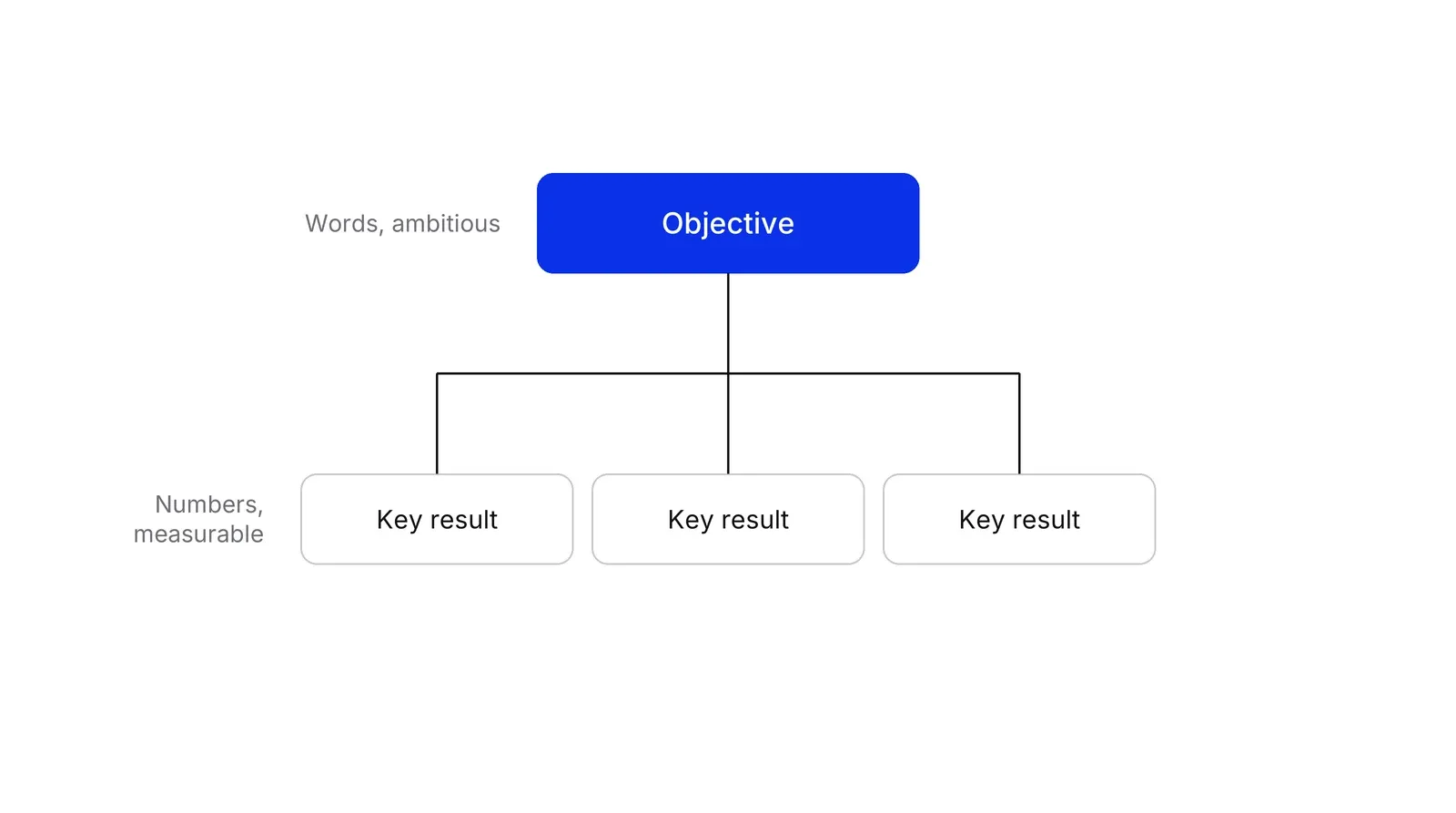
People confuse three things that look alike:
| Example | Test | |
|---|---|---|
| Objective | Make onboarding painless | Could a new hire repeat it, and does it have no number? |
| Key result | Cut median time to first payment from 9 days to 4 | Does it have a start, a target and a date? |
| Task | Build the new document upload | Can you finish it and still miss the goal? |
How many to write is not settled. Google’s re:Work guide recommends three to five objectives per team and about three key results per objective. The Atlassian playbook suggests one to three objectives with three to five key results each. Wodtke advises keeping OKRs for critical efforts only, and warns against setting them for everything the team does.
What is the 0.6 to 0.7 sweet spot?
At Google, each key result is graded from 0.0 to 1.0 at the end of the quarter, and the target is an average of 0.6 to 0.7. The re:Work guide says the sweet spot is in the 60 to 70 percent range, and that always scoring higher means the goals are not ambitious enough. Rick Klau’s write-up of Google’s practice says the same in 2013, and added that a low grade is data for the next quarter, not a penalty.
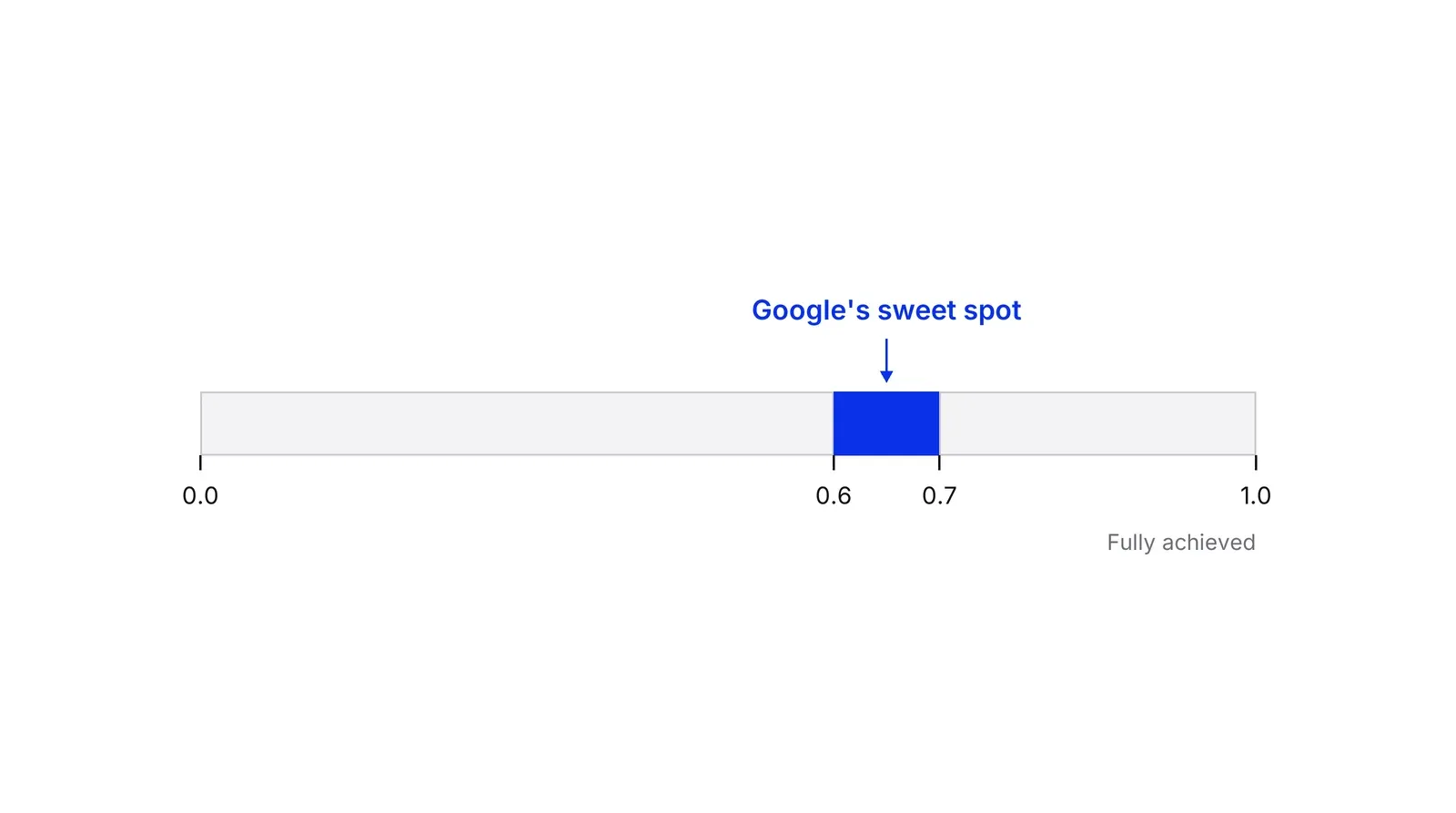
Not every key result is meant to stretch. Doerr’s site separates committed OKRs, expected to pass, from aspirational ones, which are moonshots that may span several cycles. Grove himself scored key results as met or not met, and many companies use red, yellow and green. Atlassian offers a rough calibration: a 0.7 target should have about an 80 percent chance of success and a 1.0 target about 50 percent.
The 0.6 to 0.7 figure is a practice, not a finding. We found no controlled study that tested it against other targets.
What does goal-setting research say?
The strongest evidence is for the ingredients, not for OKR as a package. Locke and Latham’s 35-year review found that specific, difficult goals led to higher performance than telling people to do their best, with meta-analytic effect sizes of .42 to .80, and that performance rose with goal difficulty until people reached the limit of their ability or stopped being committed to the goal. Feedback and commitment strengthened the effect. On complex, unfamiliar tasks, they report that a specific learning goal worked better than a performance goal.
Research on OKRs themselves is thin. A 2024 mapping study of 47 papers called OKR use under-documented from a theoretical point of view. The best-sized field study we found is Microsoft’s: 47 interviews and 512 survey responses. It found that setting and tracking goals is hard work whatever the tool, and that over half of managers said they were not very effective at turning executive goals into team work. A fintech case at HICSS 2025 listed six challenges and six enablers for adoption, and named training and concrete tasks among the enablers.
Where OKRs go wrong
Hard goals have side effects. Ordonez and colleagues argued in Goals Gone Wild that goal setting can narrow focus, distort risk-taking and push people to cheat. They cite Sears, which set auto repair staff a quota of $147 an hour and saw overcharging and unneeded repairs. This is the same dynamic as Goodhart’s law. In 2016 the CFPB found that Wells Fargo employees opened unauthorized accounts “to hit sales targets and receive bonuses”. That case was sales quotas tied to pay, not OKRs, but it is the failure that the separation of OKRs from pay is meant to avoid. A guard key result, like the rejection-rate limit in the onboarding example above, makes gaming harder.
Stretch also fails for some organisations. Sitkin and colleagues found that stretch goals are most attractive to the organizations least able to bear their risks, and their HBR article uses Yahoo’s 2012 targets as an example.
Practitioners disagree on one point. Klau says OKRs are not employee evaluations. Marty Cagan, in 2016, called OKRs the primary performance management system of the best companies, then wrote in 2020 that he had stopped recommending them in most companies he meets, because they clash with feature-team cultures. Kerr’s classic paper on rewarding A while hoping for B explains why the pay link matters: people do what is rewarded.
OKR and the tools around it
OKRs say what to change this quarter. A north star metric or a KPI tree says what to keep watching, and a key result is often a branch of the tree that you decide to move. The 4 Disciplines of Execution adds lead measures and a weekly meeting, which fit well under a quarterly OKR. OGSM works at the annual level, and an operating rhythm holds the weekly and quarterly meetings that keep the set alive. A Growth Lab plan starts from the numbers the team already trusts, because an OKR is only as good as the data behind its key results. Read how that works in the Growth Lab practice.
How to apply OKR, step by step
- Pick the one thing that matters this quarter. Ask what single change would make the quarter a success, and write it as an objective in one sentence with no number in it. If you cannot choose between two, you have two objectives and should run them as separate sets. Result: one sentence a new hire could repeat.
- Write three key results that prove it. Ask how you would know the objective was met, and answer with numbers that describe an outcome, such as a rate, a time or a count of customers. A list of tasks is not a key result. Result: about three lines, each with a starting value, a target and a date.
- Set targets you would be glad to reach 70 percent of. Google treats a grade of 0.6 to 0.7 as the sweet spot, so set targets a little beyond what feels safe. Mark any key result you will promise as committed, and label the rest aspirational. Result: each key result tagged committed or aspirational.
- Share them and give each key result one owner. Post the set where the whole company can read it and name one person per key result. Keep them separate from pay and performance reviews, as Google does. Result: a visible page with a name beside every number.
- Check weekly, adjust the work and not the goal. Spend ten minutes each week on a confidence rating for every key result and on the one action that would help most. Leave the targets alone until the quarter ends. Result: a short weekly note that shows which key result is slipping.
- Grade and learn at the end of the quarter. Score each key result from 0 to 1, average them for the objective, and ask why the low ones missed. Treat a low grade as data for the next set. Result: a graded set plus two or three changes to how you write next quarter's OKRs.
Examples
City of Syracuse, New York
Doerr's site cites the city's OKRs as a public-sector example. The objective is to achieve fiscal sustainability. The key results are to cut the general fund budget variance from 11 percent to 5 percent, to spend 95 percent of authorised capital project dollars by year end, and to spend 95 percent of grant dollars from earlier fiscal years. The objective is a sentence; every key result is a number with a start and a target.
A payments company improving onboarding (illustrative)
Take a payments company where new merchants wait a median of 9 days to take their first payment. The objective: make onboarding painless. The key results: cut the median to 4 days, raise the share of merchants who finish identity checks without a support ticket from 55 percent to 80 percent, and keep the rejection rate for valid applicants under 3 percent. The last key result guards against hitting the first two by approving everyone. The numbers are arithmetic, not a claim about a real company.
A dental clinic reducing missed visits (illustrative)
Take a clinic with 400 patients a month and 12 percent no-shows. The objective: patients turn up for the care they booked. The key results: no-shows from 12 percent to 7 percent, 80 percent of appointments confirmed 48 hours ahead, and the share of cancelled slots refilled within a day from 20 percent to 50 percent. Reading the grades at quarter end shows which of the three did the work.
When to use it
Use OKRs when a team has more good ideas than capacity and needs to agree on one direction for the next quarter, when several teams must pull the same way, or when progress is hard to see because nobody has written down what success looks like. They suit teams that own an outcome and may choose how to reach it.
When not to use it
Skip them for routine work that has a stable target, such as monthly close or on-time delivery, where a standing KPI is enough. Avoid them in organisations that hand teams a fixed feature list, and do not tie them to bonuses, because people then set small targets and hide misses.
Common mistakes
- Writing tasks as key results. 'Launch the new page' is a task; 'raise the page's conversion from 2 percent to 3 percent' is a key result.
- Setting too many. Google recommends three to five objectives per team, and teams that run ten stop remembering them.
- Linking OKRs to pay. Google keeps grades out of performance evaluation, and Doerr's site says Grove separated the two.
- Treating every key result as a stretch. Without a committed set, the team cannot promise anything to other teams.
- Changing targets mid-quarter to look good. A 0.4 grade is information; a quietly rewritten target hides it.
FAQ
What does OKR stand for?
OKR stands for objectives and key results. An objective states what a team wants to achieve in plain words. Key results are the measurable outcomes that show it was achieved, usually about three per objective. The pair is reviewed on a short cycle, most often one quarter.
Who invented OKRs?
Andy Grove developed the method at Intel, building on Peter Drucker's management by objectives, and published High Output Management in 1983. John Doerr, who had attended Grove's seminars, introduced it to Google in 1999 and popularised it in Measure What Matters in 2018. Sources differ on when the exact phrase first appeared.
How many OKRs should a team have?
Guidance varies. Google's re:Work guide recommends three to five objectives per team with about three key results each. Atlassian suggests one to three objectives with three to five key results each. Christina Wodtke advises keeping OKRs for critical efforts only. Whichever you pick, fewer is easier to remember and review.
What is a good OKR score?
At Google, each key result is graded from 0.0 to 1.0, and a score of 0.6 to 0.7 is the target. Consistent 1.0 scores suggest the goals were not ambitious enough. Committed OKRs are the exception: they are expected to reach 1.0.
What is the difference between OKR and KPI?
A KPI is a standing measure of health, such as monthly churn, that you track indefinitely. A key result is a time-boxed target for changing a number, such as cutting churn from 4 percent to 3 percent this quarter. Many teams keep KPIs running and pick OKRs for the few numbers they want to move.
Sources
- Google re:Work, Set goals with OKRs
- What Matters (John Doerr), What are OKRs? Definition and examples
- What Matters (John Doerr), The OKR origin story
- What Matters (John Doerr), The OKR TED talk
- TED, John Doerr, Why the secret to success is setting the right goals, TED2018
- Rick Klau, How Google sets goals: OKRs, 2013
- Internet Archive, record for Andrew S. Grove, High Output Management, Random House, 1983
- Edwin A. Locke, Gary P. Latham, Building a practically useful theory of goal setting and task motivation, American Psychologist 57(9), 2002
- Lisa D. Ordonez, Maurice E. Schweitzer, Adam D. Galinsky, Max H. Bazerman, Goals gone wild, Academy of Management Perspectives 23(1), 2009
- Harvard Business School Working Knowledge, When goal setting goes bad, March 2009
- Sim B. Sitkin, Kelly E. See, C. Chet Miller, Michael W. Lawless, Andrew M. Carton, The paradox of stretch goals, Academy of Management Review 36(3), 2011
- Sim B. Sitkin, C. Chet Miller, Kelly E. See, The stretch goal paradox, Harvard Business Review, January-February 2017
- Steven Kerr, On the folly of rewarding A, while hoping for B, Academy of Management Journal 18(4), 1975
- Jenna Butler, Thomas Zimmermann, Christian Bird, Objectives and key results in software teams, ICSE 2024, arXiv preprint
- Astri Barbala and others, Objectives and key results in large-scale agile organizations: challenges and enablers, HICSS-58, 2025
- Roberto Silva, Gleison Santos, Surveying the academic literature on the use of OKR: an update, iSys 17(1), 2024
- Atlassian Team Playbook, OKRs
- Christina Wodtke, The art of the OKR, redux
- Marty Cagan, Team objectives: overview, Silicon Valley Product Group, February 2020
- Marty Cagan, When performance is measured by results, Silicon Valley Product Group, February 2016
- Christoph Roser, All About Lean, The evolution of strategic management: management by objectives
- Consumer Financial Protection Bureau, CFPB fines Wells Fargo $100 million for secretly opening unauthorized accounts, 8 September 2016
Last updated Oct 9, 2026


Fractional COO or embedded operations team? How to choose at Series A
The two models solve different problems: how to tell which one your company needs, and what each costs in time and control.

What operational systems successful fintech startups use: lessons from ten companies
Starling, Monzo, Qonto, bunq, Lunar, Pleo, Tide, Ramp, Mercury and Column scaled on four operating systems. Regulators' findings show what breaks when one of them lags behind growth.

Marketing agency or growth system: when a company outgrows its agency
An agency is the right call while the founder still runs most of the company. Once the business starts copying itself into new locations or markets, it needs a system that sets goals, tests hypotheses and owns the result.