STP: segmentation, targeting, positioning
STP is the three-step sequence of segmenting a market, choosing which segments to serve and deciding how the chosen buyers should see your offer, so that product, price and message are built for someone in particular.
STP is a marketing planning sequence with three steps: segmentation splits a market into groups of buyers with different needs, targeting chooses which of those groups to serve and how many, and positioning decides what the chosen buyers should think of the offer compared with the alternatives. Philip Kotler's textbooks made it the standard model. Targeting choices run from one mass offer to offers tailored for individuals.
- Origin
- Philip Kotler (the sequence in textbook form); Wendell Smith (segmentation); Al Ries and Jack Trout (positioning), 1956 to 1972; Kotler's Marketing Management first appeared in 1967
- Level
- 201 · Tool
- Fits
- Startup, Small and mid-size, Scale-up, Enterprise
- Time to apply
- two to six weeks for a first pass, most of it spent on segmentation data and customer interviews
- What you need
- a segmentation of your market, or the customer data and interviews to build one · revenue, margin and acquisition cost by customer group, even if rough · one person who can commit budget to the chosen segments and refuse work outside them
STP is a three-step sequence for marketing planning: segment the market, target the segments you will serve, and position your offer in the minds of those buyers. Each step narrows the one before. Segmentation describes who is out there, targeting decides who you are for, and positioning decides what those people should think of you compared with what they use today.
The parts are older than the acronym. Wendell Smith set out market segmentation in the Journal of Marketing in 1956. Al Ries and Jack Trout made positioning famous with a three-part series in Advertising Age in 1972, according to the Ries history page. Philip Kotler, whose Marketing Management first appeared in 1967, and its successors are where most marketers learned the three steps as one sequence, so the model is usually credited to him. None of the primary texts we checked show Kotler claiming to have coined the term STP, so treat the credit as convention.
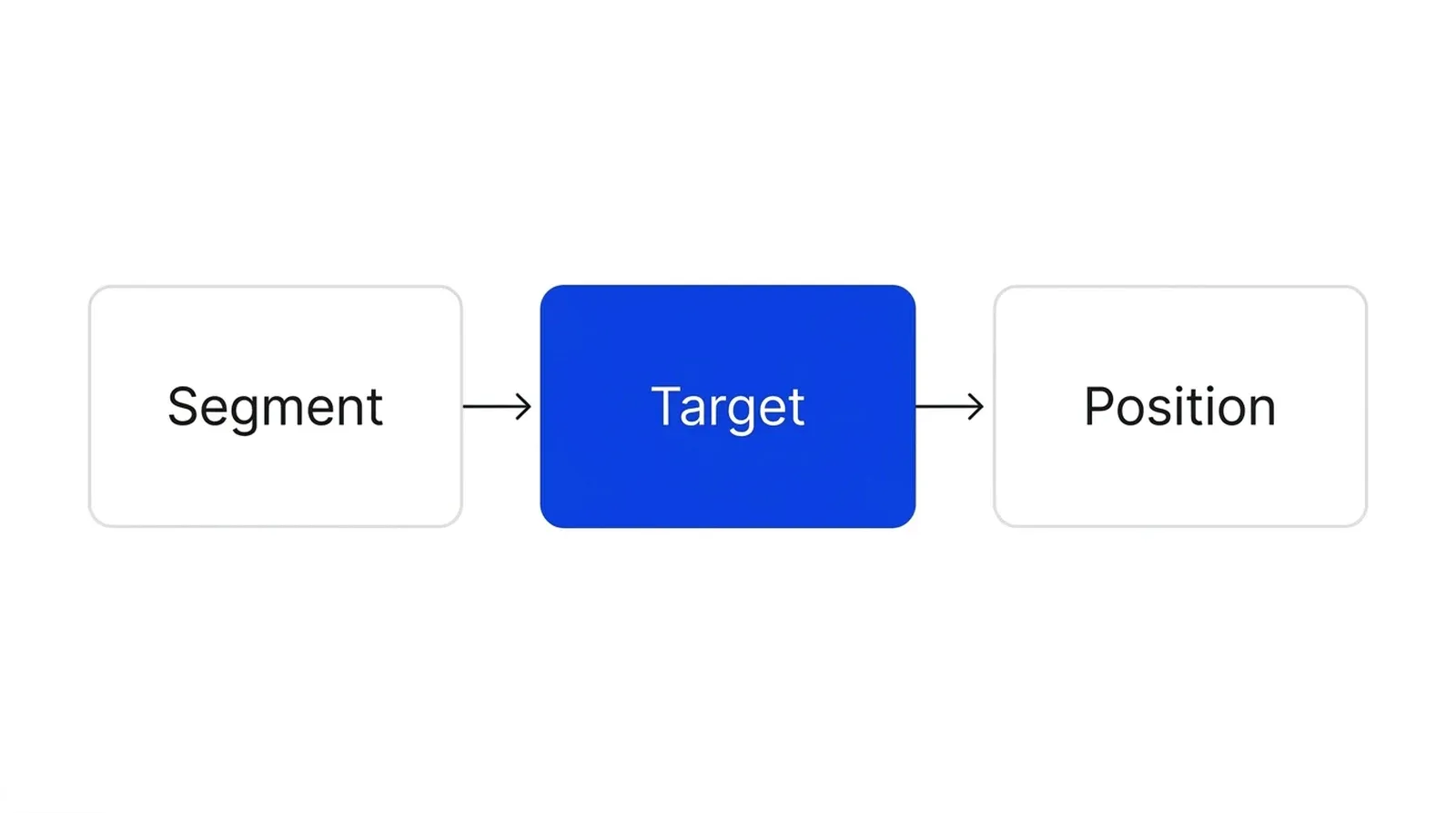
Why the order matters
The order matters because each decision limits the next. You cannot choose a target without a map of segments, and you cannot write a position without knowing whose mind you are trying to occupy. A positioning statement written before targeting ends up addressed to everyone, which means it guides no budget decision.
This page is about the middle step and the sequence as a whole. The first step has its own page on market segmentation: the bases, the tests a segment must pass, and why most segmentation studies never change a decision.
How to choose a target segment
Targeting is the decision about which segments to serve, based on how attractive each one is and how well you can serve it against current competitors. Lyndon Simkin and Sally Dibb list the usual criteria in a 1998 paper on prioritising target markets: market size, growth rates, competitive forces, customer fit and profitability.
Their finding was that practice lags far behind that list. In studies of large UK companies, many businesses still judged target markets on short-term profit. A segment can be profitable today because nobody serves it well yet, or because three rivals are about to enter. Score fit and competition next to margin, and write down the segments you will not serve. That second list is what turns a slide into a budget.
The four targeting strategies
Once segments are scored, the company decides how many to serve and how different each offer will be. Textbooks in Kotler’s tradition, including Principles of Marketing, present four strategies on a range from broad to narrow. The open textbook The Marketing Map from Thompson Rivers University sets out the same four.
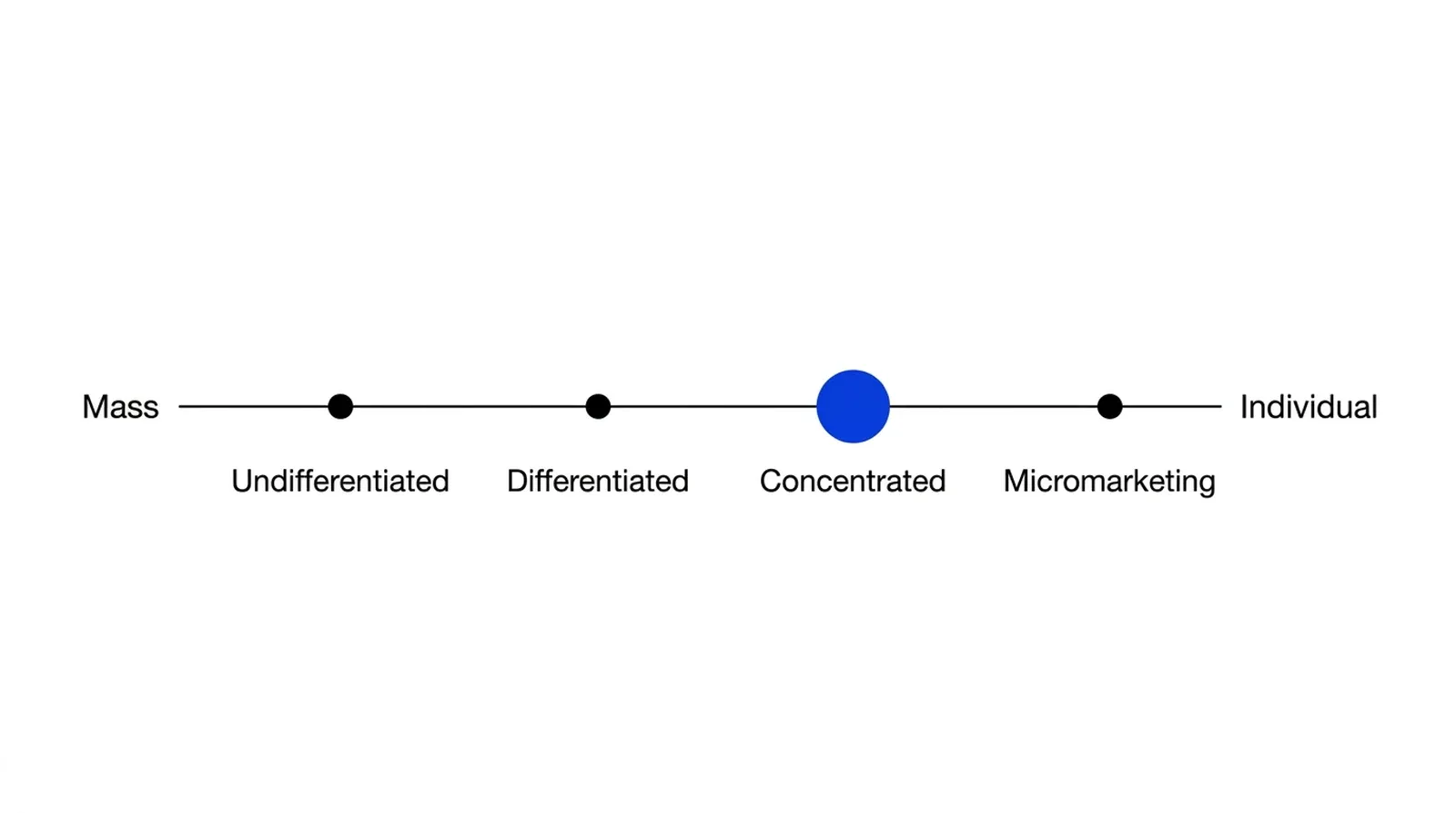
| Strategy | Segments served | Offer | Fits when | Main risk |
|---|---|---|---|---|
| Undifferentiated (mass) | The whole market | One offer for all | Buyers want much the same thing and scale lowers cost | A rival serves one group better and takes it |
| Differentiated (segmented) | Several segments | A separate offer for each | The budget can fund several strong offers | Cost and complexity rise with every segment |
| Concentrated (niche) | One segment | One offer built for it | Resources are limited and one segment is underserved | The segment shrinks or a large player moves in |
| Micromarketing | Local areas or individuals | Tailored by place or person | Data and production allow cheap variation | Tailoring costs more than it earns |
Undifferentiated: one offer for everyone
Henry Ford is the textbook case. In My Life and Work he recalls announcing in 1909 that the company would build only the Model T, with the same chassis for every car. His own price table shows the touring car falling from $950 in 1909-10 to $360 in 1916-17, while output rose from 18,664 to 785,432 cars. Mass targeting worked because the single offer funded a cost position nobody could match.
Differentiated: an offer per segment
General Motors under Alfred Sloan answered with a ladder of brands. A December 1925 advertisement held by The Henry Ford museum promised “a car for every purse and purpose”: a buyer could start with a Chevrolet and trade up to an Oldsmobile, Buick or Cadillac. Each brand had its own price band and its own buyer.
Concentrated: everything on one segment
Concentrated targeting puts the whole budget into one segment. It suits a small company because one offer costs less than four, and the team learns one group of buyers in depth. The risk is dependence: if the segment shrinks or a large rival decides to serve it properly, there is nothing else to fall back on.
Micromarketing: places and people
Micromarketing tailors the offer to local areas or to individual customers. The idea grew in the late 1980s and early 1990s. Stan Davis wrote about mass customizing in Planning Review in 1989, Joseph Pine, Bart Victor and Andrew Boynton published “Making Mass Customization Work” in HBR in 1993, and Don Peppers and Martha Rogers argued for marketing to one customer at a time in The One to One Future the same year. Kotler himself wrote on the shift from mass marketing to mass customization in 1991. In a payments business, pricing each merchant by its own volume and risk is micromarketing; so is a clinic network changing its services and hours by neighborhood.
Positioning: the last step
Positioning decides what the chosen buyers should believe about your offer compared with their current alternative. It only works once the target is fixed, because the alternative differs by segment. A freelancer compares a payout service with a bank wire; a mid-sized importer compares it with a currency broker. The usual way to write the decision down is a positioning statement, one per target segment.
The case against narrow targeting
The strongest objection comes from the Ehrenberg-Bass Institute. Kathy Hammond, Andrew Ehrenberg and Gerald Goodhardt studied consumer panels in more than 20 grocery categories and found little brand segmentation. A 2012 follow-up by Mark Uncles and colleagues covered 50 categories over 25 years and found that user profiles of competing brands seldom differ. If your rivals’ buyers look like yours, a narrow target leaves most of the category untouched.
Mark Ritson, who defends STP, accepts part of this. At the Festival of Marketing in October 2023, as Marketing Week reported, he argued that most segmentation is not fit for purpose and proposed a two-speed model: build the brand with the whole market, and use targeted segments for short-term activation. He cited Tesco, which pairs mass advertising with targeted Clubcard offers. In a 2017 column he reported Marie Oldham’s count that about half of the 39 winning IPA case studies for 2016 showed a clear targeting strategy. The evidence supports neither extreme. Broad reach builds the brand, and targeting still decides where the sales effort and the product effort go.
Why STP plans stall
Most STP plans fail between the analysis and the budget. A 2006 Bain survey found that 81% of executives called segmentation critical to growing profits, while fewer than 25% thought their company used it effectively. Dibb and Simkin traced the gap to barriers in infrastructure, process and implementation, and in a 2009 study of a utilities company found that the barriers appear at several stages, not one.
Daniel Yankelovich and David Meer added a second cause in “Rediscovering Market Segmentation”: segmentation had become narrowly focused on advertising instead of on which customers a company should build for. In Pushers’ Growth Lab work, the test of a targeting decision is whether it changes where the acquisition budget and the product roadmap go next quarter.
How to apply STP: segmentation, targeting, positioning, step by step
- Segment the market. Split buyers into groups whose needs or buying behavior differ, using the variables that explain why they buy. Keep the number small enough for the team to remember. Result: three to seven named segments, each with an estimated size.
- Score each segment's attractiveness. For every segment, estimate size, growth, margin, cost to reach and how strong the current competitors are in it. Add one column for fit: can you serve this group better than the people already serving it? Result: a table that ranks segments on attractiveness and fit, not on profit alone.
- Choose a targeting strategy. Decide how many segments to serve and how different the offers will be: one offer for everyone, a separate offer per segment, all effort on one segment, or offers tailored down to locations or individuals. Budget sets the limit. Result: a named strategy and a list of segments you will serve and segments you will not.
- Position the offer in each target. For each chosen segment, write what you want its buyers to believe about the offer compared with the alternative they use today, and the proof. Result: one positioning statement per target segment.
- Build the marketing mix from the choice. Set product features, price, channels and messages for each target so they all support the same position. Result: a plan where every budget line can be traced to one target segment.
- Review the choice against results. Report revenue, acquisition cost and retention by target segment every quarter. Drop or merge targets that do not respond, and check whether spending has drifted to segments you chose not to serve. Result: a quarterly note that confirms or changes the targets.
Examples
Ford's single model and GM's ladder
Henry Ford's memoir My Life and Work describes the decision to build only the Model T, with the same chassis for every car, and a price table in the same book shows the touring car price falling seven years in a row while output grew about fortyfold. That is undifferentiated marketing on a cost base nobody could match. General Motors under Alfred Sloan answered with a ladder of brands, advertised as a car for every purse and purpose, from Chevrolet up to Cadillac, according to The Henry Ford museum. That is differentiated marketing.
Patient segments in integrated care
Sabine Vuik, Erik Mayer and Ara Darzi, writing in Health Affairs in 2016, describe how health systems divide a patient population into groups with similar needs and then target each group with its own care model. They separate strategies for the whole population, for subpopulations and for high-risk patients, and warn that a simple segmentation is easier to use while a precise one fits patients better. Serving several groups with different care models is differentiated targeting applied to healthcare.
A payments startup choosing concentrated targeting
Illustrative, no real company implied. A payments startup with a team of 12 finds four merchant segments. Online stores selling abroad are the smallest by count but pay the highest fees and churn least, and the two large rivals serve them with the same product they sell to everyone. The startup targets only that segment, builds multi-currency payouts and returns handling for it, and stops paid acquisition aimed at offline shops. Concentrated targeting fits because the budget cannot fund four offers.
When to use it
Use it when a product is sold to everyone with the same message and results vary widely between customer groups, before entering a new market or launching a second product, and when the marketing budget has to be split between customer groups. It gives the team one explicit choice about who the business is for.
When not to use it
Skip the formal process when the category is bought by nearly everyone for the same reasons and differences between buyers of competing brands are small, which is the case in many consumer categories. It also adds little for a company with a handful of customers it already knows by name. Do not use targeting as a reason to stop all broad brand advertising.
Common mistakes
- Choosing targets on short-term profit alone, without asking whether the company can beat the rivals already serving that segment.
- Naming a target segment and then buying media that reaches everyone, so the choice never shows up in the budget.
- Picking differentiated marketing with a budget that can only fund one good offer, so every segment gets a weak one.
- Treating targeting as permission to ignore everyone outside the segment, when many buyers of the category sit outside it.
- Writing positioning before the target is chosen, which produces a statement aimed at everyone.
FAQ
What is STP in marketing?
STP stands for segmentation, targeting and positioning. Segmentation divides a market into groups of buyers with different needs, targeting picks which groups the company will serve, and positioning decides how those buyers should see the offer against the alternatives. The order matters, because each step depends on the decision made in the step before it.
What are the four targeting strategies?
Undifferentiated or mass marketing sells one offer to the whole market. Differentiated marketing serves several segments with a separate offer for each. Concentrated or niche marketing puts all effort into one segment. Micromarketing tailors offers to local areas or to individual customers. Textbooks in Kotler's tradition present them as a range from broad to narrow.
What is the difference between differentiated and concentrated marketing?
Differentiated marketing serves several segments at once, each with its own product, price or message, as General Motors did with brands from Chevrolet to Cadillac. Concentrated marketing serves one segment only. It needs less money and builds deep knowledge of one group, but the business depends on that segment staying large and uncontested.
Who created the STP model?
No single person. Wendell Smith described market segmentation in the Journal of Marketing in 1956, and Al Ries and Jack Trout popularized positioning in Advertising Age in 1972. Philip Kotler's Marketing Management, first published in 1967, and his later textbooks made the three steps the standard teaching sequence, which is why the model is usually credited to him.
Is STP still relevant?
Yes, with a caveat. Ehrenberg-Bass Institute research shows buyers of competing brands look much alike, which argues for broad reach. Mark Ritson's answer in 2023 was a two-speed model: build the brand with the whole market and use targeting for short-term activation. Segmentation and positioning stay useful even when the targeting is broad.
Sources
- Wendell R. Smith, Product Differentiation and Market Segmentation as Alternative Marketing Strategies, Journal of Marketing 21(1), 1956
- Philip Kotler, Marketing Management: Analysis, Planning and Control, Prentice Hall, 1967, first edition (ESCP library record)
- Philip Kotler, Gary Armstrong, Sridhar Balasubramanian, Principles of Marketing, 19th edition, Pearson, 2023
- Lian Dumouchel, The Marketing Map, Thompson Rivers University Open Press, Selecting Target Markets
- Philip Kotler, From Mass Marketing to Mass Customization, Planning Forum, 1991 (Kellogg School of Management record)
- Henry Ford with Samuel Crowther, My Life and Work, 1922, Project Gutenberg
- The Henry Ford, Advertisement for General Motors, A Car for Every Purse and Purpose, 1925
- Ries & Ries, The History of Positioning
- Stanley M. Davis, From Future Perfect: Mass Customizing, Planning Review 17(2), 1989
- B. Joseph Pine II, Bart Victor, Andrew C. Boynton, Making Mass Customization Work, Harvard Business Review, September-October 1993
- Don Peppers, Martha Rogers, The One to One Future: Building Business Relationships One Customer at a Time, 1993, Internet Archive record
- Lyndon Simkin, Sally Dibb, Prioritising Target Markets, Marketing Intelligence & Planning 16(7), 1998
- Sally Dibb, Lyndon Simkin, Market Segmentation: Diagnosing and Treating the Barriers, Industrial Marketing Management 30(8), 2001
- Sally Dibb, Lyndon Simkin, Implementation Rules to Bridge the Theory/Practice Divide in Market Segmentation, Journal of Marketing Management 25(3-4), 2009
- Kathy Hammond, A. S. C. Ehrenberg, G. J. Goodhardt, Market Segmentation for Competitive Brands, European Journal of Marketing 30(12), 1996
- Mark Uncles, Rachel Kennedy, Magda Nenycz-Thiel, Jaywant Singh, Simon Kwok, In 25 Years, Across 50 Categories, User Profiles for Directly Competing Brands Seldom Differ, Journal of Advertising Research 52(2), 2012
- Mark Ritson, Segmentation is not the prerequisite for success, Marketing Week, October 2023
- Mark Ritson, We should thank Byron Sharp, not attack him, Marketing Week, January 2017
- Daniel Yankelovich, David Meer, Rediscovering Market Segmentation, Harvard Business Review, February 2006
- Rob Markey, Gerard du Toit, James Allen, Find Your Sweet Spot, Bain & Company, November 2006
- Clayton M. Christensen, Scott Cook, Taddy Hall, Marketing Malpractice: The Cause and the Cure, Harvard Business Review, December 2005
- Sabine I. Vuik, Erik K. Mayer, Ara Darzi, Patient Segmentation Analysis Offers Significant Benefits for Integrated Care and Support, Health Affairs 35(5), 2016
Last updated Oct 9, 2026


Marketing agency or growth system: when a company outgrows its agency
An agency is the right call while the founder still runs most of the company. Once the business starts copying itself into new locations or markets, it needs a system that sets goals, tests hypotheses and owns the result.

Why healthcare marketing agencies stall: the short, mid and long wins model we use with clinics
Most agencies own the click and nobody owns the front desk. How we structure clinic work in three horizons, the research behind each one, and one year of results.

The compliance layer under fintech marketing operations
A fintech marketing agency can build campaigns. It cannot own the compliance review, the KYC drop-off or the multi-market licensing rules that decide whether a lead ever becomes a customer.