Scenario planning
Scenario planning is a method for preparing a strategy for several plausible futures at once, instead of betting the plan on a single forecast.
Scenario planning is a strategy method in which a team writes three or four plausible, very different stories of how its environment could change, then tests its plans against each one. It does not try to predict the future. It finds the moves that hold up in every scenario, the bets that depend on one, and the signals that show which future is arriving.
- Origin
- Herman Kahn (RAND, Hudson Institute); developed for business at Shell by Ted Newland and Pierre Wack, 1950s to 1960s (Kahn); first formal Shell round November 1971
- Level
- 301 · Advanced
- Fits
- Scale-up, Enterprise
- Time to apply
- two to three workshops over four to eight weeks for a first scenario set, then a quarterly check of signposts
- What you need
- one strategic decision or question the scenarios have to serve · 6 to 12 people from different functions, plus two or three outsiders · interviews with decision makers about the assumptions they hold · a facilitator who is not the person whose plan is being tested
Scenario planning is a method for preparing a strategy for several plausible futures at once. A team writes three or four stories of how its environment could change, each one internally consistent and each one different in kind, then checks its plans against all of them. Shell, which made the method famous in business, says its scenarios are “absolutely not predictions or expectations of what will happen.” The point is to stop a company from betting everything on one forecast.
Large companies, governments and armed forces use it for decisions that lock in money for years: a refinery, a market entry, a licence, a ten-year lease. Bain’s management tools survey shows how its popularity moves with the mood of the economy. Rigby and Bilodeau report that use of scenario and contingency planning fell “from 70% usage at its peak to 19%” in their 2017 survey.
Where scenario planning came from
The method has two roots. The American one runs through Herman Kahn, a physicist who joined RAND in the late 1940s, wrote On Thermonuclear War in 1960 and founded the Hudson Institute in 1961. Hudson’s own profile credits him with developing the scenario method. Kahn applied it to nuclear strategy first, then to society at large in The Year 2000, written with Anthony Wiener in 1967.
The second root is French. Angela Wilkinson and Roland Kupers, a former Shell scenario planner and a former Shell executive, note that credit “often goes to” Kahn, but a form of the practice grew up at the same time in France around Gaston Berger and Bertrand de Jouvenel. The American school leaned on probabilities, the French one on what ought to happen.
Shell turned it into a business tool. Planners Ted Newland and Pierre Wack took part in a Hudson Institute scenario exercise with Kahn in 1967, according to Jenny Andersson’s history in Business History Review. Shell’s first formal round of scenarios was finished in November 1971, and Wilkinson and Kupers count 34 rounds of global and long-term energy scenarios and updates since then. Wack set out the approach in two Harvard Business Review articles in 1985, “Uncharted Waters Ahead” and “Shooting the Rapids”.
How a scenario differs from a forecast
A forecast picks the most likely future and plans for it. A scenario set describes several futures and refuses to rank them. Newland and Wack, Wilkinson and Kupers write, “steered clear of probabilistic forecasts” and asked only that each scenario be plausible.
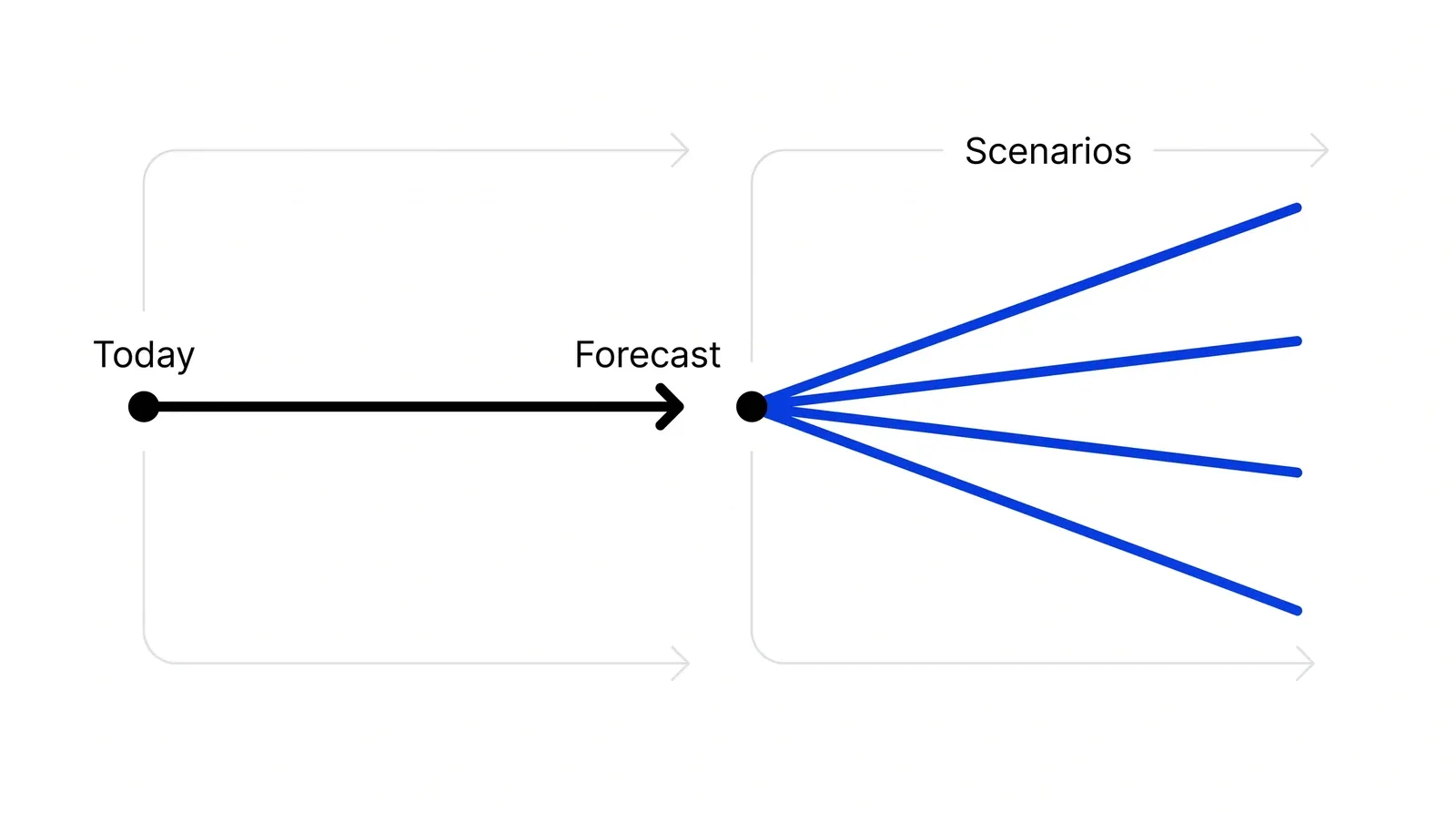
| Forecast | Scenario set | |
|---|---|---|
| Output | One expected future, sometimes with a range | Three or four futures that differ in kind |
| Probabilities | Central to the method | Deliberately left out |
| Best use | Short horizons, stable markets | Long horizons, forces you do not control |
| What you do with it | Plan for the number | Find moves that work in every world, and signposts |
| Typical failure | Confident and wrong when the world breaks | Interesting stories nobody acts on |
The building blocks: predetermined elements and critical uncertainties
Every scenario set rests on one split. Predetermined elements are forces that will play out whatever happens: an ageing population, a regulation already passed, a factory already under construction. Wack’s second 1985 article, as HBR’s summary puts it, structures the future “into predetermined and uncertain elements.” Predetermined elements appear in every scenario.
Uncertainties are forces that matter and could go either way. Global Business Network’s practitioner guide asks teams to rank them by importance to the question and by how uncertain they are, then take the top two or three. These are the critical uncertainties. Crossing two of them on axes gives four scenarios.
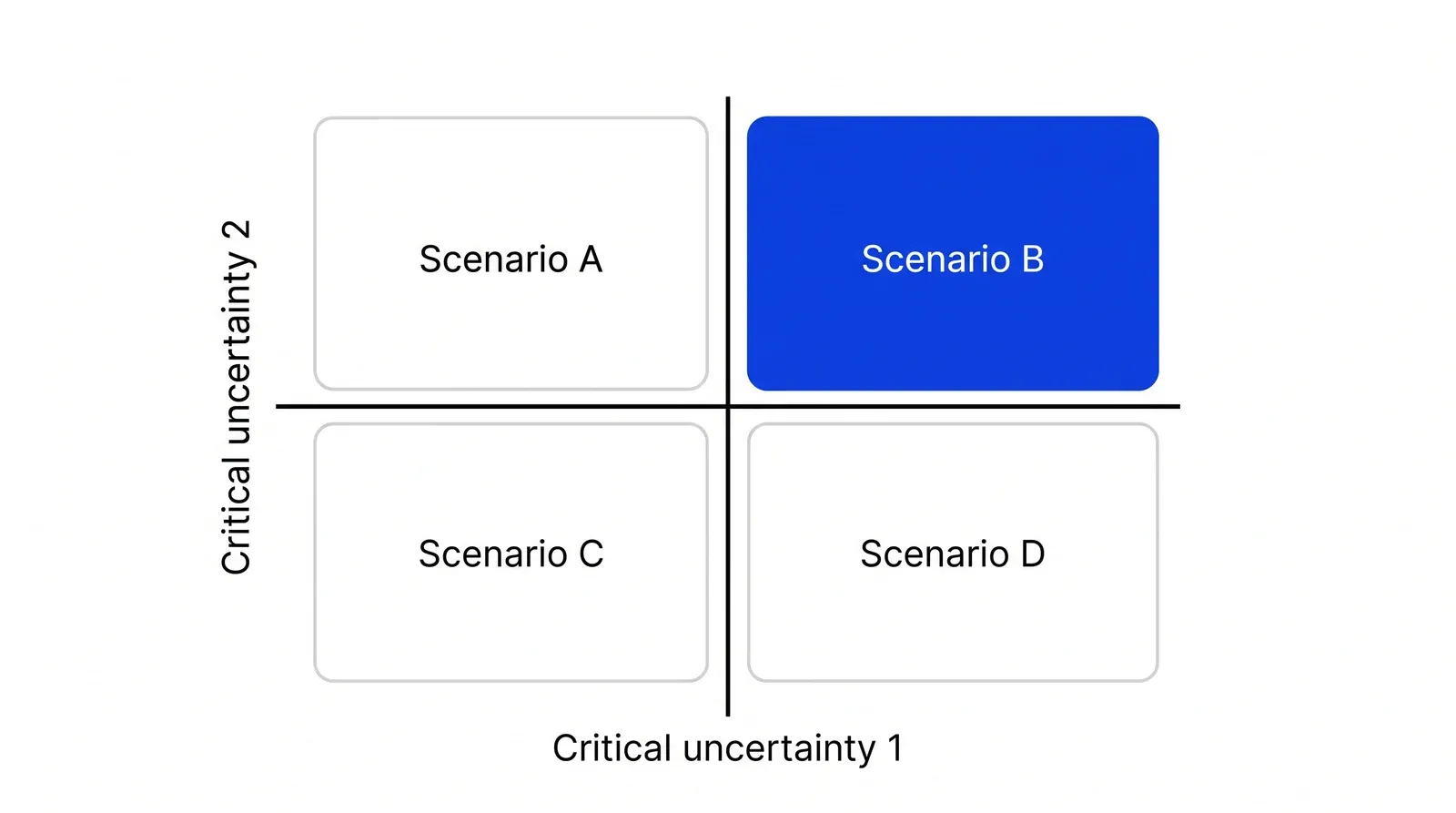
The same guide warns that scenarios should be “not simply a best, worst, and most likely world.” A best and worst case around a middle case is still one forecast with error bars.
Did Shell’s scenarios anticipate the 1973 oil shock?
Partly. The popular version says Shell saw the 1973 crisis coming and beat its rivals because of it. The documents support a narrower claim.
What holds up: before October 1973, Shell’s planners had written scenarios in which oil-producing countries gained power and cut supply. Michael Jefferson, who joined Shell as chief economist in January 1974, quotes the January 1973 scenario book, which had an “Energy Crisis” scenario and expected breaks in oil price and supply before 1980. A May 1973 paper singled out one scenario that threatened the industrialised world. Wilkinson and Kupers write that when the crisis hit, Shell’s managing directors “had already considered a comparable scenario.”
What does not hold up is the precision. Jefferson reports that the highest case in the January 1973 book took crude only to $6.15 a barrel. Shell’s own 40-year history says the real price went from about $2.50 to $11 within weeks. Jefferson adds that the hit to growth and inflation was worse than Shell’s operating companies expected. Even Wack’s own framing, as summarised by the Andrew W. Marshall Foundation, was that management was prepared for the eventuality, “if not the timing.”
The claim about beating rivals is the most contested. Shell’s 2013 history says the scenarios let it “respond more swiftly than its competitors,” and Art Kleiner wrote in 2003 that they helped Shell prosper more than its rivals. Neither gives a comparison. Wilkinson and Kupers, both former Shell insiders, go the other way: “We have no solid examples of Shell’s having anticipated future developments better than other companies,” they write, calling the 1970s story mythology. Andersson traces that mythology to Wack’s 1985 articles. Jefferson also records that the 1971 scenarios pushed Shell into a 50% stake in Gulf General Atomics, a nuclear venture, bought in 1973 and sold back in 1981 after Shell concluded the reactor could not be built profitably.
The fair reading: because of the scenarios, the shock arrived as a world Shell’s managers had already talked through. The scenarios did not predict it.
What the research says it does to decisions
Lab and field studies point to a modest, specific effect. Paul Schoemaker’s 1993 experiments in the Strategic Management Journal found scenarios widen people’s confidence ranges, working against overconfidence. A 2015 study by Phadnis and colleagues ran three field experiments with experts. Scenarios did not raise or lower their overall confidence, but judgments moved with how an investment fared in each scenario, and experts came to prefer more flexible options.
Done badly, the method disappoints. McKinsey reported in 2015 that 40% of executives it surveyed in 2013 described scenario planning as having little effectiveness, and traced much of that to inexperience, delegation and the same biases the method should counter.
How it fits with other tools
Scenario planning sits on top of environment scans. A PESTLE analysis supplies the driving forces; a SWOT analysis can then be repeated inside each scenario to see how strengths hold up. In Pushers’ Growth Lab work, the useful output is short: the moves to make now, the ones to hold back, and the signposts that would release them.
How to apply Scenario planning, step by step
- Frame the focal question and the horizon. Write the decision the work must serve, such as whether to open a second country or build a lending product, and pick a horizon long enough to challenge current assumptions. Global Business Network's guide says most strategy scenarios look five to ten years out. Result: one question and one end year on the wall.
- Interview decision makers about the official future. Ask the people who will act on the scenarios what they expect, what they fear and what would surprise them. This exposes the official future, the unspoken forecast the current plan rests on. Result: a written list of the assumptions the scenarios must test.
- List driving forces, then split them. Brainstorm the outside forces that shape the focal question: regulation, technology, customer behaviour, funding, competitors. Sort each into predetermined elements, which will happen whatever you think, and uncertainties. Result: two lists, with the predetermined ones kept for every scenario.
- Pick two critical uncertainties and cross them. Rank the uncertainties by impact on the focal question and by how unpredictable they are. Take the top two, give each a range between two extremes, and cross them into a 2x2. Result: four scenario frames that differ in kind, with no best, worst or most likely case.
- Write each scenario as a story. Give each world a short, memorable name and a narrative from today to the end year: what happens first, who wins, what customers do. Check that each story is internally consistent. Result: three or four one-page scenarios people can retell from memory.
- Test the strategy in every world. Run the current plan and two or three alternatives through each scenario. Mark which moves work everywhere, which pay off in only one, and which fail badly somewhere. Result: a short list of no-regret moves to make now and contingent moves to hold back.
- Set signposts and review them. For each scenario, pick two or three leading indicators that would show it is starting to unfold, assign an owner, and review them every quarter. Result: a monitoring sheet that tells you when to trigger the contingent moves.
Examples
Shell and the 1973 oil shock
Shell's planners started formal scenario rounds in November 1971. Its January 1973 scenario book included an Energy Crisis scenario and expected breaks in oil price and supply before 1980, and a May 1973 paper singled out a scenario that threatened the industrialised world. When the embargo came in October 1973, the managing directors had already discussed a comparable world. The scenarios did not get the size right: the highest January 1973 case had crude at $6.15 a barrel, while Shell itself says prices went from about $2.50 to $11 within weeks.
A payments company choosing where to expand
Illustrative, no real company implied. A cross-border payments firm wants to enter one new region within five years. Its two critical uncertainties are whether regulators open licences to foreign e-money firms and whether instant bank-to-bank payments reach small merchants. Crossed, they give four worlds. Building local partnerships works in three of them, so it starts now. A full local licence pays off in only one, so the team watches two signposts, a draft licensing rule and merchant adoption of instant payments, before spending on it.
A clinic network planning capacity
Illustrative, no real clinic implied. A chain of 12 outpatient clinics faces two uncertainties: how far insurers shift to paying for outcomes and how fast patients accept remote consultations. In a world of outcome contracts and high remote use, half the planned new floor space is wasted. Leasing space with break clauses holds up in all four scenarios, so the chain changes its lease terms first and delays two openings until the signposts move.
When to use it
Use it when a decision locks in money or people for years, when the outcome depends on forces you do not control, such as regulation, technology or prices, and when leaders disagree about where the market is going. It suits growth-stage and large companies with long-lived assets, licences or entries into new markets.
When not to use it
Skip it for decisions you can reverse cheaply within a quarter, where a quick test beats any scenario set. Skip it when the main uncertainty is a number you can estimate well, which calls for sensitivity analysis, or when no one with authority will read the scenarios and act on them. If the scenarios cannot change a decision, do not commission them.
Common mistakes
- Building best, worst and most likely cases. These are three versions of one forecast, and people pick the middle one and carry on as before.
- Assigning probabilities to each scenario. Teams then plan for the most probable one and drop the rest, which defeats the purpose.
- Handing the work to a junior team or consultants while the decision makers stay out of the room. McKinsey lists delegation as a common reason scenario work underdelivers.
- Stopping at the stories. Without a test of the strategy in each world and a list of signposts, nothing changes on Monday.
- Retelling the Shell 1973 story as proof that scenarios predict. Shell's own scenario veterans call that version a myth.
FAQ
What is scenario planning in simple terms?
It is a way to plan for several possible futures instead of one forecast. A team picks the two or three outside forces that matter most and are hardest to predict, writes a short story for each combination, then checks which decisions work in all of them and which depend on one future arriving.
What are the stages of scenario planning?
Global Business Network's guide names five phases: orient, explore, synthesize, act and monitor. In practice that means framing the question, listing driving forces, crossing two critical uncertainties into scenarios, testing strategy in each one, and tracking leading indicators that show which scenario is unfolding.
Did Shell predict the 1973 oil crisis with scenarios?
Not in the way the story is usually told. Shell had scenarios before October 1973 in which producers cut supply and prices jumped, so managers had considered such a world. Its highest documented price case was far below what happened, and former Shell scenario insiders writing in Harvard Business Review called the anticipation story mythology.
How is scenario planning different from forecasting?
A forecast gives one expected future, often with a range around it. Scenario planning gives several futures that differ in kind and deliberately has no favourite. Shell describes its scenarios as absolutely not predictions. The output is a set of decisions that hold up across futures, plus signals to watch.
How is scenario planning related to the Delphi method and brainstorming?
They are different tools that are often used together. Brainstorming produces the long list of driving forces. The Delphi method polls experts in rounds to converge on estimates, which can help judge how uncertain a force is. Scenario planning then turns the most uncertain forces into distinct stories and tests strategy against them.
Sources
- Pierre Wack, Scenarios: Uncharted Waters Ahead, Harvard Business Review, September-October 1985
- Pierre Wack, Scenarios: Shooting the Rapids, Harvard Business Review, November-December 1985
- Andrew W. Marshall Foundation, library entry for Scenarios: Uncharted Waters Ahead
- Angela Wilkinson, Roland Kupers, Living in the Futures, Harvard Business Review, May 2013
- Shell, 40 Years of Shell Scenarios, 2013
- Shell, What are Shell Scenarios?
- Jenny Andersson, Ghost in a Shell: The Scenario Tool and the World Making of Royal Dutch Shell, Business History Review 94(4), 2020
- Michael Jefferson, A History of Energy and Societal Scenarios for a World in Transition, Energy Research & Social Science 90, 2022
- Art Kleiner, The Man Who Saw the Future, strategy+business, Spring 2003
- Oxford Futures Library, Pierre Wack Memorial Library
- Thomas J. Chermack, Foundations of Scenario Planning: The Story of Pierre Wack, Routledge, 2017
- Roland Kupers, Angela Wilkinson, The Essence of Scenarios: Learning from the Shell Experience, 2014
- Hudson Institute, Herman Kahn
- Herman Kahn, Anthony J. Wiener, The Year 2000: A Framework for Speculation on the Next Thirty-Three Years, Macmillan, 1967, Internet Archive record
- Herman Kahn, On Thermonuclear War, Princeton University Press, 1960, Internet Archive record
- Paul J. H. Schoemaker, Scenario Planning: A Tool for Strategic Thinking, Sloan Management Review, Winter 1995
- Paul J. H. Schoemaker, Multiple Scenario Development: Its Conceptual and Behavioral Foundation, Strategic Management Journal 14(3), 1993
- Yogesh Phadnis, Chris Caplice, Yossi Sheffi, Mahender Singh, Effect of Scenario Planning on Field Experts' Judgment of Long-Range Investment Decisions, Strategic Management Journal 36(9), 2015
- Ron Bradfield, George Wright, George Burt, George Cairns, Kees van der Heijden, The Origins and Evolution of Scenario Techniques in Long Range Business Planning, Futures 37(8), 2005
- Peter Cornelius, Alexander Van de Putte, Mattia Romani, Three Decades of Scenario Planning in Shell, California Management Review 48(1), 2005
- Drew Erdmann, Bernardo Sichel, Luk Yeung, Overcoming Obstacles to Effective Scenario Planning, McKinsey, June 2015
- Darrell Rigby, Barbara Bilodeau, Bain & Company, Management Tools & Trends 2017
- Diana Scearce, Katherine Fulton, Global Business Network, What If? The Art of Scenario Thinking for Nonprofits, 2004
- US Department of State, Office of the Historian, Oil Embargo, 1973-1974
Last updated Oct 9, 2026

Marketing agency or growth system: when a company outgrows its agency
An agency is the right call while the founder still runs most of the company. Once the business starts copying itself into new locations or markets, it needs a system that sets goals, tests hypotheses and owns the result.

Why healthcare marketing agencies stall: the short, mid and long wins model we use with clinics
Most agencies own the click and nobody owns the front desk. How we structure clinic work in three horizons, the research behind each one, and one year of results.

Why channel tests stall after month three
Most paid channel tests do not end with a decision. They end when the budget runs out, the attribution model changes, or everyone quietly stops looking at the dashboard.