Business Model Canvas
The Business Model Canvas is a one-page template with nine blocks that describes how a business creates, delivers and captures value, so a team can see its whole model at once and test the weakest parts first.
The Business Model Canvas is a one-page template that describes a business in nine blocks: customer segments, value propositions, channels, customer relationships, revenue streams, key resources, key activities, key partners and cost structure. Alexander Osterwalder and Yves Pigneur published it in Business Model Generation in 2010. Teams use it to map how a business makes money and to list the guesses they still need to test.
- Origin
- Alexander Osterwalder and Yves Pigneur, 2004 (business model ontology, PhD thesis); 2010 (Business Model Generation)
- Level
- 201 · Tool
- Fits
- Startup, Small and mid-size, Scale-up
- Time to apply
- 2 hours for a first canvas; 2 to 6 weeks to test the riskiest blocks
- What you need
- one business model to describe: a product line, a new venture or a planned change, not the whole group · 3 to 6 people who know customers, operations and finance · a printed canvas or a whiteboard and sticky notes · current numbers: prices, unit costs, sales by segment
The Business Model Canvas is a one-page template that describes how a business creates value for customers, delivers it and gets paid for it. It splits a business into nine blocks, from customer segments to cost structure, and lays them out so the whole model fits on one sheet. Founders use it to design a new venture; larger companies use it to compare an existing model with a new one.
A business model, in David Teece’s words in Long Range Planning (2010), describes how a firm delivers value to customers, gets them to pay and turns those payments into profit. The term itself has a messy history. Joan Magretta noted in Harvard Business Review in 2002 that during the internet boom it was used to dress up weak plans, and a 2011 review by Christoph Zott, Raphael Amit and Lorenzo Massa in the Journal of Management found that researchers still shared no common definition. The canvas gave managers a fixed vocabulary where the literature had none.
Where the canvas came from
The canvas started as academic work. Alexander Osterwalder wrote his PhD thesis, The Business Model Ontology, at the University of Lausanne in 2004, supervised by Yves Pigneur. An ontology here means a fixed set of terms and the relations between them. The thesis described a business through four pillars: product, customer interface, infrastructure and finance, and tested the model on a case study of the Montreux Jazz Festival. A year later Osterwalder, Pigneur and Christopher Tucci reviewed the wider business model literature in Communications of the AIS.
The version most people know appeared in Business Model Generation, which Wiley published in July 2010. The publisher lists 470 practitioners from 45 countries as co-creators. The template itself is free: Strategyzer AG, which designed it, releases it under a Creative Commons Attribution-ShareAlike 3.0 licence, so anyone may use and adapt it with credit.
Sources give different years for “the canvas”. Some secondary accounts say the nine blocks date from 2005, others from 2008. The documented milestones are the 2004 thesis and the 2010 book, and this page uses those.
The nine blocks and the question each one answers
Each block answers one question about the business. The table follows the order in which most teams fill them in.
| Block | Question it answers |
|---|---|
| Customer segments | Who are we creating value for, and who pays? |
| Value propositions | What problem do we solve or what need do we meet for each segment? |
| Channels | How do customers find us, buy from us and receive the product? |
| Customer relationships | What kind of relationship does each segment expect: self-service, personal help, a community? |
| Revenue streams | What do customers pay for, how much and how: one-off sales, subscription, commission, licence? |
| Key resources | Which assets make the offer possible: people, licences, data, equipment, brand? |
| Key activities | What must we do well every day to deliver the offer? |
| Key partners | Which suppliers or partners do we rely on, and for what? |
| Cost structure | What are the biggest costs, and which blocks cause them? |
The value proposition block has its own detailed tool, the Value Proposition Canvas. Our page on the value proposition explains how to write one from customer jobs, pains and gains.
How to read the layout
The position of each block carries meaning. The right half faces the customer: segments, channels, relationships and revenue. The left half is the machine behind the offer: resources, activities and partners. Value propositions sit in the centre and connect the two halves. The bottom row sets costs, which mostly come from the left side, against revenue, which comes from the right.
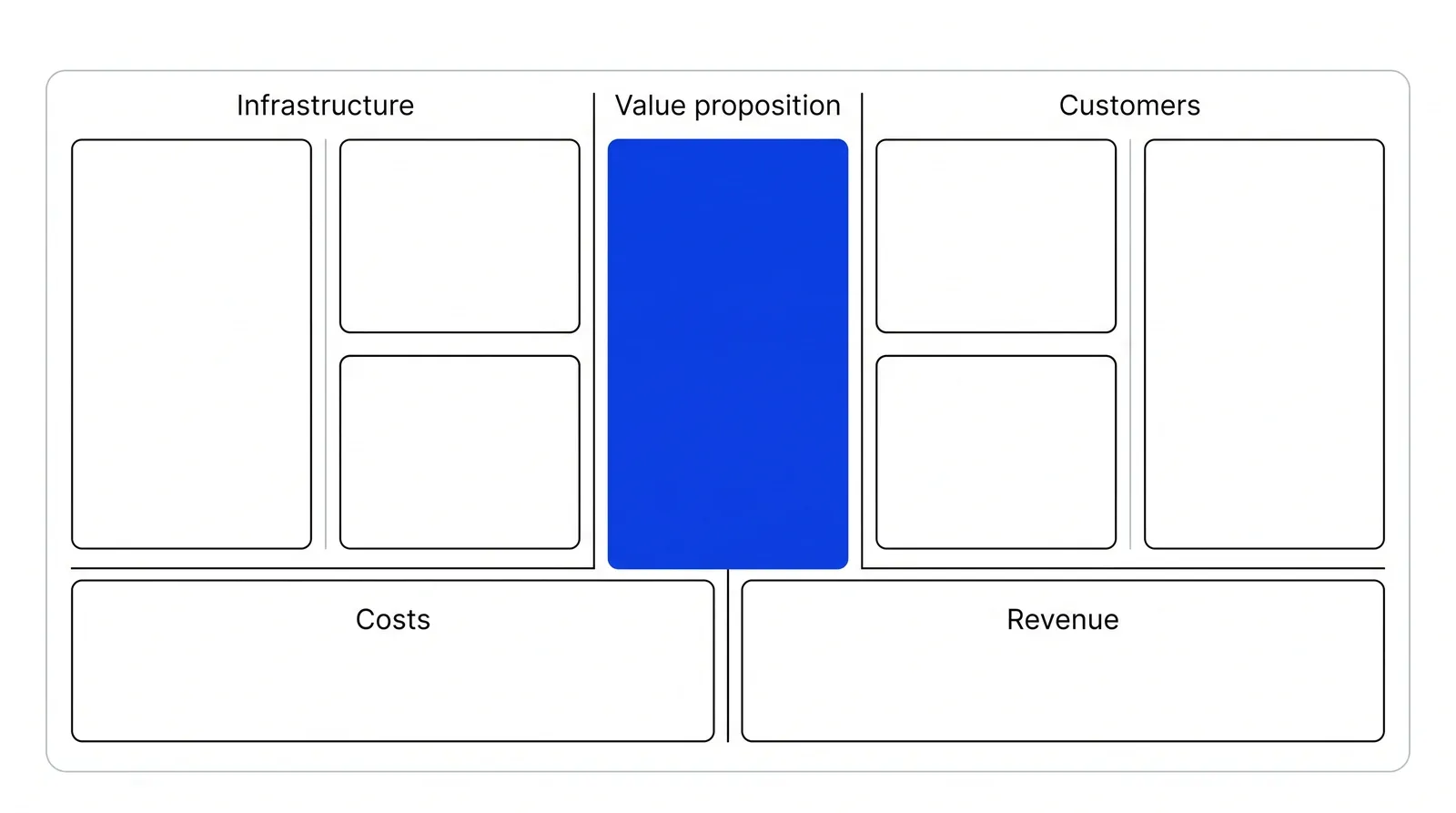
The layout makes gaps visible. A value proposition with no channel cannot reach anyone. A key activity that supports no value proposition is a cost with no reason to exist. A good habit is to read the finished canvas aloud as one chain of sentences, from segment to cost. If the chain breaks, something is missing.
Every note is a hypothesis
A filled canvas records guesses. Teece makes the same point about business models in general: a model reflects management’s hypothesis about what customers want and how the firm can get paid for providing it.
Steve Blank built a teaching method on this idea. In his Stanford Lean LaunchPad class, which became the curriculum for the US National Science Foundation’s I-Corps programme in 2011, teams treat each block as a set of hypotheses and test them by interviewing customers. Blank writes in his 2026 course report that the canvas gives students a visual roadmap of every hypothesis they need to test. He quotes Errol Arkilic, then head of commercialization at the NSF, calling the canvas “the laboratory notebook” of this scientific method for startups. Blank’s 2013 HBR article argues that this approach may make the traditional business plan obsolete.
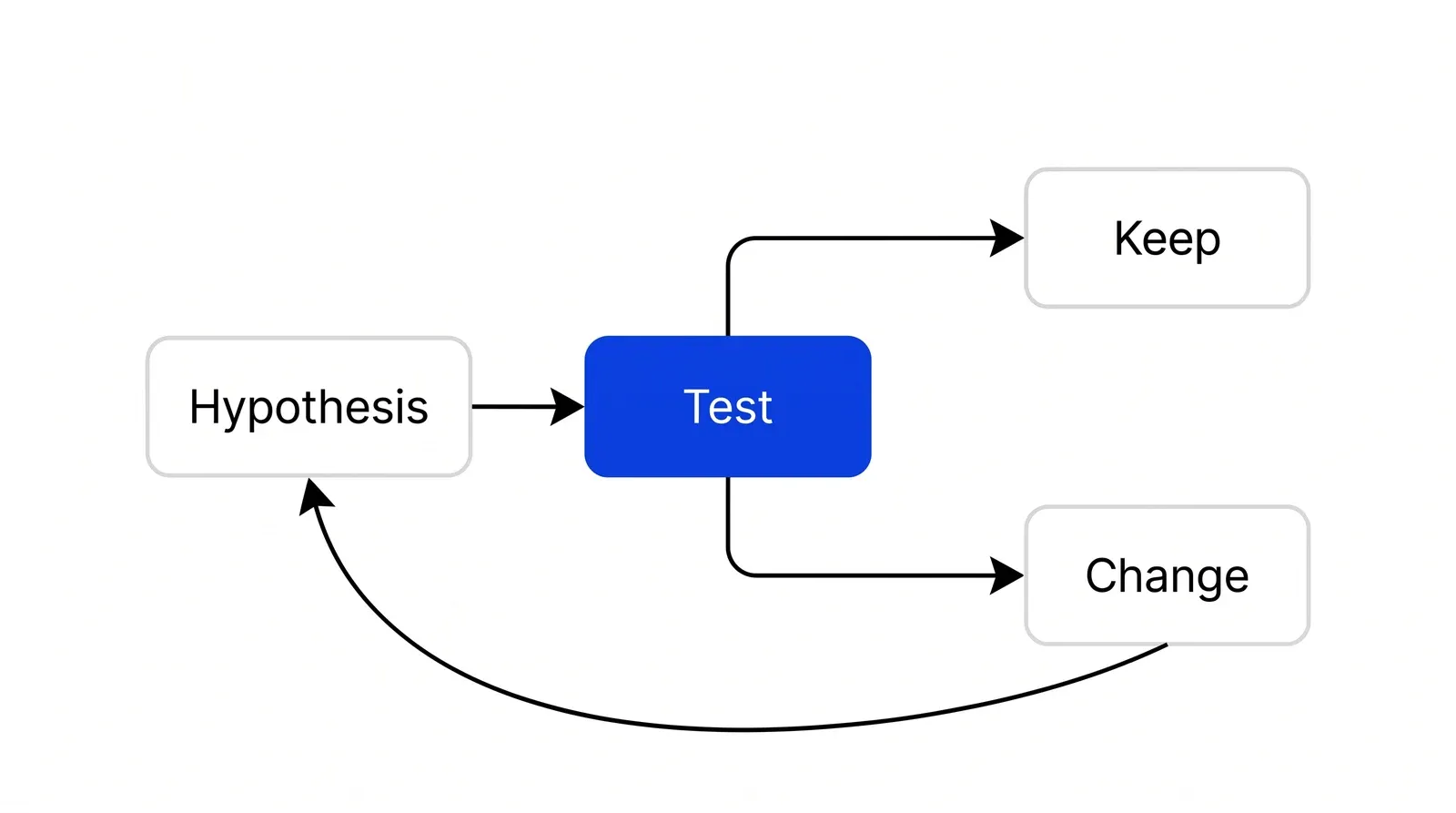
In our Growth Lab work we use the same logic through HADI loops: each risky note on the canvas becomes a hypothesis with an action, a metric and a date to check it.
Business Model Canvas vs Lean Canvas
The two are often confused because they share a layout. Ash Maurya created Lean Canvas in 2010 after meeting the Business Model Canvas. In his own comparison he explains that he swapped four blocks for ones that matter more before a startup has customers.
| Business Model Canvas | Lean Canvas | |
|---|---|---|
| Author and year | Osterwalder and Pigneur, book 2010 | Ash Maurya, 2010 |
| Built for | Describing or redesigning any business model | Testing a startup idea before product and market fit |
| Blocks it keeps | All nine | Customer segments, value proposition, channels, revenue, costs |
| Blocks it adds | None | Problem, solution, key metrics, unfair advantage |
| Blocks it drops | None | Key partners, key activities, key resources, customer relationships |
| Best moment to use | An operating business, or a new venture with known partners | An idea with no proven demand yet |
Maurya’s reasoning is that early partnerships are often wasted effort for an unproven startup, and that activities and resources follow from the solution once it is tested. For a running company with real partners and a supply chain, those dropped blocks are often where the money is.
Where the canvas falls short
The main criticisms concern what the page leaves out. A 2014 University of Twente master’s thesis by Bastian Coes, based on literature, online discussions and interviews with business model developers, found three repeated complaints: no room for competitors and other external forces, a value proposition defined narrowly around profit, and blocks written at uneven levels of detail. Antony Upward and Peter Jones compared Osterwalder’s ontology with the needs of strongly sustainable businesses in Organization & Environment and found 12 gaps, mostly because the model is built around profit.
Several adaptations answer these gaps. Blank’s Mission Model Canvas replaces revenue streams with mission achievement and customer segments with beneficiaries for government and nonprofit teams. Alexandre Joyce and Raymond Paquin’s triple layered canvas adds environmental and social layers of nine blocks each.
Be careful, too, with the famous model patterns people copy onto the canvas. The razor-and-blades story says Gillette gave away handles and profited on blades. Randal Picker’s study in the University of Chicago Law Review found that Gillette did not do this while its patents protected it, from 1904 to 1921, and moved toward it only after they expired, to match the market. Check a pattern against your own numbers before you borrow it.
How to apply Business Model Canvas, step by step
- Pick one model and one customer segment to start. Write at the top which business the canvas describes and for what period. If you serve two very different customer groups, such as patients and insurers, draw both but start with the one that pays. Result: a canvas with a clear scope.
- Fill the right side first. Start with customer segments and value propositions, then channels, customer relationships and revenue streams. Write one idea per sticky note, using a separate colour for each segment so you can follow it across the page. Result: a picture of who you serve, what they get and how money comes in.
- Fill the left side and the cost box. Add the key resources, key activities and key partners that the right side needs, then list the main costs those three blocks create. Every note on the left should support something on the right. Result: a picture of what it takes to deliver the offer and what that costs.
- Check that the boxes tell one story. Read the canvas aloud as a sentence chain: this segment buys this value through this channel, pays this way, and we deliver it with these resources, activities and partners at this cost. Remove notes that link to nothing. Result: a model in which each block connects to another.
- Mark the riskiest guesses. Circle the notes you have no evidence for and rank them by how much damage a wrong guess would do. Usually the top risks sit in customer segments, value propositions and revenue streams. Result: a short list of hypotheses to test.
- Test, then redraw. For each top hypothesis write a cheap test, the result that would prove it wrong, and a date. Talk to customers, run a pricing page, ask a partner for terms. Update the canvas after each test and keep the old versions. Result: a model that changes when the evidence does.
Examples
A dental clinic adding a membership plan
Illustrative. A clinic wants recurring revenue from patients without dental insurance. Customer segment: uninsured adults living within 5 km. Value proposition: two cleanings and check-ups a year plus 15% off treatment for a fixed monthly fee. Channel: the front desk at checkout and the booking website. Revenue stream: €25 a month, so 300 members bring in €7,500 a month. Key activity: recall scheduling, so members actually use their visits. Key resource: hygienist hours. Cost structure: if each cleaning visit costs the clinic €40 in hygienist time and materials, 300 members using two visits each cost €24,000 a year against €90,000 in fees. The riskiest block is the segment: will uninsured patients prepay at all? The clinic tests it by offering the plan to the next 100 uninsured patients before it changes the booking system.
A payout service for online marketplaces
Illustrative. A fintech startup pays freelancers on behalf of marketplaces. Customer segments: two, the marketplace that pays the fee and the freelancer who receives the money, which makes it a two-sided model. Key partner: a licensed bank or e-money institution that holds the funds. Revenue stream: 0.8% of payout volume, so a marketplace sending €2 million a month brings €16,000. Cost structure: if the bank charges €0.20 per payout, 10,000 payouts cost €2,000, plus fixed compliance staff. The canvas shows that the partner block carries the main risk: without the bank there is no product, so the first test is a signed term sheet from a bank, before more sales calls.
Xerox and its research spin-offs
Documented. Henry Chesbrough and Richard Rosenbloom (Industrial and Corporate Change, 2002) describe how Xerox built a successful company by commercializing a copying technology that other leading firms had rejected, using an effective business model. Later, Xerox judged spin-offs from its Palo Alto research centre through that same model. The spin-offs that succeeded did so with business models that differed a lot from Xerox's. The lesson for canvas users: a model that works can stop a company from seeing other models.
When to use it
Use it when you are designing a new venture or product line, when you need a shared picture of how an existing business makes money, before a pricing or channel change, or when you want to compare two or three possible models side by side. It works well in workshops because everyone sees the same page.
When not to use it
Skip it when the question is about the market around you: competitive pressure is better handled by Porter's five forces, which the canvas leaves out. For an early startup with no customers yet, Lean Canvas puts the problem and key metrics in front. Do not use one canvas for a whole group with several distinct businesses, and do not treat a finished canvas as a business plan or a financial model.
Common mistakes
- Drawing one canvas for the whole company. A bank with retail and corporate arms has at least two business models; mixing them on one page hides the trade-offs between them.
- Writing categories instead of decisions. Replace 'social media' with a choice someone can act on, such as 'Instagram ads to parents of children aged 3 to 8'.
- Leaving the boxes unconnected. If a key activity does not support any value proposition, or a cost has no source in the left side, the canvas is only a list of notes.
- Treating the first version as the answer. The canvas is a set of guesses until customers, partners and numbers confirm them; date each version and redraw after tests.
- Ignoring what the canvas leaves out. Competitors, regulation and market size have no box; run a separate market analysis alongside it.
FAQ
What are the 9 building blocks of the Business Model Canvas?
Customer segments, value propositions, channels, customer relationships, revenue streams, key resources, key activities, key partners and cost structure. The right side covers customers and income, the left side covers what the business needs to deliver its offer, and value propositions sit in the centre linking the two.
Who created the Business Model Canvas?
Alexander Osterwalder, with Yves Pigneur. It grew out of Osterwalder's 2004 PhD thesis at the University of Lausanne on a business model ontology, supervised by Pigneur. The canvas reached a wide audience through their 2010 book Business Model Generation, published by Wiley and co-created with 470 practitioners from 45 countries.
Is the Business Model Canvas template free to use?
Yes. Strategyzer AG, which designed the template, publishes the canvas under a Creative Commons Attribution-ShareAlike 3.0 licence. You may use, print and adapt it, including for commercial work, as long as you credit Strategyzer and share adapted versions under the same licence.
What is the difference between the Business Model Canvas and Lean Canvas?
Lean Canvas is Ash Maurya's 2010 adaptation for startups. It keeps the layout but replaces four blocks: key partners, key activities, key resources and customer relationships give way to problem, solution, key metrics and unfair advantage. Use Lean Canvas to test a new idea and the Business Model Canvas to describe an operating business.
Which block of the Business Model Canvas should you fill first?
Start with customer segments, then value propositions. The rest of the canvas depends on who pays and what they get. After that move along the right side to channels, relationships and revenue, and finish with the left side and costs, checking that each element supports something on the right.
Sources
- Alexander Osterwalder, The Business Model Ontology: a proposition in a design science approach, PhD thesis, University of Lausanne, 2004 (repository record)
- Alexander Osterwalder, Yves Pigneur, Christopher L. Tucci, Clarifying business models: origins, present, and future of the concept, Communications of the AIS 16, 2005
- Wiley, Business Model Generation: A Handbook for Visionaries, Game Changers, and Challengers, Osterwalder and Pigneur, 2010
- Strategyzer, The Business Model Canvas
- Strategyzer AG, The Business Model Canvas template, CC BY-SA 3.0 (Princeton University course copy)
- University of Toronto Libraries, Business Model Canvas research guide
- David J. Teece, Business models, business strategy and innovation, Long Range Planning 43(2-3), 2010
- Christoph Zott, Raphael Amit, Lorenzo Massa, The business model: recent developments and future research, Journal of Management 37(4), 2011
- Erwin Fielt, Conceptualising business models: definitions, frameworks and classifications, Journal of Business Models 1(1), 2013
- Joan Magretta, Why business models matter, Harvard Business Review, May 2002
- Mark W. Johnson, Clayton M. Christensen, Henning Kagermann, Reinventing your business model, Harvard Business Review, December 2008
- Henry Chesbrough, Richard S. Rosenbloom, The role of the business model in capturing value from innovation: evidence from Xerox Corporation's technology spin-off companies, Industrial and Corporate Change 11(3), 2002
- Steve Blank, Why the lean start-up changes everything, Harvard Business Review, May 2013
- Steve Blank, Lean Launch Pad 2026 @ Stanford: lessons learned presentations, June 2026
- Steve Blank, The Mission Model Canvas: an adapted Business Model Canvas for mission-driven organizations, February 2016
- Ash Maurya, Lean Canvas vs Business Model Canvas, Leanspark
- Bastian Coes, Critically assessing the strengths and limitations of the Business Model Canvas, master's thesis, University of Twente, 2014
- Antony Upward, Peter H. Jones, An ontology for strongly sustainable business models, Organization & Environment, 2016 (OCAD University repository)
- Alexandre Joyce, Raymond L. Paquin, The triple layered business model canvas: a tool to design more sustainable business models, Journal of Cleaner Production 135, 2016
- Alexandre Joyce, Raymond Paquin, Yves Pigneur, The triple layered business model canvas, ARTEM Organizational Creativity International Conference, 2015 (repository record)
- Randal C. Picker, The razors-and-blades myth(s), University of Chicago Law Review 78, 2011
Last updated Oct 9, 2026

Marketing agency or growth system: when a company outgrows its agency
An agency is the right call while the founder still runs most of the company. Once the business starts copying itself into new locations or markets, it needs a system that sets goals, tests hypotheses and owns the result.

Why healthcare marketing agencies stall: the short, mid and long wins model we use with clinics
Most agencies own the click and nobody owns the front desk. How we structure clinic work in three horizons, the research behind each one, and one year of results.

Why channel tests stall after month three
Most paid channel tests do not end with a decision. They end when the budget runs out, the attribution model changes, or everyone quietly stops looking at the dashboard.